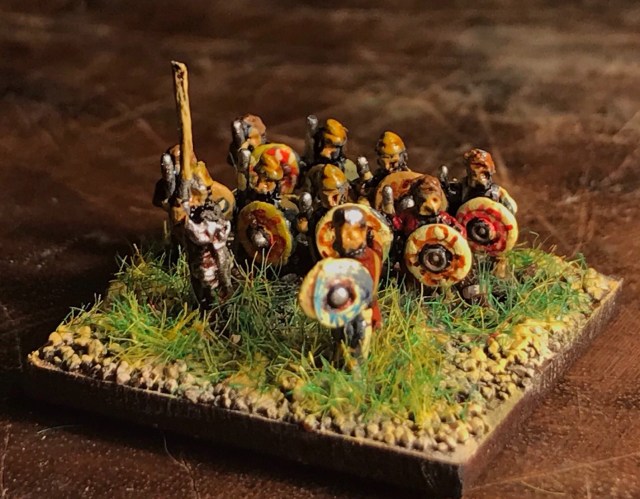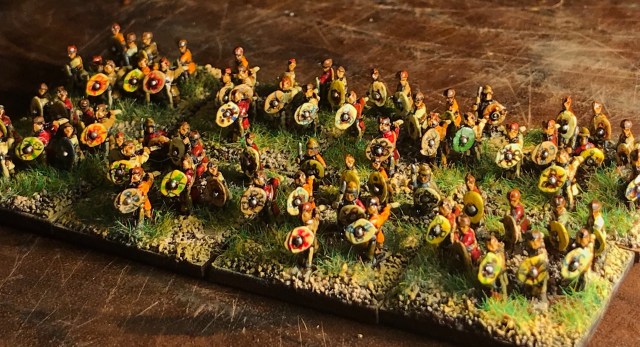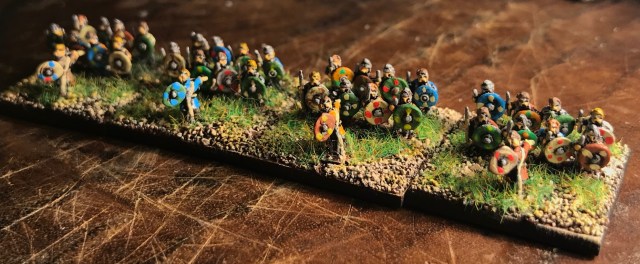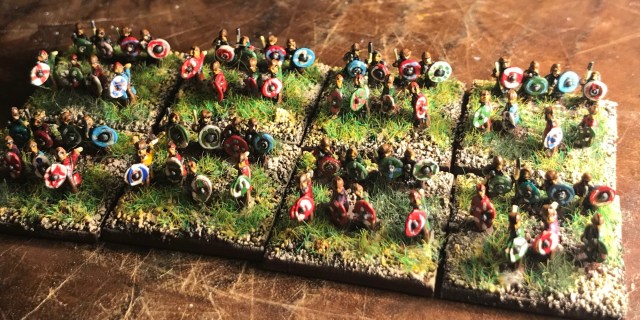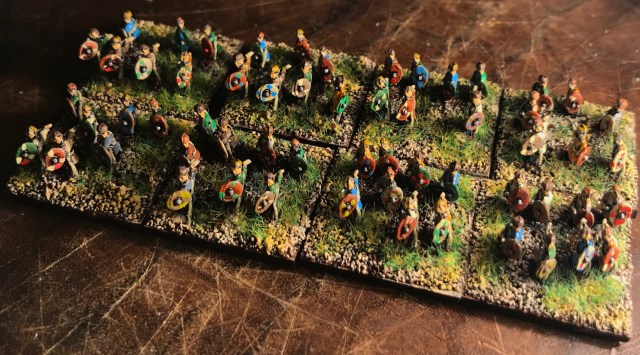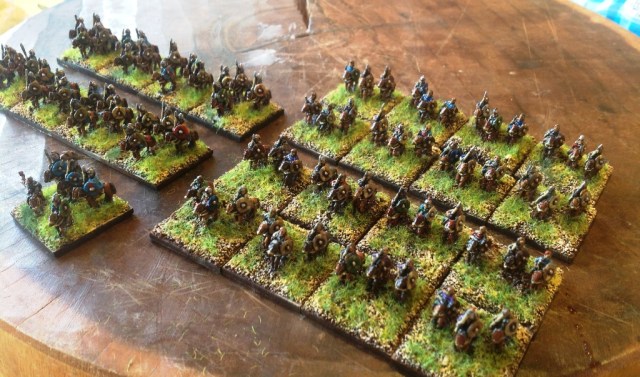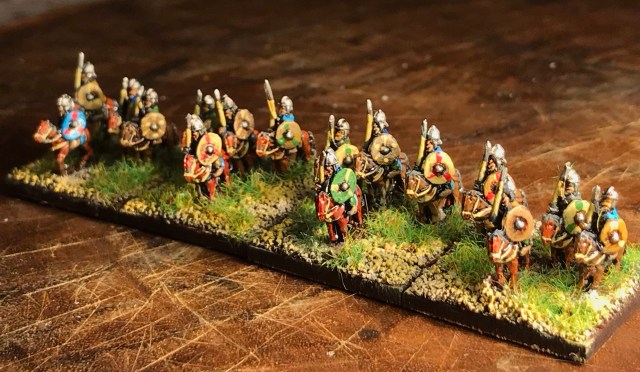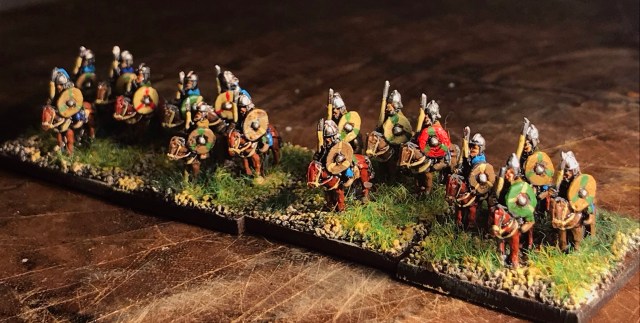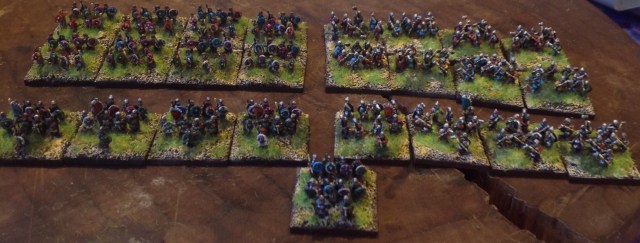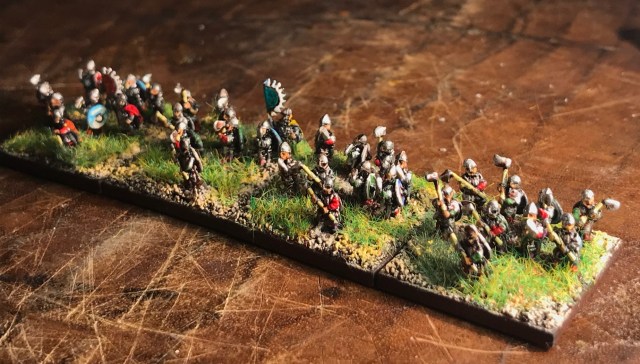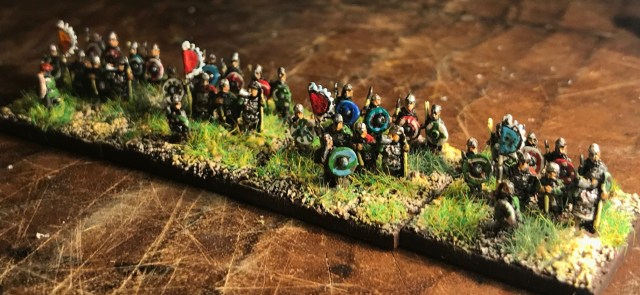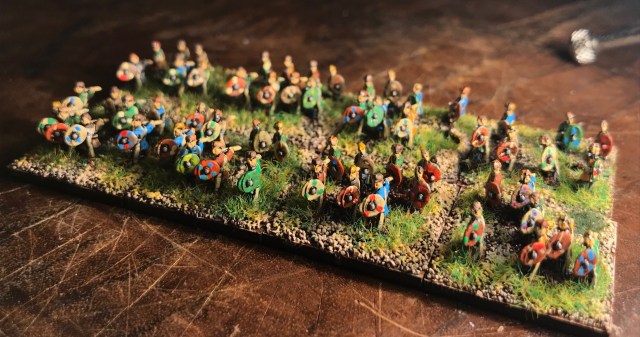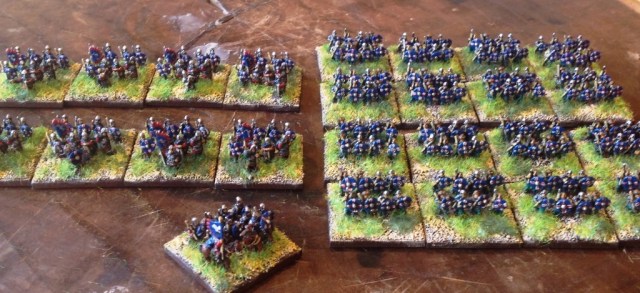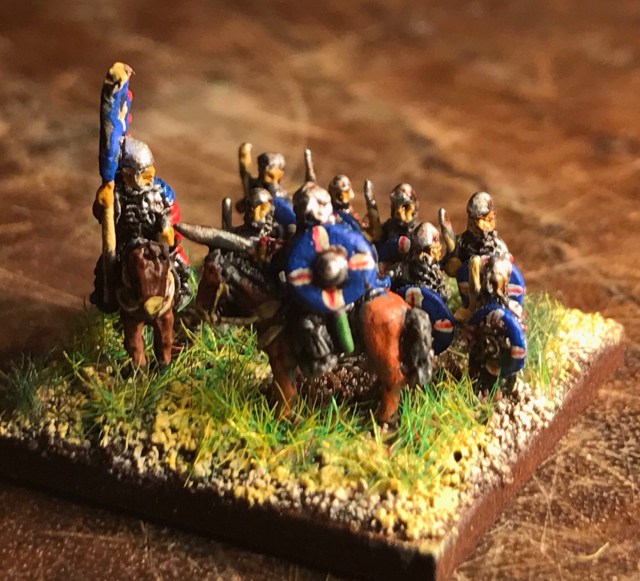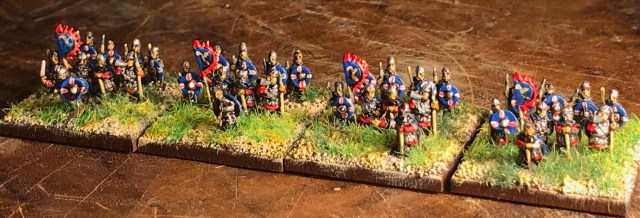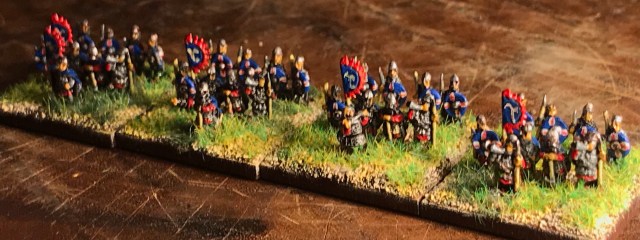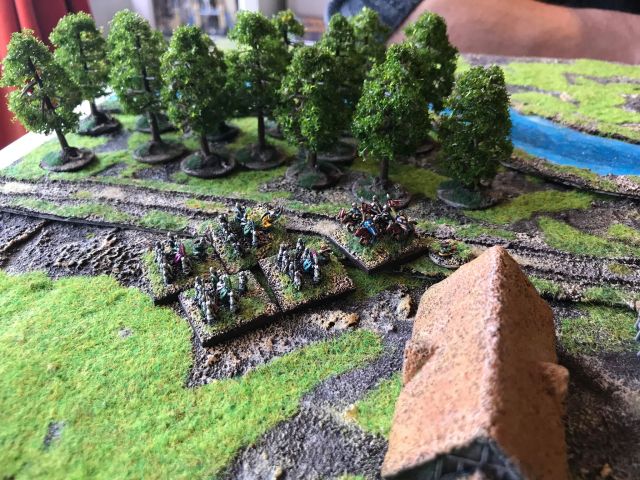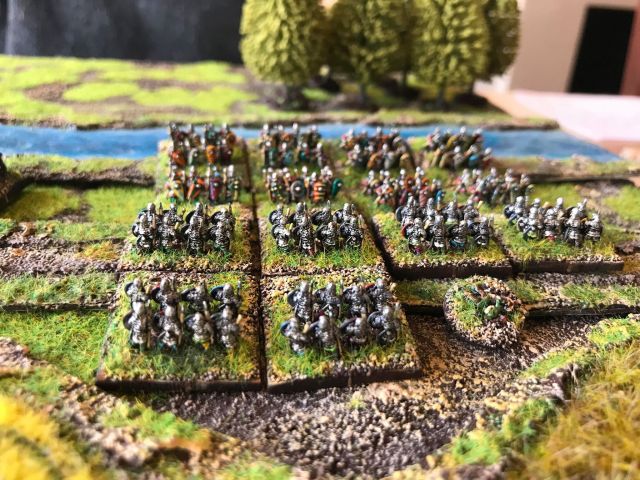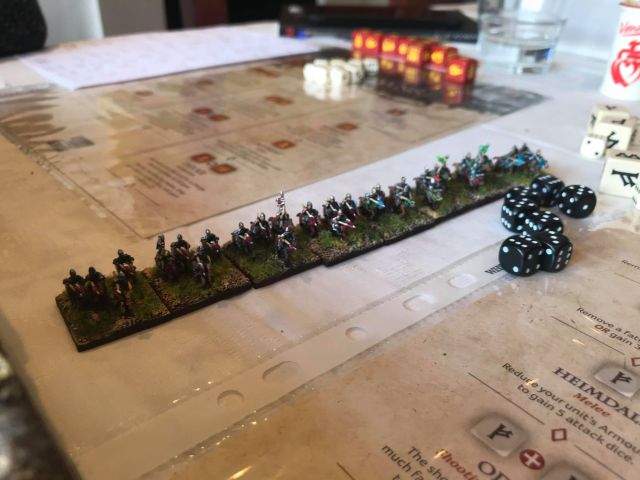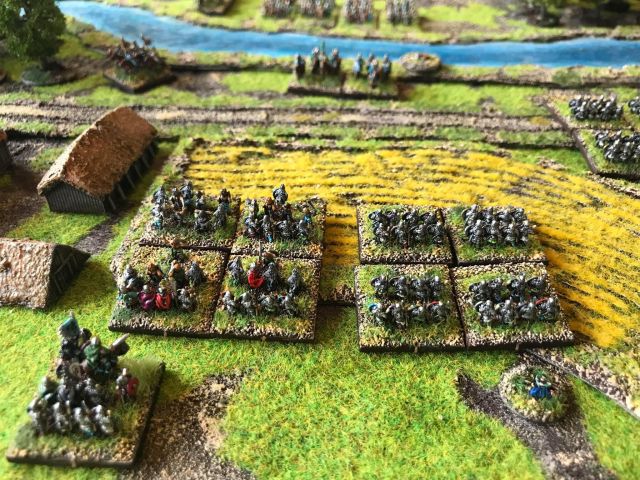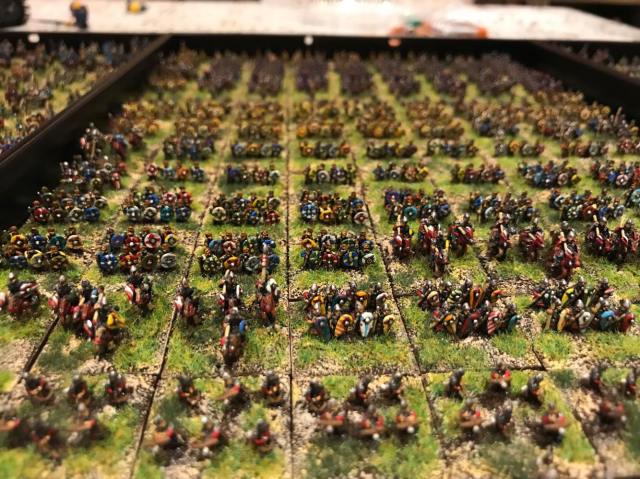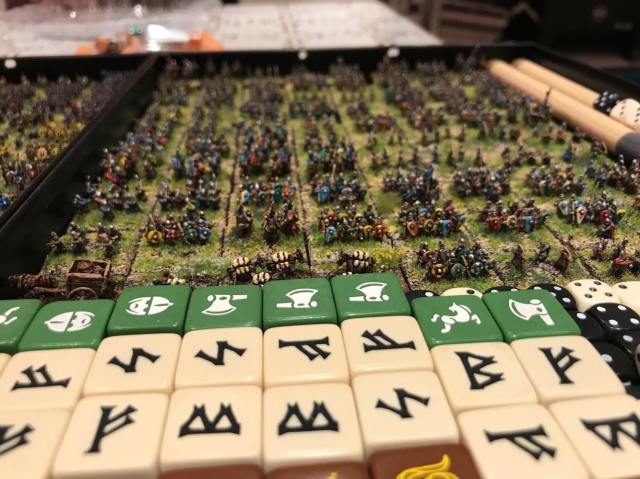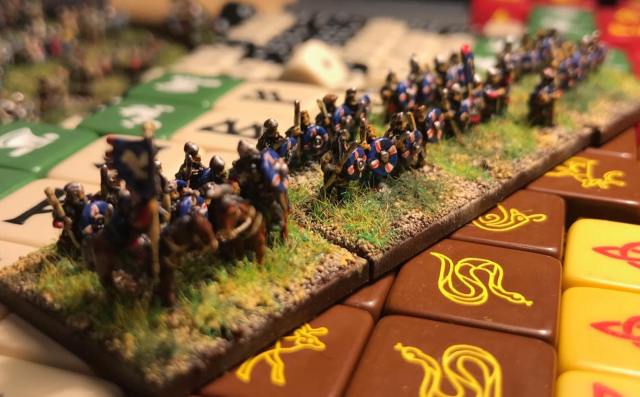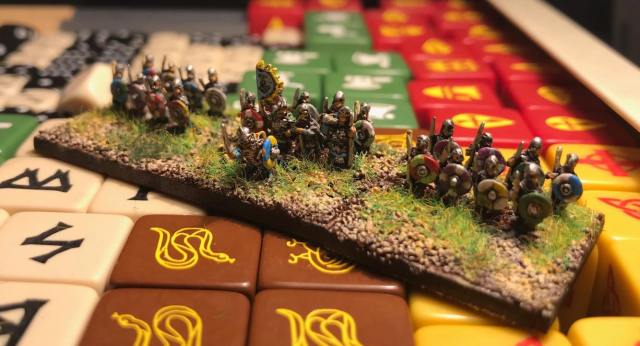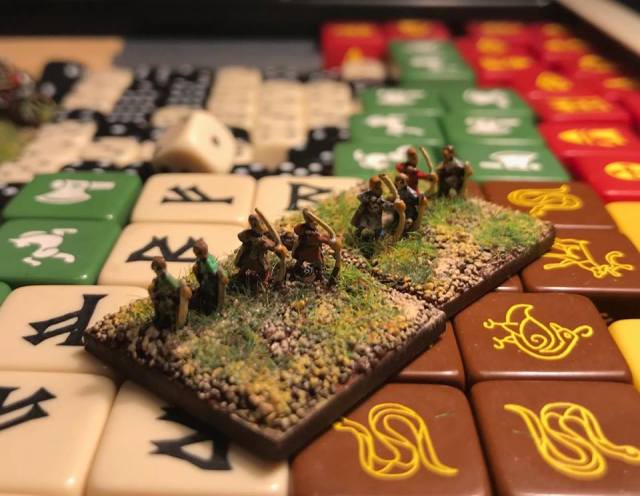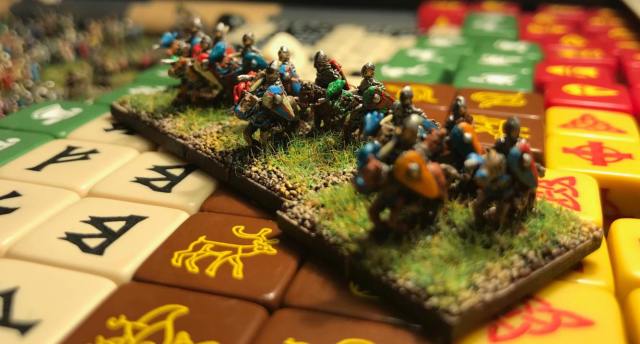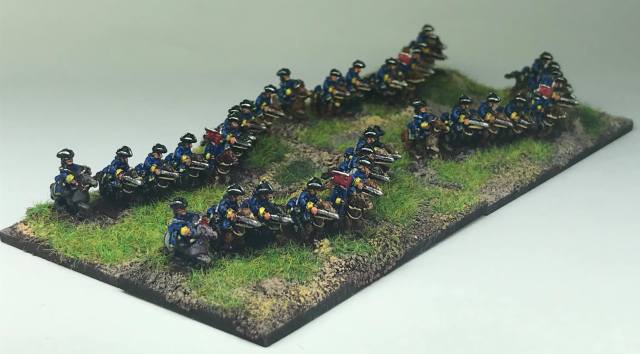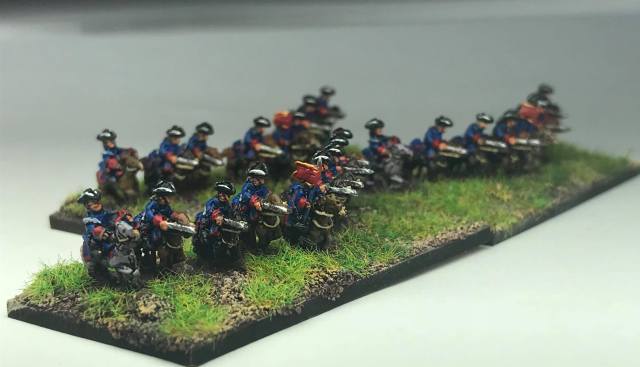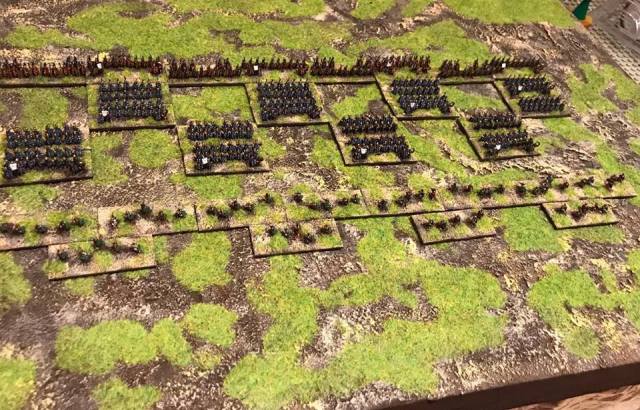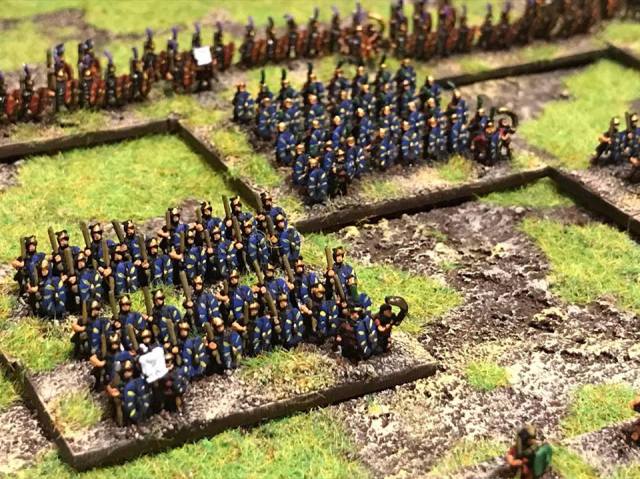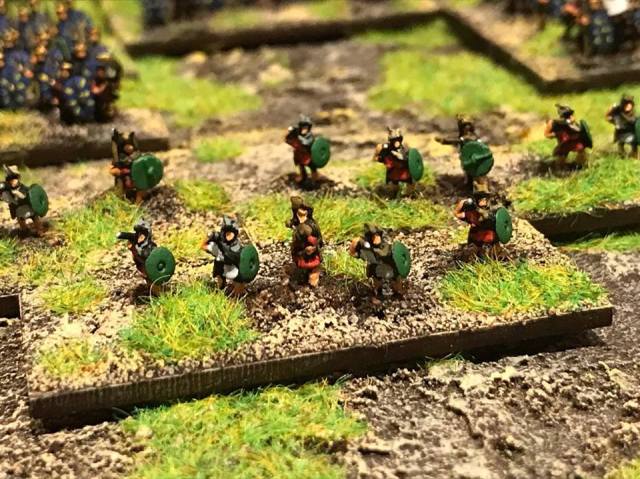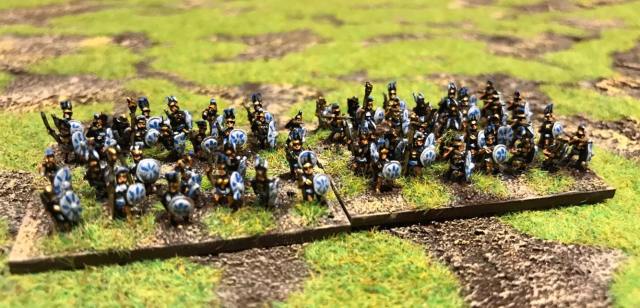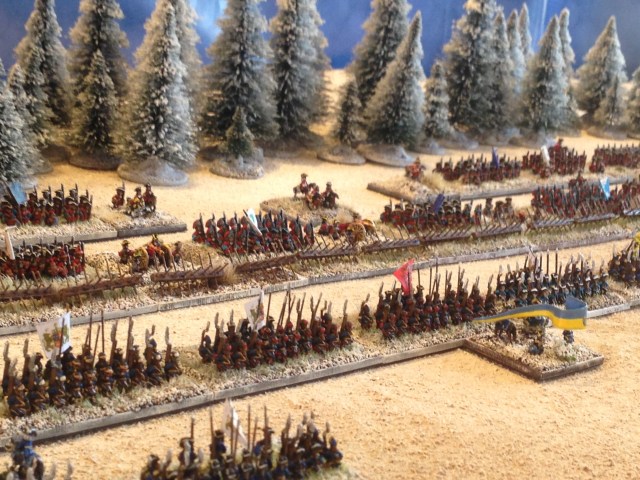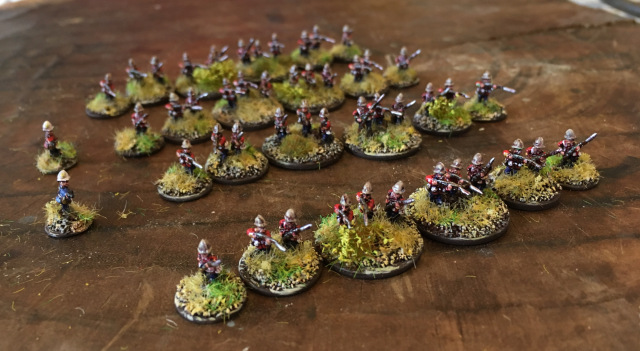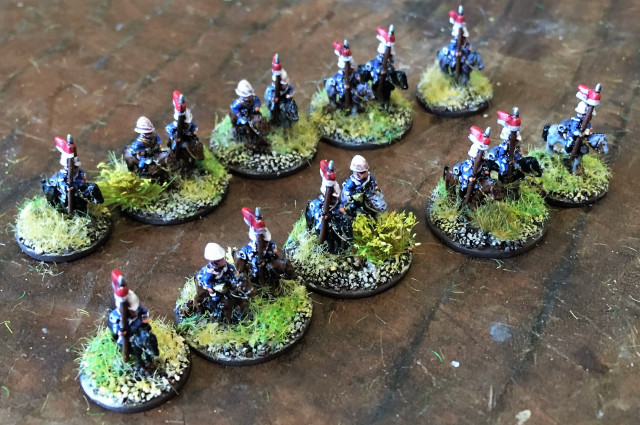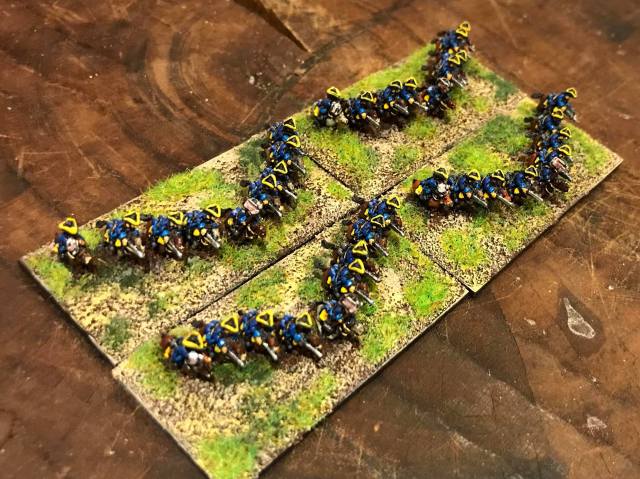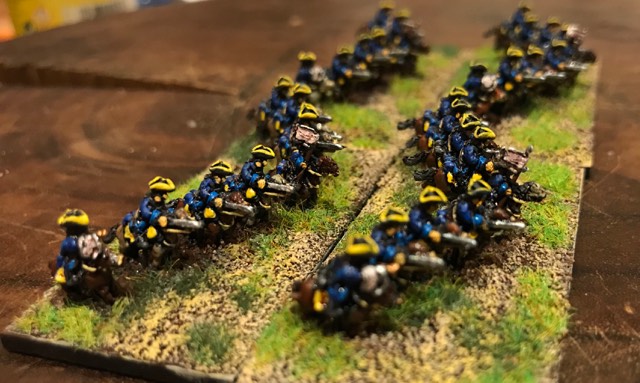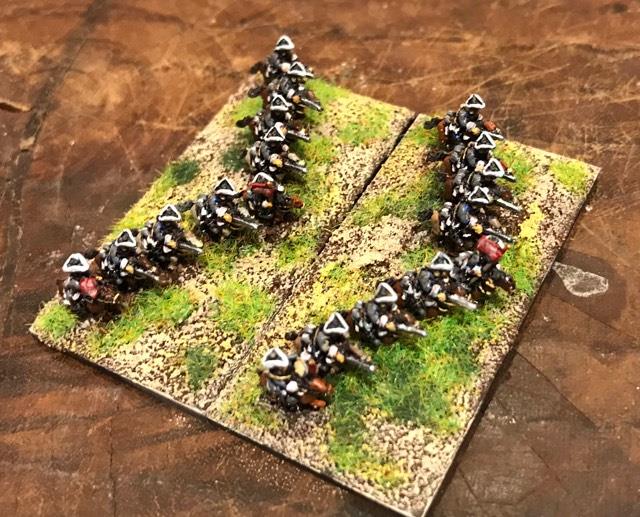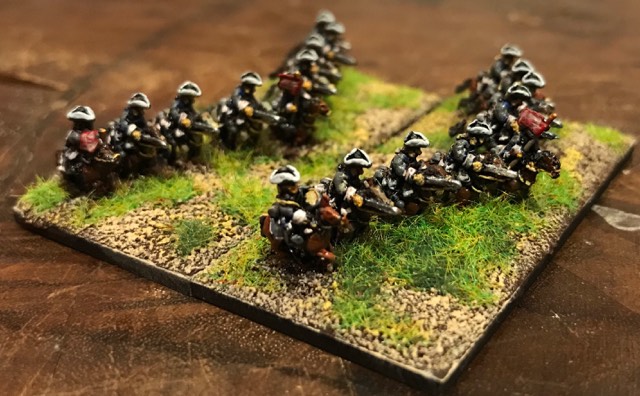
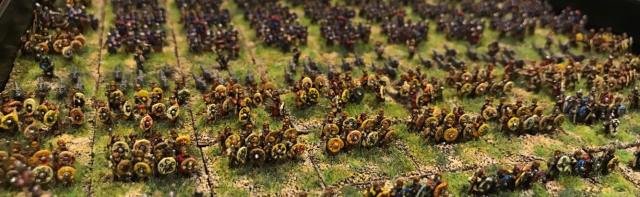
Saga 2nd Edition in 6mm Age of Vikings – Twilight of the Thundergod

Saga_8

I had a very  nice day at Salute yesterday, but have decided to reflect on that next week as I think his blog post is long enough – but in summary of Salute I can say “a lot of people, met some new and old friends, the games looked great, got some gifts(!), picked up some stuff and bought some more, What a Tanker from Too Fat Lardies looked fun, a fantastic GNW battle from Michael Leck – from my perspective the Show rolled a Six.”  More next week on this and some further on the progress on the Horka Project.
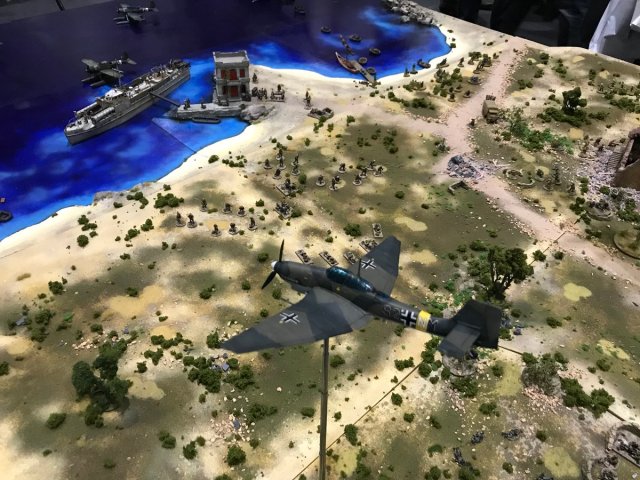


best.jpg
Ok, one picture for now of what I think was the most stunning table on the day and it was simply based on the colour schemes used – it was very nice.  Yes other tables had more impressive buildings and clutter but in terms of overall visual appeal and artistry this was the one to beat on the day – I think colour and composition goes a long way and this one I think proved that point.   This was put on by “A Few Brits and the Hobby” and was depicting the Battle of Leros in 1943.  It was a demonstration game and was depicting the last successful German invasion of the war (WW2) when the island of Leros was taken in November 1943 as part of the Taifun operation (yes you are right another operation in 1941 was carried out with the same name).  From the guys own blur for the game “Despite being outnumbered by the defenders, the Germans managed to gain local numerical superiority in various small battles and used total air supremacy to defeat the enemy despite heavy losses.  Leros was another British disaster in the eastern Mediterranean and Germanys last major campaign victory in the region.”


back to the main theme….

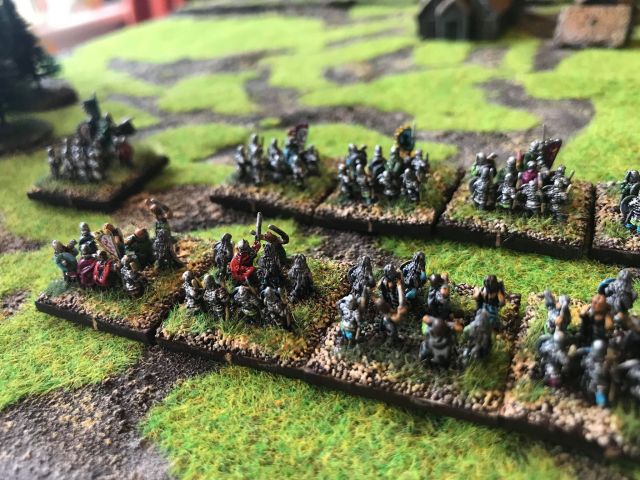
I decided to start this blog on the back of doing a participation game of Saga in 6mm with the gentlemen from the eminent Meeples and Miniatures podcast (link here) for the Joy of Six in 2016.  The demo game was Saga in 6mm and I went all out and did starter armies (4pts) for the 12 factions from the three first books for the Age of Viking era (a total of 15 official Age of Vikings factions were produced for the first edition rules, if we exclude semi-official ones like the Skraelings, Revenant and Steppe Tribes).

This is the 100th blog update since the start and I felt it appropriate to do an update on Saga on the back of the Second edition being published earlier this year.  It is a long one but I do hope you will find it of some interest.

For this special occasion I asked Neil Shuck for a few words as a kind of preface (thank you Neil).

“When I had a conversation with Dave Luff on the podcast about the possibility of gaming Saga in 6mm, we had no idea of the forces we were about to unleash.
Dave was on one of his ‘it’s only a counter’ monologues, and with the fact that that very nice Mr Berry had just brought out some more of his Dark Age range, we were discussing the idea of being able to play Saga in a smaller scale, and what impact that might have on the game.  As with many of our ideas, it never got close to the painting table, so imagine our surprise when Per contacted us to say that he had taken our idea and moved it to the next level.

We may have planted the seed, but Per is a force of nature when an idea takes hold, and the rest is, as they say, history.  Per did a fantastic job creating all the forces, plus building the tables, and the games were very well received on the day.  More importantly, the game still works – if anything, the grander scale created by the smaller models gives it a more epic feel.  Congratulations Per, you have done a fantastic job with this.” 

– Neil Shuck, from the Meeples and Miniatures Podcast (link here).

cropped-mm-banner-10-years-copy.jpg

Here is a link to that very first blog post with a postscript that makes a few notes and links to the other relevant posts.  Note that the Factions are presented again in the text that follows, I will not repeat the information in the Part 6 to 8 sections about terrain, buildings and painting.
We had a blast on the day of the Joy of Six 2016 Show and Neil wrote about his experience on the Meeples and Miniatures webpage here and my report on the Roll a One blog is here.
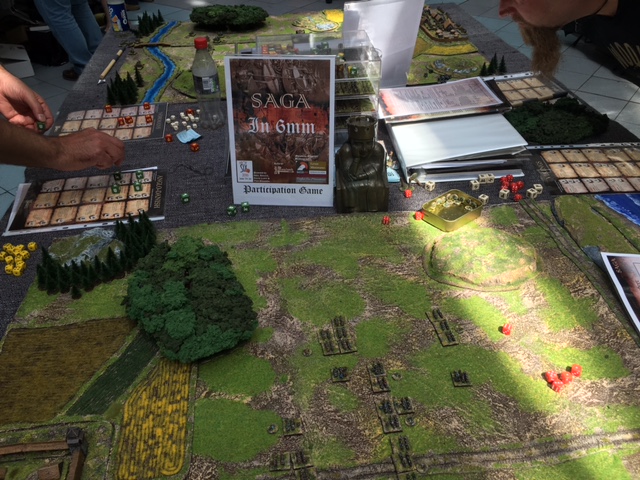
img_2089.jpg
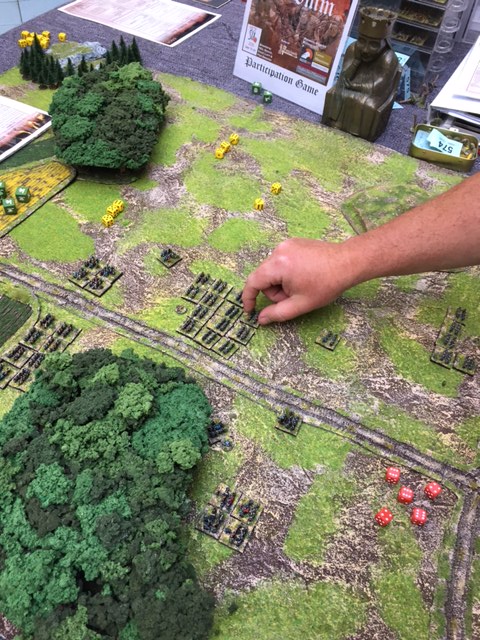
From the 2016 event – we ran two table – The Queens table and the Kings table (you can see the Lewis chess Queen overseeing the proceedings on this table and the king is blocked by the Sign overseeing the other).

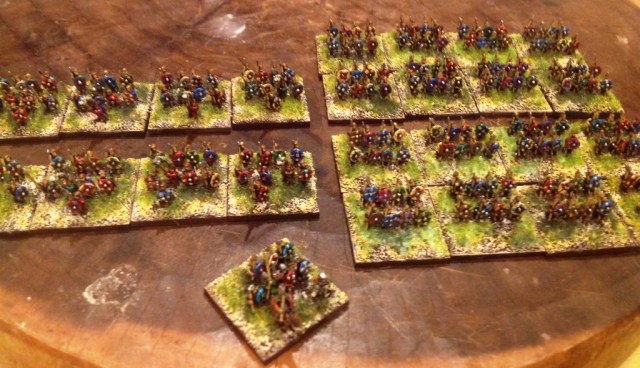
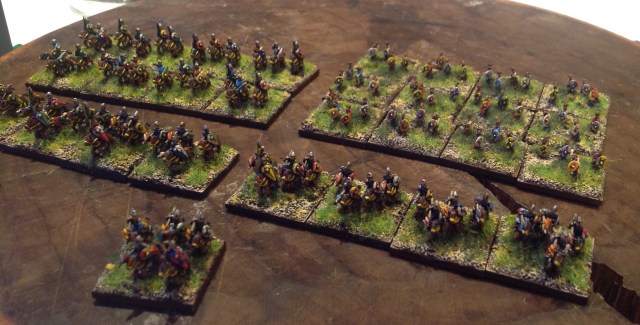
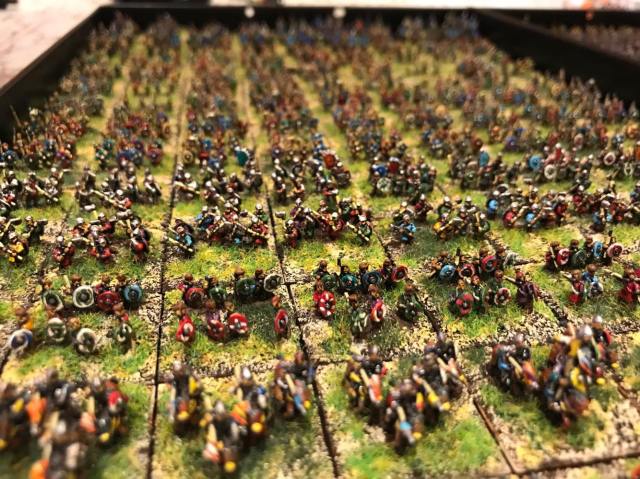
It was a nice project to get done and all-in-all I did 2,474 miniatures in a total on 324 bases (25mm square).  Each base contained between 3 to 10 miniatures depending on type, but in general:

  • Mounted – Warlord 5, Hearthguard 4, Warrior 3
  • Foot – Warlord 10, Hearthguard 9, Warrior 8, Levy 4

After the show the Little One and I played a fair few games of Saga and we really enjoyed it.  We then drifted away to other things and the models have been left standing relatively still for a while (apart from a few sessions using the eminent Dux Brit rules from Too Fat Lardies, a test of the Sword and Spear Rules and a few games of Saga here and there).  In the beginning of the year (2018) Studio Tomahawk released the updated edition of Saga (I will call is Saga 2) – where there is a core set of rules and then a book for each era (e.g. Viking, Arthurian, Crusade, etc.).  I was debating on whether to get the new rules or not as we found the old ones more than satisfactory, but as I stated in an earlier blogpost.

I have all the old Saga books and I am aware this version will probably not blow me away in the same way as the first set, but it is on the basis of that very first set I bought the second edition. Saga is a fantastic game and I, and especially the Little One, want to be part of the ongoing process of making it even better.

I got the basic rule book for £8.50 (this contains the basic rules) and the Age of Vikings (this has the Viking factions and 12 battle boards) supplement for £25.50, which I believe is very competitive, from Dark Sphere (link here) with free postage (as at 14/03/18). That is a total of £34.

The original Saga Rules were typically sold for £25 and gave you 4 battle boards, three additional supplements (actually four if you count the campaign supplement) were produced cover the Viking Age at a typical total cost of say £42.  This gives a total comparative cost at £67 vs. £34.  So this new packaging is more cost effective, although the start-up cost is higher (£34 vs £25) as you need some battle boards to play the game.

The only thing that slightly irritated me is that there is only one base scenario in the basic rules – Clash of the Warlords, and that there are no specific scenarios in the source books  either – instead there will be a specific scenario book.  I really hope that this scenario book is something really special as I honestly think that some more scenarios could have been included in the basic rulebook or in the supplement(s) – so the comparison above is not fully a like for like.

On the back of having read the rulebook and the Age of Viking supplement and had a few games, I personally think it was worth the upgrade. I can use all of my existing models to play and the Saga Dice are the same (I have two sets of each type of dice as I used them for demo gaming and that allowed a higher number of combinations to be played over two tables at the same time) with one exception (the Last Romans, see below).

On the other if you have the old rules I am not sure I would be a position to strongly insist you should do or feel the same.  It is still Saga after all. However, I do hope that more supplements covering other Ages will be developed and made available on the back of this re-release.  The pictures of some Samurai warriors in the rulebook gives an interesting hint.

This blogpost will re-introduce the factions presented in those old blog posts, with what I hope are better pictures. In addition there are some changes to the composition and I have now enough figures to do starting warbands for the 10 of the 12 included in the Age of Vikings supplement.  I will further include some notes on changes to the rules (that only makes sense if you know the first edition) and finally show a few pictures of from some of the games we have played over the Easter Period with some friends and family.  I hope it is of some interest – it was nice to get them on the table again.

 Factions (4 pt Starter Armies)

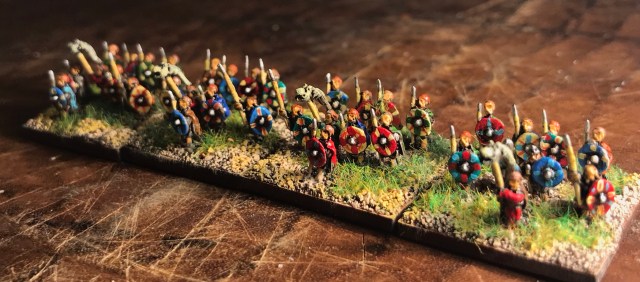
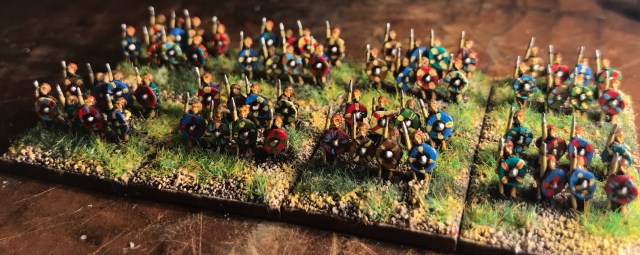
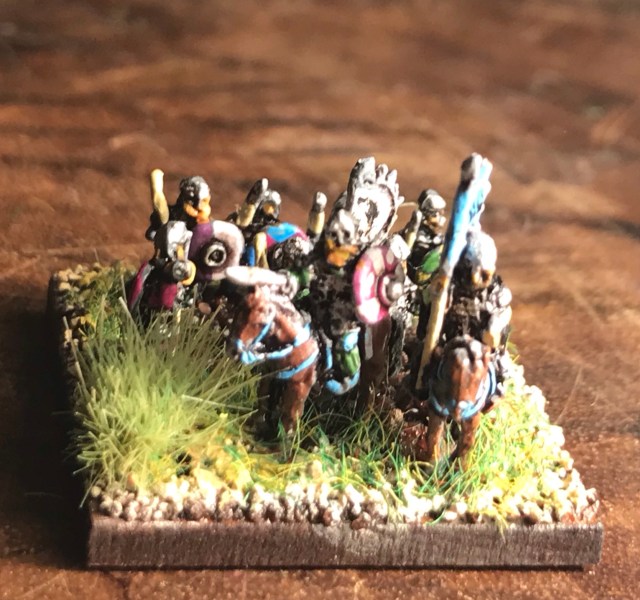
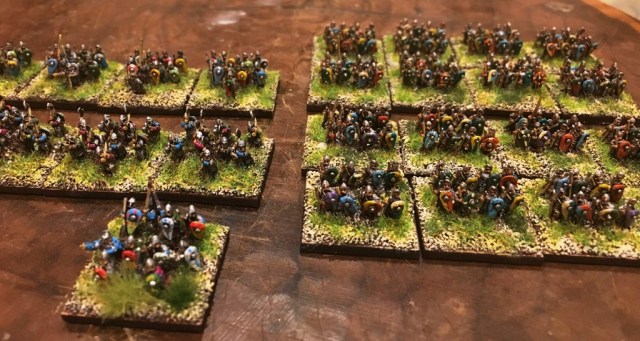
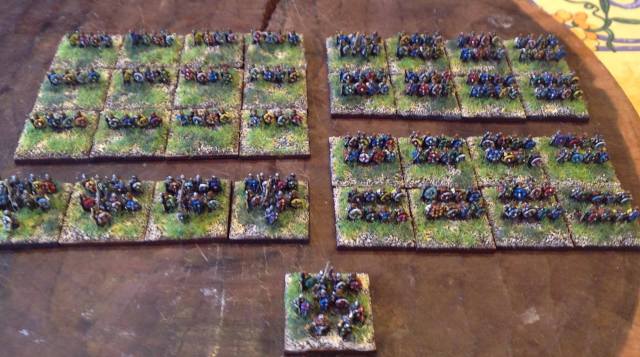
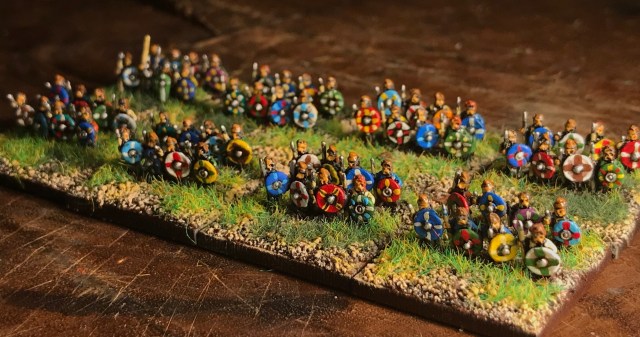
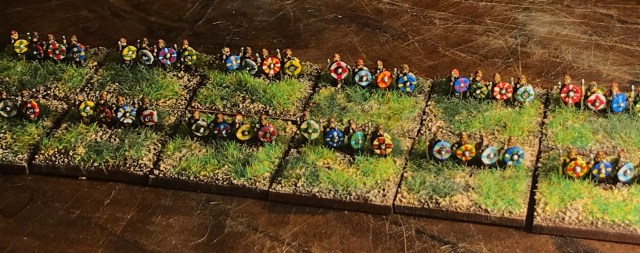
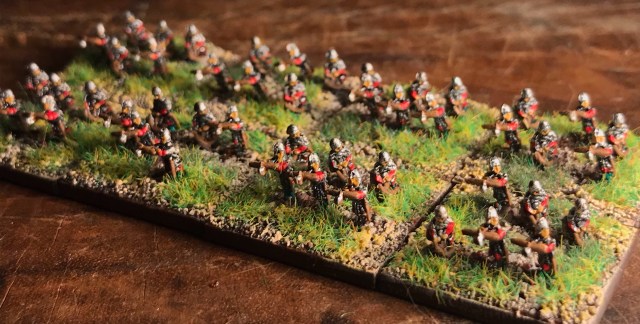
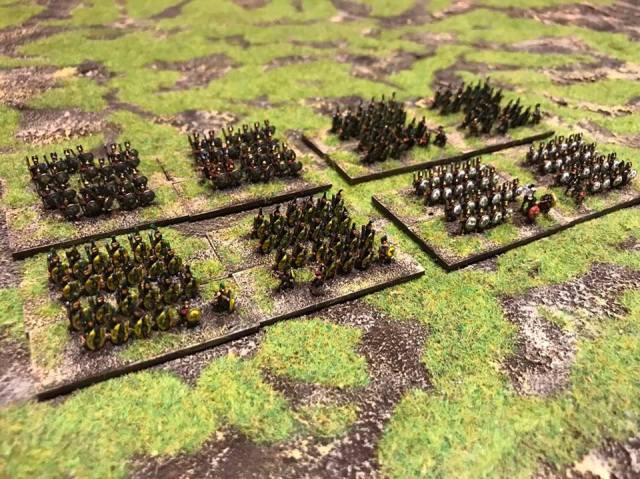
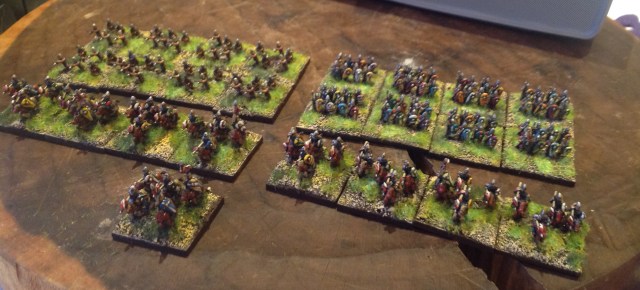
 Anyway let us look at some of the miniatures (again!, note I do not have miniatures for two of the factions but are repeating the advice I gave in Saga in 6mm – Part 12).  All models, with the exception of the Irish Dogs, are from Baccus 6mm (link here) and the codes are from their catalogue to indicate what miniatures have been used.  The original picture showing the whole 4pt warband have been reused here, but I have also included close ups of each unit.  I am in two minds about this as I think 6mm is best shown in mass not as individual close ups (well I let you form your own opinion).  When you paint bulk and fast like I do for my projects it does not always look that great in a close up – but then why not.  All are on 25mm square bases, you may want to refer to that as an inch at your own peril of being 0.4mm out!

A few changes are noted in the text basically:

  • Reduction of a Battle Board (-3)
    • The Welsh and Stratchclyde Welsh now share a Battleboard 
    • The Normans and Bretons now share a Battleboard
    • Their is no longer a Pagan Prince board, but I assume this one is now assumed included in the Pagan Rus board (as one of their heroic options are a Pagan Prince)
  • Renaming of Battle Board (+/-0)
    • The Frankish board is now renamed the Carolignian board
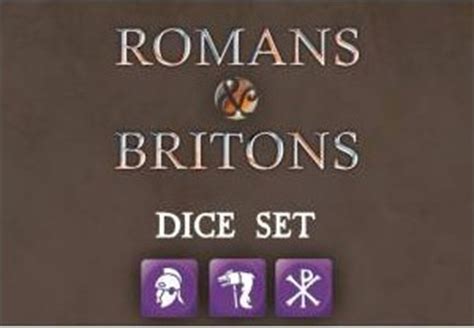
    • The Byzantine battleboard is now renamed the Last Romans (and actually needs a set of dice I do not have (yet!) – the Roman/Briton dice that were introduced with the Saga Aetius and Arthur rules. 
thWCR0RAUQ.jpg

Anyway here are the Warbands:

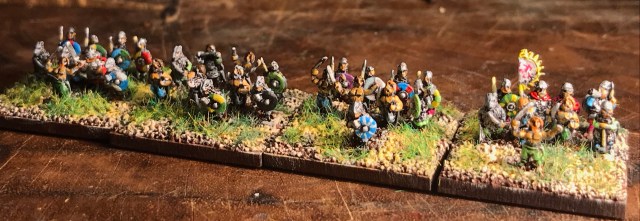
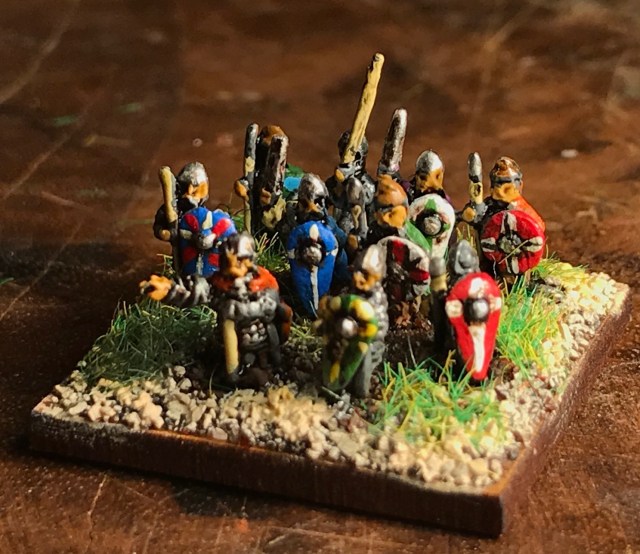
Irish Starting Warband
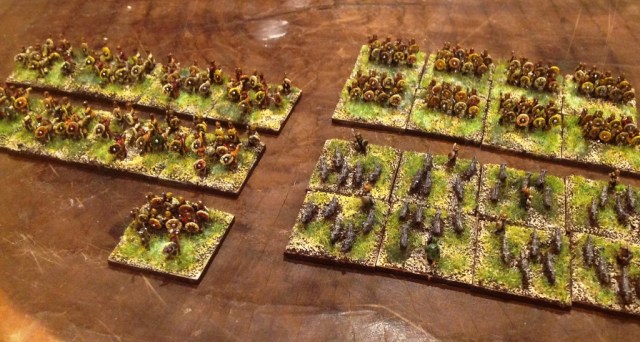
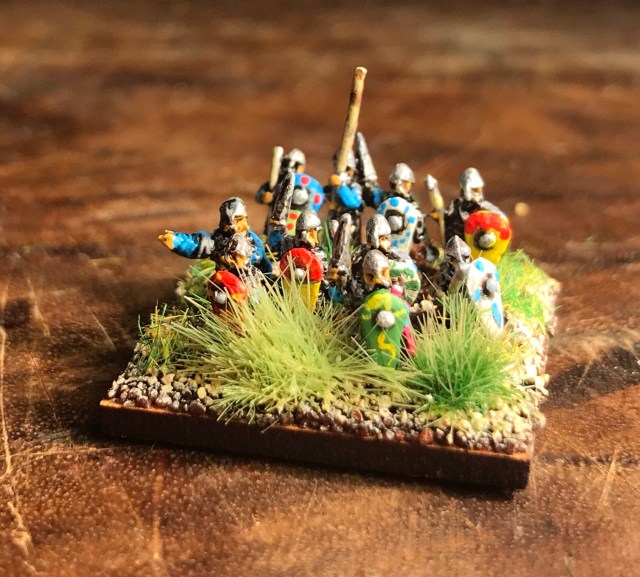
The front figure are from the ALR04 Lanciarii (from the Late Roman Range) and a banner miniature I do not know from where. The two row of warriors are from EMV02 – Unarmoured Spearmen (vikings!).
These are actually two Hearthguard (Fianna) Units and I used the ALR04 Lanciarii (from the Late Roman Range) to represent these Javelin armed units.
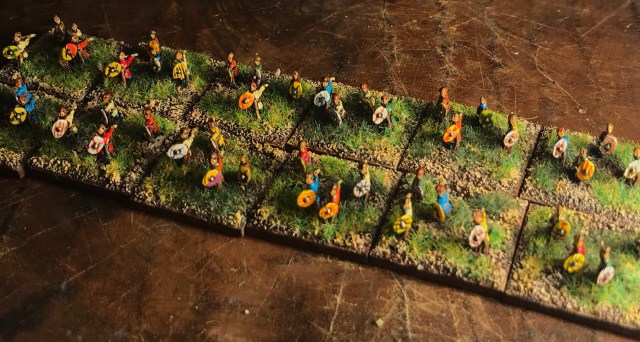
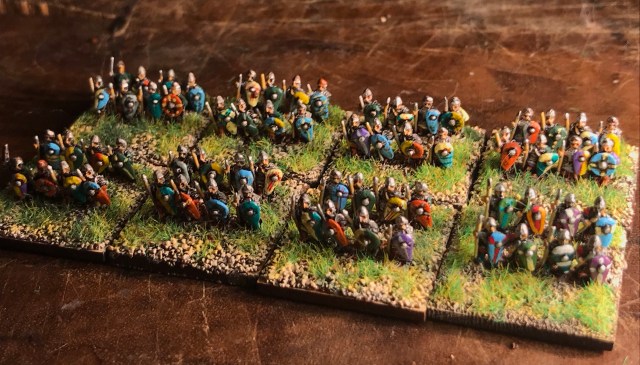
These are my favourites they are the Warrior units and I used EMV02 – Unarmoured Spearmen (vikings!).
The Irish have the option to field a warrior unit of war dogs and who could honestly resist that? I needed to find some 6mm dogs. Baccus does not do any dogs but I did not need to get to any extreme measures as Perfect Six (link here) do some nice ones (and since I ordered my dogs they now also do wolves that could represent even more terrifying dogs – mine were border collies painted grey rather than the less intimidating Lassie look) so I ordered enough dogs to do 8 No. bases with 5 dogs and a dog handler on each. I used AMO01 Moorish infantry from the “Rome and Enemies range” for the dog handlers. These were leftovers from another project and I felt that the movement in these skirmish type figures were suitable to act as “leaders of the pack”. The war dogs may be more legend than reality but I think they add flair to the game.

Welsh Starting Warbands

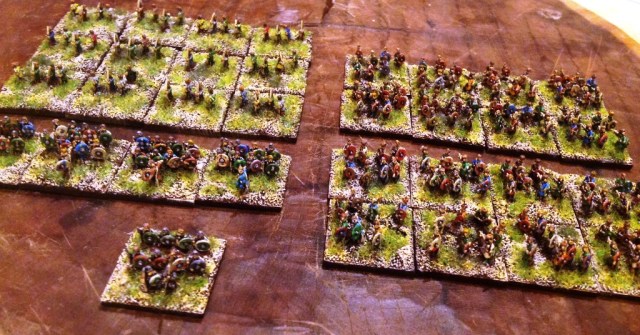
I have two Welsh starting warbands as there were two separate boards in the first edition – one for Welsh and one for the Mounted Strathclyde Welsh.

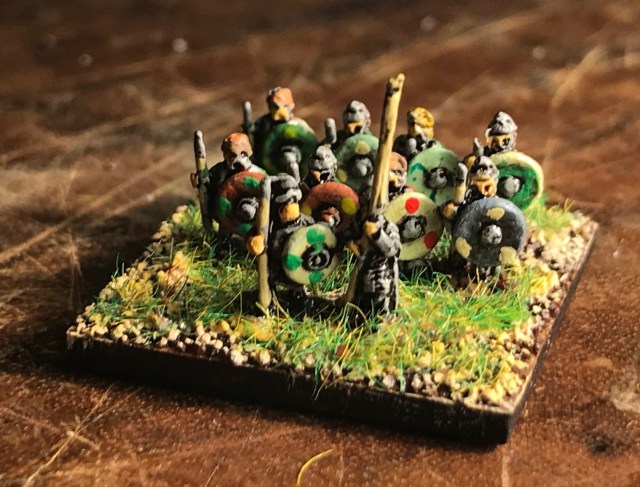
Welsh
IMG_4345
For the Warlord I used the unarmoured spearmen (EMV02 – from the Viking code) fronted by 2 spearmen figures
IMG_4349
For the Hearthguards I used the unarmoured spearmen (EMV02 – from the Viking code) fronted by an individual model from the Late Roman lanciarii code (ALR04) to mark the units as being armed with Javelin .
IMG_4348
These warriors were made by using a front line of  models from the Late Roman lanciarii code (ALR04) to mark the units as being armed with Javelin, with a back line of the EMV02 Viking unarmoured Spearmen.
IMG_4350
A Javelin warrior unit bases on ALR04 – Lanciarii
IMG_4347
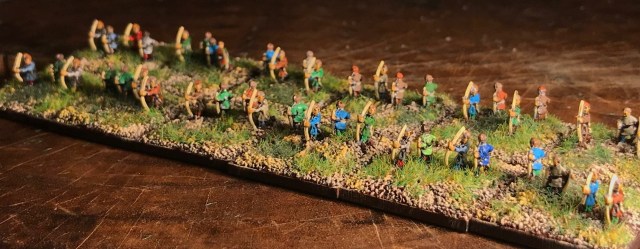
For the bonnedig (levy) I used Norman Archers (EMN05) – to get some balance versus all those Javelins.

Stratchclyde Welsh

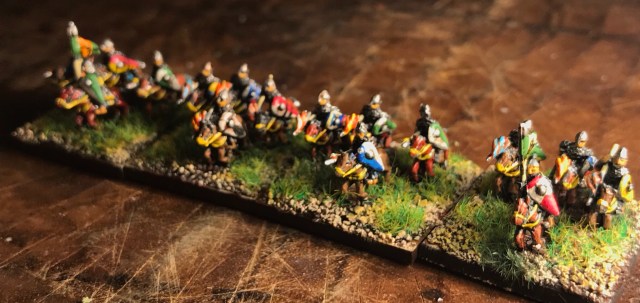
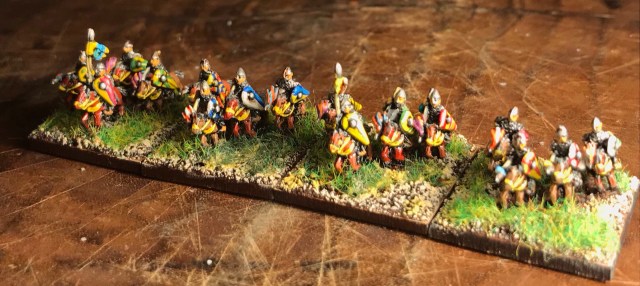
Stratchclyde Welsh Warlord – Modelled with AG003 – Gothic Heavy Cavalry. For the miniature holding his hand up I have no clue.
Stratchclyde Welsh Hearthguard (Teulu) – AG003 Gothic Heavy Cavalry.
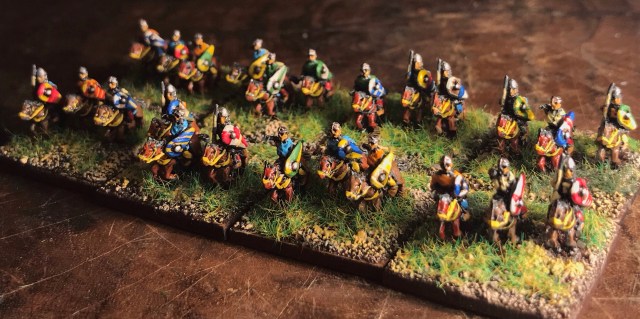
Stratchclyde Welsh Warriors – AG004 Gothic Medium Cavalry.
img_3736
Stratchclyde Welsh Warriors – AG004 Gothic Medium Cavalry.

Scots Starting Warband

Scot Warlord – the mounted miniature a AG003 Gothic Heavy Cavalry, the man with the axe from the EMA05 – Saxon Leaders and command set, the first row of soldiers a mixture of figures from various sets, the backline from AG001-Gothic infantry
Scottish Hearthguard – AG001 – Gothic Infantry
Scottish Warriors – AG001 – Gothic Infantry

Viking Starting Warband

Viking Warlord – The mounted Vikings are from the EMV05 – Viking Luminaries and Loonies pack and the foot from the EMV01 – Armoured Spearmen pack.
Viking Hearthguard (Berserkers) – the hero models are from the EMV05 – Viking Luminaries and Loonies pack and the foot from the EMV01 – Armoured Spearmen pack.
Viking Hearthguard – the hero models are from the EMV05- Viking Luminaries and Loonies pack and the foot from the EMV01 – Armoured Spearmen Pack.
Viking Warriors – EMV01- Armoured Spearmen

Norman / Breton Starting Warband

As for the Welsh this is now one Battleboards for what used to be two – the Normans and the Bretons.  The difference is that the mounted Hearthguards have Javelins.

Norman

IMG_4358
Charging cavalry (EMN01) was used for the Warlord (but with one of the fronting figures from the EMN06 – Norman Leaders pack).
IMG_4359
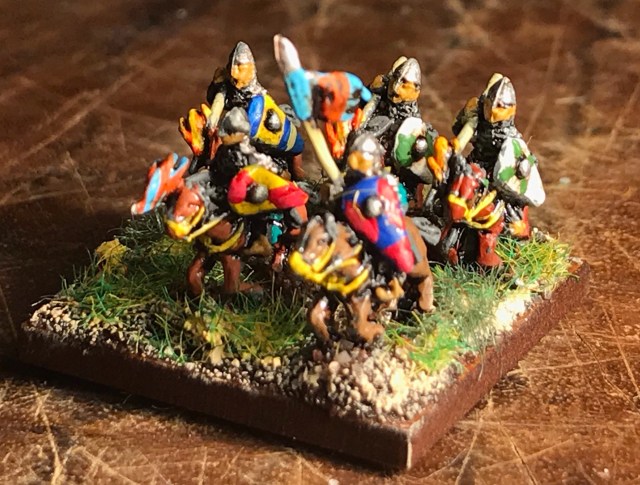
For the hearthguards (Knights) I used the Charging cavalry (EMN01)
IMG_4352
Another unit of Hearthguard (Knights) using the Charging cavalry (EMN01).
img_4356.jpg
The crossbow unit are Warriors so I decided to put 6 on each base (mainly as I only had one pack of 48 miniatures EMN07 – Norman Crossbowmen at the time and it divides nicely with 8, if you remember your times table).
IMG_4357
The archers are Levy and based on the EMN05 – Norman Archers


Breton


img_3762
For the Warlord I used EMN01 (Norman Armoured Cavalry) , however in doing it again I would have used the EMN03 (unarmoured cavalry) code for all mounted Breton units – to represent the more Javelin oriented Breton cavalry.
img_3758
For the Hearthguard unit I also used EMN01 (Norman Armoured Cavalry), with the same comment as for the Warlord above.
img_3759
Another Hearthguard Unit using EMN01.
img_3761.jpg
These are the Warriors using the EMN03 – Norman unarmoured cavalry code and represent the Javelin armed mounted Breton soldiers.
img_3761
These are the Warriors using the EMN03 – Norman unarmoured cavalry code and represent the Javelin armed mounted Breton soldiers.
img_3760
Javelin armed levy using ALR04 – Lanciarii.

Anglo-Danes Starting Warband
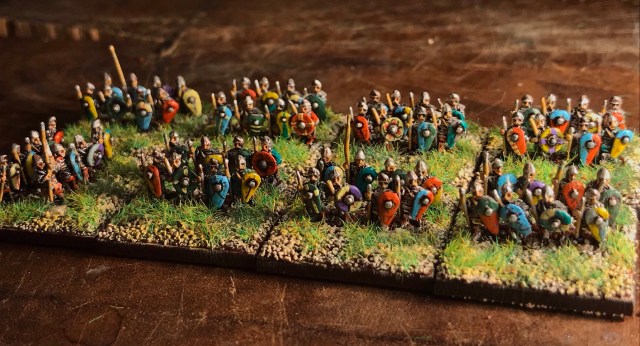
Anglo-Danish Warlord – Mixture of Leaders and personalities from the early medieval range as well as EMA01 – Huscarles with Spear.  Technically this should perhaps be a heavy weapon (e.g Dane Axe equipment and this is how we play and just remember it).
Anglo-Danish Hearthguard – EMA01 – Huscarles with Spear and leaders from
Anglo-Danish Hearthguard (Heavy Weapons) –  EMA02 – Huscarles with Axe
Anglo Danish Warriors – EMA01 – Huscarles with Spear (look at the unit in the front left, seems like someone did not listen to their orders)
Anglo Danish Warriors – EMA01 – Huscarles with Spear

Anglo-Saxon Starting Warband

IMG_4351
For the  warlord unit I used the Huscarls with Spear (EMA01) fronted by miniatures from the Saxon Leaders pack.
IMG_4360
For the hearthguard  I used the Huscarls with Spear (EMA01) again fronted by miniatures from the Saxon Leaders pack.
IMG_4353
For the warriors I used EMA03 – Fyrd Spearmen
IMG_4354
Another unit of warriors, again, using EMA03 – Fyrd Spearmen
IMG_4355
These are the Ango-Saxon shield and spear levy and I used a thin line of  Fyrd Spearmen (EMA03).

Carolignians / Franks Starting Warband
For the Warlord I used the Norman charging cavalry (EMN01).
For the hearthguards I used the Norman charging cavalry (EMN01).
Another hearthguard unit (EMN01).
A warrior unit using the Norman armoured infantry (EMN01).
As one warrior unit can be armed with Crossbow I did so with Norman Crossbowmen (EMN07).

Norse-Gael Starting Warband


IMG_4341
For these domesticated Vikings I used armoured Viking spearmen (EMV01) for the warlord unit (fronted with miniatures from the Viking and Norman leader packs – leftovers from EMV05 and EMN06).
IMG_4346
For this hearthguard unit (heavy weapons) I used the Viking axemen (EMV03)
IMG_4342
This Warrior unit is using the  armoured Viking spearmen (EMV01)
IMG_4343
This warrior (heavy weapons) unit is using Viking axemen (EMV03)
IMG_4344
The final warrior unit used the unarmoured Viking spearmen (EMV01) fronted by the good old Lanciarii (ALR04) as these are Javelin armoured warriors.


Jomsvikings Starting Warband
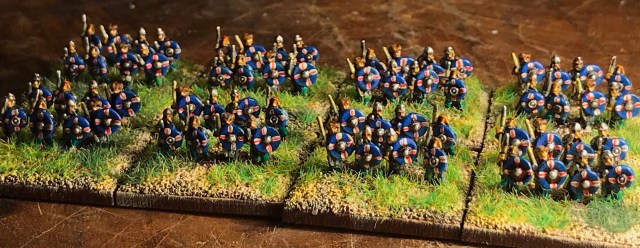
The warlord is using Armoured Spearmen (EMV01) fronted by mounted characters from (EMV05).  I used a uniform look for this legendary mercenary norse warrior warband which is probably not very likely – but I like the overall effect.
This is a Hearthguard, again using the Armoured Spearmen (EMV01) fronted by characters from (EMV05).
Another Hearthguard unit, same as above.
Warriors using the unarmoured spear (EMV02).
Again, Warriors using the unarmoured spear (EMV02).

The Last Romans (Byzantines)

Did not make this faction, but here are my ideas (I have the miniatures and just need to get them done).

Starting Army: Mounted Warlord (CIS01 – Seljuq Turk Heavy Cavalry), Mounted Hearthguard (CIS01 – Seljuq Turk Heavy Cavalry), Mounted Hearthguard with Bow (ASS02- Armoured Horse Archers), Warriors (EMV01 – Armoured Spearmen), Warriors with Bow (ALR05 – Archer).

Pagan Rus

Did not make this faction either, but here are my ideas (I have the miniatures and just need to get them done).

Starting army: Warlord (EMV01 -Armoured Spearmen), 2 No. Hearthguard (EMV01 -Armoured Spearmen), Warrior (EMV01 – Armoured Spearmen) and Levy with Javelins (ALR04 – Lanciarii)

Starting Army (Rus Princes based): Mounted Warlord (CFR04 – Turcopoles), 2 No. Mounted Hearthguard (CFR04 – Turcopoles), Warrior (EMV02 – Unarmoured Spearmen) and Warrior with Bow (ALR05 – Archer).

Playing the Game

Changes to the 2nd Edition Rules

You may want to skip this sections if you have no interest in what the changes are between the two versions, as this only makes some sense if you are familiar with the rules.

When reading the two rules again side by side (pun not intended) a few changes can be noted between the versions.  In addition to what I will cover here the battleboards have changed but I have not yet analysed them and probably will not.  I have played most of the old battle boards at least once but would felt it a step too far for the purpose of this. Doing this review/rough notes took me longer than I wanted it to take, I do not pretend I believe it is complete and may have missed or misunderstood something:

  1. The Warlord model (base in our case) can no longer use the side by side ability
  2. Resilience ability now allows 1 fatigue to be taken instead of 1 hit  up to its limit (see below – but to lower your suspense it is now 3 fatigue markers for all units).  
  3. Only a Hearthguard model/base (within (S)hort distance) can be used to sacrifice/taking damage on behalf of the Warlord. 
  4. We obey ability now allows free activation of any action – not just movement. 
  5. The Warlord now has 8 attack dice (previous he had 5) and only generate one Saga Dice (previously it generated 2 dice)
  6. Heroic units gets the warlord abilities as well.
  7. Levies now generate Saga Dice if the unit has 6 or more figures – previously they did not generate any at all.
  8. Warriors generate Saga Dice if the unit has 4 or more figures – this avoids the 1 man warrior unit being withdrawn to generate Saga dide.
  9. The Saga Dices left on the battleboard from a previous round does not affect how many you roll in your next turn (unless the total of dice on the board + allowed Saga dice from units is higher than 8. As 8 Saga Dice is still the maximum in play at any given time).
  10. In combat you can use 2 fatigue to cancel an enemy activation
  11. You can spend 1 fatigue to reduce the movement of an unit activating to S(hort)
  12. In shooting you can spend more than 1 fatigue to decrease the defending units armour, and in melee the same and also for increasing the attackers armour.
  13. All units are now exhausted when it has 3 fatigue markers allocated to it (3 is the maximum accumulation allowed), this gives -1 to all attack dice.
  14. All units in a group fight if they are engaged with another unit.
  15. Movement is done in straight line (including charges/attacks) 
  16. Models (bases in this case) in a unit to stay within S(hort) from the first unit being moved – this technically means that levies at 12 models cannot create a long line. For our purposes not a big problem, we tend to play the units as 2 deep by 6 frontage (levies), 2 by 4 warriors and 1 by 4 for hearthguards.  This to simulate some kind of depth in shield wall concept typical for the “Age”.
  17. Movement is free (cost no Saga dice) if you are at L(ong) range away from any enemy and movement ends up L(ong) range from any enemy.
  18. Shooting – combat pool maximum at Step 1 at 8 dice, final maximum at Step 3 16 dice.  There is no limit on the number of defence dice that can be applied (previously twice the number of hit was the maximum).
  19. Meele – a unit can only be engaged with one enemy units. There is no longer a step 0 (the reaction abilities are no longer being used). Maximum combat pool is now 16 at Stage 1 and double at Stage 3.  As for missile there is no limit for the number of defence die than can be applied.  Defending unit may choose to Close Ranks and gain the effect of solid cover but only gets half of its normal number of attack dice (The old rule of sacrificing attack dice to get defence dice is no longer used).  Note this rule is not available to mounted, bow/crossbow armed units and heavy weapons (e.g. dane axes).  So perhaps a better name for the ability would be to “Form Shieldwall!”.  Defenders in solid cover never withdraw if they outnumber the attacking unit, other units may end up less than VS if there are terrain restrictions.
  20. If all the figures are in cover, the cover counts – if not it does not count.
  21. Dangerous terrain introduced – works like uneven terrain but also causes 1 fatigue to the unit.
  22. Changes to the dimension of the sizes of terrain – I let you go a figure this one, I do not tend to care about these things – sorry!.  It is getting late.
  23. Equipment /Weapons – clarification of modifications and restriction, changes to rules for composite bows (free activation and no fatigue), crossbow (+1 to attack instead of -1 to Armour, and can only shot once per turn), javelin (+1 melee attack dice when charging, an example of this is the classic roman infantry attack I suppose), there is a new improvised weapon category.

Playing it over Easter

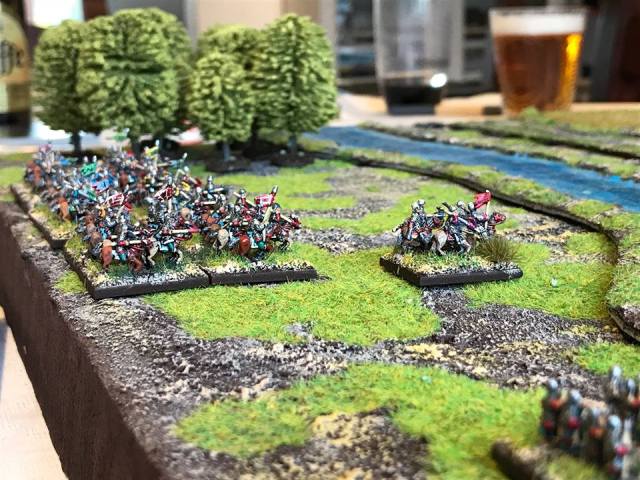
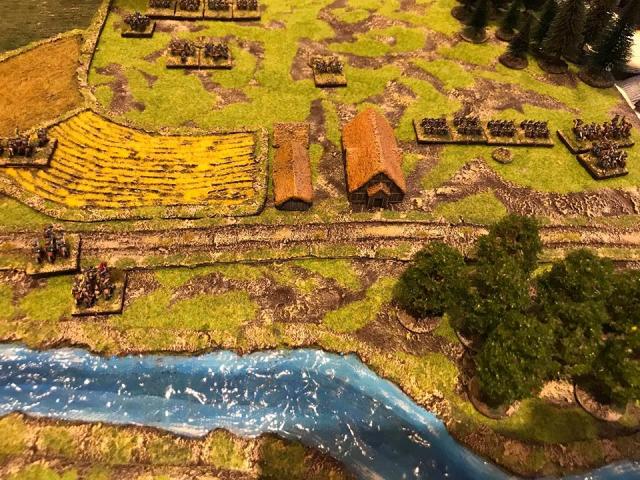
We decided to play a few games over the Easter Period and we only used starter warbands and I used my 2 by 2 terrain tile (famous from sessions of Pikemans Lament last year) as this one can easily be accommodated in a house full to the brim of family and friends. As we had mixed familiarity of the rules this was sufficient to get a few games played, starting within direct engagement distance.

We play the rules exactly as written, one a base is the same as a base in the 28mm version, no adjustments for ranges of missile weapons or movement.

Here are a few pictures from these games, the games flowed nicely and went really well.
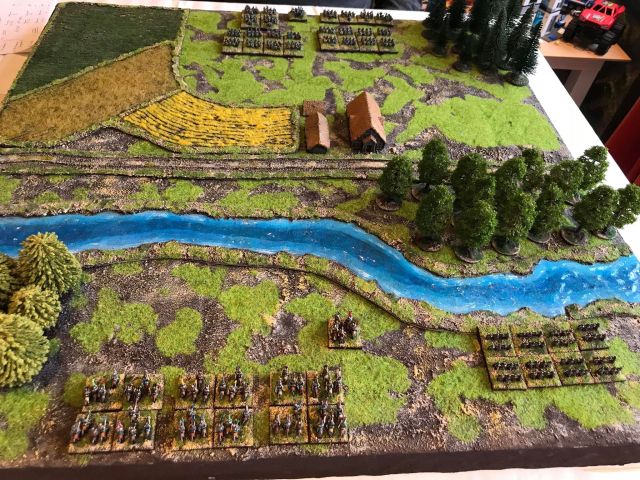
sga
The Easter set-up – all games played with the same terrain constellation and with the same opponents – Vikings vs Normans.  For the normans we used 3 units of 4 Knights/Hearthguards and a unit of 8 Sergeant/Warriors and the Lord himself.  The Vikings had a unit of 4 No. Hearthguard Berserkers and a normal 4 base strong Hearthguard unit, supported by two units of 8 warriors (and the Warlord himself, mounted on a horse but moving like a foot unit).
sga2
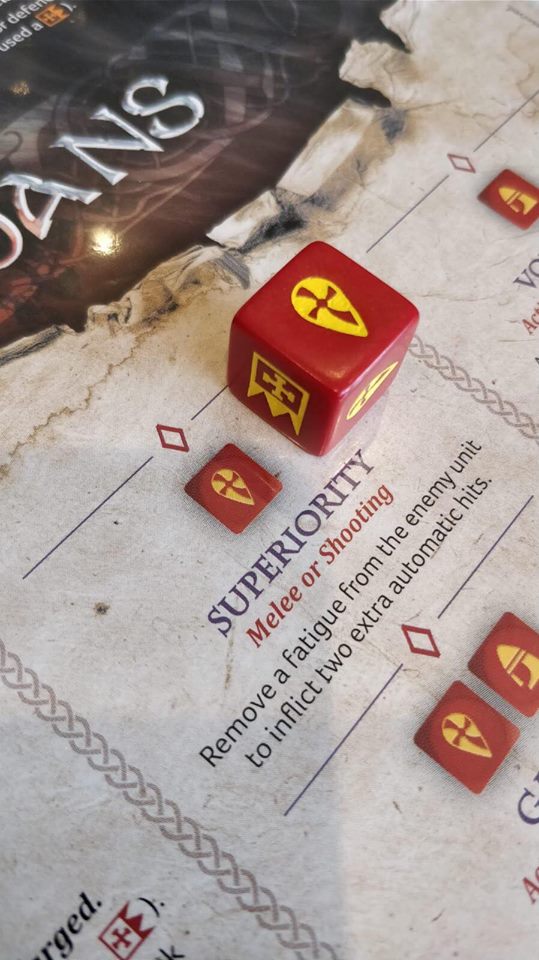
The new rulebooks and  battleboards – they have the same feel as the old Crusade boards (if you are familiar with these).
Playingsaga1
Let us ride down those Norsemen!
playingsaga2
I like the effect of this picture!
playingsaga3
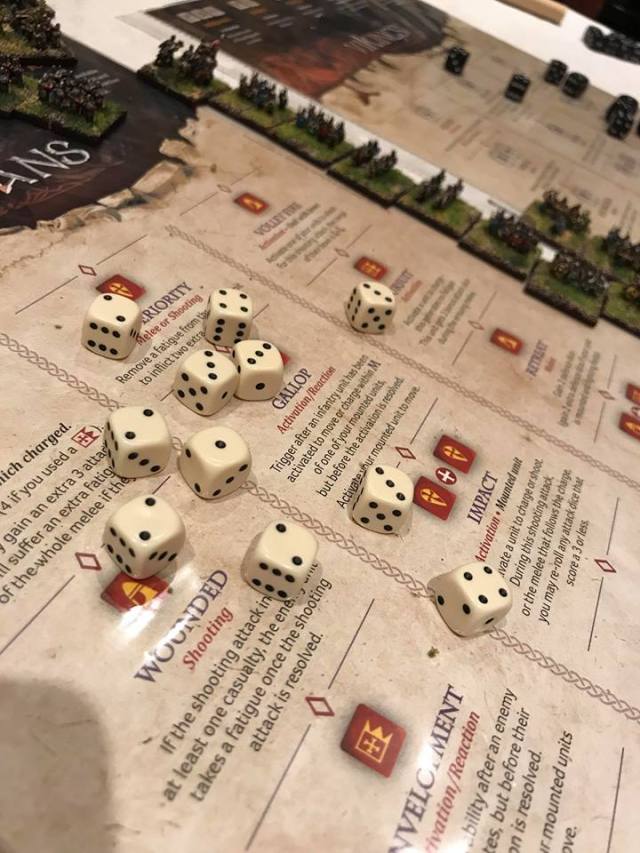
I know there is only 1 No. One rolled here but I needed to roll 5 or more to hit, with 8 base and 3 bonus dice for my warriors. I hit shit all with that roll!

playingsaga5

playingsaga9
Very powerful if used at the right time.  I got my warlord sacked by this ability being used.
playingsaga10
The Norse Warlord fighting unit of 4 Sergeants (Warriors)
playingsaga11
A Viking attack on the Norman Warlord
playingsaga12
The Normans breaking through my shield wall
playingsaga13
The Guys on the bench. It must have been when I played the Normans! A row of Hearthguard taken out!

playingsaga14playingsaga16


Conclusion:  Saga is still fun and works really well in 6mm whether you have the old or the new set of rules.  In its base it is a simple I go you go – you roll to hit and then your opponent rolls to save kind of game.  But with the addition of being able to use your opponents fatigue to gain benefits and the battle boards it is a unique game and I, and the Little One, really like it.  

Note: I have played six games with the new version and lost five. 

/ I hope that was of some interest, below two bonus parts one about music and the other some old Saga battle shots!

Bonus 1: Old Battle Shots 6mm in Action

Bonus 2: Music for you musings

In the original postings we included some recommended music whilst painting your warbands – so here are a few oldies and a few new ones

Amon Amarth starting with their Twilight of the Thunder God (that incidentially would be a fantastic title for a set of wargame rules in the Age of Vikings) followed by At Dawn’s First Light and Pursuit of Vikings – it does not get much more Viking melodic death metal than this.  This is perhaps not everyone’s cup of, sorry I meant horn of mead!

If that was too heavy for you do not despair there are some equally good options (youtube is full of this kind of things – should get your warbands done in an afternoon or give you plenty of inspiration to crush your opponents on the wargames table).


Gaslands in 6MM – out of sight but not out of mind

GASLANDS IN 6MM

img_3928.jpg

Some time ago I was writing a few blog entries about doing Gaslands in 6mm and then it went quiet – we actually have played a fair few games and really enjoy it.

Anyway a little bit of summary of where we are at with this:

  1. Overview
  2. Games we have played on our Toxic Track
  3. Using Dropzone commander terrain
  4. Further ideas – Snowmobiles and Zombies

As I have said before I am not in a position to have a permanent set-up so prefer to do some of the games I play on smaller surfaces (say a maximum of 3 by 4 feet), so games like X-wing or Saga are great straight from the box.  Another way to achieve this is to convert a bigger scale game (e.g.28mm) from inches to centimeters (1″ becomes 1 cm) or by using half inches (1″ becomes 1/2″ or 1.27cm – not that difficult if you make special measuring sticks – a one time investment in time) – and using smaller scales for the miniatures. I did this for the Dan Mersey series of rules (e.g. here and here) and for Too Fat Lardies Sharp Practice (e.g. here) and it does work.  Yes it is a little bit more fiddly.

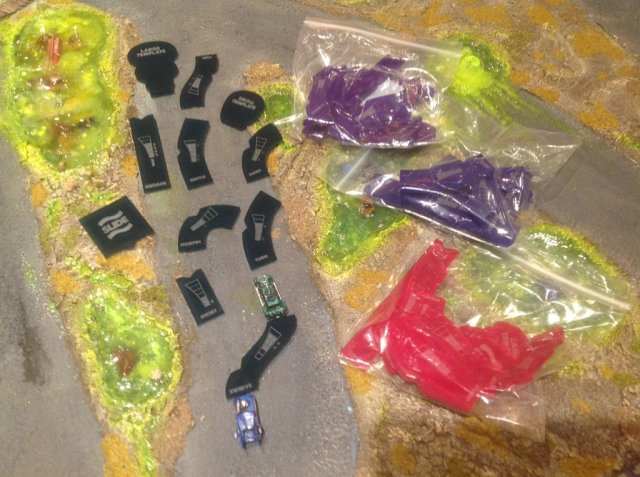
My original thoughts on doing Gaslands in 6mm – well actually more than thoughts – can be found summarised in a blog post I wrote earlier (Here).  After this I got myself some 50% movement templates that I bought from Bendyboards (link here, contact Lee and ask him for 50% if this is of interest) that produces the official Gaslands templates.  This in effect means that a 2 by 2 foot board equates to a 4 by 4 in full scale.

 If you want a good overview of the game, I think this review (link here) is a good summary and worth reading instead of me repeating something similar in content but less enjoyable and thorough.  I agree with the sentiment of this review.

TERRAIN FOR PLAYING THE GAME

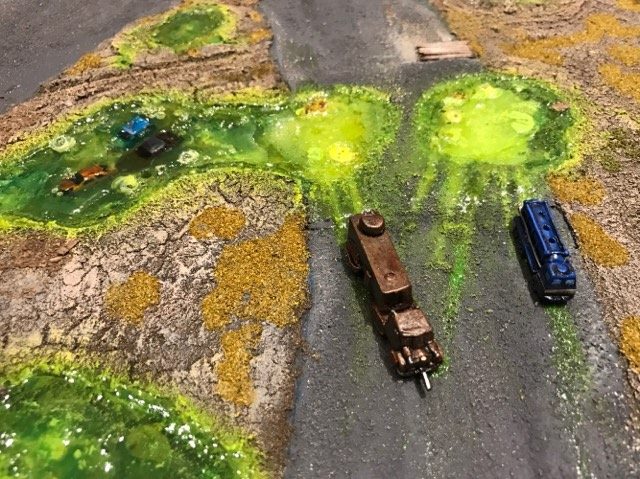
Getting toxic

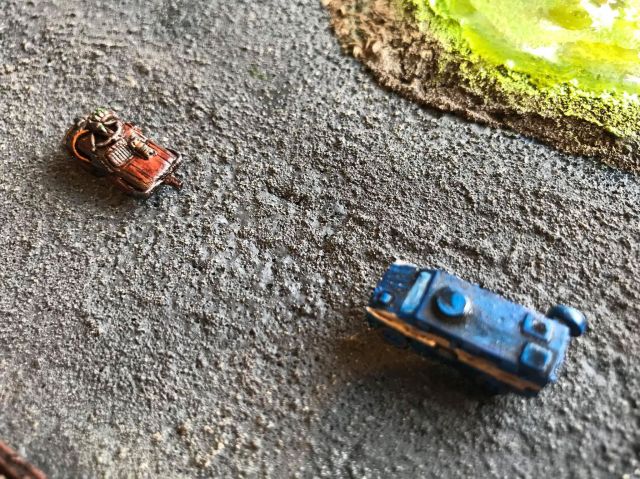
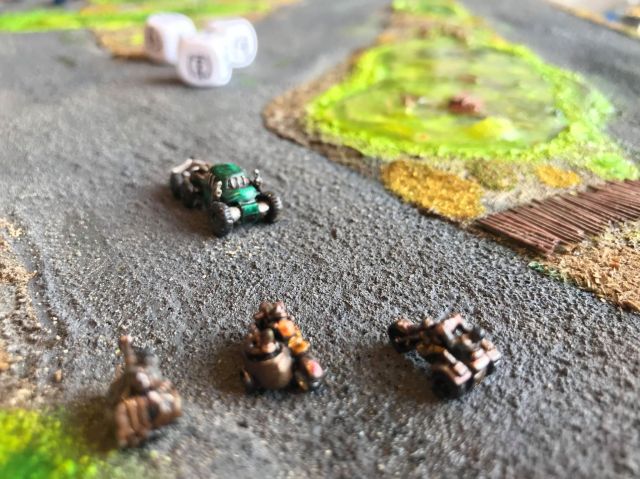
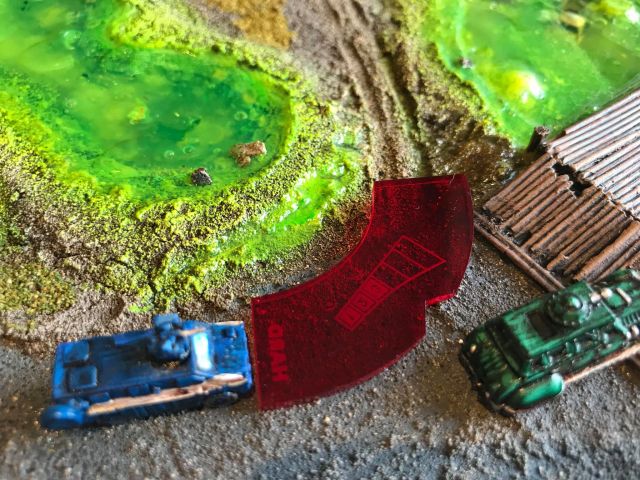
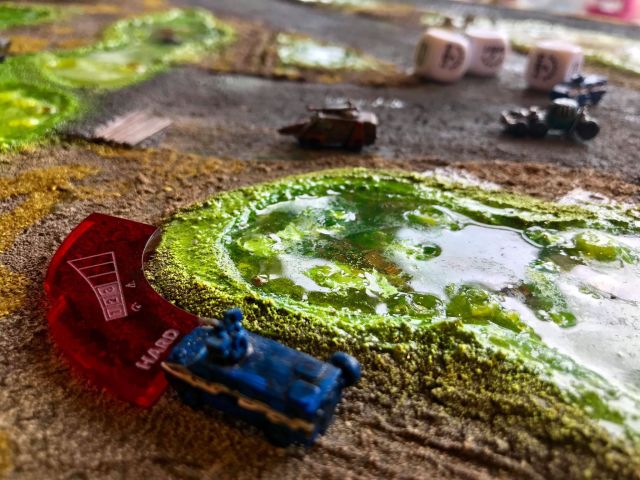
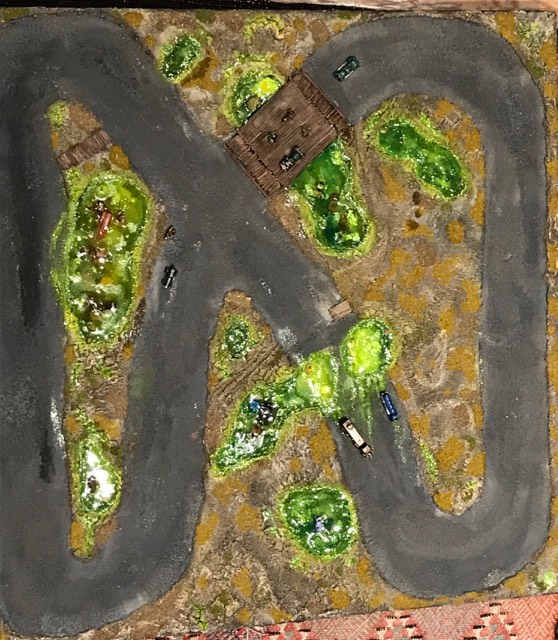
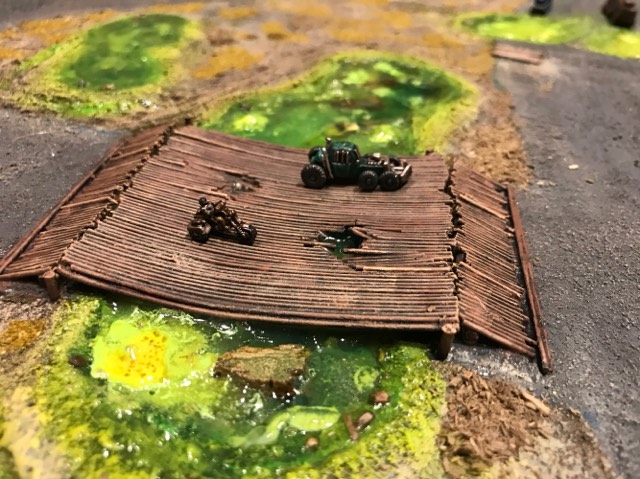
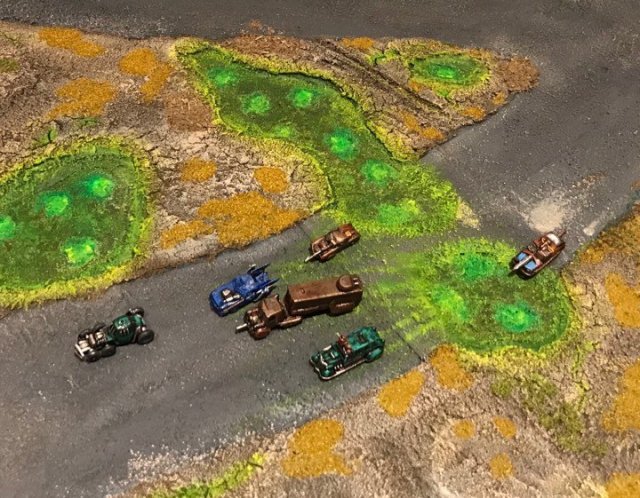
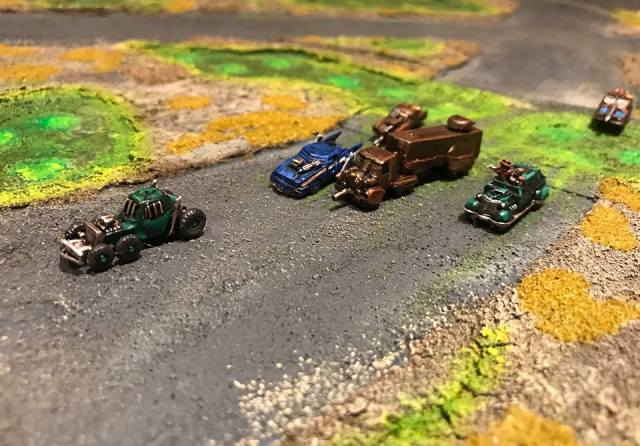
So far we have used the Toxic track I made some time ago to do our games, we played a fair few games just using a car each with front mounted machine gun, but we have now also done some games with 3 to 5 vehicles on each side.  I find that it produces different games – the single car race is about outmaneuvering and skill whilst the selection of vehicles tends to lead to a more skirmish fight situation – at least the way the Little One and I are playing.  Both version highly enjoyable.

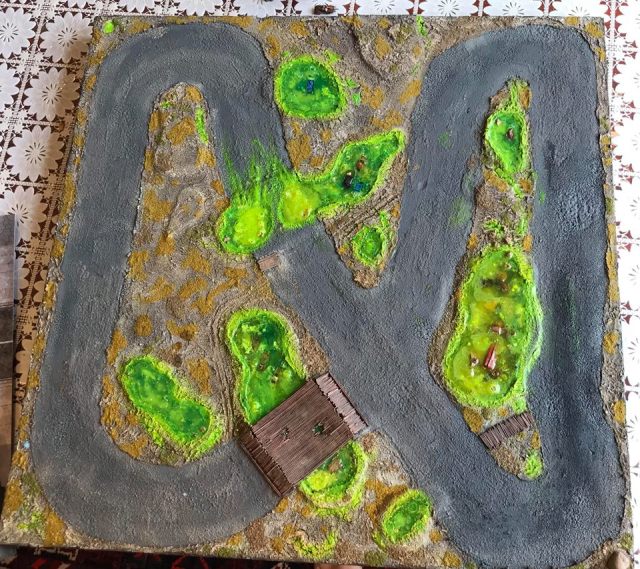
Here is the terrain board again (2 by 2 feet) – we are ready to press the pedals very quickly with 2 minutes of so set-up time.

gaslands3.jpg

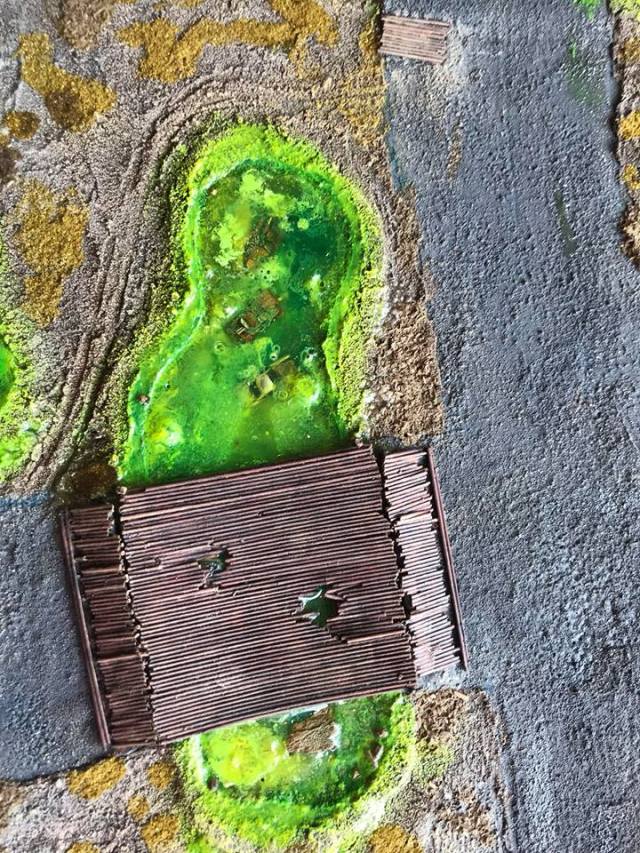
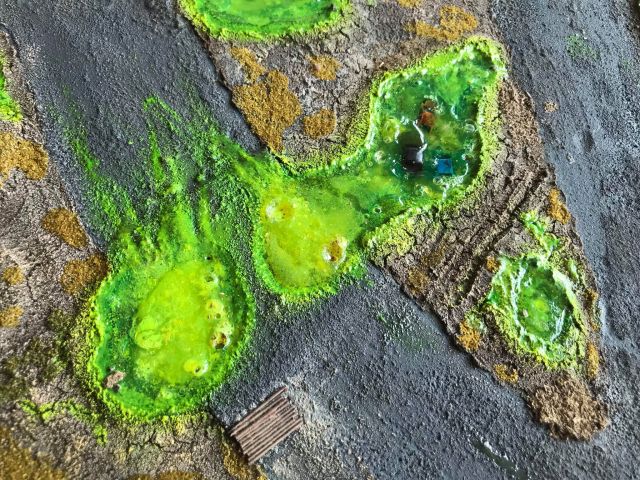
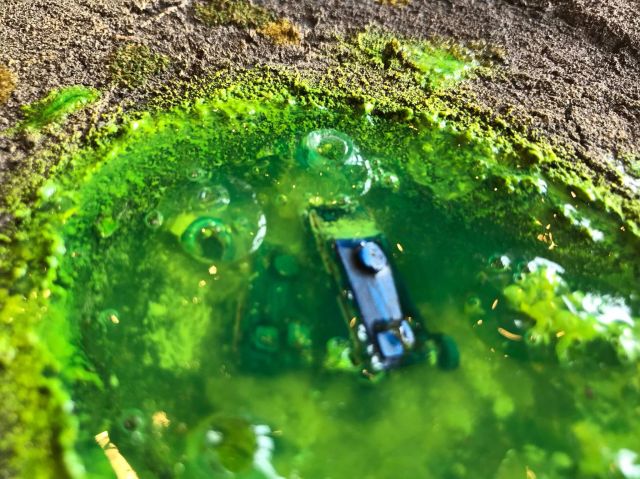
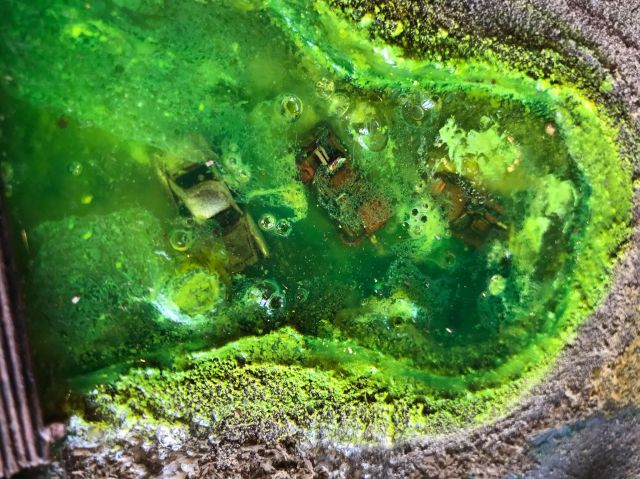
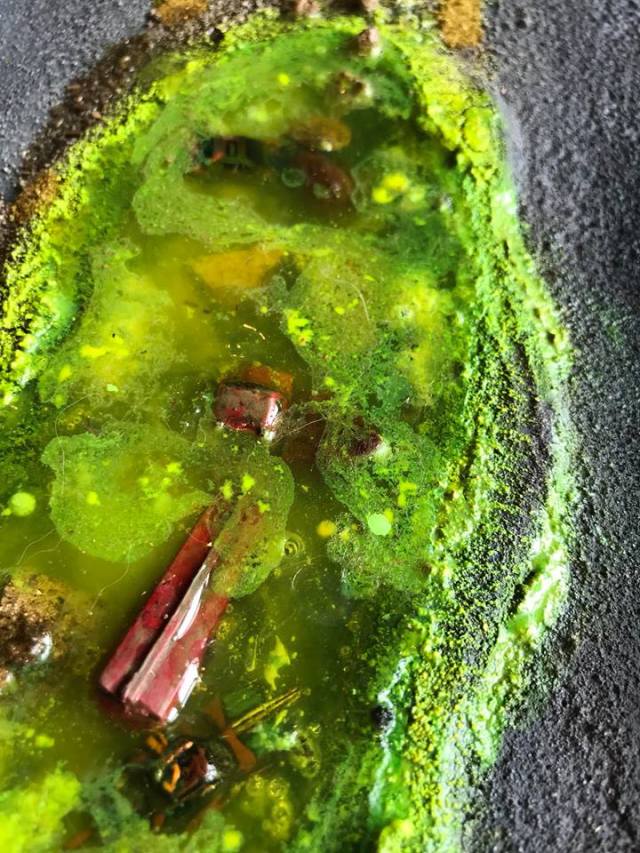
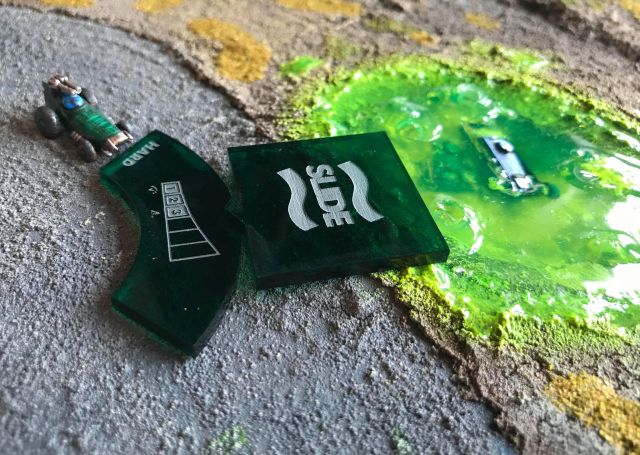
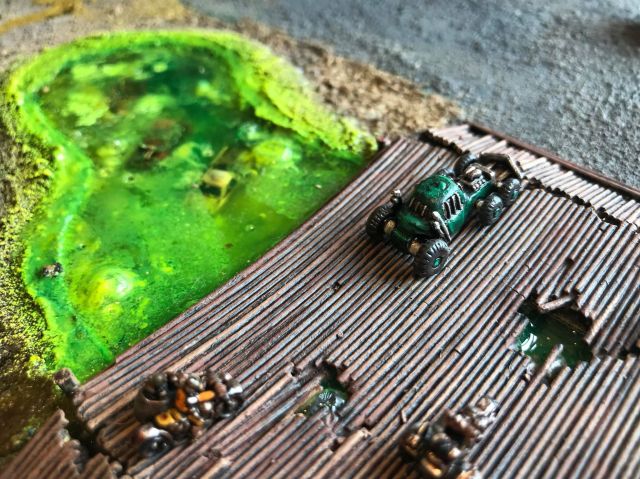
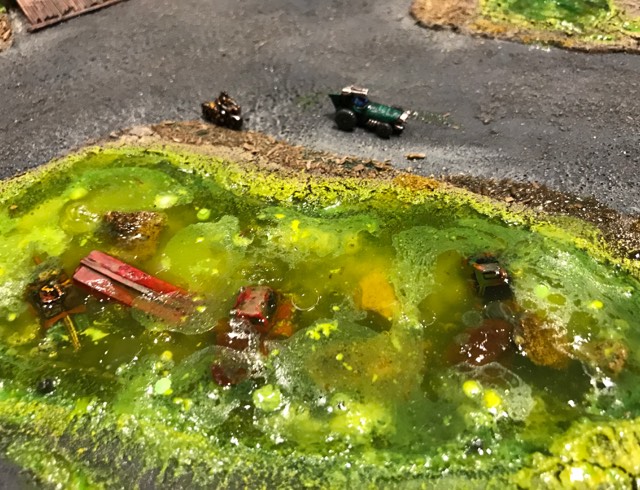
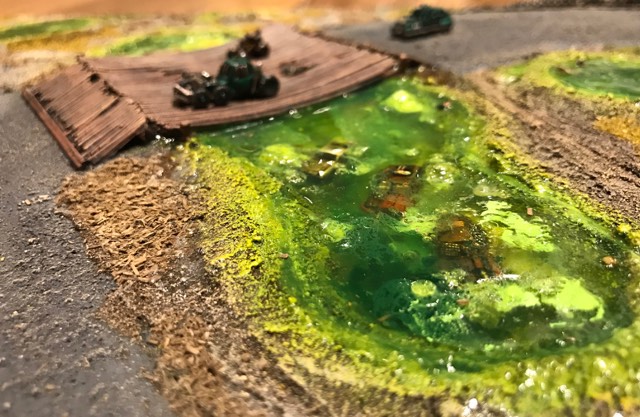
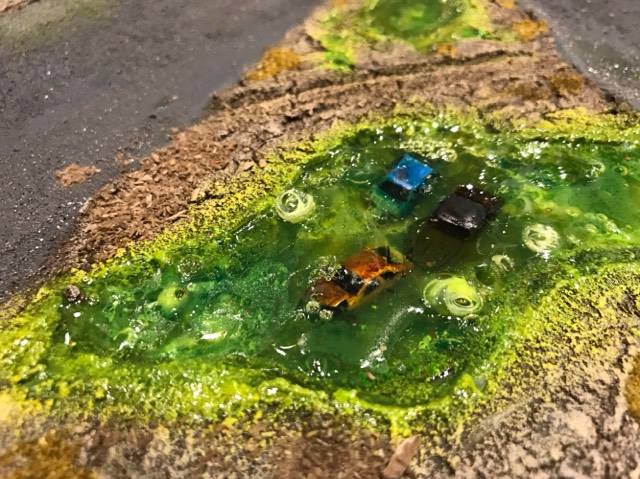
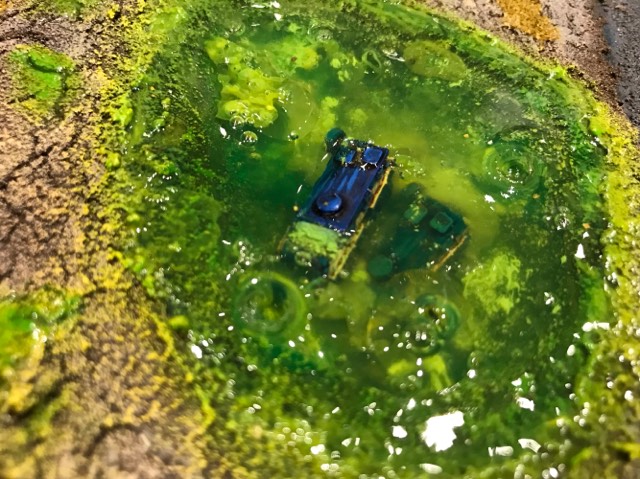
It has some slimy pits that are best left alone.

gaslands1gaslands2gaslands4gaslands5gaslands6

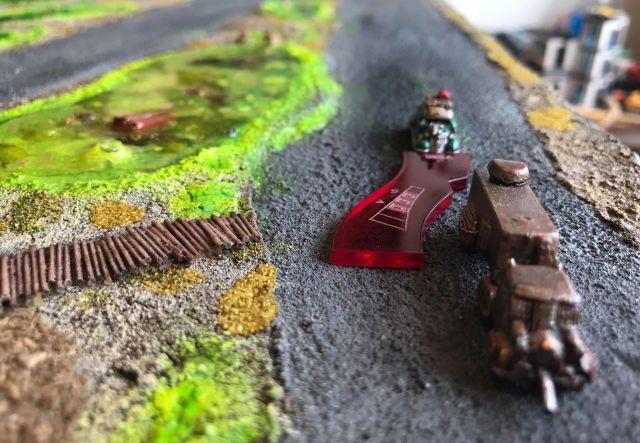
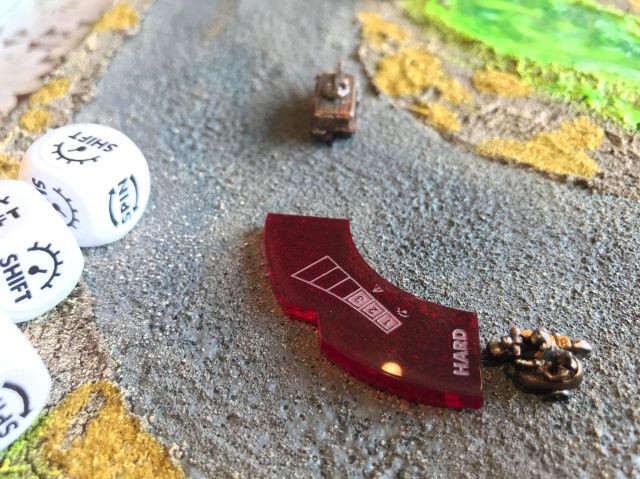
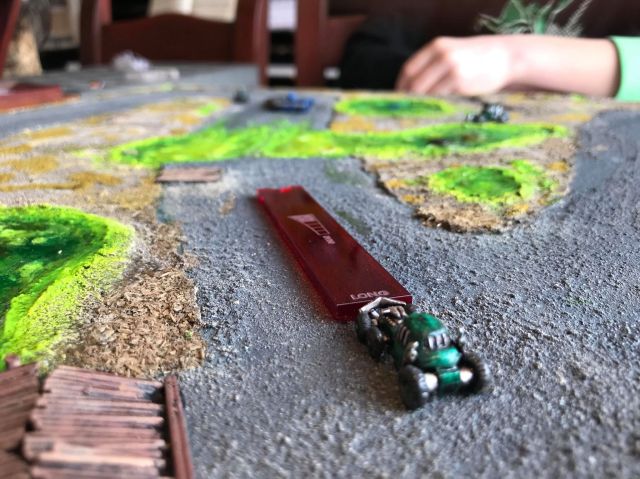
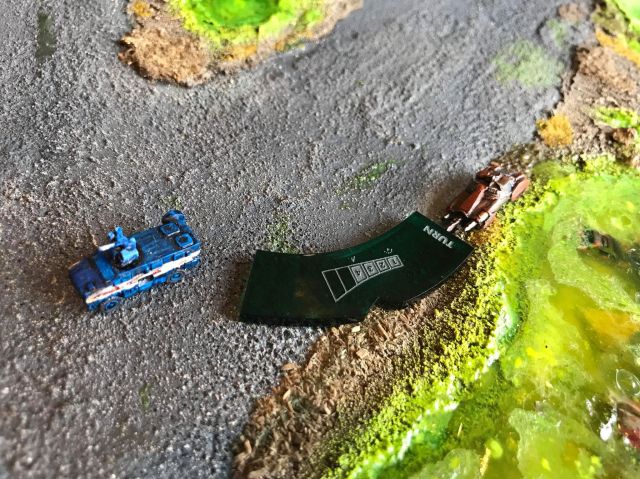
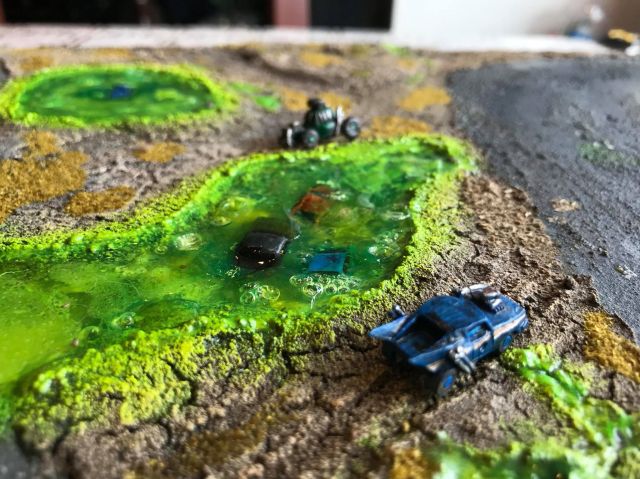
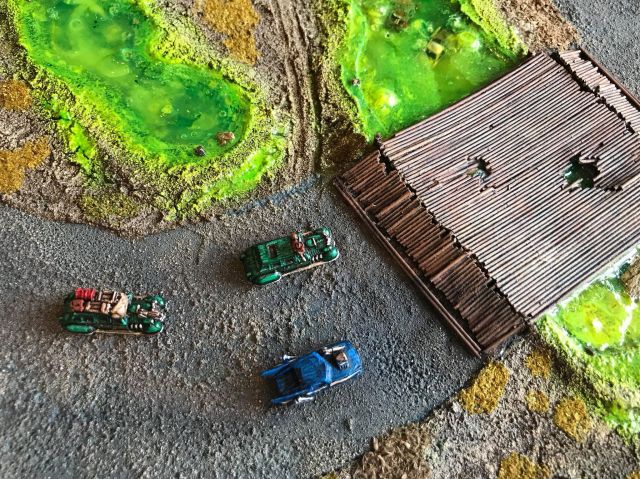
Here are a few shots from some of the games we have played.

gaslands7gaslands8gaslands9gaslands10gaslands11gaslands12gaslands13gaslands14gaslands15gaslands16gaslands17gaslands18

dropzone commander ruined city tiles

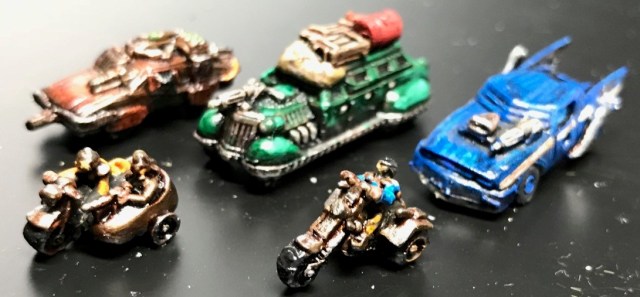
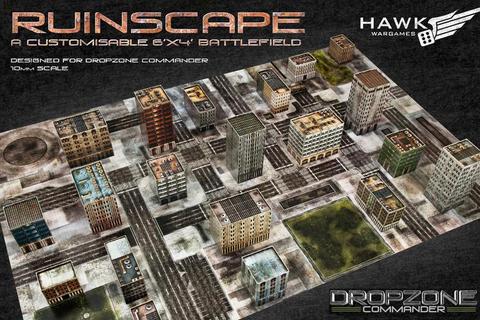
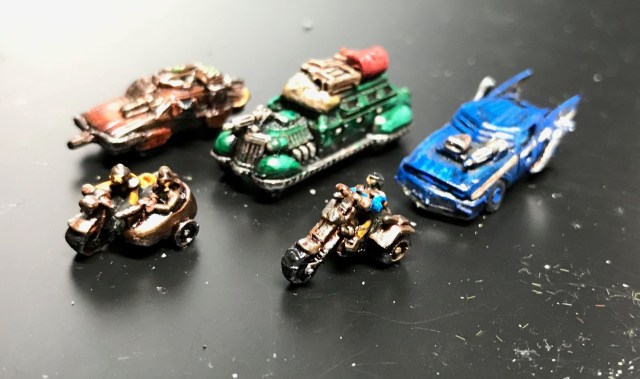
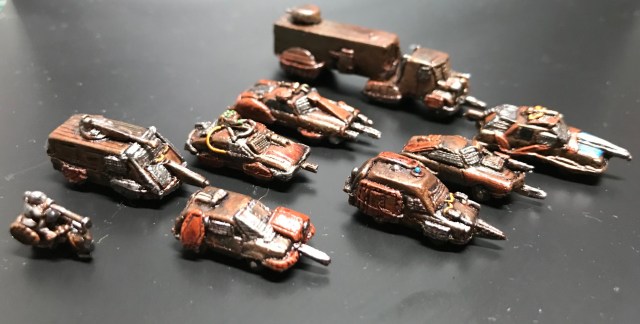
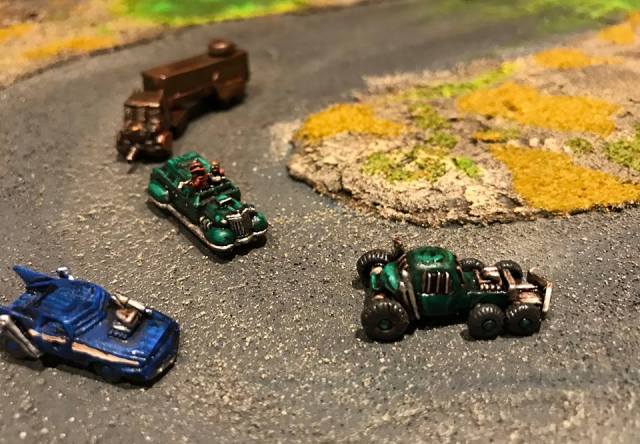
I actually came to the conclusion that the cars I ended up getting were probably closer to 10mm than 6mm scale – instead of 1/285 scale I found them being more like 1/200.  10mm normally is referred to as 1/160.   I then remembered the Dropzone commander rules and some cityscape terrain I had seen that looked decent – at least from what I was seeing.   I ordered a set of ruined city tiles and buildings for the Dropzone commander game.  It is a card board set in 10mm scale and I think this will work brilliantly as it may portray a section of a city where the level of radiation is too high for permanent inhabitation, or otherwise abandoned, and is now being used for Gaslands competitions.

You can find more information about it here.  It comes with 20 buildings and mats to cover 6 by 4 feet, so more than plenty for our needs. At £20 (reduced at the time I bought it 3rd April 2018, from £30) for the whole set (including delivery in the UK), hardly any significant outlay even if it is cardboard and we will probably end up knocking down the buildings whilst maneuvering our cars – but I will keep you posted on how this cardboard adventure will progress.

large.jpg
Here is the full set as presented on the Webpage. Looks ok I would use some model trees for the park but otherwise good to go.  It is recommended that you mount the tiles on some sturdier board.

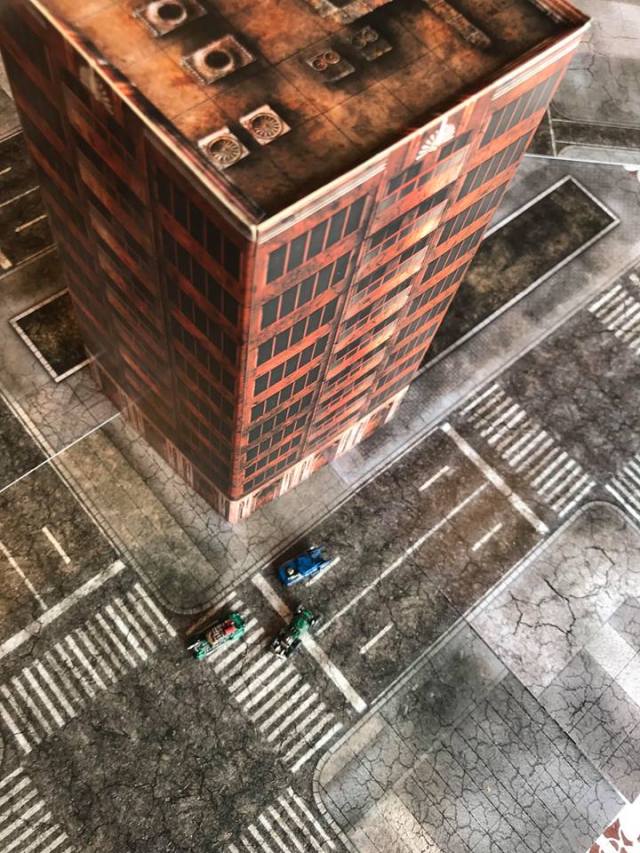
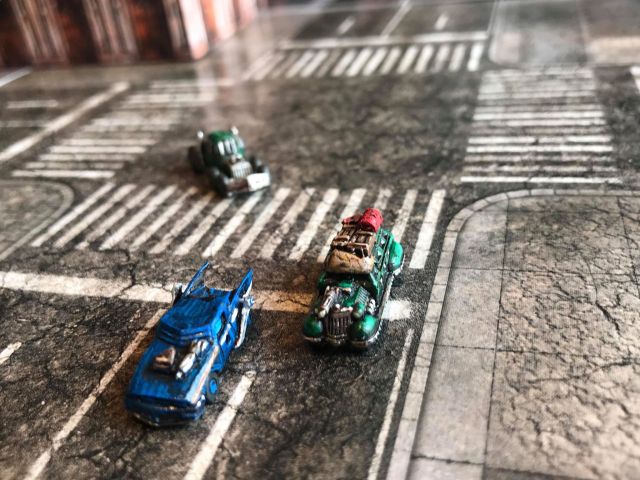
Here are some shots showing how the cars I am using compare in relation to the terrain.  I think it is a more than adequate fit and I think this terrain have some potential for a lot of different things.


gaslands19
Really like this
gaslands20
Spot on


In addition you can download more buildings for free on the webpage (here), but I think I will stick to these pre-printed ones as I am happy with the amount of terrain I already have in the basic set.  I suppose if you use these you could re-sixe them to fit to the scale you are using.

print.JPG
Example of a printable free building for Dropzone Commander as the link above.

further gasland ideas

mutant 1984

I recently completed some Snowmobiles for my Mutant 1984 project, based on a matchbox model (“Snow Hopper”). I found these at a Poundshop for £1 each.

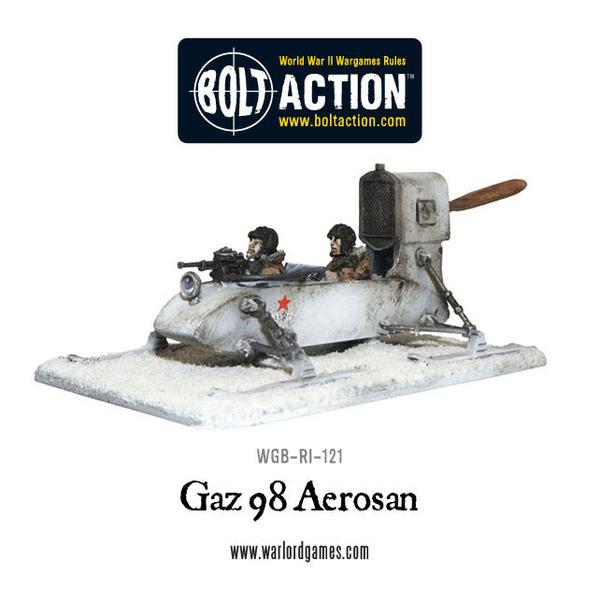
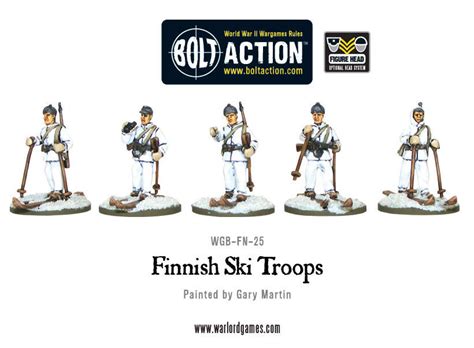
These are in “28mm” and I am planning on using Gaslands for a chase scene with some skiers, snowmobiles and some other snow vehicles, like the one in the picture below from Warlord Games – the Gaz 98 Aerosan (link here, picture from their webpage) and the skiers (link here, picture from their webpage). Still work in progress, so some time away from completion.  It is basically a “downhillish” race where a detachment of Pyri Commonwealth Scouts on skis are being spotted by some Borderguards of the Ulvriket Army on Patrol in the occupied Göinge during the cold Winter Year 109.

wgb-ri-121-aerosan-a_grande.jpg


thJH2TJQIB.jpg

6MM ZombieS

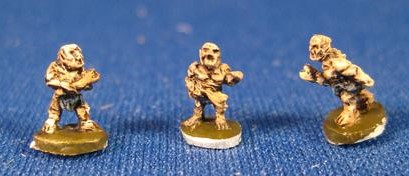
I also have some 6mm zombies that I need to paint to do the zombie scenario for my “6mm” cars, these are from Microworld Miniatures and I will be using Zombies and Ghouls (link to Microworlds Undead Range, here. Pictures from their Webpage).

ghoul1_grandezombies1_large

In summary we are having fun with these rules!, I hope you are too.

Next time is the 100th Roll a One blog entry.

/All the best, and by the way we had a guest font in this blog post it is called 28 days later and used in Gaslands – you can download it here.


Horka 1708 update – Russian Infantry Completed

In the last posting (here) I set out what this blog posting would be about:

Blogpost 98, w.c 02-Apr-18. Some completed stuff for Horka 1708, this will be pictures of the completed Russian Infantry – the 64 bases required.  I just need to complete the basing and add flags to the final ones in the next few days. 

For once I seem to have managed to live up to at least my own expectations. I spent the first day of the Easter Break finalising the basing and then added some flags the following day – boring at hell at times but I figured it would be worth the effort. Here are some pictures (there is a listing the completed unit at the end of this posting).  All models are from Baccus (link here).

infantry4
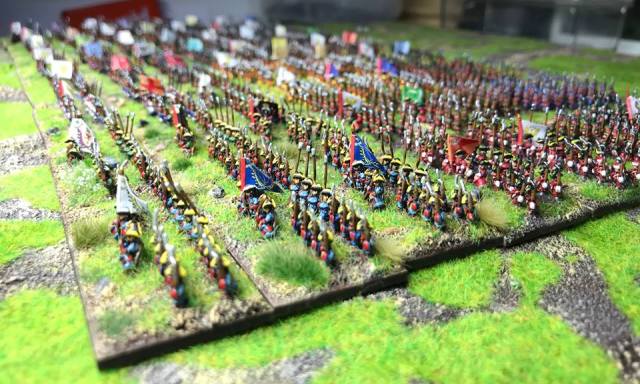
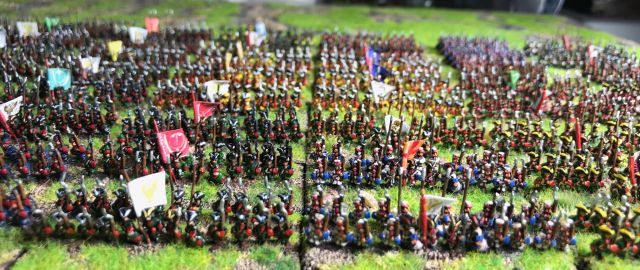
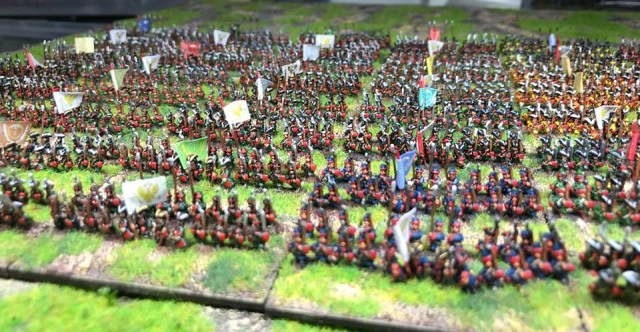
Aerial shot of the Russian Infantry element of the Horka 1708 army, 64 bases and each base represents a battalion. There are another 91 bases of cavalry to add as well as some artillery and leaders.  Note that I have tried to avoid the lines being too straight as I think this adds a better feel of “movement and maneuvering”.  The units without standards/flags are grenadiers. 


infantry2
A few dudes with flags from Baccus and Tiny Tin Troops


infantry1
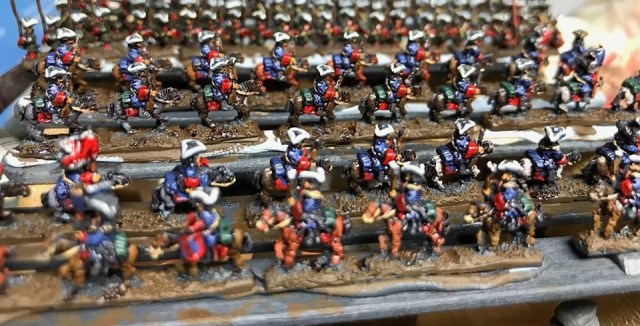
The majority of the Infantry have Green Coats with Red Cuffs, but there are some more colours on offers.


infantry3
A lot of the Russian had Karpus/Kartuz it is a type of hat worn by Swedish and Russian Soliders – you can find more on headgear on a blogposting by Boris Megorsky here 


I am doing the final cavalry elements and hope to be able to inspect them on the parade ground shortly before I get onto to finalising the Swedes.

prep4
Last cavalry unit drying following application of Windsor Newton Nutbrown Ink.


In other news I have ordered some stuff over the last few weeks for my Mutant 1984 project (1980s roleplaying in a world that most certainly was), I would like to give a little shout out for the miniatures from Space Vixens from Mars.  They regularly show up at shows and do their games and invite anyone along for a hilarious ride.   Here are a few of the models that I will be using for my Mutant 1984 project (taken from their webpage – link here).

I wanted to have a rock band with mutated Beetles but had to go with Plan B, the Mutated Beetles.  They are famous throughout the Pyri Commonwealth and I will try to find a Walrus head and do a headswap!

Here is their typical set list (length of the show tends to be dependent on the capacity of the steam powered electrical generator of the local venue).

Here comes the Burning Sun, For the Benefit of Mr. Rijn, Baby You Can Ride my Horse, Mutant on the Hill, Got to Get you into my brain, Happiness if a smoking blunderbuss, I am the Mutated Walrus, I want to hold your four hands, Mental Mystery Tour, Mean Mr. Ketchup, Roll Over Justin Beaver, September in the Acid Rain, Three cool mutated cats, Two of Me and finally (and I suppose you also grew tired of the list!) You’ve Got to Hide Your Mental Powers Away.

Anyway, hope that was of some interest.  We have also been playing some games over the Easter Break but those will be presented in some future blogs as per the plan presented last in the last blog.


playingsaga2.jpg
Saga in 6mm played over the Easter Weekend using the new Saga rules – good times were had!


If you are interested in following the blog you could like it on facebook (link here), become a follower on twitter (link here), or sign up here as a wordpress user or by leaving your e-mail.

/ See you

Russian Infantry units at Horka 1708

(now 100% completed)

Unit Type Ref Bases ToTSK Unit Models
Preobrazhenski Infantry R01 3 Large Unit 72
Semenovski Infantry R02 3 Large Unit 72
Ingermanlandski Infantry R03 3 Large Unit 72
Astrachanski Infantry R04 1 Small Unit 24
Moscowski Infantry R05 2 Normal Unit 48
Sibirski Infantry R06 2 Normal Unit 48
Pskovski Infantry R07 2 Normal Unit 48
Kazanski Infantry R08 2 Normal Unit 48
Vologodski Infantry R09 2 Normal Unit 48
Nizhegorodski Infantry R10 2 Normal Unit 48
Busch’s Grenadier Regiment Infantry R11 2 Normal Unit 48
Repnins Grenadier Regiment Infantry R12 2 Normal Unit 48
Kievski Infantry R13 3 Large Unit 72
Narvski Infantry R14 3 Large Unit 72
Schlüsselburgski Infantry R15 2 Normal Unit 48
Novgorodski Infantry R16 2 Normal Unit 48
Butyrski Infantry R17 2 Normal Unit 48
Rostovski Infantry R18 2 Normal Unit 48
du Bois’ Grenadier Regiment Infantry R19 2 Normal Unit 48
Rentzel’s Regiment Infantry R20 2 Normal Unit 48
Lefort’s Regiment Infantry R21 2 Normal Unit 48
Kargopolski Infantry R22 2 Normal Unit 48
Koporski Infantry R23 2 Normal Unit 48
Tobolski Infantry R24 2 Normal Unit 48
Belgorodski Infantry R25 2 Normal Unit 48
Luzhski Infantry R26 2 Normal Unit 48
Olonetzski Infantry R27 2 Normal Unit 48
Ryazanski Infantry R28 2 Normal Unit 48
Vjatski Infantry R29 2 Normal Unit 48
Chernigovski Infantry R30 2 Normal Unit 48


GNW Horka 1708 update, Tiny Tin Troops, 2nd Edition Saga and Helion Books


Saga_8.jpg
Dark Ages Warriors (6mm Baccus)

I am currently spending a lot of hobby time finalising bases for the Horka 1708 project that will be presented at the 6mm show Joy of Six in July this year (a link to the webpage here).  This will be  my 6th year of putting a game on (2012 GNW Fraustadt 1706, 2013 GNW Klissow 1702, 2014 GNW Kalisz 1706, 2015 GNW Gadebusch 1712, 2016 Saga in 6mm, 2017 GNW Lesnaya 1708 and Dragon Rampant in 6mm).  It is my favourite show of the year because it showcases what can be done in this scale and what is available as a lot of the 6mm miniature and terrain/building traders are in attendance. I suggest you check it out and get yourself to Sheffield this Summer (15th July).

I tend to move big chunks of works forward at the same time rather than completing say 4 bases and moving on to the next 4 set of bases.  I used to do it in incremental steps, and I would recommend it to anyone who wants to complete a big project/campaign by winning small victories on the way.  I still get a kick of a completed base and how that seemingly randomless drybrushing on top of the brown base, in combination with the static grass creates that little illusion that puts the models in some kind of bigger context!

However, my current small victories are all the other diversions (Gaslands, Winter War, Mutant 1984, etc.) whilst I slog away with the big one.  At times these diversions takes me away from the main mission for weeks.  But I have to admit that it does not take much to get me back to the Great Northern war period.  This final futile grasp of Sweden as a Great Power and the great battles, tragedies and personalities it contains.  I know how it all ends, but it still blows me away and there is so much more to find out.

On that note (and I have mentioned a few before) check out Helion Company’s Century of the Soldier series that have a lot of upcoming books for the Great Northern War in particular but so much more. Link to Helion here.  Give them a visit and get yourself some cool books.  I am really pleased to see Great Northern war books in English and anyone who is doing them will certainly sell me a copy – but also gets a shout out.

Here are a few of the titles I am looking forward to (various release dates):

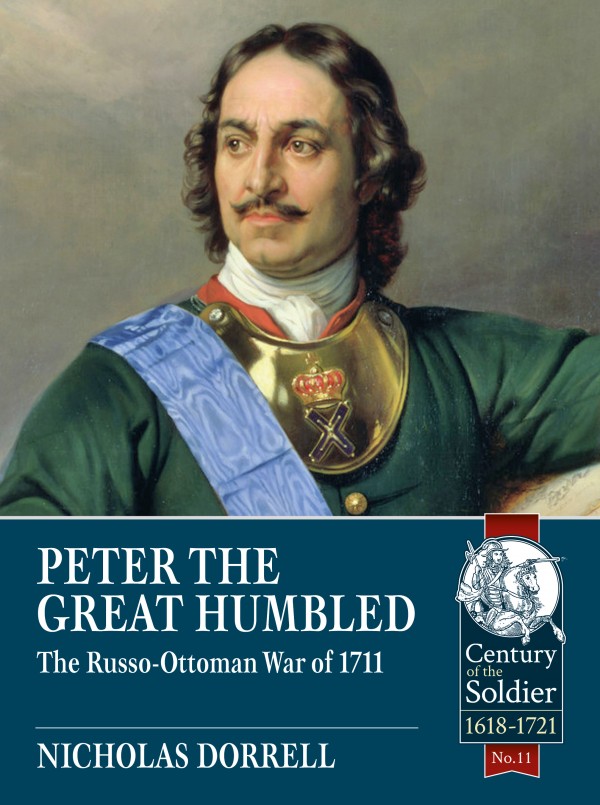
I am currently (re-)reading another one from the Century of the Soldier series about the Pruth campaign that was released a at the end of January this year (incidentally, as Nick wrote it I had read the initial draft, but had not seen the bespoke drawings of troop types of the two sides and re-enactment pictures of Russian soldiers – and I really enjoyed it).  I discussed this book here that formed the basis for a little skirmish side project using Pikeman’s Lament (see more here, here  and here).  However this campaign lends itself to bigger battles.  Think about the mixture of differing troop types with the colourful Ottoman army of the period on one side againt the more westernized Russian army with Kalmucks, Tartars and Cossack support on the other – what a spectacle.  [editor notes: At this note he drifts away into that la la land again, planning battles and setting up painting progress spreadsheets again].

In 1711 Peter the Great, the Tsar of Russia, led a large army of veterans from Poltava and his other Great Northern War victories into the Balkans. He aimed to humble the Ottomans in the same way he had the Swedes a few years before. Victory would secure useful allies in the Balkans, cement Russia’s ‘Great Power’ status and offer Peter the opportunity to finally gain control over the Swedish king, Charles XII, thus completing his victory over Sweden. Yet within a few months, the ‘backward’ Ottomans had forced the Tsar and his Tsarina and their army of veterans into a humbling surrender near the Pruth River. The war was the first time that Russia was strong enough to confront the Ottomans independently rather than as a member of an alliance. It marked an important stage in Russia’s development. However, it also showed the significant military strength of the Ottoman Empire and the limitations of Peter the Great’s achievements. The war was of significance to the allies of both the Russians and the Ottomans. It was of course of an even greater importance to all those directly affected by the war such as the Swedish, the Polish, and the Cossacks, who had taken refuge from the reverses of the Great Northern War in the Ottoman territory. It would also bring about the defeat of the Moldavian and Walachian ambitions to shake off the Ottoman overlordship, elevating Dimitrie Cantemir into the position of a national hero celebrated to this day by the people of Romania. The book looks at the causes of this little known war and its course. Using contemporary and modern sources it examines in detail the forces involved in the conflict, seeking to determine their size, actual composition, and tactics, offering the first realistic determination on the subject in English. 

9781911512318.jpg

Taken from the Helion website (link here).

So how am I getting on with the Horka project, then?. I actually did not know until recently as my notes were a little bit here, there and everywhere.  So I opened up a spreadsheet and did an inventory and counted the models I had to date.  Here is a summary of where the painting is at expressed as percentage complete (then there is basing etc, but since that is relatively quick I am only interested at this stage on whether I have enough painted lead or not!):

  • Swedish Infantry (672 foot) – 57% (16 of 28 bases done)
  • Swedish Cavalry (648 riders)  – 96% (69 of 72 bases done)
  • Russian Infantry (1536 foot) – 94% (60 of 64 bases done)
  • Russian Cavalry (819 riders) – 93% (85 of 91 bases done)

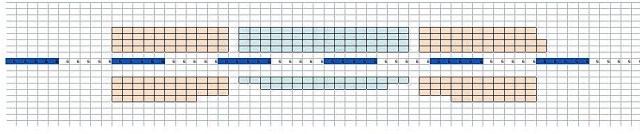
Overall – 90% complete (230 bases of 255 are now in painted condition) – over 3,500 miniature .  When I counted it all up I have to admit that I was pleasantly surprised that I had so little left to do.  It is the largest amount of bases I have ever put on a table to date. The picture below show the two armies spread on a 12 foot (3.6m) table (the middle white and blue ruler shows 1 feet increments). Both have a 8 foot frontage (2.4m) and the Russian one is mostly 4 bases deep.  I think it will be worth the Joy of Six ticket just to see that – but then I am somewhat biased with regards to tricorne hats (and Karpuses).

frontage.jpg

Then there is artillery and leaders but I have not yet checked whether I need to do any more than what I already have available from previous projects.  I am going to have a little chat with Nick Dorrell on the likely composition of the artillery at this stage of the campaign – I will have a view and he will correct it.

Here is a photo of the work in progress – or work in a mess more like it!


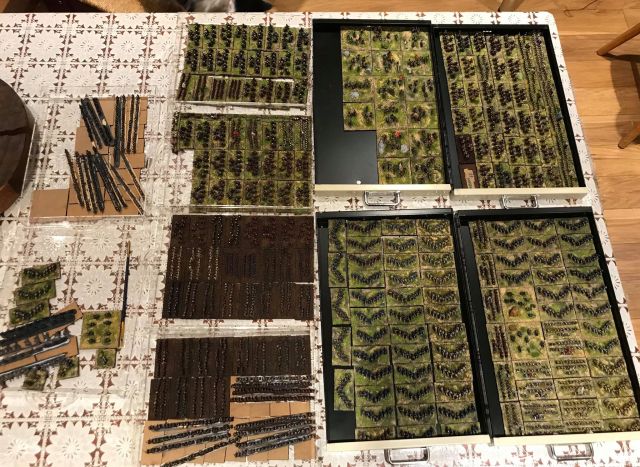
horka0.jpg
All required bases at various level of completion – 90% painted, 100% Baccus

I would like to do a shout out for Tiny Tin Troops that amongst many things do flags (web page here) – I found their Russian GNW flags especially useful for my project.  With so much infantry a lot of flags are required and although you could do them yourself it can be time consuming of to recolour images, etc.

logo2colour

They compliment the Baccus sheets I have used up nicely (link here) – order the 8mm version (this is not the scale but the height of the flag) – link here. Nice and pleasant to deal with.

Their range of flags covers Crusades, Flodden, ECW, Ireland 1690, GNW, WSS, 7YW, Napoleonic, Armada Naval and they also have some WW2 Posters (for 6-28mm figs).

There is a painting gallery there that you may find fascinating if you are into the period, especially these.  This is from the time TTT had a painting service – inspiration stuff!

  • 6mm GNW here
  • 6mm Camps and baggage here (my favourite!, and very inspirational)
  • 6mm WSS here
  • overview page here

As for the Terrain I will not start the terrain mat (5 by 12 feet) until the weather gets more stable as I ideally need a good few sunny days – lacking in space and inspiration to do it on a gloomy day.  This is normally the last thing I do anyway so I do not expect this to be done until end of May or June.

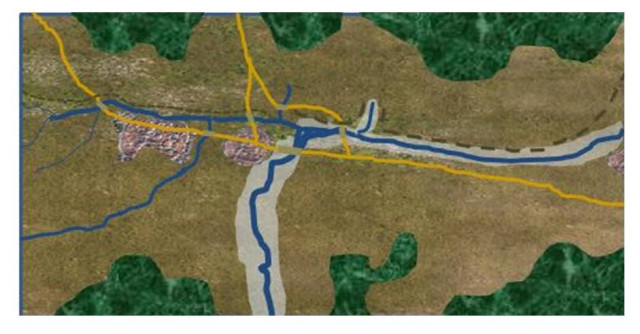
mapping out 3
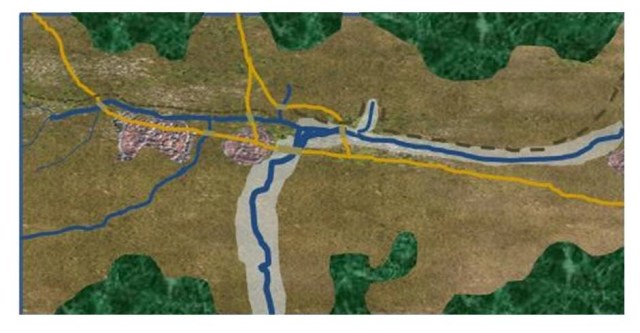
The rough sketch of the battle

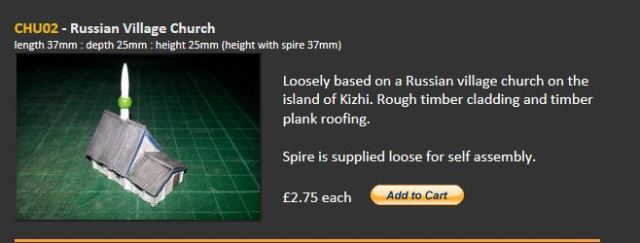
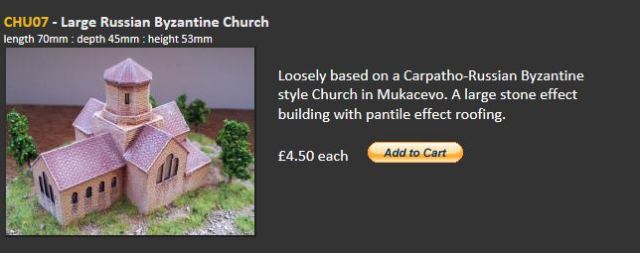
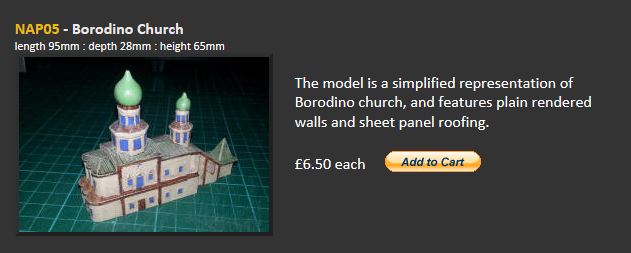
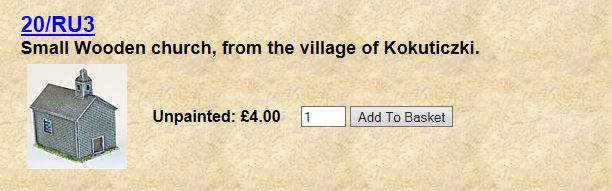
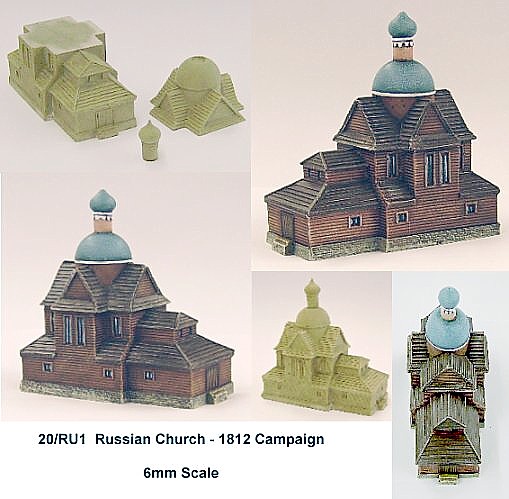
I will need to start worrying about the real estate that I will need for Horka itself and the Villages around it.  The Better one got me a nice bunch of Eastern European buildings (mostly churches) following my thoughts on the Monastery at Poltava (more here) that I need to paint up as well.  I have some buildings already so I do not see this as a major effort.

Overall it is all in hand.

I also got the latest Saga Rules and the Viking supplement and they are nice products indeed.  I am coming up towards the 100th blogpost (having done an average of 1 post a week since I started) and I would like that particular one to be about Saga v2 in 6mm as a homage to the very first blog post Saga in 6mm (link here).  Planning to run a few games with the models I already have (I made 12 starter factions so I do not think I need to paint any more at the moment).

Some of the changes I noted so  far are:

  • Warlords have changed significantly with regards to the special abilities.
  • Levy units generate Saga dice (if they are 6 or more models on the table).
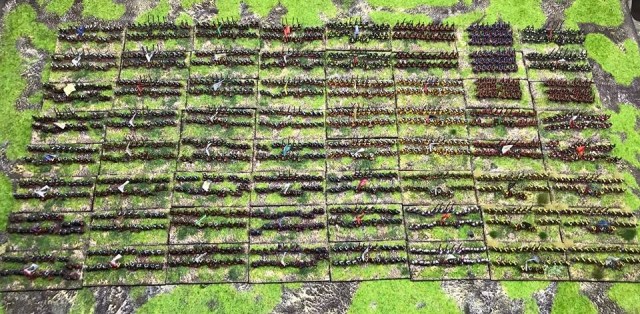
  • Warrior units reduced to less than 4 models do not give you Saga dice. This avoids the potential of a 1 man warrior unit being held back to spawn saga dice.
  • If you are far away from an enemy you can move a unit for free as a first activation.
  • Some simplification of fatigue, combat and movement rules

I got the basic rule book for £8.50 (this contains the basic rules) and the Viking supplement (this has the Viking factions and the battleboards) for £25.50, which I believe is very competitive, from Dark Sphere (link here) with free postage.

I have all the old Saga books and I am aware this version will probably not blow me away in the same way as the first set, but it is on the basis of that very first set I bought the second edition.  Saga is a fantastic game and I, and especially the Little One, want to be part of the ongoing process of making it even better.

So we are, for sure, dusting of the cobweb of the warbands (that was used for the Original Saga rules and have been stand in for some games of Too Fat Lardies Dux Britanniarum games).  The Little One is smiling – the Big One too.

Here are a few shots of the Saga stuff (all based on 25mm square bases) as we felt obliged to stare at it for a few minutes.

saga_1Saga_2Saga_3Saga_4Saga_5Saga_6Saga_7

/Take care


Pushing forward towards Moscow and Nekropolis

Some progress on the Towards Moscow Trilogy Project with some Swedish Horse done for Horka 1708 and some further progress on the Mutant 1984 project.

Swedish Horse for the Horka 1708 Battle

As I have promised myself I finally did another push on the Towards Moscow project and finalised another batch of Swedish cavalry (30 bases). More background on this project here.  Most facts from the book “The Great Northern War 1700-1721 – Colours and Uniforms”, by Lars-Eric Höglund and Åke Sallnäs.  That concludes the Swedish cavalry needed for the Project (a total of 66) – next I will “attack” the Swedish Infantry.

Dückers Dragonregemente

duckersdragoons.jpg
Dückers Dragonregemente, also known as the Preussiska (Prussian) dragonregemente. Colonel/Överste Karl Gustav Dücker. Raised in 1704, recruits from Bremen, Pomerania, Livland and Courland. 1000 men at the Battle of Horka. Captured at Poltava 1709  and not raised again. 

Gyllenstierna Dragonregemente

gyllenstiernadragoons.jpg
Gyllenstiernas Dragoonregemente formed of six companies (750 man) in 1707 when the Gortz regiment was divided into two smaller regiments. Captured at Poltava and never raised again.

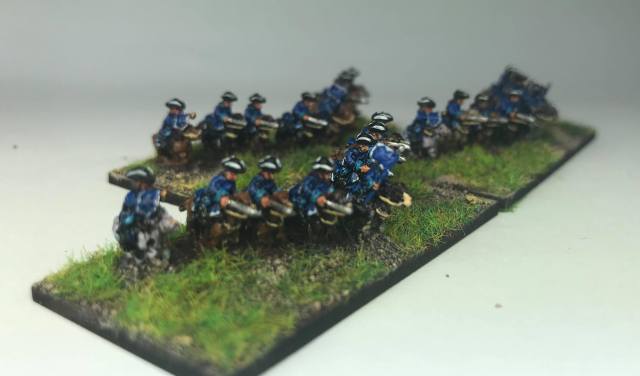
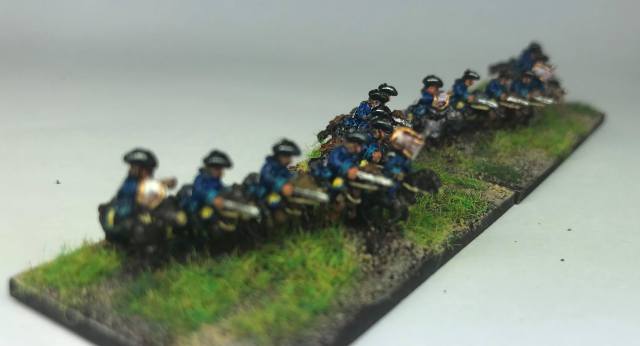
Stenbocks Dragonregemente

HielmStenbockDragoons.jpg
Stenbocks Dragonregemente, enlisted regiment formed by Magnus Stenbock in 1704 through enlistments.  Colonel for the Horka Battle is N. Hielm.  Captured at Poltava and never raised again. 1000 men (initially 600 but increased in size in 1707).

Meierfelts Dragonregemente

meierfeltdragoons.jpg
Meierfelts Dragonregemente, enlisted regiment since 1703. Colonel Meierfeldt, 1250 man since 1707, initially 600 men.  Captured at Poltava and never raised again.

Skånska Ståndsdragonregementet

skanskastandsdragoner.jpg
Skånska Ståndsdragonregementet was a temporary regiment that was raised from the households from the clergy, persons or rank and the well situated in Southern Sweden. The Colonel of the Regiment was the Prince of Würtemberg, and 1,250 man strong at the time of the Horka Battle. Captured after Poltava.  Raised again in 1712 and then broken up in 1721.

Taube Dragonregemente

taubedragoons
Taubes Dragonregemente (also known as the Schlesiska Dragonregementet). enlisted regiment with recruits from Bremen, Pomerania, Livland and Courland.  Established in 1704, captured at Poltava and was not raised again.  Originally 600 but 1000 man strong at the time of the Battle. Colonel G.A. Taube.


Upplands (Livregementet och Östgöta) Tremänningsregemente till Häst

upplandstremanningar.jpg
Temporary cavalry regiment raised in 1700 from regions in central Sweden. Colonel at the time C.G.Kruse and 834 man strong.  Captured at Poltava and reestablished in 1712.

Adelsfanan in Sweden and Finland

Adelsfanan.jpg
This was a very old unit at the time of the Great Northern War and had its origins from the feudal times when the nobility needed to provides Knights in service of the crown. Adelsfanan can be translated as the Cavalry Corps of the Nobility and all officers were of Noble birth. The regiment was 600 man strong at the time and the Colonel was A. Ramsvärd.


Nekropolis Bunker Guard Unit and Scientists

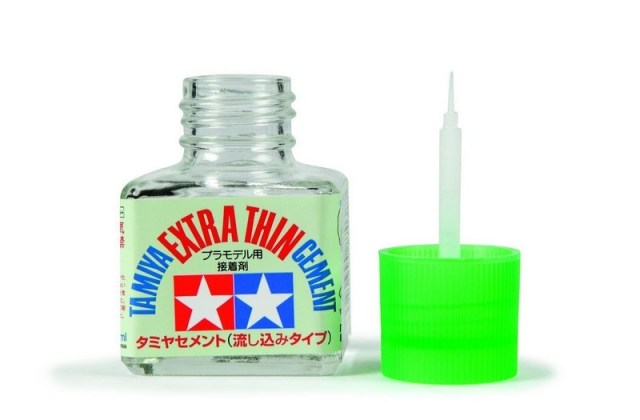
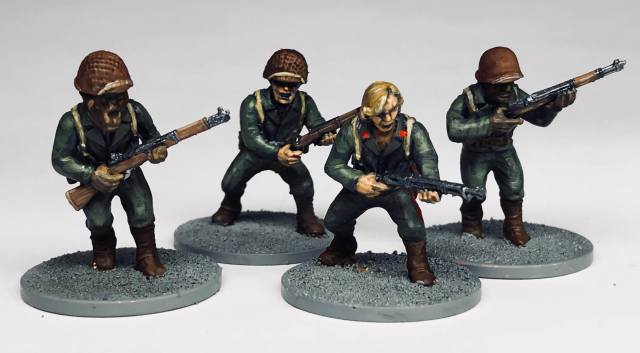
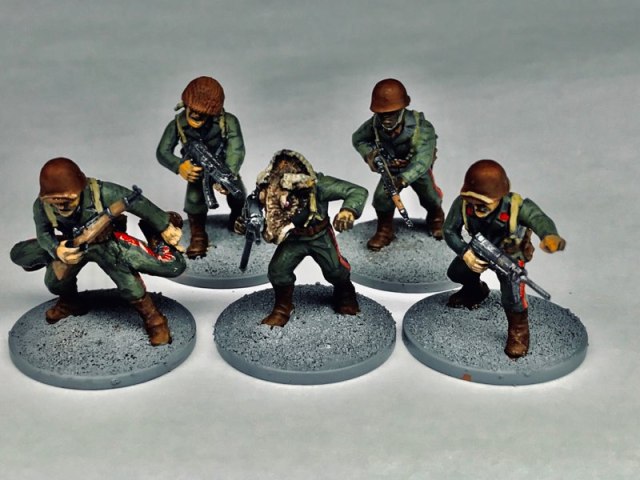
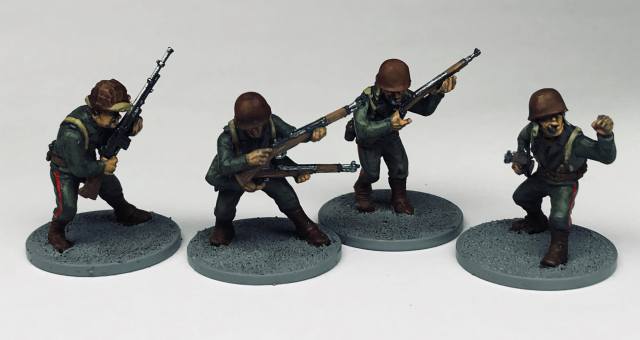
I also managed to get some time to do some of the miniatures I need for the Mutant 1984 project (see here).  This time some soldiers for the bunker.  Basic models are Warlord American Infantry Plastics (see here – although I got a very good deal from eBay).  These models require some assembly that is great for this project as I wanted to do some headswaps and specials – I used Tamya Extra thin cement for this (apart from the metal bits with a glued with gel superglue) and it works very well (here is a review about it).

17273-300087038.jpg
This product made me drop the hate in my previous love hate relationship to the hard plastic miniature stuff.


It also fills my bit box with some cool stuff that can be used for other things (bazookas, backpacks, smgs, pistols, rifles, etc).

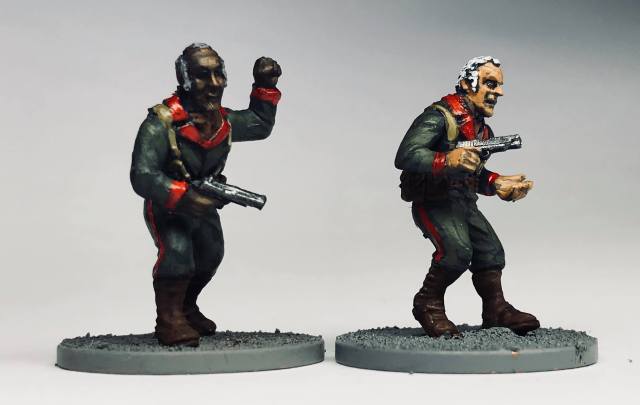
The only direct description we have from the original scenario book are that the uniforms were green and the trousers have red stripes.  Did these in a sitting – wargames standard I suppose and happy overall.  I think I will make the Bunker floor grey concrete but not sure yet – so maybe I will change the base colour later.  (Note to self: Uniform bronze green with german field grey).

soldiers4.jpg
Oberstløjtnant Hintz and  Major Rantzau (I used two of the Scientist heads from Crooked dice – see here).
 

soldiers2.jpg
Another Scientist head was used for Sekondløjtnant Tamyia Sand, and for the Baboon soldiers head I do not remember were I got it from.


soldiers1.jpg
I glued some extra legs on a guy and added a rams head to another (again some old miniature I had lying around got brutalised) – this is Chefsergent Niels Laudrups team.


soldiers3.jpg
Some more soldiers, I think my favourite is the guy with four arms and two rifles.

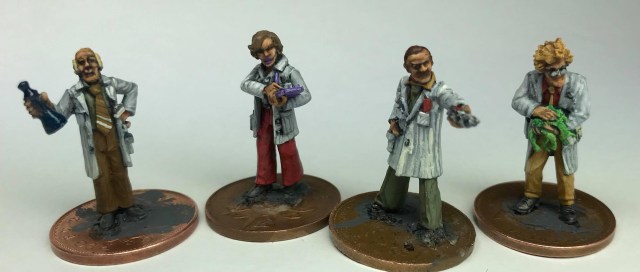
I also painted the 4 scientists, these are from Crooked dice and are fantastic models.

scientists.jpg
You can find the first 3 models here and the other one here.

I also update the write-up page (here) with this one as well for the soldiers in the border cabin (after snow basing them).
28458570_1928918987178174_1389830826_n

/ That was all, until next take care.


More Markers for Chain of Command and Command & Colors Romans

This is a follow-on from the post two weeks show some more Chain of Command markers I need to play the game.  These are the ones I have done (for other markers go here):

  • Patrol Markers – done, see below.
  • Suppression fire – done, see below.

Patrol Markers

John Bond has a good guide on doing patrol markers and I was going to do them in this fashion using poker chips and then put stickers on – elegant and what you need (link here).

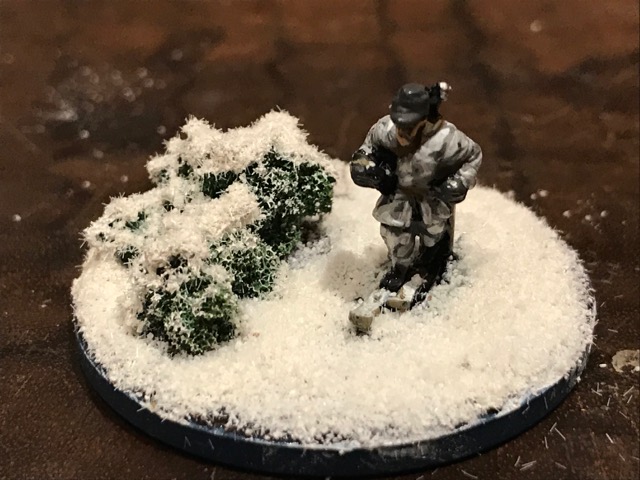
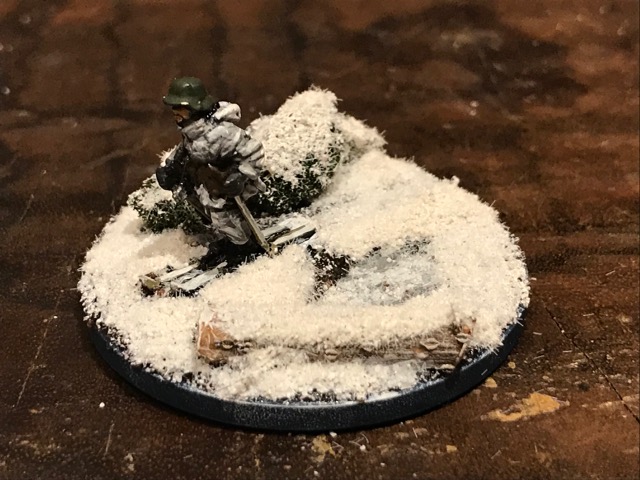
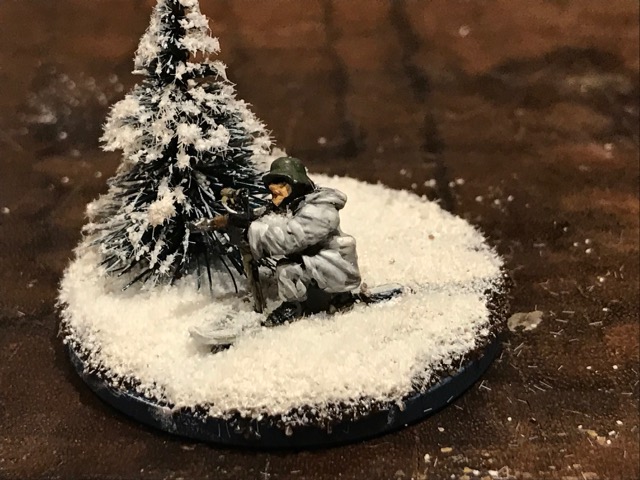
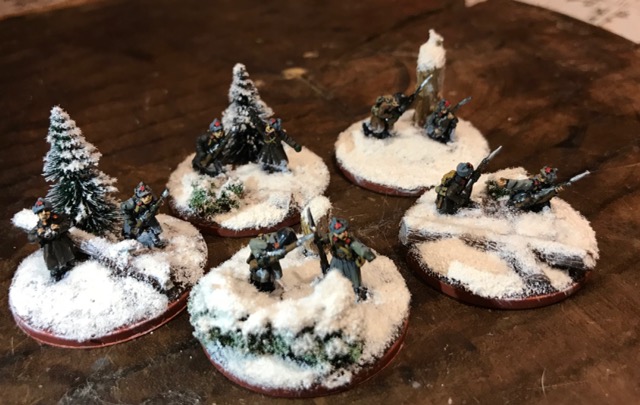
Having read the guide I got myself some Poker chips and found some Finnish and Sovietic symbols on the net to make the stickers from. I then thought that it would be cool to add some skiers on the finish ones and then it all went in another direction, adding stumps, trees and bushes.  Overkill – perhaps, but why not? Difficult to turn these around to indicate that they are locked down!  Had great fun doing them.

IMG_4023
The Finnish Patrol Markers on Blue Poker Chips


IMG_4019
“Should I take out the platoon now or tell the others?” (Battle Front Miniature with a twig and some trees)
IMG_4020
“Can’t wait for this patrol phase to be over so I can get into the Sauna again!” (Peter Pig German Ski Trooper with some trees)
IMG_4024
“I wished the Russians could have moved Leningrad instead of the border” (Peter Pig German Ski Trooper with a Piece of Clump Foliage pretending to be a bush)
IMG_4025
“Finally it is a little bit downhill!” (Peter Pig German Skitrooper with clump foliage and twig)
IMG_4029
“The Officer said that the wolves will eat well this winter – I get it now”, (You guessed it another Peter Pig German Ski trooper with a tree).
IMG_4022.JPG
The Sovietic Patrol Markers
IMG_4018
“Do not worry about the yellow snow, it was me. I see Finns over there” (Battlefront Miniatures with Peter Pig Russian Early Helmet head swap, a twig and some clump foliage).
IMG_4021
“Look they are cooking Sausages!” (Battlefront Miniatures , a twig and some clump foliage)
IMG_4026
“Forward comrade, for the Motherland” (Battlefront Miniatures , a tree and some clump foliage).
IMG_4027
“Aren’t we a little expose here Comrade?” (Battlefront Miniatures and a twig).
IMG_4028
“There is something moving over that field” (Battlefront Miniatures , a twig and a tree).

Suppression Fire

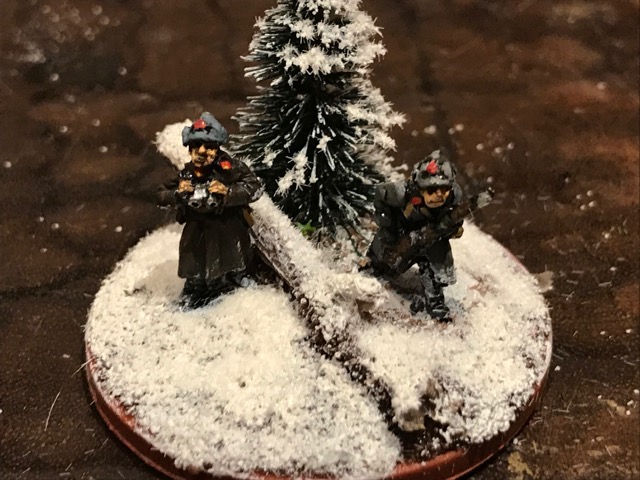
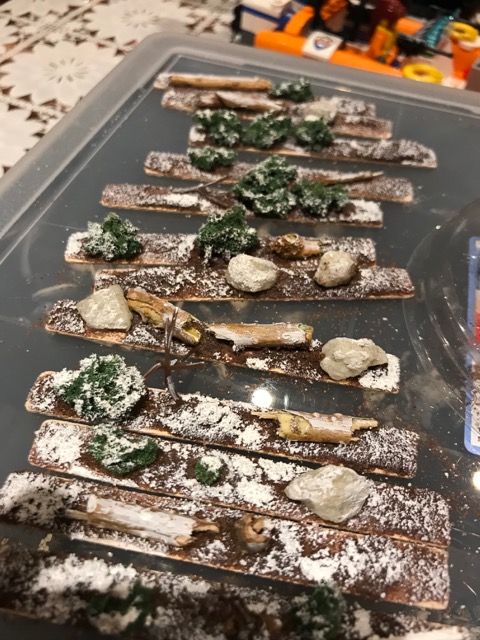
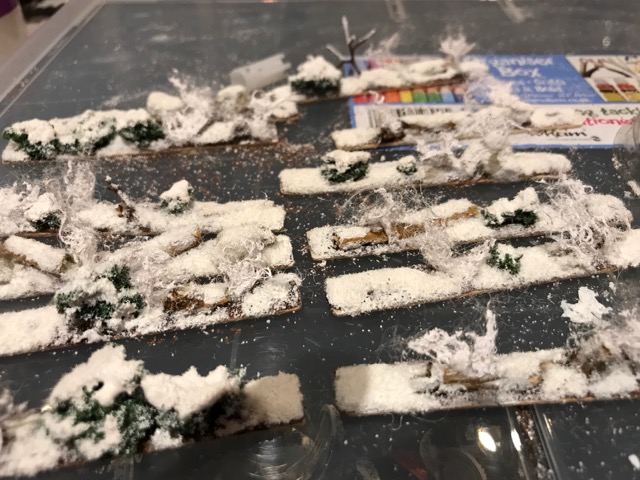
I made these from 10mm wide strips of some wood I had lying around – I suppose I could have used lollipop sticks as well. I added some twigs, green foam, stones and winterises and added some fluffy stuffing mixed with pva glue and some white paint. The last part to stimulate snow flying as shots are being fired.

IMG_4031
Bases before snow is added


IMG_4032.JPG
With snow and flying snow, to indicate areas that are being subject to firing.

I am going to make the suppression markers the same, but smaller.

Romans for Command & Colors

I also had my order in from Marching in Colours (link here) of some various miniatures – excellent as always.  I spent the weekend basing and a very limited amount of detailing a large lot of Roman (and allied) infantry that I will be using for my Command and Colors game (see more here although I have changed some of the proposed basing conventions).  I will do a write up of progress so far next week and also discuss the amount of bases and hexagons needed for this project. I am also working on the forces that will serve under the Barca family, but that will take some time to complete as I will need to focus on the Great Northern War stuff for the next few months.

Roman Front.jpg
The Republican War Machine. I am doing 2 bases per Command & Color unit. Loose one get a dead parrot marker, loose two give it back and loose a base. loose three get the dead parrot marker again, etc. 50 by 20mm bases!
HastatiPrinc.jpg
Hastati/Princeps/Triari
Velite.jpg
Velites
Samnites.jpg
Samnite Warriors
Allies5.jpg
Auxilia (Italian Allies)

/ Hope that was of some interest

Bonus Blog Post – Filler Cars for Gaslands in 6mm

1_200b

This is a bonus 2017 blog, my annual review/reflection can be found here if you are interested, that blog also contains some pictures of Gaslands movements templates I will be using for my games and where to get them.

I wanted to have some additional cars for my Gaslands project to use as cars for the game, but more importantly to have in the background and to make some terrain pieces with so I ordered some models for architectural and/or railway use.  As we noted in a previous post the 6mm scale (a link to that post here) is an artistic scale and varies between manufacturers and even between ranges from the same manufacturer.

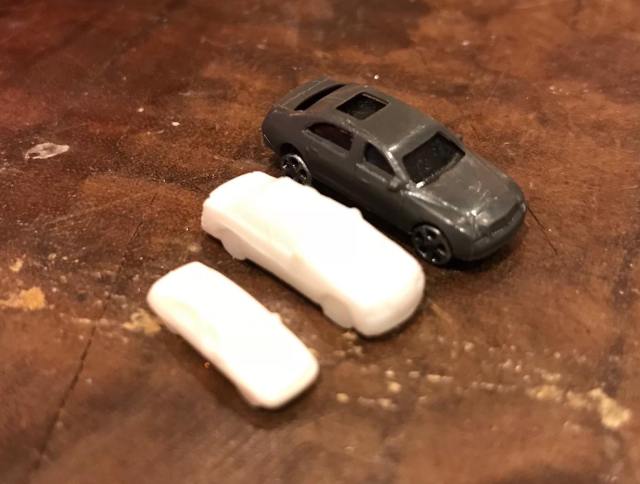
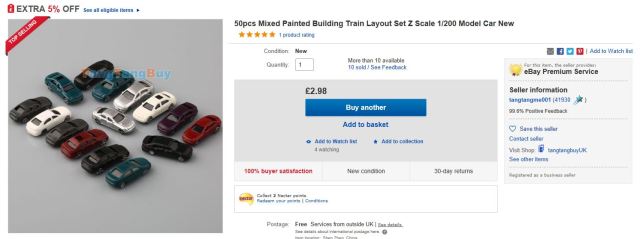
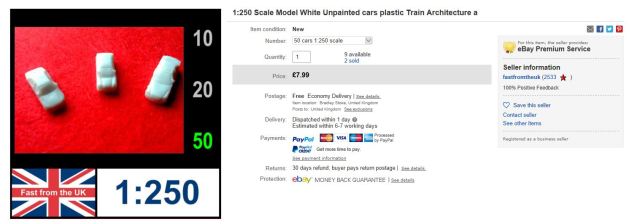
I ordered cars in the following scales on e-bay: 1/300, 1/250 and 1/200. Pictures below and valid as at 31-Dec-17.  These were from the actual sellers I used.

1_2001_2501_300

In summary (the 1/250 vehicles are from the UK, the others come from China).  It took between 1 and 3 weeks for them to arrive.


1_200b.jpg
From left to right, 1/300, 1/250 and 1/200.


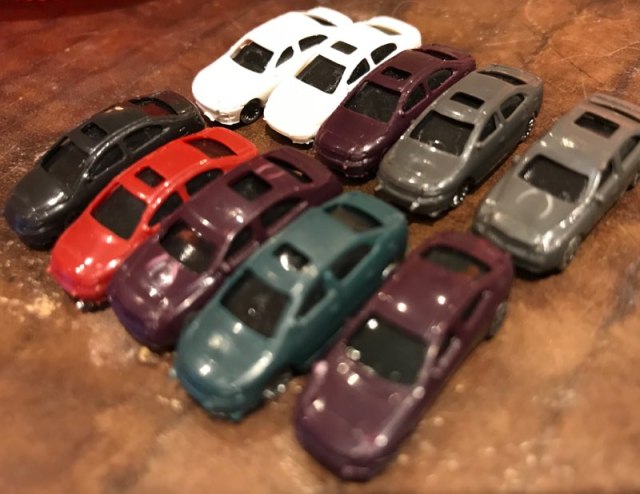
1/200 – 50 vehicles for £2.98 (in different coloured plastics) – length 25mm, width 10mm. 

1/250 – 50 vehicles for £8 (in white) – length 17-20mm, width 7mm.  But you can find cheaper from Chinese sellers.

1/300 – 100 vehicles for £2.54 (in white) – length 14-15mm, width 5mm.

So how do they compare to the stuff I am using for Gaslands?


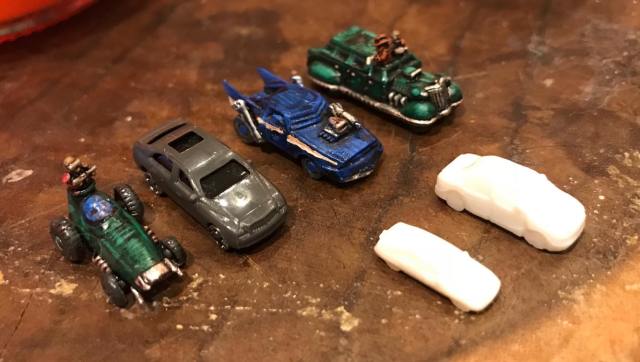
1_200c.jpg
The 1/200 model fits best to the vehicles I am using for Gaslands (please see the previous blog for reference to these vehicles, link here again)


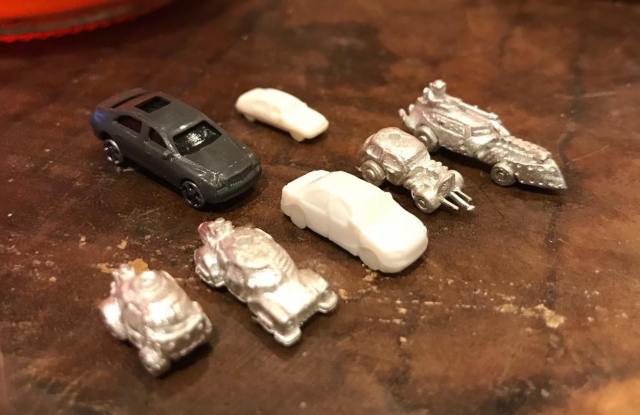
1_200d.jpg
The 1/250 model fits best with the earlier Microworld range (again see the link to the previous blog for further information here)


So the 1/200 model is a pretty good match for me and the 1/250 stuff reasonable for the first set of cars Microworld did.  They also come in a lot of different colours and variants, I think they will just need some clean up of the plastic, some highlights and perhaps some matt varnish to tone down the shine and we are good to go.  I may even stick some weapons on some of them and use them for regular races not just as fillers.


park.jpg
A few of the cars, three types and 6 different colours.


I have ordered some more 1/200 models as I would like to create some nice obstacles, it would be cool to have racing track through an old car dump, a car graveyard track – that would be classy indeed!

/But that is for another time, hope this was of some help.


2017 ending 2018 coming!


IMG_4011
Swedish attack on Saxon defensive position (Baccus Miniatures) with seasonal flair. The Swedish tactics of just marching on with resolve and in silence and then throw their snowballs, or perhaps fire their muskets, at short distance followed by a full on charge is just about to be implemented.  The most important factor to the outcome is the morale and resolve of the Saxons who are desperately firing away at the Swedes – will they stand to the Swedish onslaught or shit themselves and run away?

A long one again, sorry…but a lot of pictures…

 I have been away on holiday in Sweden over Christmas with the family and the only miniatures related stuff I have been physically close to have been my copy of the Gaslands Rules. I have read them and they seem to be a lot of fun, but more about that later.

This is the second year end for the blog and I have yet again had a joyful hobby year.  My original idea was to do a blog about my preparations for my Saga Game(s) at Joy of Six in 2016, but then I never stopped.  I found that it gave me some kind of efficiency in a strange way and I seem to have been more productive and organised than I used to be as a direct consequence.  That original post on Saga in 6mm (link here) still gets some hits, but the most popular one from 2016 is the first blog on Sharp Practice in 6mm.

With the Saga game in 6mm I wanted to show that it is possible to take a “28mm game” and change the individual 28mm miniature on a 25mm circular base and replace this with a 25mm square base with 4 to 10 No. 6mm miniatures, keeping all measurement as they were and still have a good time.  The game was still played on a 3 by 4 table, just as recommended by the rules.

img_2099
Saga at Joy of Six 2016

Saga, as a game, worked anyway and playing it with 6mm miniatures gives a different feeling using individually based miniatures – I have tried both and I prefer the multiple based version.

The other approach I have taken with regards to 6mm is that you can take a game where 28mm miniatures (to take an example scale) are normally being used and half the measurement or use centimeters instead of inches.  In this case each 28mm miniature is replaced with an individually based 6mm miniature. I have done this and played Sharp Practice, Pikeman’s Lament, the Men Who Would be Kings and Dragons Rampant.  It works but it is more fiddly than 28mm, but this aspect can be mitigated somewhat if you use the (1-2-3) basing as suggested in the Pikeman’s Lament rules, if your game is about figure removal from units with non-individual figures – like the games mentioned above.  This method is best described by Michael Leck who came up with the idea on his blog page (see here).  A blog entry shows how I based my Colonial 6mm British (see here) using this approach (kind of!), pictures below.

col1
Each line a unit of 12 men. You loose one man you take away a single base, you loose one more (2 in total) you take away another single base, you loose another man (3 in total) you put the single base back and take away a base with two, and so on. Simple and I promise less fiddly and complicated than you are currently thinking.
col5
I only did 1 and 2 miniature bases for the Lancers (8 in each units) but it still works with the same principles as above.

Here is an example of a game we played this year on a 2 by 2 board (Pictures below, link to the write up and lots of pictures here) – you could carry the board under your arm and the terrain and the miniatures in a small little box. We had a jolly good time playing it.   Did I mention that it took me two short evenings to paint up each force used in the game!

battle-1
2 by 2 feet table
img_2768
Ottoman Cavalry charging the Russian Dragoons who were supposed to protect the wagons.  1-2-3 basing system in use (Baccus and Perfect Six)

Here is another one (with the write-up here), this time Ottomans vs Swedes.

batt-29swed-shot-start-2table

As for the most popular post in 2017 it is more difficult to say and perhaps unfair to compare as some of the posts, by the nature of weekly postings, have been on longer than others. However, the first blog on Colonial 6mm using The Men Who Would be Kings rules (link above) seem to have got some wider interest and so have the other postings covering Dan Mersey’s rules (Dragon’s Rampant and the Pikeman’s Lament rules he did with my friend Michael Leck) – they are all very similar with some notable variations in the Colonial set where there are commanders for each section as opposed to the overall force for the others and the damage is based on actual figure count – not a fixed full damage until half units are left going then down to half until wiped off the table, to mention a few of the more notable differences.  I refer to these as the “Mersey Skirmish Engine” (MSE).

On the whole we have really enjoyed these games and they fit us really well as the rules are simple but not simplistic – i.e. there is sufficient depth to make the decision making challenging and there is a high level of friction built-in the activation system.  I mainly game with the Little One who is celebrating his first double digit birthday next year so this simple but not simplistic factor is important to us.  The best children movies are the ones that contain some sneaky adult jokes – watch any Shreck movie and you get what I mean.  I find that the more complicated games looses the little ones interest quicker and in some cases never really captures him to start with.

The best games was when we were using my 6mm French Indian war models with the Pikeman’s Lament set, on that horrible “wargames mat” I bought in Rhodes on the family holiday. We played a fully functioning skirmish wargaming on what in fact was a doormat (some pictures here) and had some great fun in the sun.

img_3623img_3625

img_3629
Gaming on the Doormat!


We also played some other games including the Terminator Game, Sharp Practice, Dreadball (a great late start!), X-wing, The Twilight of the Sun King, Road Wolf,  Maurice, to mention a few.  I also read and tested the new Basic Impetus rules and Sword and Spear and would like to try these a little bit more.  I also did two forces for 6mm sci-fi but I am yet to find a ruleset that inspires me.


I wanted to play Chain of Command with my Finns and Russian, but I failed miserably.

Anyway here are my key painting, modelling and gaming ambitions for this coming year.

Great Northern War – Twilight of the Sun King Rules (6mm)

Painting/Modelling 90%, Gaming 10%.

The 18th century in general and the Great Northern war in particular is one of my favourite historical settings and I am currently working on the Horka 1708 battle for Joy of Six in July 2018 (here is a link to some background to this).  This will be the biggest battle I have done to date and I am very excited about it and this is the kind of battle and set-up that really works with the 6mm scale and gives the look and the feeling of a real battle.

I would also like to do a smaller table to give the Düna crossing in 1701 a fair go with the Twilight of the Sun king Rules (see some discussion on the rules here).  I think the “did I hit?, did I damage?, did you have armour protection?, did you manage to save? – rolling sequence” is funny and engaging for a skirmish level rule-set but I am warming to the abstraction of the Twilight rules for BIG battles more and more for every time I play them (here is a note about the rules and where to find them). I have plenty of nice modelling and painting ahead of me for these projects.

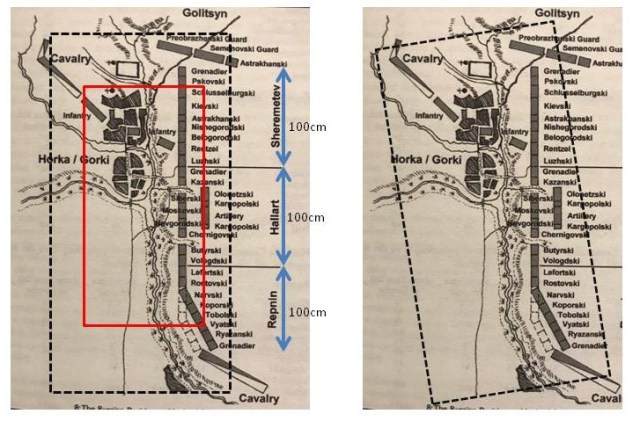
mapping-out-3
The field of Battle for Horka (link to it in the text above)
Mapping out 1

Figuring out the battlefield for Horka

Winter War and Continuation War – Chain of Command Rules (15mm)

Painting/Modelling 50%, Gaming 50%.

I re-read Hjalmar Siilasvuo’s account of the battle of Soumussalmi  (Wikipedia link here) over the Christmas break.  It is an inspirational account of how, in essence, three Finnish regiments defeated two Russian divisions and one tank brigade. Siilasvuo was one of the most successful Finnish Commanders during the war years.

The Battle at Raate had ended with a total defeat of the enemies 44th Divison, The objective given to my soldiers were completed. My men had, with commendable resilience fought for over a month in the harsh winter conditions at Soumussalmi.  In defiance of death they had attacked the superior enemy.  Their only guiding star was the precious, common fatherland, that fought for its existence.  The cost of the great victories was paid with the heroic deaths of many brave  warriors.  With sincerity they had given their life for the fatherland, their homes and their faith.  The white crosses on the graveyards where the signs of their sacrifice.  They showed the people the path to honour, a hard path, but the only path. 

Translated, hastily, from H.J. Siilasvous book “Striderna I Suomussalmi”

I also went to the Cinema in my Hometown in Sweden and watched the new film based on Väinö Linna’s book the Unknown Soldier about a Machine Gun Company during the Continuation war from the mobilisation in 1941 and the early successes to withdrawal and retreat leading up to the armistice in 1944 , I have read the book and seen previous iterations of the movie and thoroughly enjoyed it.  The story is fictional but based on Linna’s experiences serving in the Infantry Regiment 8 during the war – it would make an interesting wargames campaign.

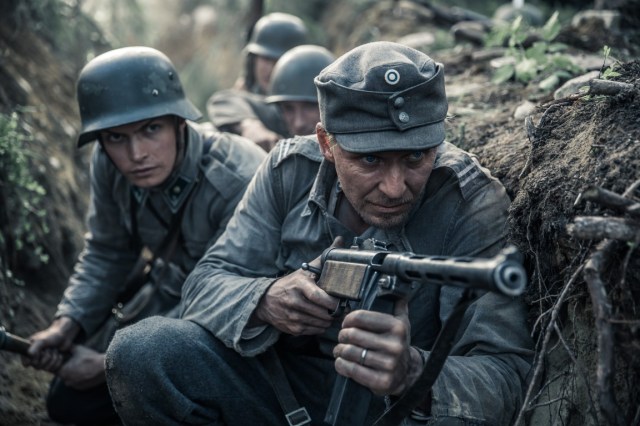
ft-tuntematon-sotilas-rokka-Medium
Still from the Movie Tuntematon sotilas [Unknown Soldier] (2017). Vänrikki Kariluoto readying a grenade during some trench fighting and Corporal Rokka getting ready to charge in and clean the next stretch of trench with his Suomi KP/-31 Submachine Gun.  Corporal Rokka is a typical example of a Big Man and a Veteran of the Winter War.

 I have all I need for some Winter war action as I did a platoon of Finns and Russians last year.  Here are some links to those Platoons (see here and here) as well as some background you may find interesting.  I will not fail these platoons this year.  I hope the Little One is up for it too! Link to the eminent Chain of Command rules here.  I would also like to have a go at doing a winter wargames mat, as I have not yet found anything on offer that I especially like (I have an old mat but it could be better).  I also have some Russian Scouts and more than enough Finns in Summer Uniforms to do some continuation war stuff.

fengineers.jpg
Some of the Finns I prepared – an Engineering Section. The NCO is screaming – “Why the hell did you paint us and left us spend the whole year fully winter dressed in a box! Get your bloody act together!, or perhaps he is screaming Mitä helvettiä?, Levitä laardi! (What the hell?, spread the Lard!)

Punic Wars – Command and Colours Boardgame (6mm)

Painting/Modelling 70%, Gaming 30%.

I am going to do a modular board and the necessary miniatures using mdf hexagons and 6mm units based on 50 by 20mm bases.  I laid out the plans in a blog entry earlier in the year – here.  I am looking forward to doing this as I am a fan of the game and  I have wanted to do this since I read about Dan Becker’s project many years ago (see here) and got inspired from the game presented at Joy of Six this year.

Mutant 1984 – Mutants and Deathray Guns (28mm)

Painting/Modelling 50%, Gaming 50%.

I was going to do this project using (see more here) using the Scrappers rules but I have recently decided to try out the Ganesha games set called Mutants and Deathray Guns (link here).  I am keen that Rifleman Croc Lacoste gets some battle-hardening sooner rather than later, he has been waiting more than a while.

pyri3
Perry’s 95th Riflemen but not like you are used seeing them. Proud soldiers of the Pyri Commonwealth army, a mix of pure humans, mutants and mutated animals, on a rescue mission to a forbidden zone.  Crocodile head from the Crooked dice and high tech rifle from my old bit box (?).


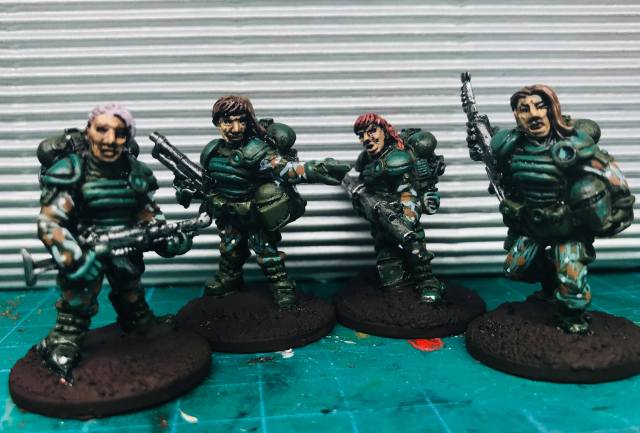
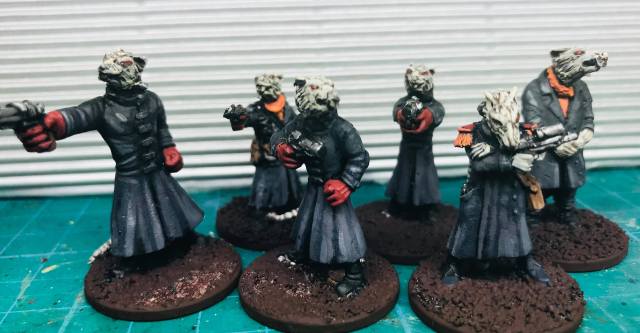
I actually did some mean looking power armoured warriors (from Ion Age, IB52 Muster Female Squad, link here) when I got home yesterday evening as well as a gang of rats (conversions from the following miniatures – 3 of the bodies from Crooked dice here, 2 of the bodies from Moonraker miniatures – 0046 Scavenger. Handgun. Shotgun here, and 0074 SMG. Rasta here, the last body on the far left I do not remember, the heads and tails are from Giants rats, also from Moonraker, here).

4 green
These Ladies would be part of a small security unit frozen in Cryonics freezers and woken up when the level of radiation had reached a survivable level. Now they have found a harsh and wild world, but they still have some powerful weapons, plenty of ammunition and their power packs are fully charged.
rats
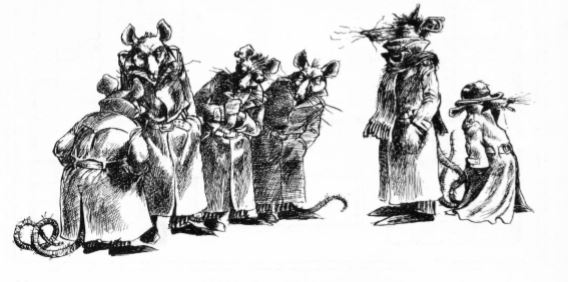
In one of the classical adventures for the Swedish Roleplaying game Mutant that is the inspiration to this project, called Nekropolis, the PCs have an encounter with a group of rats.  This gang is my homage to those guys.


rat2.JPG

The Original Picture from the scenario – Nekropolis, den Grå Döden Del 1, 1985, TAMB Äventyrspel AB

Gaslands (6mm) 

Painting/Modelling 30%, Gaming 70%.

This is the best thing that I have come across in 2017 and I read the rules over Christmas (link to the Gaslands page, here. Where you can get the rules and accessories).  This will be fun and I have more or less everything I need to get on with it (some notes here, here and here).  Being true to form I decided to do this in 6mm as I was aware of some nice looking models out there. However there are some considerations to make and I advice that you read my blog entries above, if you are considering doing this.

IMG_3928Irregular1gastrack7gastrack6gastrack5

DRl_fDmXUAAVjWn.jpg
50% movement templates with the 6mm cars.

In addition I may do the occasional game of Colonial skirmish, Dreadball, some Saga battles with the dark age stuff, French Indian war with SP2 or T&M, Maurice or Pikeman’s Lament with Swedes and Saxons, and I may even progress the Rommel stuff I started, but we will see. I am pretty sure it will be totally different at the end of the day/year but as long as I have fun it does not really matter.

I would also like to do some WW2 units to use for a Norwegian Campaign. I did a fair few a few years back but in a moment of stupidity let them go.

Some thanks and then I will let you go

I have done a fair number of hours at my painting and modelling desk this year, when I do this I tend to listen to podcasts and audiobooks – the following are the hobby related ones I have found especially inspirational this year and I am grateful they are doing what they do. Get some paint and click on the titles and go and listen, you may have a painted army standing before you after you finish! Thank you to all involved in the production of these.

Meeples and Miniatures – solid show, like a Volvo of the 240 series. Solid running top notch quality!

The Too Fat Lardies Oddcasts – effortless delivery of wargaming wisdom! Only 4 episodes so far but it feels like it has been around for ages.

Veteran Wargamer – excellent! Jay has definitely helped me make my gaming more fun!

WSS Podcast – at times feels like listening to one of those annuals I got as a kid, great stuff!

Wargames Recon – enthusiasm can go a long way, this one goes miles!

If I had one wish it would be that the Historical Wargames Podcast got on air again – I really enjoyed that show.  If I had another wish it would be great if there was a wargames podcast similar to the Grognard Files (a nostalgic throwback show to the RPGs of yesterdays) that reflected on some of the “dead” games out there.  The Veteran Wargamer, for example, had a show about games from beyond the grave (link here) and I think that one was a good start – look out for Jay’s comment on the game Chess.

Special thanks this year to the Little One who possibly prefers solo computerised quests as opposed to games with Dad using painted miniatures, but never fails to get stuck in and getting on with it.  At Joy of Six he ably, more or less on his own, ran the Dragon Rampant table we put up.  Also a big thank you to the Other Ones who may not be interested at all in this hobby of mine but who lets me get away with spending far too much time on it.

I would also say thank you to Chris of Marching in Colour (here is a link to his excellent painting service) who has been painting a fair few of my GNW units for this and next year’s TMT project – giving me more time to do some fantastic diversions and maximising the fun in the limited hobby time I have available.

Nick Dorrell, and his chums from the Wyre Forester Wargames club (link here), we ran Kalisz 1706 at Salute this year (see here) and Lesnaya 1708 at Joy of Six (see here). Nick and I have been doing 6mm Great Northern War Battles for the last six years as mentioned above we are doing Horka 1708 this year – if I get all of it done!   Also to Rob and Laurent that helped us at Salute and Peter and Igor of Baccus who always makes Joy of Six an easy gig!

Finally (almost), a big thank you for all you people out there who likes the blog on Facebook, follows it on Twitter (yes I have recently got myself wired up on this too), directly here on WordPress, or just comes by occasionally or even incidentally.  I really like the messages that comes through the blog and discussions I have had face-to-face with readers of the blog at the Joy of Six and Salute this year.

Now go and enjoy the end of this year. Hope you have a great 2108 and hey! – why not give something back to the hobby!  Having just eaten half of the world and drunk the other part over Christmas it tends to be at these times when we reflect on our health and promise to deal with it next year.  Henry Hyde, of Wargames compendium and Battlegames fame, just released a video that may not result in your lead mountain being painted any quicker but may help you being around long enough to have time to deal with it.  The video is called “Exercise Ideas For Writers and Gamers” – that is giving back big time so a my final thanks goes to you Henry!  Here is a link to the video on YouTube.

/ All the best and see you in 2018

Swedish Cavalry, Gaslands and Seasonal Greetings from him

I have to admit to being less than productive recently due to work and other real stuff, but hey ho (ho ho ho.. it is soon Christmas!).  A short blog entry this time.

Stuff for Horka 1708

I did do a few bases for the next TMT installment the Battle of Horka 1708 (more here), here is some Swedish Cavalry:

Kunglig Majestäts Livdragonregementet (His Royal Highness Lifedragoon regiment) – this enlisted regiment was set up by General Carl Gustaf Rehnskiöld in 1700.  It was a prestigous regiment and it had fought at many of the big battles of the Great Northern War.

pic5.jpg

pic6.jpg

Södra Skånska Kavalleriregementet (South Scanian Cavalry regiment) – this provincial regiment fought during the Scanian War at the Battle of Lund 1676 and Landskrona 1677 (it was then called the Blekinge regiment at Horse).  After the Scanian War it was stationed as one of the provincial cavalry regiment of Scania (Skåne, this is the most southern Swedish Province that has been fought over  by  Swedes and Danes for eternity!) and got the name it was known for during the Great Northern War.

 pic1.jpg

pic2.jpg

Nylands- och Tavastehus läns kavalleriregemente (Nylands and Tavastehus County Cavalry Regiment) – this Finnish Provincial regiment had origins from the early  17th century.  I already had some but then realised they were on wintery bases, for Fraustadt, so I had to make a few more.

pic3.jpg

pic4.jpg

Gaslands Death race Track

I also finished my Gaslands Board and if failure is the best teacher I now know a few more things about resin – But it is all hard now!  I wanted to create an effect of toxic and radioactively radiant water and I think it looks pretty decent with some after pouring messing with paints etc – I also put a few vehicles into the resin giving the overall feel that if you end up in the toxic/radioactive it does not end well.

gastrack7

gastrack1gastrack2gastrack3gastrack4gastrack5gastrack6

I have also ordered some smaller sized movement templates for Gaslands – but they are yet to arrive. It will probably be on the other side of Christmas before I have a go at racing the track, but I will let you know how it goes.  More about this here.

I will do a little end of year review next week after I have met family and friends for some fun over the festive seasons.  This will be a summary of the last fifty or so blog entries and my reflections on my plans and what I actually ended up doing and perhaps a reflection or two.

/Until then Seasonal Rolls of Ones from him!


100 years of Finnish Independence, Chain of Command Glory, Gaslands and Stressing about Poltava 1709

Today marks the 100th anniversary of the Finnish Declaration of Independence from the Russian republic.  Incidentally it is also my Sisters birthday, but she is no 100 yet! So double joy.  Finland had (since 1809) been part of the Russian Empire and ruled by the Russian Emperor as Grand Duke.  Before this Finland had in essence been part of the Swedish Kingdom since the 13th century.  The independence and resolve of the Finns have been tested on many occasions, most significantly during the civil war in 1918, Finnish Winter war in 1939-40 and during the Sovietic offensive in 1944.  In addition the cold war era was also to become a balancing act in trying to move forward next to the Soviet State. On the whole, this young nation has done an amazing journey as a nation from a very unstable start in 1917, when the deck of random event cards was firmly shuffled, to the current position of strength and stability.

Finland_flag-3

We have put two candles in our window this morning.  This was traditionally done to show support to the young Finnish nationalists who travelled through the countryside on their way to Germany (during the Great War) to get military training to aid their fight for Finnish independence.  The candles also meant that the house was ready to offer shelter and keep them hidden from the Russian Authorities.

Germany, who was at war with Russia, supported the Finnish independence movement as this would weaken Tsarist Russia.  The support was in the establishment of the Royal Prussian 27th Jäger Battalion that consisted of Finnish volunteers.  The Anti-Russian sentiment had grown strong following repressive Russification of Finland that up to this date had a certain level of autonomous rule.  This had escalated since 1899 and as a consequence many Finns hoped the Russians would loose the war against the Germans.

There is a very interesting article here about the Jägers; covering (i) the time leading up to independence and the actions during World War 1, (ii) their role during the Finnish Civil war that broke out in 1918, and (iii) their influence on the build up of the Finnish army that fought so bravely during the Finnish Winter War in 1939-40 (more here and a further related article here  and here).  There is a lot of wargaming potential here – but then I have not yet done much with the Winter war Finns and Russians for Chain of Command I completed last year (see more here and here).

However, when Tsarist Russia fell to the Bolsheviks in 1917 the Finns seized the moment – more or less (read all about it here).  The rest is history – 100 years ago today! Being one part Swedish and the other Finnish, this is an important day for the family.  We will be eating some Karelian Pasty and some Stew and perhaps a shot of Vodka or two (but maybe not the Mango version!).


Also, but a day late, but with reference to the Chain of Command mentioned above, an official “well done” to the Too Fat Lardies on winning the best game category as voted by the readers of Wargames Illustrated.  You can find out more about Too Fat Lardies and the Chain of Command rules here.  Whilst you are there check out their Podcasts, oddly called, Oddcasts! – enjoy the lard!

DQQ6R7CX0AAevVZ.jpg

Gaslands moving forward

I have been working on my Gaslands Track I showed last week but did not like it and decided to do a new one – I will pour Resin this weekend. This is how things look so far. We have had the Gaslands Track inspector over and he has given us the Green Glow on the progress so far.

24550158_1814394785297262_1286009149_n.jpg

24231722_384309288648563_4360549493770641653_n24294338_384309291981896_2531703557293485997_n24774720_384309295315229_4562780498811737517_n


Poltava Anxiety

As you may be aware, I am going to do Poltava at Joy of Six in 2019 as part of the Towards Moscow Project.  This is the long term project I am doing with Nick Dorrell and the Wyre Forresters (we did Lesnaya 1708 this year, see here, and are currently working away on the what-if Horka 1708 battle for 2018, link here and here) and I occasionally reflect (or perhaps Stress) on how I want to present it. The Poltava Battle is after all one of the most decisive battles of Swedish history and, I am sorry to say, without doubt a total disaster from a Swedish perspective.  I have to admit that I found some of the past Battles that resulted in glorious Swedish victories like Fraustadt, Klissow and Gadebusch easier to present and prepare for than the battles at Kalisz or Lesnaya where the Swedes were defeated. The disaster at Poltava is in a separate league of its own.

One way of doing it is to show the full story including some additional elements on the table than normally are presented.  The tables I have seen to date are showing the main action outside the Russian Camp; sometimes the redoubts are included and this is frankly all you need for the Battle.  One example of this is the recent Poltava Battle, laid out by Jon and Diane Sutherland, at Crisis (in 28mm). This battle looked absolutely fantastic and as far as I could tell covered the main action and the redoubts.  To me it looked as grand as one of Simon Miller’s To the Strongest Offerings (see link here if you do not know what I mean) – a real battle of the era and I wish I had seen it on the day.

However when we do it, and because we are doing it in 6mm,  I will not let practicalities be in the way of creating a different kind of spectacle and will extend the narrative to include further elements that are important to the background of the Battle.  So, in short I found myself compulsed to do a little plan/sketch over the battlefield and the various elements I wanted to include in addition to the mandatory Russian camp and redoubts.

Presentation2.jpg
Poltava Battlefield Highlights


Marten's_Poltava
Battle of Poltava by Denis Martens (1726) . The Russian Camp is on the left.
redut1
Drawing of the Redoubts (more information and pictures here)

Here we go.

1. The Swedish Camp – I want to take all the Wagons that I did for Lesnaya (link here and here) for a spin.  The camp will be made from things from the Baccus Equipment Range (link here, EQU04 – Tents and EQU05 – Camp Site).  Here is a link to Tiny Troop’s gallery showing some great and very inspirational GNW stuff and what can be achieved with these models as a base.

2. The Fortified Town of Poltava – at the time of the Poltava Battle the fortress was surrounded by ravines, had wooden palisades and a number of bastions. It had five gates and each of these was protected by a special tower.  I found mainly stock photos, but if you google Cossack Forts you will get the picture – I will do this using very thin spaghetti (see here for how I have used this excellent material in the past).  As for some buildings I really like the Total Battle Miniatures range that contains a large number of town type buildings that will work well (link to the range here). Most other ranges contain farm/village type of eastern houses – but for the Poltava battle I want to have the rural look outside the walls and some more “town” character within the walls.

Engraving
Siege of Poltava – not sure the colourist had been in the region? Actually not sure how accurate anything is in this picture – to be honest.
poltava1
Wooden Tower
fortress1.jpg
Map of the Poltava Fortress

3. The Swedish siege lines, with trenches, engineers and artillerists, gabions, siege guns, etc.  The Swedish King (Charles XII) had laid Siege to the fortress in an attempt to provoke the Russians to a battle.  Again, I will be using stuff from the Baccus Equipment ranges (see link above, EQU13 – Sappers/Pioneers, EQU06 – Military Site) and some Siege Guns and mortars (link here, WSS16 – WSS Siege Guns and WSS17 – WSS Mortars).

4. The Cossacks – the surrounding area is full of Cossacks and Kalmuks and I have a 2 meter frontage worth of these to put up in various places of the Battle (I used these in a similar role for the Kalisz Battle, we last tabled at Salute in 2016, see more here and here).

And finally

5. The Holy Cross Exaltation Monastery that still exists and have been there since 1650.  It sits on top of a wooden hill and it would be shame if this was not part of the table. On the eve of battle it was used as headquarter by the Swedes and the infantry was deployed around it.

I have seen pictures of the Monastery on the net and it typically looks like this.

Poltava-Monastery.jpg

So in doing this in 6mm with a ground scale with a battalion frontage of about 60mm, some simplification is required, my first thought was to do the centre church and the taller clock tower closer to each other, and that would be it.

I even found two good contenders for the role of the centre church, both beautiful models.

mAGISTER MILITIUM.JPG
Magister Militium – link here and a very nice model.
church.JPG
Total Battle Miniatures – link below.


However doing some further research I learned that the Monastery had been burnt down in 1695 (having been a classical wooden construction) and was being re-built in stone and a the two buildings we can see on this classic picture did actually not exist at the time of the battle.

  • The left hand clock tower was completed in 1776.
  • The Cathedral in the middle was completed in 1756.

Leaving us with the following skyline.

Poltava-Monastery2

So there goes the main features I have had in my mind all these years. As to how it may have looked I have no clue.  You can read more about the Monastery (and a lot more on the battle) on this webpage dedicated to the Poltava battle.

So, instead I thought I will represent the monastery with a Eastern type of Church of some kind. There are a number of options in doing this, so what follows is a little bit of a showcase of some of the ones to consider (this is based on browsing pages in the beginning of December 2017).

Total Battle Miniatures

I have a few Total Battle miniatures from their Pike & Shotte and Black Powder Europe  ranges and they have been used to represent Klissow, Kalisz and some other places in the past.  With regards to Eastern Churches there are a few options – with two smaller wooden churches and the massive Orthodox church presented above (link here).

TOTAL BATTLE MINIATURES.JPG


Leven Miniatures

Leven have some options too.  I have a fair few of their dark ages range that I use for Saga battles (see more here).  They have some fantastic stuff and the range is constantly growing, check out their Vauban fort whilst you are there.

LEVEN1LEVEN2LEVEN3

Timecast

I have a few a number of Timecast’s models including the Small Wooden church.  You can also buy a similar small wooden church from Baccus, with a plinth base (More here and here).

TIMECAST3TIMECAST2TIMECAST1

Irregular Miniatures

Irregular offers a Russian Village that includes a Church in their 6mm scenic and assessor range (link here).  The full set will set you back £20.

6mmRusssvil.jpg

Hovel

Hovel does a Greek Orthodox Church with Onion dome  (link here).

hOVELS.JPG


Battlescale Wargames Buildings

I also found this one that I think looks really good from a company I had not heard of before. Link here.

bATTLESCALE


What next

I felt I needed a nice Eastern type of Monastery so although it represents overkill for the time of the Poltava Battle, I went for the more flashy look, and got the following set from Total Battle Miniatures (it includes the monastery and the large grand building on a tile):

monastery4

On further inspection I also “fell” for the Timecast large Orthodox Church – this will be my church in the fortress itself, so I got myself one.

20_ru1.jpg

I also got the Russian Village church from Leven and the Russian Church from Battlescale Wargame buildings, and maybe one or two other items (like some cottages, mills, Zulu huts!, etc.) as I always feel it is a shame only ordering one thing considering postage.  Now, that will deal with my spiritual needs for Poltava (and all of it actually all useful for the Horka battle too) and a few more pieces of resin to toss on that famous pile.

/ Order restored