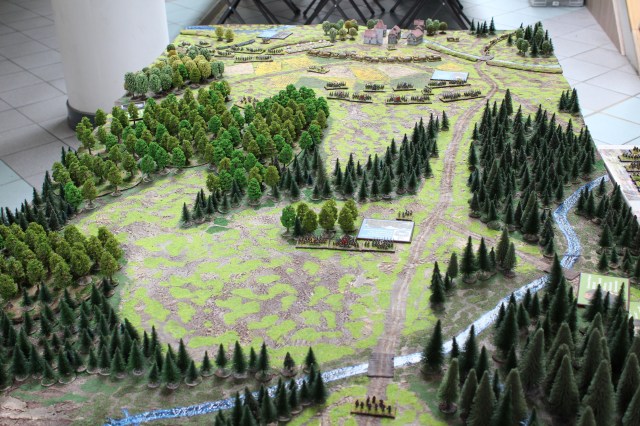
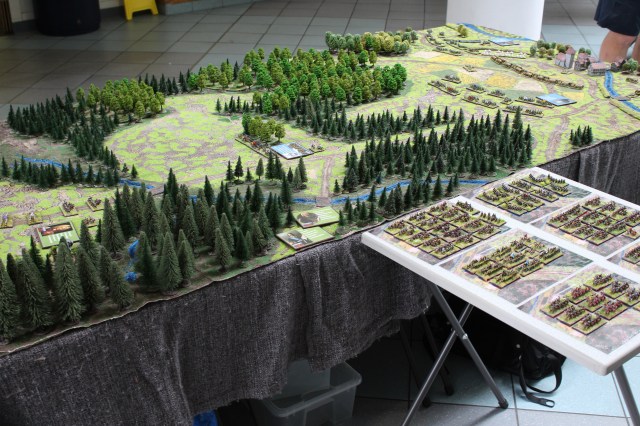
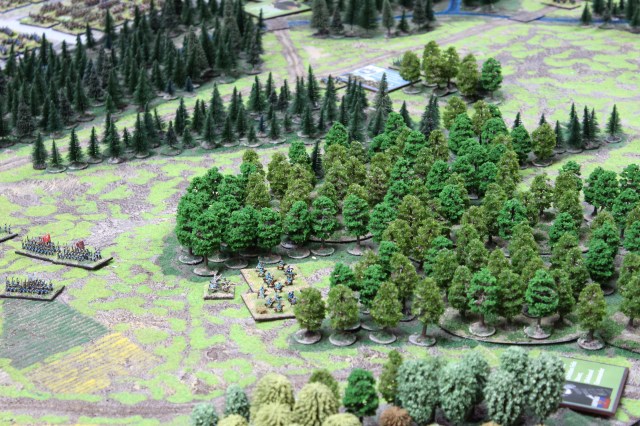
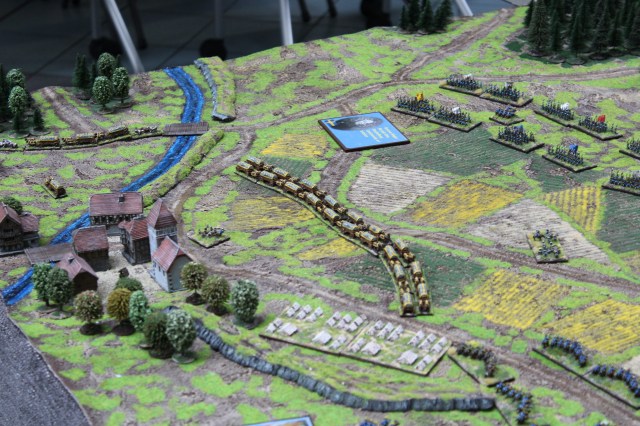
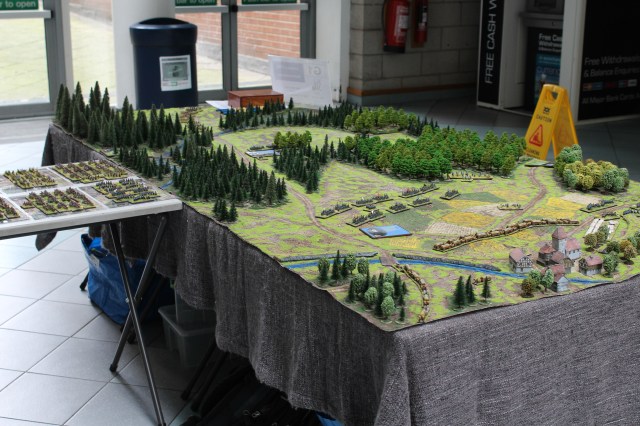
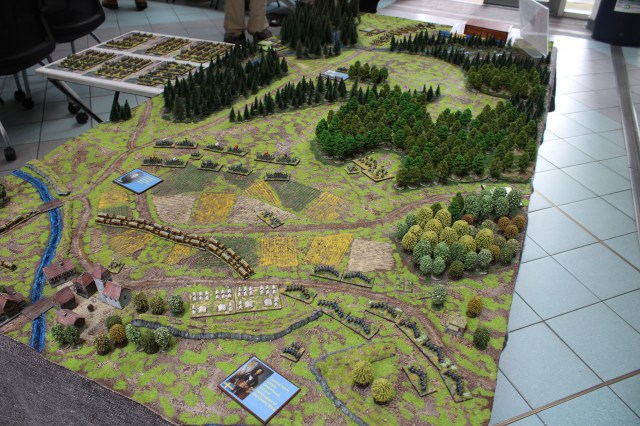
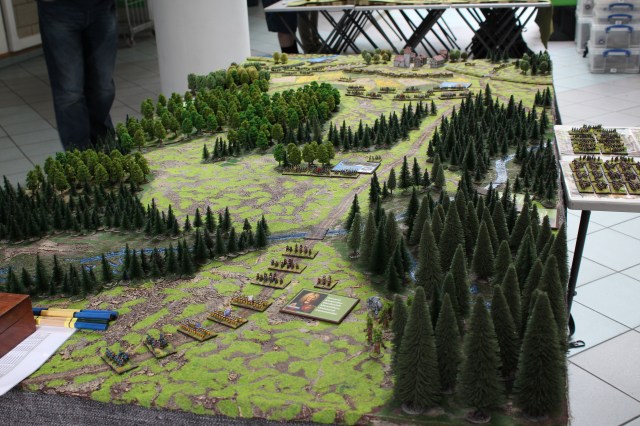
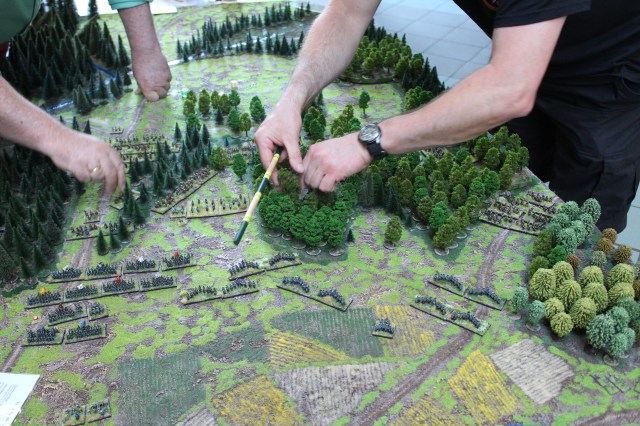
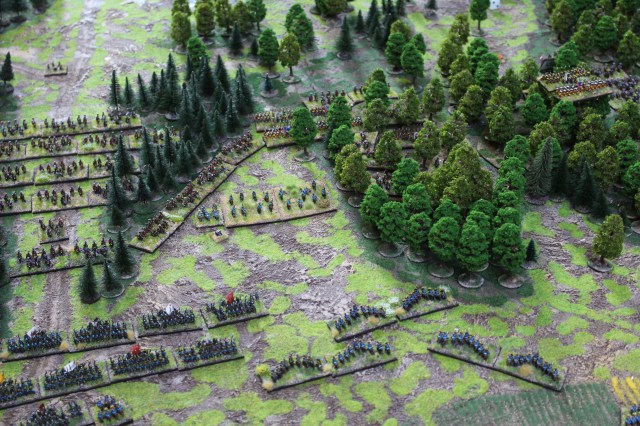
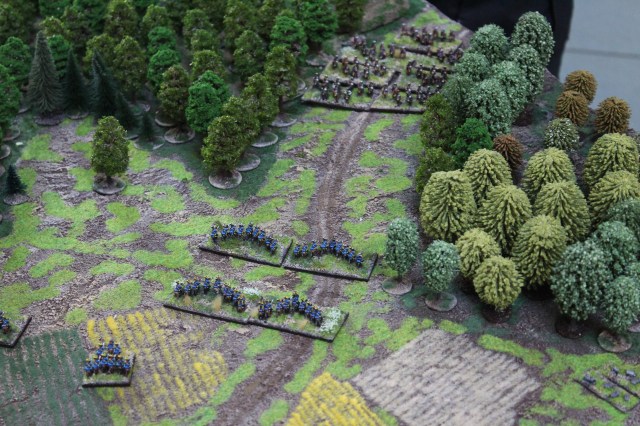
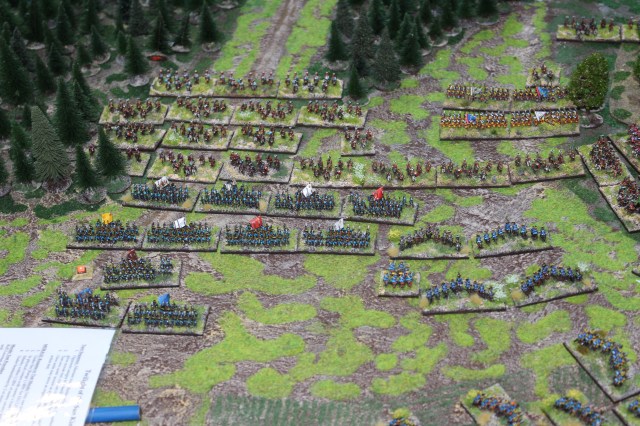
As you may be aware the next Great Northern War installment of the Towards Moscow Trilogy (TMT) is the Battle of Horka in 1708. The battle did not happen but was inspired from reading Nick’s book on the Russian campaign and with the addition of some artistic, or should that be historic, freedom I think we have something good enough to work on and present at the next Joy of Six in 2018. As always I will try to write a fair few installments here on the blog as things progresses (you can follow us here or like us on Facebook if you want to keep up with the developments or just come back every now and then). Anyway let us do a little bit of an intro so we are all on the same page (as per normal I have included links to previous posting and some external sources that may be useful if you are interested).
The Battle of Horka
Having ousted the Danes out of the Great Northern War (see more here) by the invasion of Zealand and crushed the Russians with the decisive victory at Narva, the young Swedish Monarch, King Charles XII (Carolus Rex, Karl XII) had decided to turn his efforts to deal with the final member of the coalition that had challenged Sweden’s Baltic supremacy – Saxony / Poland. It took him another 6 years before he had secured a treaty with Augustus the Strong. However the King still had unfinished business with the Russians and the time had come to march towards Moscow …. (you can read more about the TMT project and some of the background here)
In the beginning of July 1708, shortly after his victory at Holowczyn (see more here), the King had reached the Dnieper river with the Crown Army at Mogilev. It was, he believed, the last major physical obstacle on the road towards Moscow. The Russians had not made the advance easy as they had applied an scorched earth policy (the same policy that both Napoleon and Hitler would come to know later in history) destroying or removing supplies, burning bridges, withdrawing from villages, harassment of the moving army by irregular Cossack and Kalmuck light horse and dragoons, in combination with the constant rain (it had rained for about 4 weeks almost every day) that destroyed the crops and the hay and also affected the roads that further slowed down the March. The Russians would not give the King the decisive battle he needed. An army does indeed not only march on roads in knee deep mud but also on its stomach and there were still another 300 miles to Moscow – but as we know hope was on the way.
“So once the Swedes had secured the area around Mogilev they stopped to wait for Lewenhaupt and his vital supplies to arrive. … Meanwhile the Russian army had also halted and encamped, as the next obvious destination of the Swedes was the city of Smolensk, the Russians occupied a strong position on the road from Mogilev to this city. The camp was at Horka, sometime called Gorki, a short distance east along the road to Smolensk. … The Swedes considered attacking the position but in the end did not. Had the done so it seem likely that the Russians would have stood and fought.”
from The Dawn of the Tsarist Empire, by Nick Dorrell
We know the King would have liked to get on with it.
“Charles XII wanted to march on and put further pressure on the Russians after their disappointing defeat at Holowczyn – the sooner the better – before they had a chance to recover.”
Translated from Katastrofen vid Poltava (The Catastrophe at Poltava) by Peter From
So in our scenario the King gave the order to break up the camp and “Gå-På” towards the Russian position at Horka and the Russians did not slip away.
I will detail more about the assumptions on the armies that will clash on the day of battle in later postings. In the background I have been working away on the Russians and they are in various stages of completion. I had Chris from the excellent Marching in Colour helping me with a large part of the Lesnaya Russians last year and I also sneaked in a few ones for this project in the Order – so I had a good head start on these, but there are still a lot of work to do.
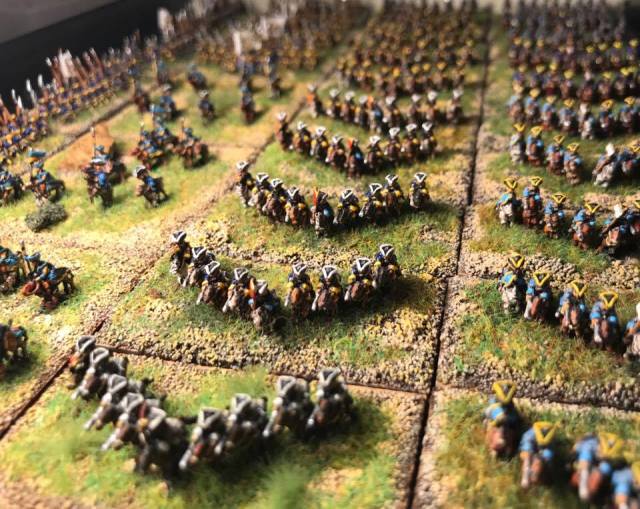
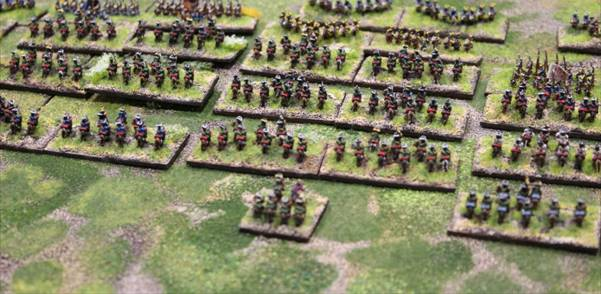
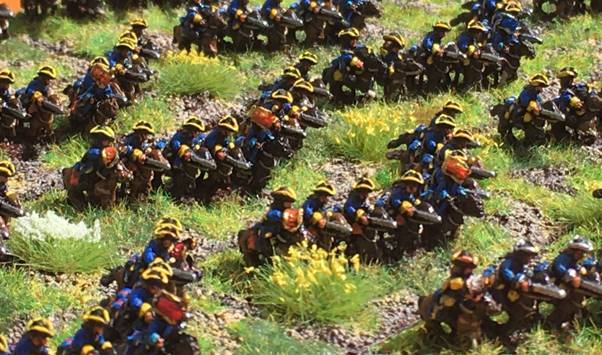
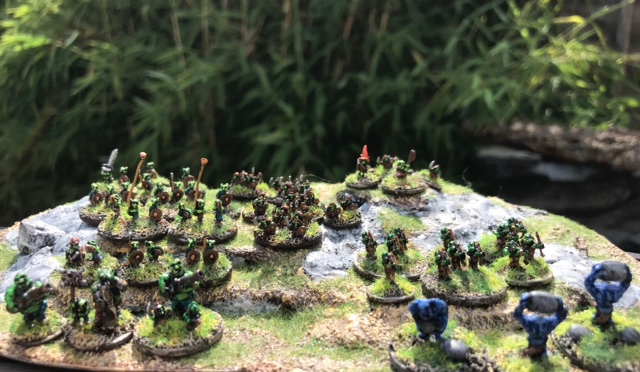
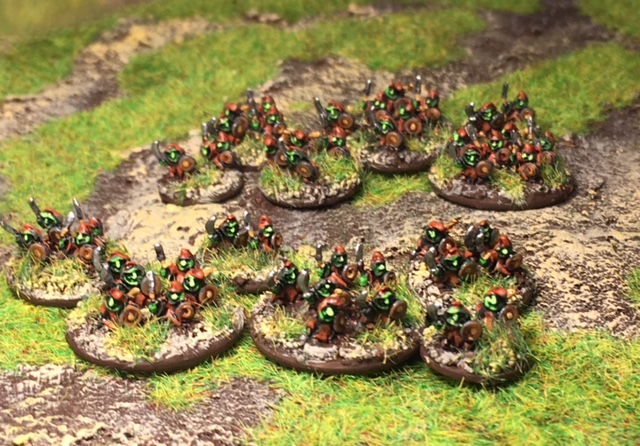
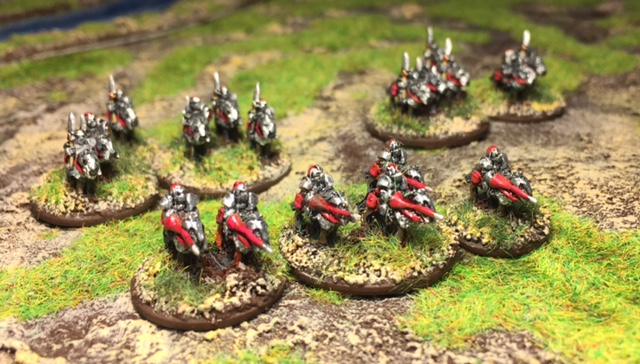
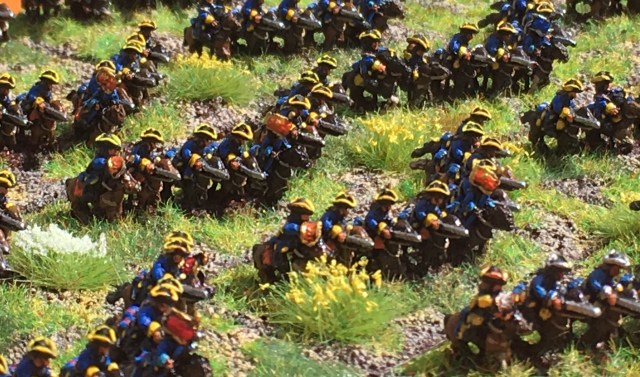
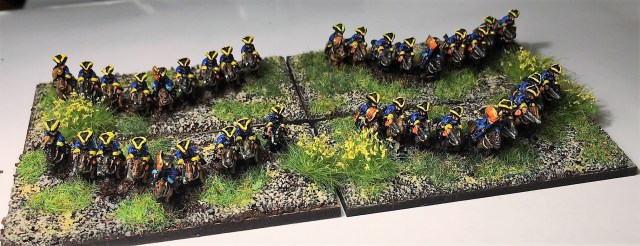
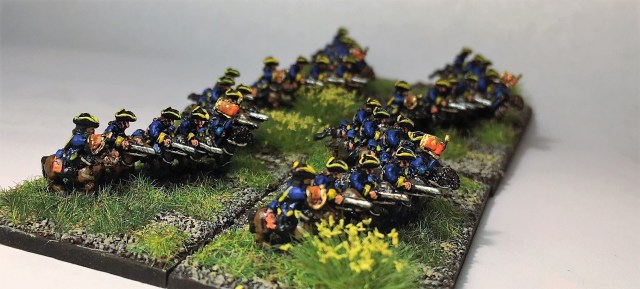
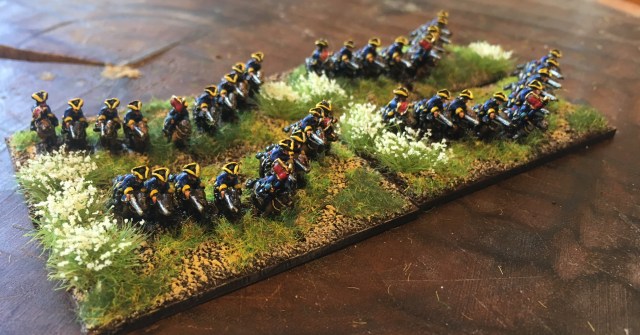
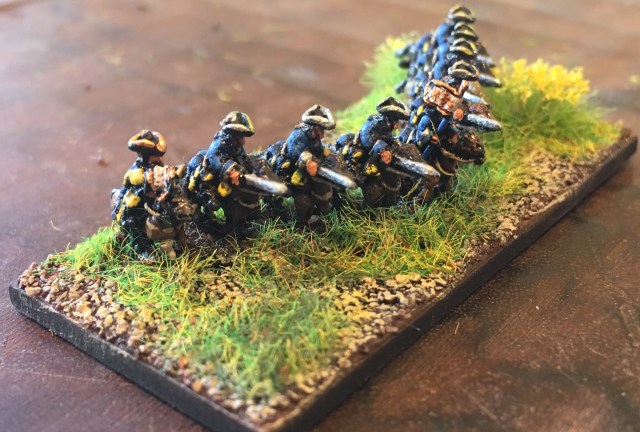
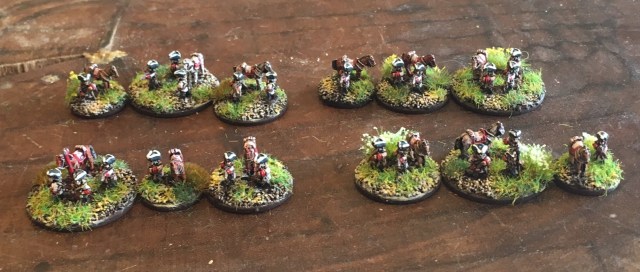
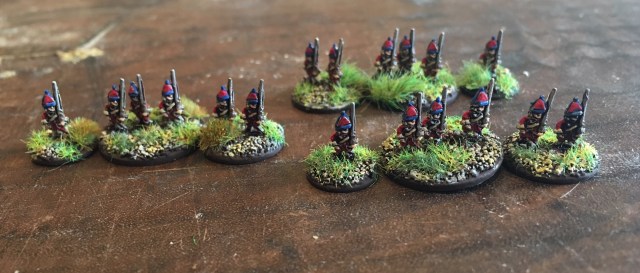
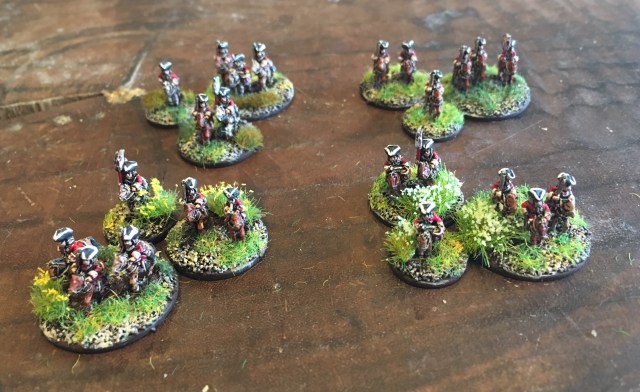
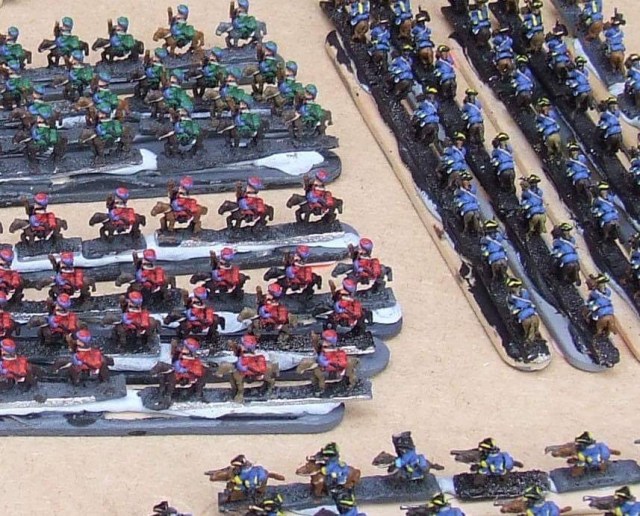
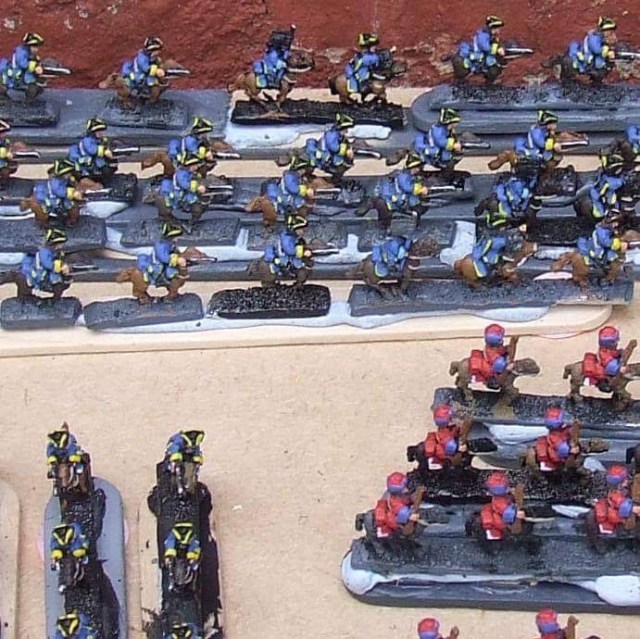
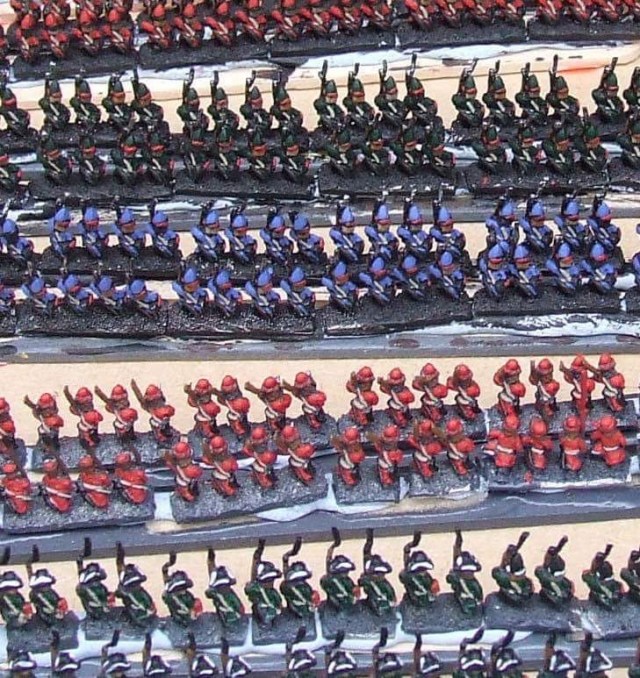
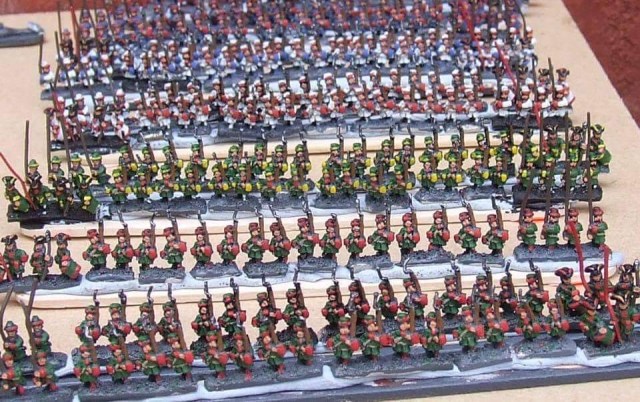
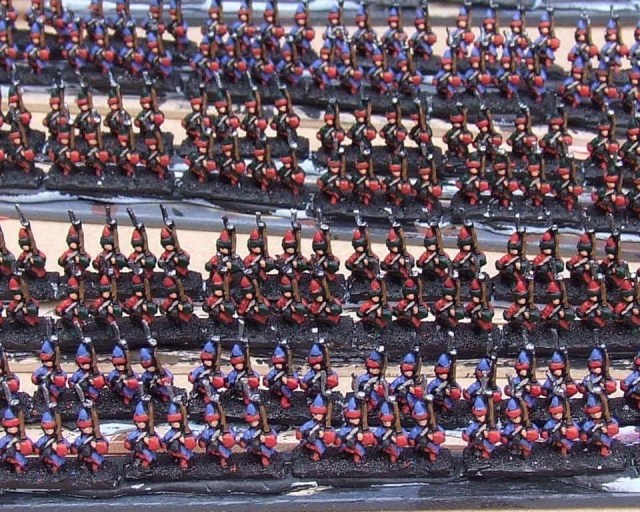
For the Swedes I had enough painted lead already from various project to cover about 45% of the bases needed – so there is a little bit more work to do on this front as well. Took out the miniatures from the Storage and took a few pictures whilst doing the inventory.
Here is the current list of units required for the Swedish side, this is based on the 35,000 strong army as at Grodno in 1707.
Unit – Name of the Regiment/unit
Type – Infantry or Cavalry
Ref – Reference
Polemos Bases – 60 by 30mm base with 9 riders or 24 foot (60 by 60mm bases with 7 for the light cavalry) – 2 of these are a normal unit in Twilight of the Sun King rules. 1 is a small unit and 3 a large unit. The X/Y indicates how many I have already and how many I need to do.
Class – GH/GD – Galloping Horse/Dragoon (Swedes with Aggressive cavalry), GP – Swedish Infantry with Pike.
After some fun days in France as reported last time (see here) and visiting a number of places in Bordeaux, I think the most fascinating thing was neither a Chateau nor an old Fortification. Instead I think the Dune of Pilat was one of the highlights of the Trip. It is the tallest sand dune in Europe and I have not seen as much sand since I visited Sahara a few years back. After the time there I think I had enough sand in my shoes to cover a 6 by 4 feet table (more about the dune here). It gave me a strong kick to get on with the Rommel project and the desert bases (But not too strong it seems as I did s**t all on that project this week).
Rising from the Ashes
I realised that I need to do another 46 bases of cavalry for the next Great Northern war project so I prepared them and gave them a coat of grey over the weekend – I will send away most of these to Marching in Colour (link to this excellent painting service here) – as my little Autumn treat (see more here).
Command and Colors
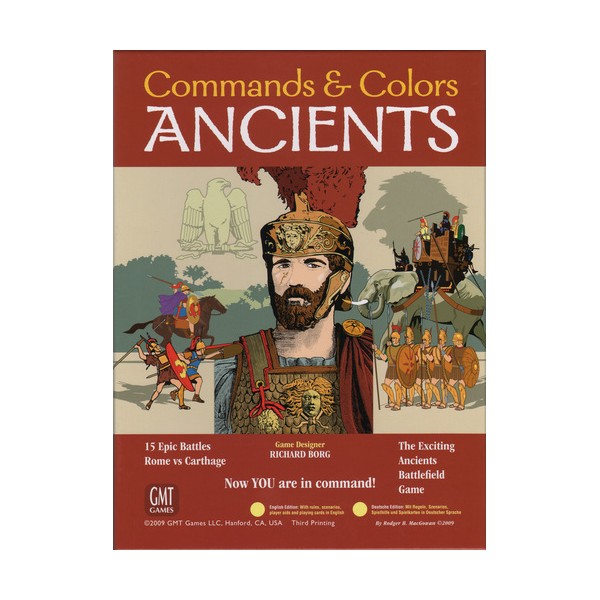
Since I went to Joy of Six earlier this year I have been thinking about the Ancient Command and Colors game staged by the Wyre Foresters (see more here, the game is shown at the end of the post). Having recently got the Tricorne version of the game my Command and Colors itch has become more difficult to resist.
Great Game and you can read more about it on Boardgame Geek – here.
I have a fair few unpainted Republican Romans from Baccus (link to their Republicans here), and some Rapier ones too (link to their ancient range here), that I have had in one of the boxes in a dark corner (I recently discuss these boxes of shame here).
The game uses a hexagon board with terrain tiles and wooden blocks. The approach is to replace the hexagon board with sanded and static grasses tiles and the blocks with miniature bases.
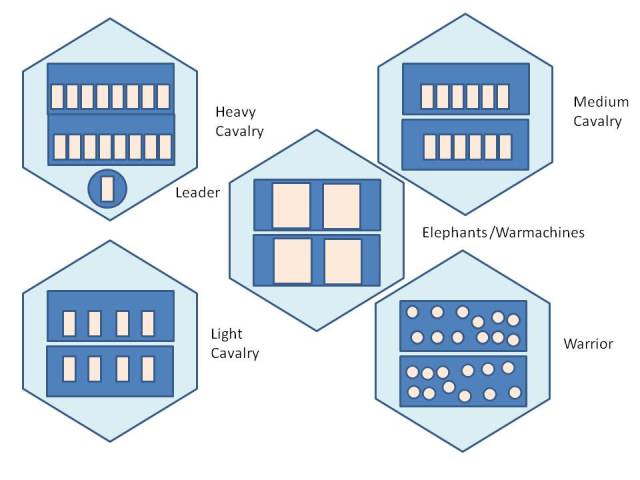
I decided to got with 70mm hexagon bases (side to side, being 80mmish at its widest point) and using 2 No. 50mm by 20mm bases for each unit. I will use the following basing convention for the number of miniatures:
Infantry basing convention – Auxillia (two rows of 8 miniatures – 16 in total per base, 32 per unit), Heavy Infantry (two rows of 10 miniature – 20 in total per base, 40 per unit), Medium Infantry (two rows of 11 miniatures – 22 in total, 44 per unit), Light infantry (6 per base in random order, perhaps more!, 12 per unit)
Cavalry (and war machines and warriors) Basing Convention Heavy Cavalry (one row of 8 horses, 16 per unit), Medium Cavalry (one row of 6 horses, 12 per unit), Elephants/War machines (one row of two miniatures, 4 per unit), Light Cavalry (one row of 4 horses, 8 per unit), Warriors (12 models spread over a base, 24 per unit).
I intend to send a few bases worth of these to Marching in Colours to get this project progressed a little bit more. I did throw some quick paint on a few to have a look how they would turn out and to give to Chris as a reference for his work.
Some Heavy Triarii Infantry – Rapier on the left and Baccus on the right – Note that the Rapier base is slightly bulkier and the figure look taller than they are compared to the Baccus ones. The Miniatures work very well together.
Princeps/Hastati from Baccus
In addition I need to get some Hexagon bases for the terrain and after surfing around I found that Supreme Littleness Designs (link to them here) sells 6 No. 70mm bases for £1. I will need to figure out how many I would need, there are 113 hexagons on the board, but I want to have a few more for special terrain, like rivers, forts, hills, shoreline, etc. For forest I intend to create small canopies that can be placed on top of the units, etc. I think that there are about 20 scenarios for the Punic wars so I think I will count the units of each type and any terrain features to give me what I need. I will get back to this in due course.
I could have gone with bigger bases for the units as well as the size of the hexagons but I think it will be big enough side project as it is.
He is a Keeper
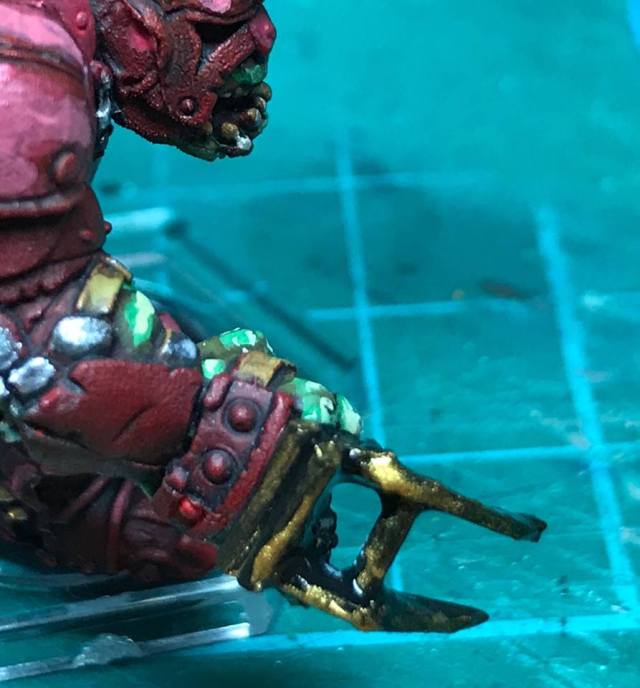
I also pimped up one of the Dreadball Guards (Orcs) to a Keeper with a “ball glove” , using an old credit card and some spaghetti. It ended up looking brutal enough – he is a keeper!
A few small steps, but all of them in the right direction!
It seems like ages ago that we went to Sheffield for the Joy of Six 2017 and I have had my head down into work and some neglected duties like 1800mm terrain modelling (gardening) and real life painting (some feature walls instead of shield walls) with a limited amount of any useful hobby time. However, there is always some progress on some front in the Roll a One world (but more on that next week).
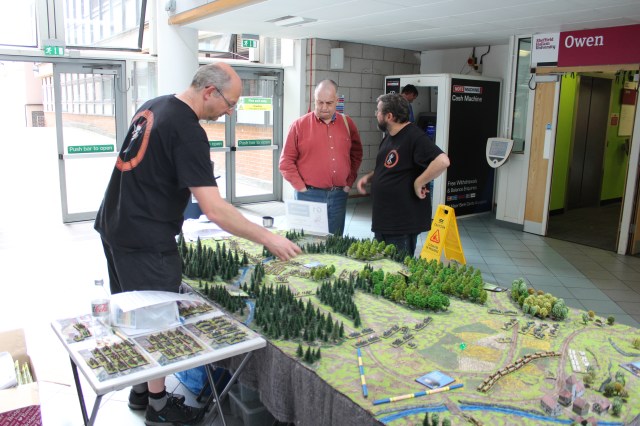
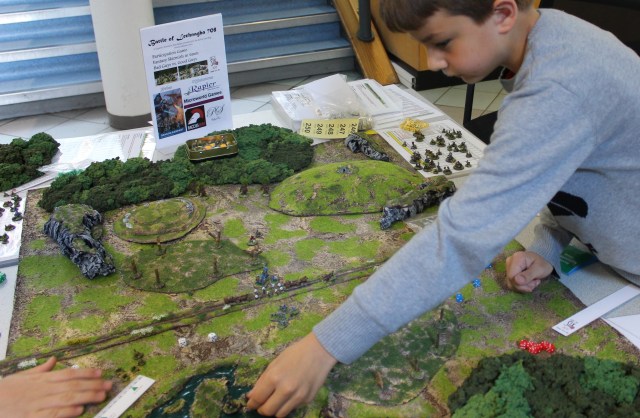
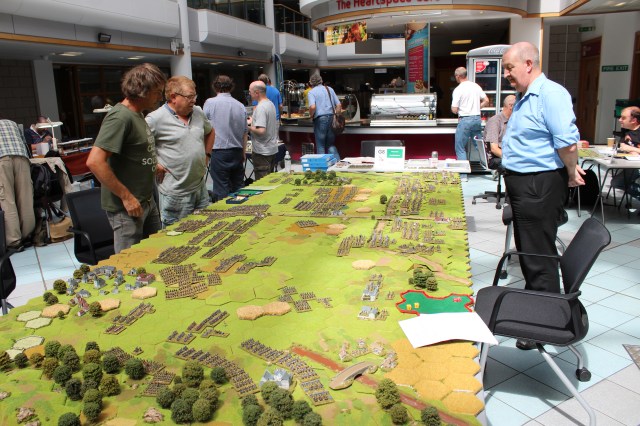
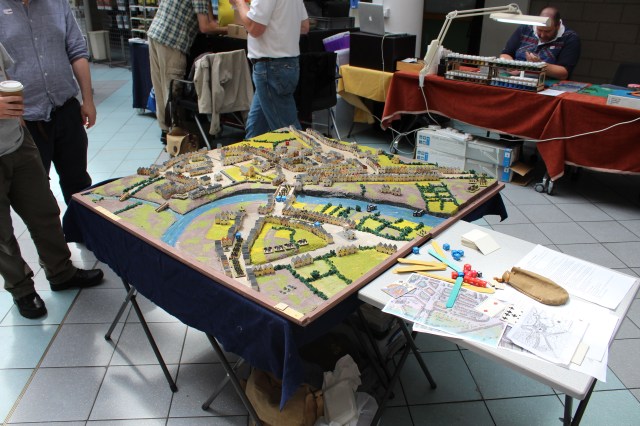
This is my take on the fantastic spectacle that is the Joy of Six – it is very biased as I frankly spent most of the day around the two tables I had brought. I had a few round trips but failed to take more than a few pictures of the other offerings – mainly because I ended up having a chat and then feeling bad that I had left the tables and rushed back. However, this was a little bit of an unnecessary mitigation as the games were running pretty well without my interference. The Wyre Foresters running the Lesnaya Table and the Little One the Lechnaga bash. So as far as a proper show report goes it is a limited one. For a better overview check out the report on Baccus page (link here and here).
A tale of two tables
It was a nice and sunny day in Sheffield and we woke up early as we actually managed to get to bed relatively early. The mat for the Lesnaya Battle was rolled out and it was so refreshing compared to the usual 2 by 2 feet boards I have been using in the past – that invariably have warped a little bit and/or the underlying tables being uneven leading to some interesting and unintended elevations.
I had some fears about the varnish and the rivers but it all seemed to work very well – I think I have convinced myself that I will do mats from now (more on this adventure here).
When we had put on all the trees, the houses, the wagons and the starting units I took a step back and I have to admit we were pleased. “It is GEFAG!”, the Little One said – Good Enough For A Game!
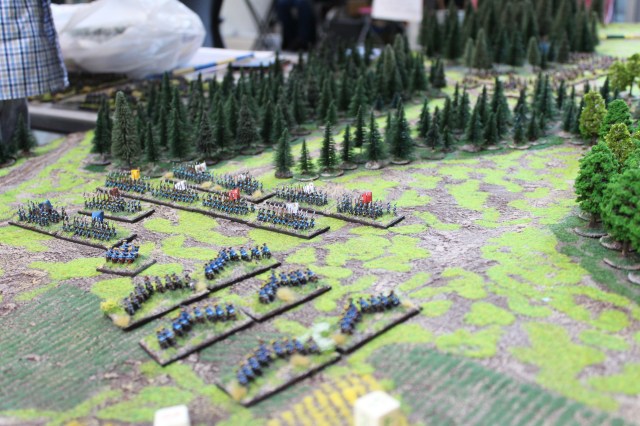
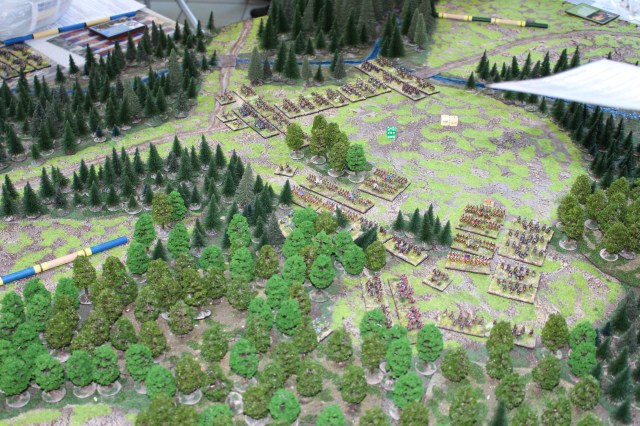
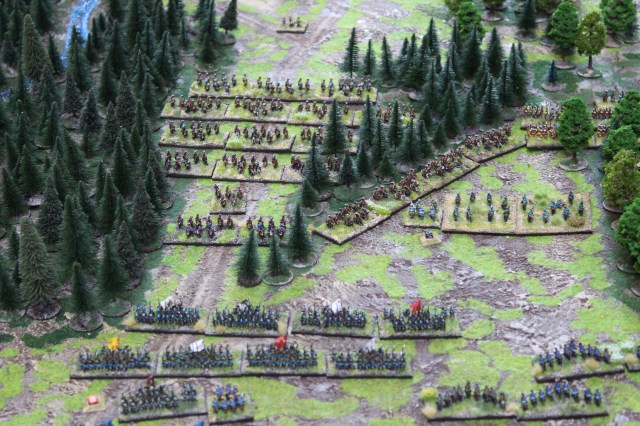
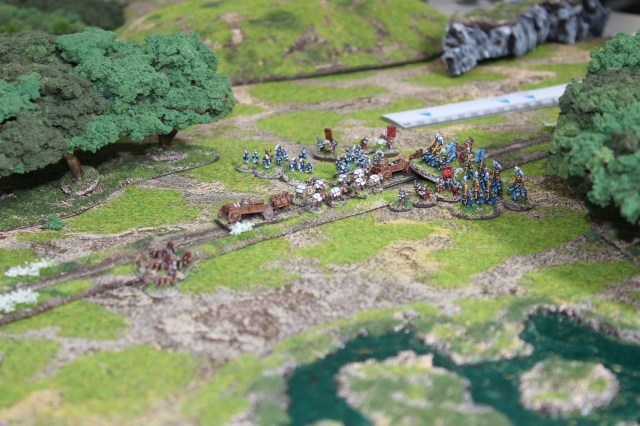
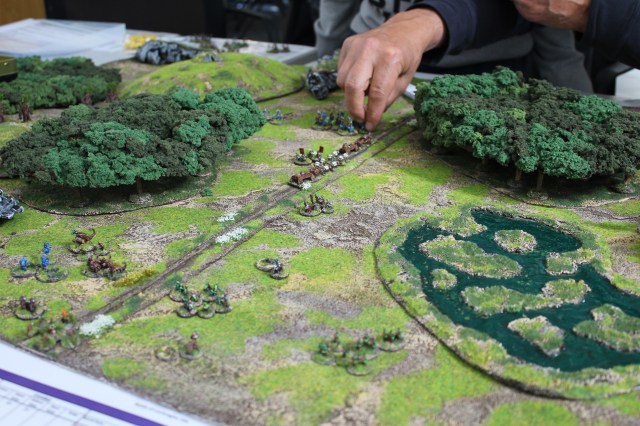
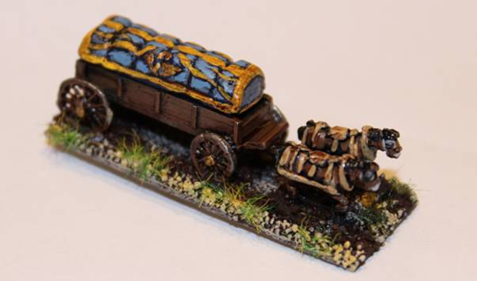
View with Lesnaya at the far end. There was a nice shine in the river and the simple bridges (made from thin Spaghetti) worked really well! In the middle Freijbourgs rear-guard awaiting the onslaught of the Russian war machine.Side table for the Russians as they were coming onto the table during the Battle from the directions – Golitsyn’d Division with Tsar Peter, Menshikov’s Divison and Bauer’s Division. There were also few Swedish enforcements (on the top left hand corner).Bauer’s eventual entry point in the left corner.Shot showing the defensive lines of Wagons, Lesnaya and Stackelberg’s Infantry (Swedish) as well as some of the Cavalry.Another AngleWith the Cavalry commanded by General Lewenhaupt himself.The density of the forest really worked
The Wyre Forrester, under the guidance of Nick Dorrell, got on with the job. Most of the time was spent talking about the table, the war, the mat and the Twilight of the SunKing Rules that was used on the day (the basing I use is the Polemos “standard” but this works equally well for the TotSK rules – one base is a small unit, two bases a normal unit and three bases a large unit).
At the latter part of the day the game started moving in earnest but did not reach a climax before we packed up.
Here are a few pictures from the action.
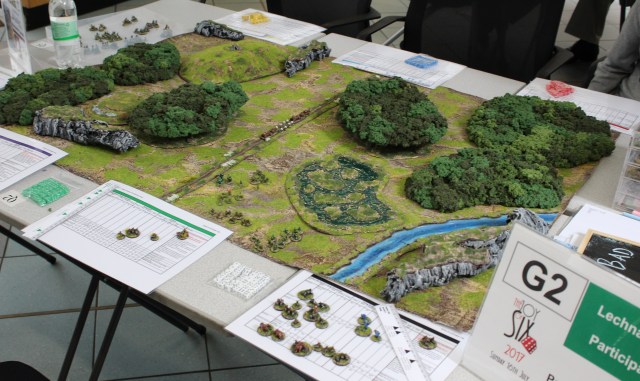
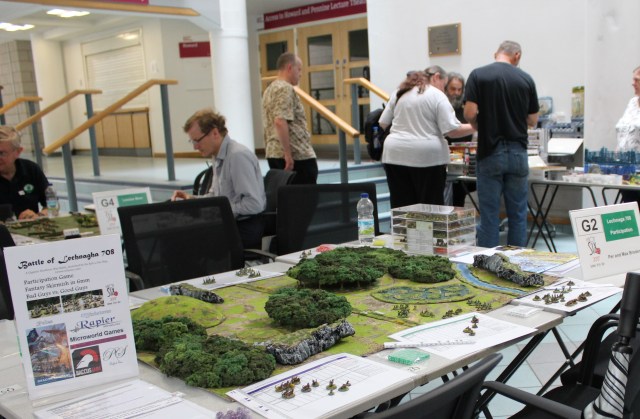
For the Lechnaga battle (see background here and here) we used one of the mats I did for the Saga stuff last year and the canopy forests (see more here on this terrain). The actual gaming area was the middle half of the 3 by 4 foot mat.
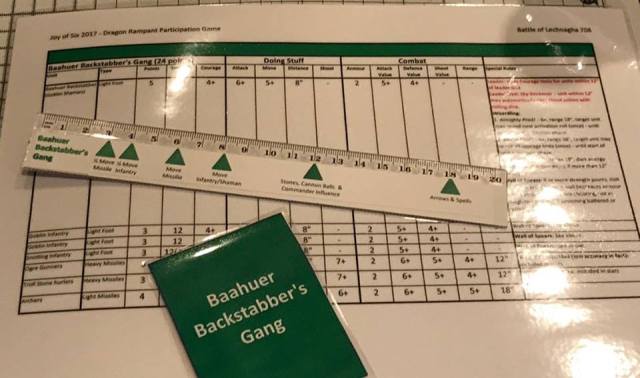
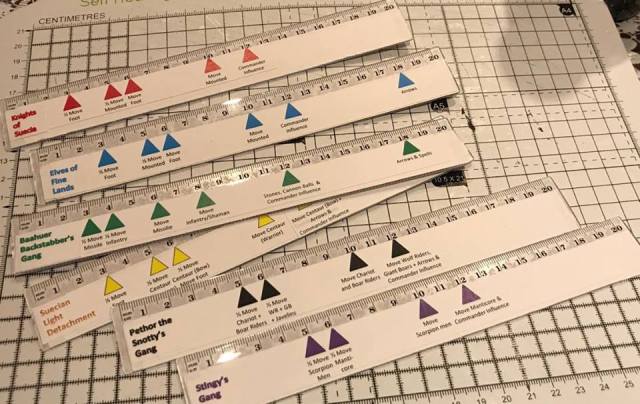
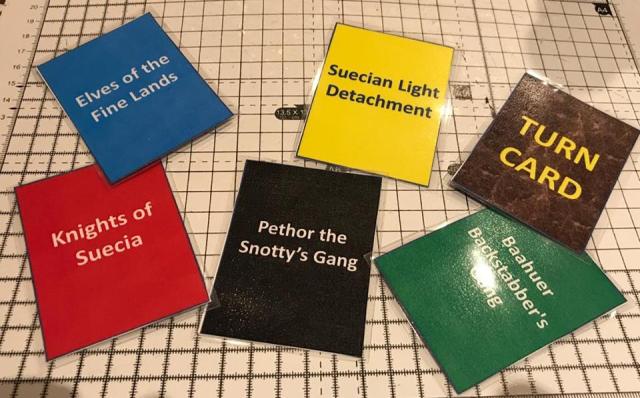
We decided to run the game (using Dragon Rampant Rules) with a war band/force sheet for each player and did a bespoke measuring stick based (we used centimeters instead of inches) on the units in the war band. We also did cards that to use to agree the order in which a player had a go – this created another layer of friction to the game. All, of course, colour coordinated! I have provided the files if you are interested in doing something similar.
I bought some cheap 20cm rulers for 50 pence each and printed out the file (download files here in PDF and Powerpoint – Dragon Rampant Rulers and Dragon Rampant Rulers) on some sticker paper (normal paper and glue may do as well!) and put them on the rulers where appropriate.
A then the file with the factions used on the day here Factions and here Factions .
We had a few good games – the Little One was in charge. Here are some pictures – a big thank you to the few who dared to sit down and roll a few dice with the kids. The future of the gaming community and industry salutes you! The Little One would like to give a special thanks to Oliver and Chris!
Other tales
It was a very good day, but it always seems to end too quickly, here are a few of the things that I managed to capture.
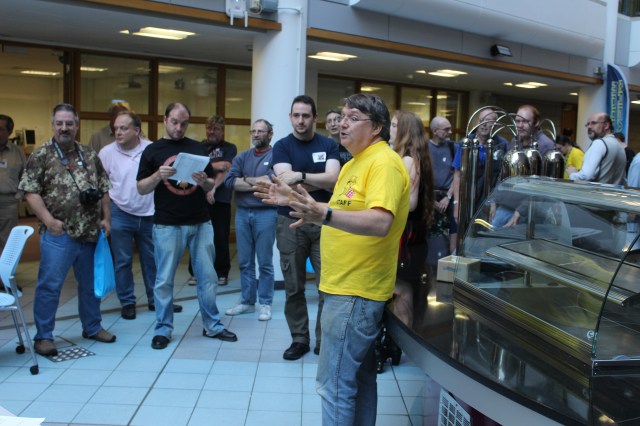
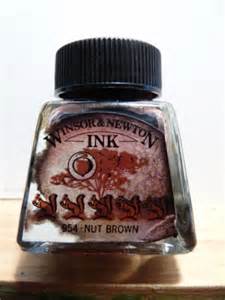
Arguably the warmest smile for miles!, but this is how we most commonly see Dr Mike in action. His posts on the Baccus forum in the old days got me inspired enough to get on with painting my first set of 6mm units. Grey primer, black wash, block and Nut-brown ink and base it nicely and consistently.My first contact with Waterloo was through that famous Abba Song and my mother moving like a Dancing Queen in front of me. Dan Hodgson’s (on the front left) Waterloo was equally brilliant and was an absolute treat. Chris Grice, on the right who wrote the Polemos Napoleonic rules, looked like a true General pondering on his next move of the day. Here is the blur from the Baccus page. I am a fan of Dan!Mr Peter Berry himself doing the Raffle and the many thanks session! Never in the field of human table top conflict have so many had so small toy soldiers to thank for so much!
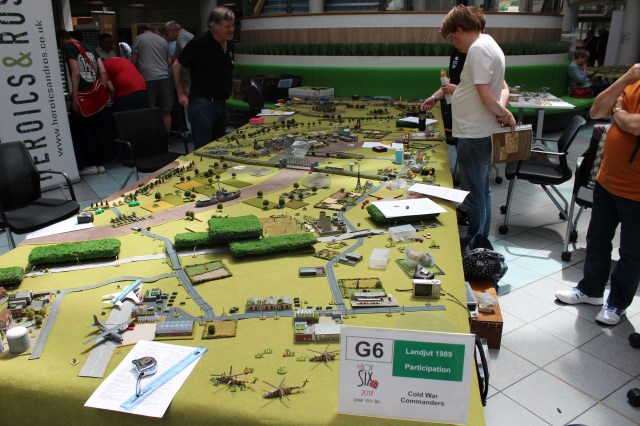
Cold War Commanders – Landjut 1989 (Always having a good time and game, link to their blog here). As a Swede I love when the Danes get a little harmless kicking on the table top.
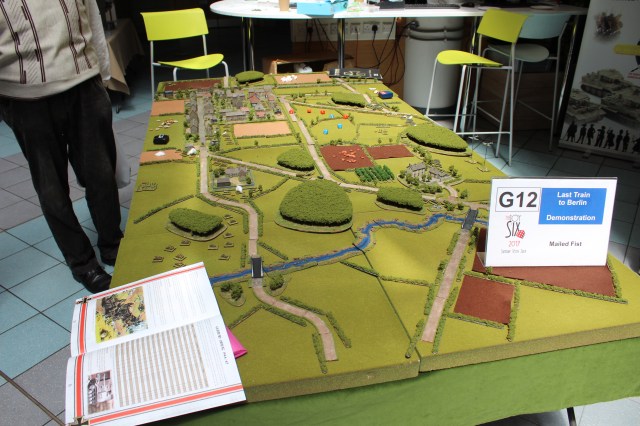
Mailed Fist – Last Train to Berlin (always very nice games and detailed terrain). I should have taken a picture of the town but got star struck and just stared!
South London Warlords – Neustadt Crossing 1985 (Excellent!). More about it here. Iain we should meet up for a game at some point!MADgamers – Eastern Front 1700 (Trevor, thanks for the little chat). Always happy to see you Gents at Joy of Six!
WW1 Grand Style (I think the sign had a slight error – I let you go and figure). Very nice!
Salford 1642 – Excellent and so many houses! Link to some more blur here.
Of particular interest to me was the Battle of Issus using Command and Colours (or is it Colors!) by the Wyre Forest gang. This really got me inspired to do something similar for the Punic Wars (but I save this discussion to another time – when I have not clue what to write about!). There is a picture of it on the Baccus link above.
Yet again a very good event indeed. Thanks to Baccus, Wargames Emporium and all the other people that makes it all happen. I have to extend the thank you to my two Little Ones – one doing her second year in the Yellow Joy of Six Jersey, selling entrance and raffle tickets, and the other for running one of the games. Also a big thanks to Nick and the other merry men from the Wyre Forest!
Finally and big thank you to all of you who came around and said hello and told me you were reading this blog and liked it. I really appreciate it and all you others who seem to come by every now and then!
We will back next year!, did I say thank you?
/ Have a good week!
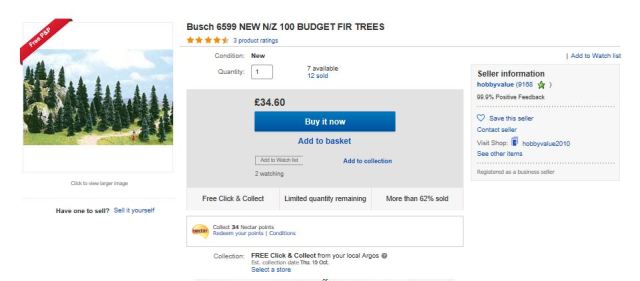
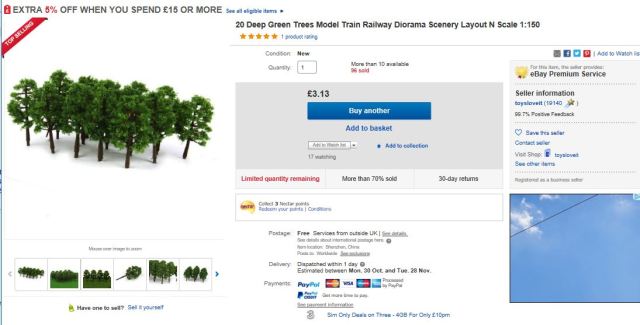
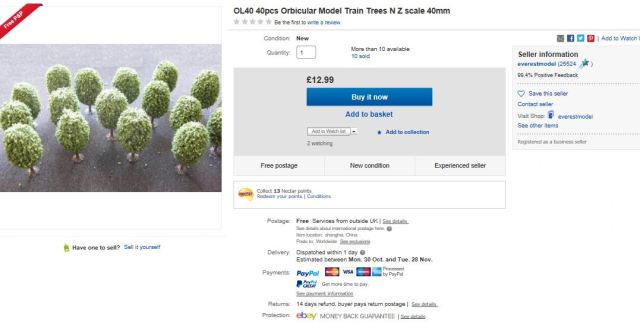
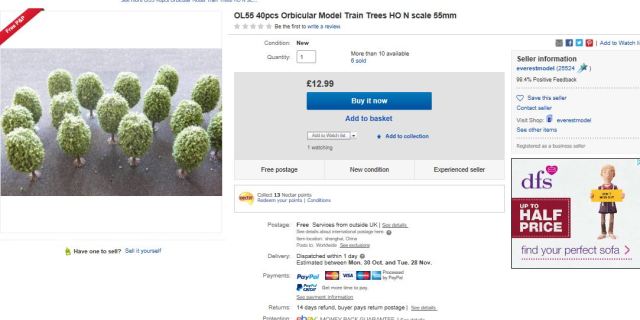
Postscript (15/10/17): I have had a few queries on the sources of the trees I used for this project, I got these from various sources on eBay. Here are a few screenshots done on the date indicated above of what I used. None of these are based (apart form the Orbicular ones have a little of a root section) and I did it by using washers with a bit of Milliput and make a hole in, let it dry, glue on some sand and paint it up, flock it and stick in the tree with some glue. Some boring hours of work but I do think it is well worth it.
The fir trees were from Busch and I think I got 3 or 4 packs of these – shop around as I recall I got mine somewhat cheaper.
The other main tree was of this variety.
I also got a few packs of the following:
Another postscript a little bit later:
These are the blur for the two games we ran on that day.
One of the highlights of every Joy of Six is Per Broden’s annual exploration of his Swedish heritage as he stages wonderful games with a distinctly Scandinavian feel. At the Joy of Six 2016 he went one further and produced two games.
He is repeating this feat this year, with two very different offerings in scope and subject matter.
Here is what you can expect to see this year in Per’s own words:
‘Lesnaya 1708
I, Nick Dorrell and the very decent chums of the Wyre forest Wargames club will be doing three battles (two that took place and one that could have been) from the Great Northern War covering the, from a Swedish perspective, ill-fated Russian campaign 1708 to 1709. Each of these battles will be presented at the Joy of Six show over the next three years.
The campaign is the invasion of Russia by Charles XII of Sweden starting with the crossing of the frozen Vistula river in early 1708 and ends with the Swedish defeat at the Battle of Poltava in the Summer of 1709. It is the beginning of the end for Sweden as a dominant military power in north-eastern Europe.
The first battle is Lesnaya 1708 and is interesting as it is, in effect, an ambush by a Russian flying detachment, led by Tsar Peter himself, on a smaller Swedish army that is travelling through the forests of the Polish-Lithuanian Commonwealth. The Swedish army is led by General Lewenhaupt who is escorting a supply column of more than 4,500 wagons to support the main Swedish Army. From the perspective of doing the battle we need a lot of forest as well as about 40 or more bases to represent the supply column itself.
In writing this the miniatures (from the Baccus range) are about 95% complete with a few more Russian dragoons to go. The main thing remaining is the gaming area itself and a large number of trees is being finalised (there will be about 500 trees on the table!).
Overall the forces consists of:
Russians, a few leaders and artillery as well as 10 bases (24 miniatures, on 60 by 30mm bases) of infantry and 57 bases of Dragoons (9 miniatures, on 60 by 30mm bases).
Swedes, a few leaders and artillery as well as 10 Polemos bases (24 miniatures, on 60 by 30mm bases) of infantry and 57 Polemos bases of Dragoons (9 miniatures, on 60 by 30mm bases)
We will using Nick Dorrell’s adaptation of the Twilight of the Sun King Rules published by the Pike and Shot society, to play the game.
The game, and it’s very uneven progress, is being reported on the roll a one blog (rollaone.com) – you can follow it there and see if we make it over the finishing line in July.’
So game number one, is another of Per’s GNW epics. His second production couldn’t be more different both in scope and subject matter, although I do detect a little Swedish influence creeping in…
‘The Skirmish at Lechnagha in the Year of 708, since the birth of Suecia, during the Gigantic Northern War 700-721
A black arrow with red feathers suddenly hit one of the pack mules and it fell violently to the ground as its legs gave away to the heavy load it was carrying. This was shortly followed by hideous laughs and taunts from the surrounding forest – the same damn laughs he had heard so many times before. With the black and red arrow signature there was no doubt what was coming next. Prior Lewen Hauptmann of the Knights of Suecia, threw his red cloak over his shoulder, raised his warhammer and turned to his men and screamed; “Get ready for the Greenskin’s attack! Push them back to their rotten holes! Give no pardon as it shall not be given to you! From earth they have come and to dust they will go!”. He pulled down the visor of his helmet and gave a short prayer and looked around at his men – ironclad battle hardened Knights ready to fight to their last dying breath. “For the Glory of Suecia, give us your strength of battle!” he yelled out the blessing and his brothers responded concurrently; “We accept your strength”, to complete the linkage to the divine plane. For a moment a reddish glow could be seen from their swords and spears as they were imbued with the spiritual power.
The Prior reflected for a moment on the stupidity of this wretched mission and how he had been forced into it by the Knight Marshal Carrophlus following his failure holding the Fort at Narvay. He had chosen to spare his men from slaughter and made a deal with the treacherous Steward of Polesh, Arghaust the Strong who, he was the first to admit, surprisingly had let them go after opening the gates. The enemy had grown stronger under the combined leadership by Arghaust and the mighty Warboss Pethor the Brute, a tall Orc whose organisational skill, cunning and patience was remarkable for his kind. Pethor had manage to organise the Goblin and Orc rubble into a formidable fighting force. It had only been a matter of time before the Fort would fall and enough of his brothers had already been slain and reinforcements had not been forthcoming. The Fort was of limited strategic importance and he had chosen to live to fight another day.
As penance for this “disloyalty”, in addition to the demotion to Prior, he and his surviving men had been ordered to bring supplies to the cut-off townspeople of Lechnagha. He had no retinue of servants, squires, men-at-arms or Sergeants as was the custom for these kind of soul purification missions. It had been a hellish journey through Goblin infested forests with constant harassment. He had lost half the men they started out with and only half of them still had their horses. If their calculations were correct they were only a few miles away from the Town itself. It had a small regular army garrison and since he had felt the presence of evil watching them for the last few days he had sent a rider for some enforcements. But now that seemed to have been in vain. He thought back on the situation at Narvay and how his death there would have qualified his name into the songs of the minstrels but instead he was facing death here in the middle of this despicable forest – for what?
He was quickly brought back to reality as yet another arrow hit another mule. He looked around and could see Greenskins on both sides of the road riding their growling dire wolves closer. They always got excited at the beginning of the fighting and intensified their laughter, reminiscent of that of a raving lunatic, that normally stroke fear into their opponents. However, this was not what frightened him the most, it was the otherworldly scream he could hear from within the forest itself.
This is a participation game using the popular Dragon Rampant fantasy wargame rules by Dan Mersey (played to satisfaction not perfection). The main purpose is to have fun but also to showcase that 6mm can be used for games normally associated with the larger scales not just replacing individual miniatures with bases of many (like we did for Saga last year) but also scaling it down and still being able to enjoy a game. With a 2′ by 2′ board (the size of a small coffee table) playing in centimetres instead of inches is in fact like playing on 4’6” by 4’6″ board. We figure if you can have a few blokes taking a flag for a walk representing a regiment in some scales, why not do skirmish in 6mm?
We (the Little One and I) will run a few session over the day (with up to 4 participants each time) and welcome anyone to have a go. 1 to 2 players will control the Knights and 1 to 2 players will control the Greenskins. It will serve as an introduction to the rules and we will limit each session to about 45-60 minutes (including a high level rule go-through). We happily mix fantasy miniatures from Baccus, Rapier, Irregular Miniatures, Perfect Six and Microworld on the table.
We have blogged about 6mm skirmish extensively on the roll a one blog (rollaone.com) – I will bring some of the other miniatures for other periods for you to have a look at should you wish.’
Next weekend Joy of Six and time for us to head up to Sheffield and run some games with Nick Dorrell and the other Chums from the Wyre Forest Wargames club – we are looking forward to it!
A write-up of the two games can be found on the Baccus homepage (see here), I suggest you go there and have a look at these and the other things that will be going on at the Joy of Six.
I have spent the last week finalising the units we will field for the fantasy game and also completing the battle mat (discussed last week, here).
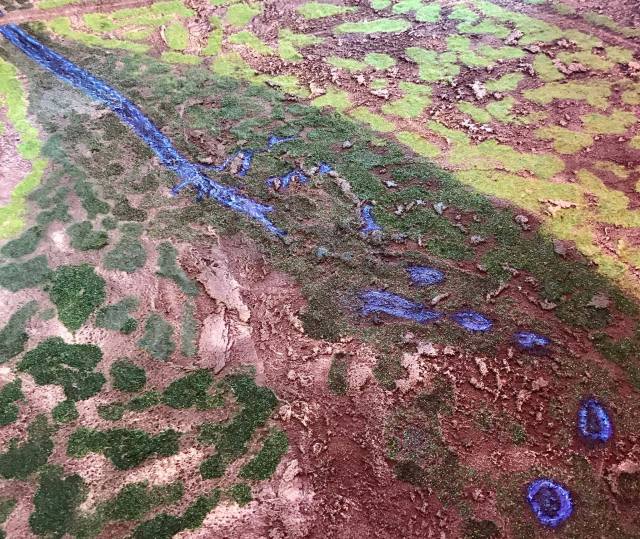
I have varnished the river sections using Liquitex High Gloss Varnish, I hope it will not crack to badly when the mat is rolled up! As per the tradition I have to bring some terrain made out of spaghetti to Joy of Six! This time all the bridges on the Lesnaya table are partially edible! (Al Dente!, more on spaghetti terrain here, here and here!).
As for the Fantasy game we will be running a participation game using Dragon Rampant. The rules are fun and easy to learn and I think will work well in this setting. As this was a last minute change I have done a lot of short burst brushwork the last two weeks and had some great fun with the Little One preparing it all. I think we need a break after Joy of Six!
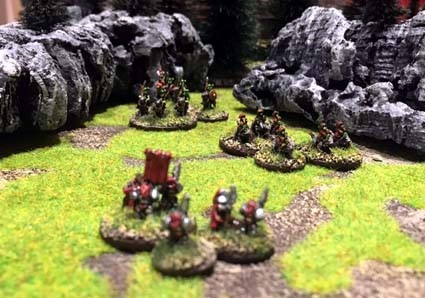
Here are a few shots of the units we have been working on (not all made it to the final war bands below).
However for the game on the day, we will allow a maximum of three players per side (Good vs Evil) using the following warbands (notation based on the dragon rampant rules):
The Good Guys
Knights of Suecia (24 points)
Leader: Prior Lewen Hauptmann (18/00 Strength leader trait, actually a blessing from Suecia, giving him re-rolls in battle).
“He pulled down the visor of his helmet and gave a short prayer and looked around at his men – ironclad battle hardened Knights ready to fight to their last dying breath. “For the Glory of Suecia, give us your strength of battle!” he yelled out the blessing and his brothers responded concurrently; “We accept your strength”, to complete the linkage to the divine plane. For a moment a reddish glow could be seen from their swords and spears as they were imbued with the spiritual power. “
Leader unit – Elite Foot (6 points)
Second Unit of Knights on Foot – Elite Foot (6 Points)
2 No. Units of Knights on Horse – Elite Horse (12 points)
The Knights – all the models are from Perfect Six (here is a link! – great growing fantasy range!)
The Men and Centaurs from Lechnagha – All models from Rapier Miniatures (Link here – Centaurs from the Greek Mythology Range and Footsoldiers from the Ancient range. Lovely models and the Rapier guys are really nice chaps overall!)
The Bad Guys
Pethor the Snotty’s (Son of Pethor the Brute) Gang (24 points)
Leader: Pethor the Snotty (Strong leadertrait).
Leader unit – Warchariot – Heavy Rider with Chariot upgrade (6 points)
Boar Riders – Heavy Riders (4 points)
2 No. Wolf Riders (short range missiles, javelins) – Light Riders (6 points)
Wolf Rider archers – Light Riders (4 points)
Giant Boars – Lesser Warbeasts (4 points)
Pethor’s Gang – A mixture of models with Goblin Wolfriders from Baccus (See link above) and Microworld (link here, fantastic range of fantasy stuff, I am getting some undead next!), Chariot from Baccus, Boar Riders from Perfect Six (see above) and Giant Boars from Irregular Miniatures (see link here – Ogres Mounted on Large Boars).
Leader unit – Light Foot, with Wizardling Upgrade (5 points)
2 No. Goblin Infantry – Light Foot (6 points)
Snotlings – Light Foot (3 points) – this are modelled with double models (i.e. 24 in total instead of 12 models).
Ogre Gunners – Heavy Missiles (weighty projectiles, simulating very bad accuracy with a short range, 3 points) – 3 ogre models but small snotlings on the bases still allowing the 1-2-3 basing.
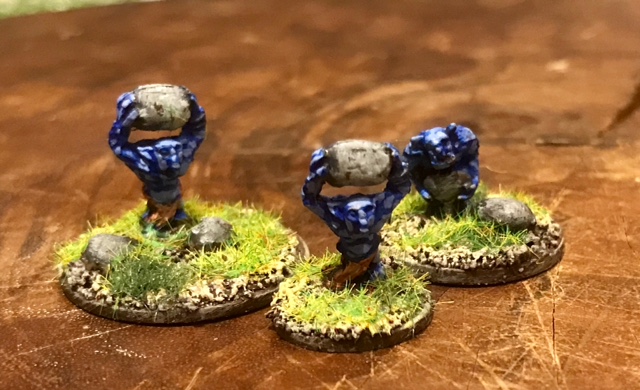
Troll stone hurlers – Heavy Missiles (weighty projectiles, stones, 3 points) – 3 troll models, with stones on the bases allowing the 1-2-3 basing to work.
Archers – Light missiles (4 points)
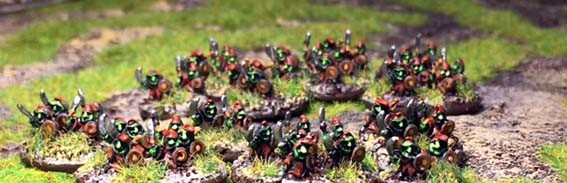
The Backstabber’s Gang – Goblin infantry from Baccus, Snotlings from Microworld (actually Goblins), Ogre gunners from Irregular Miniatures, Stone Hurlers from Perfect Six and the Backstabber himself from Microworld. I will try to remember to give the infantry some flags (the poles look a little bit empty!).
Stinghy’s Gang (24 points)
Leader: Stingy Stjartdell (Goader leader trait).
Leader Unit – Heavy Riders (Scorpion Men, with Venomous Upgrade, 7 points)
Scorpion Guards – Heavy Riders (Scorpion Men, with Venomous Upgrade, 7 points)
Ferocious Manticore – Lesser Warbeast (Flying, Venomous, Hatred of Elves, 10 points) – using Harpys to mark Strength.
The Stingy Ones – All models from Rapier Miniatures. These are my favourite models – the Manticore and Harpys from the Greek Myth Range and the Scorpion Men from the Glorantha Range.
All the very best. come and say hello if you come to Sheffield next week. For those who do not, I will write some updates in the next few blogs!
With two more weekends before the Joy of Six show, I felt under positive pressure this week to get the final bits completed, the key item being the mat.
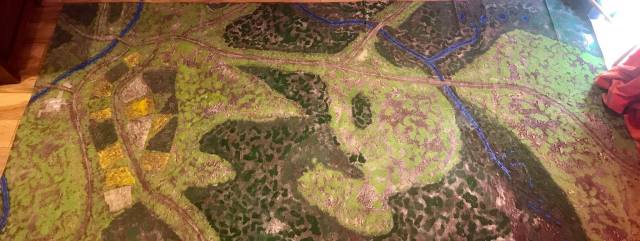
The idea this year was not to use terrain boards, as I have done previously, but instead try to do a terrain mat that contains most of the terrain features (see some background here and here). I had this rolled up piece of plastic backed drop-sheet with the acrylic paste on top – all dry but a very heavy 8′ by 4′ mat. Having been rolled up for about 2 week I did notice some cracking and a few strange folds, but nothing scary. It was time to decorate.
Remember the objective (upside down compared to the previous postings).
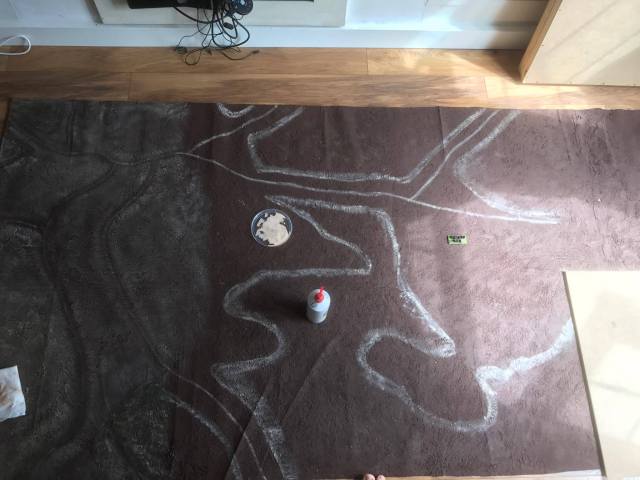
Marking it all out and getting stuck in there.
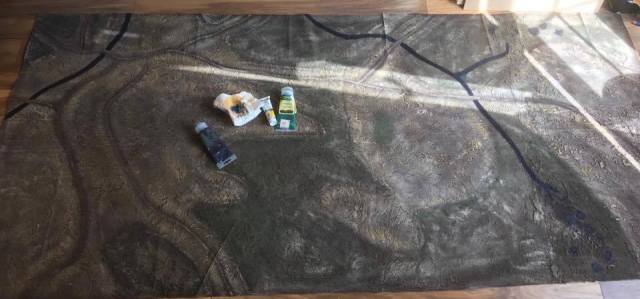
Drybrushed and ready for some static grass and flock!
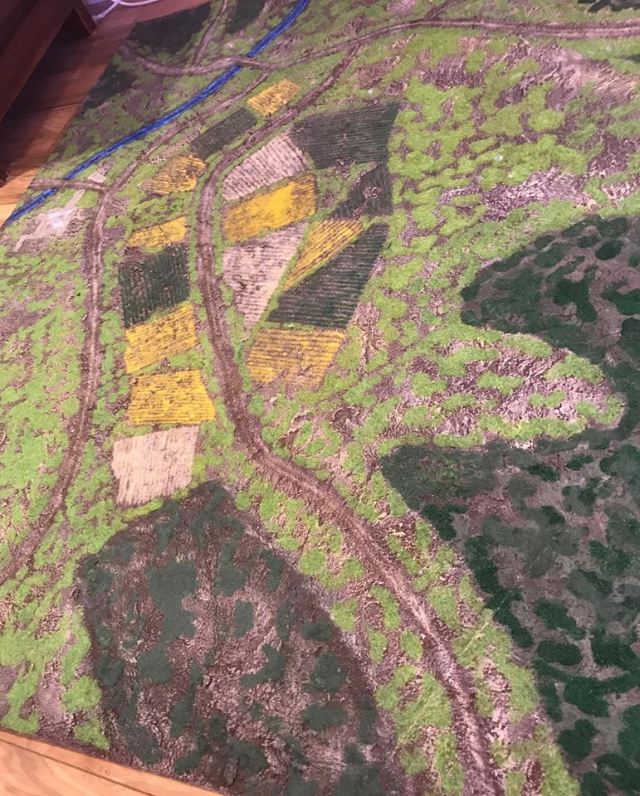
After static grass, flock and river detailing (and a good vacuum clean!) – I am actually very pleased. Dark green areas will be covered with trees and I will make some small bridges to put over the river crossings, and some buildings for Lesnaya and finally some features to show the elevation on the left.
Some details (note road space exaggerated – to allow a basewidth through!)
I think it will be good enough for the day! It took some time but I think it was worth it. It took two relatively long sessions to get it done.
Plan B
As you are aware we have two tables at Joy of Six this year (16th July in Sheffield, see more details here) – the Lesnaya Battle as show above but we were also going to do some French-Indian War using the Sharp Practice 2 (SP2) rules with the help of Neil Shuck, of Meeples and Miniatures (see, or actually listen, here!) fame; “Hello Neil!”. Neil and I ran the Saga games last year and we had a blast. However Neil is not able to make it this year so I decided to change the plans slightly and run something with the Little One. We have too little time to get up to speed with SP2, to give it a fair go, so we decided to go with plan B. As you are well aware we have grown very fond of the Dan Mersey rules and as there are no other fantasy games on offer at Joy of Six this year – we went and figured.
I will do a little presentation of that game next week but you can see some background in previous posts (here). In addition I decided to do a few more units and here are some work in progress shots (Ogres and Treemen from Irregular Miniatures, Elves from Baccus and Centaurs from Rapier Miniatures).
/ Take care and hope to see you at the Joy of Six(tenth July)
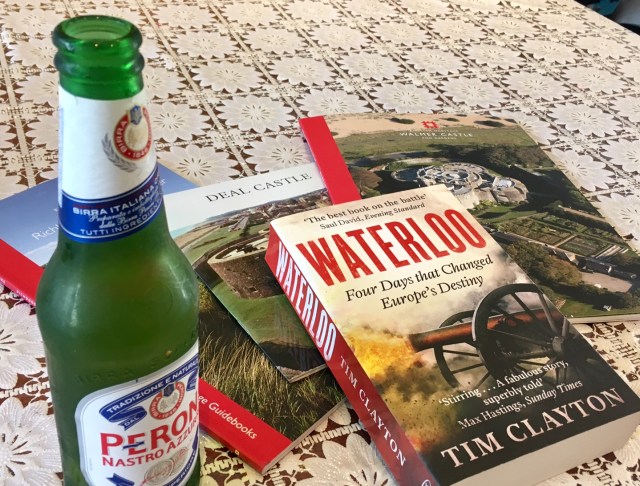
I had a fantastic day on Saturday as the better Ones arranged an early Father’s Day present with a day out that I could not have designed any better myself. I got to see two of the gun forts (Deal and Walmer Castle) that were established following Henry VIII’s break with the Roman Catholic Church and the associated fear of an European invasion. On top of this we went to the old Roman Richborough fort. All of these sites are very close to Dover castle (that is a fantastic place but we did not go there this time) and doing all three sites made an eventful and varied day. All of them are being run by English Heritage (here are links to them should you be interested, Walmer, Deal and Richborough Fort).
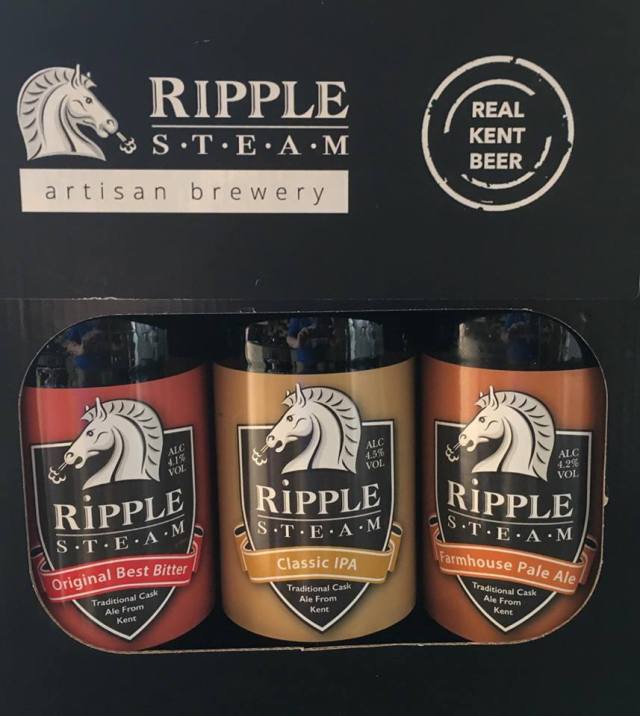
We found a few bottles of fine Kent produce as well.
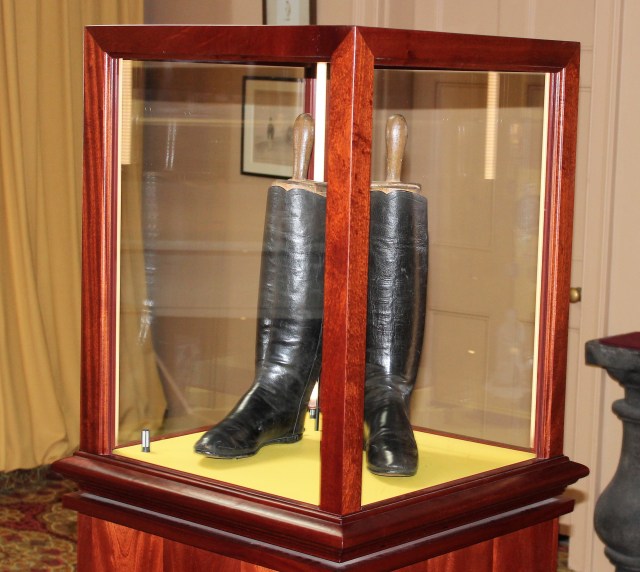
…and we also got to see a pair of Wellington’s own boots. These can be seen at Walmer Castle, where you can also see his field bed that he slept in during this campaigns. This is also the place where the great solider died. Incidentally today is also the anniversary of his most famous battle – Waterloo.
Father’s Day in all glory but the Wargames Show must go on, so on Sunday morning I set out to do the next step of the Lesnaya battlefield – the base mat.
I used the following in doing the mat (base idea from previous posting here, read the external stuff as well as these contains a lot of useful hints and different approach, I am doing the base brown mat first not all of it in one go – for example):
Drop Cloth / Dust Sheet – bought mine from ebay £10.54, it was 12′ by 8′ (I need 4′ by 8′ for my mat, but will do it a little bit wider) – this should be enough to do another larger mat as well. I use the variety that has a weave side and a laminated waterproof side.
Acrylic Sealant / Decorators Caulk (Note: make sure it is acrylic/paintable not silicone that does not take paint very well) – costs from £1 and upwards – I got a good deal on some brown variety (helps out as I want the base colour of the mat to be brownish) for a little bit more. But white should work, you just need enough paint. I used a total of 10 No. 310ml tubes (for use with applicator gun!).
Birdcage Sand – this is fine sand with some crushed Oyster shells that helps the cage birds in their digestion and is a source of calcium. For us the crushed shells helps to create additional structure on the surface of the mat that will look good once dry brushed. I got myself a large bag of sand for a fiver (£5) from the Pet Shop.
Paint– I bought some chocolate brown emulsion paint from a pound shop that I mixed into the overall mix (I used two small pots), this made the Colour less sharp (the basic brown acrylic is not that nice and looks more like something else than a basic ground colour).
Mix it all up and spread it out – let it dry. Not very impressive so far but I now have a 8′ by 4′ structured surface that I can start tailor making for the Lesnaya battle (as presented in the last blog!, see here), with drybrushing, flock and static grasses. I will leave it to dry for the day and then cut it out and roll it up.
But that is for another day, now I am going to go and fully enjoy Father’s Day!
After having banged the 6mm skirmish drum for a while I have no choice but to get on with the big battle of the Year as Joy of Six is getting closer.
In creating a battle board for gaming a known battle there are a number of steps I take to allow me to create a reasonable area that creates the right balance between four elements – historical accuracy, playability, available space and overall visual impact. Remembering important issues such as the difference between the ground scale and the figure scale for large scale battles (and building scale) – this is why you see towns represented by just a few buildings next to rivers that looks like the models could just jump over.
The Lesnaya Battle was not a straightforward “line-them-up-and-attack” battle but happened in stages where the Russians first attacked the Swedish rearguard that was reinforced in stages but the front line of battle constantly moved back towards Lesnaya – it quickly became clear that the battle would be best played length wise on the table.
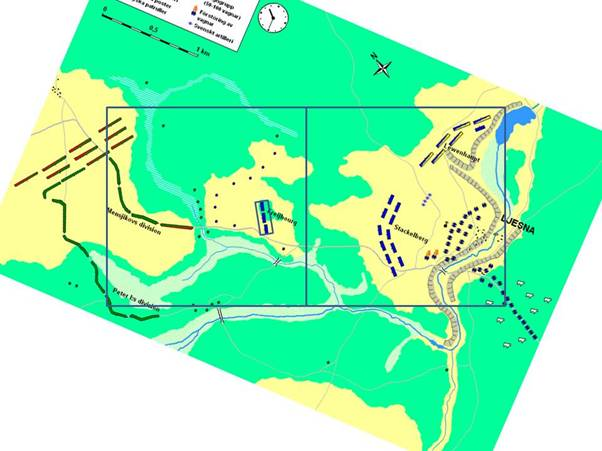
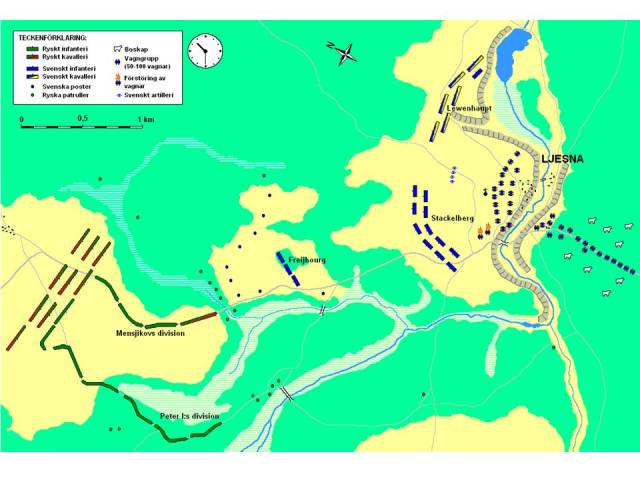
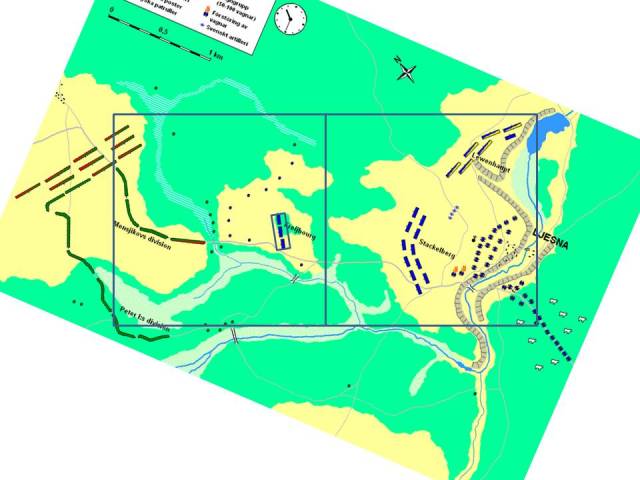
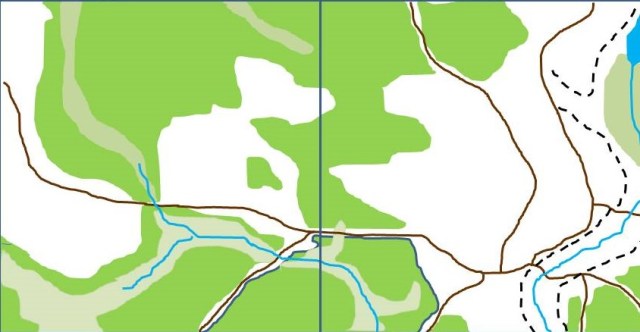
I have used the map below as basis for the battle board and it was produced by Örjan Martinson on his absolutely brilliant Tacitus Webpage that contain a lot of useful information about the Lesnaya as well as other battles of the Great Northern War (link here http://www.tacitus.nu/gnw/battles/Lesnaya/ ). The map show the position of the opposing sides at the start if the battle (Note the name of Lesnaya in the traditional Swedish spelling – Ljesna).
Map from the Tacitus Webpage at the Start of the Battle
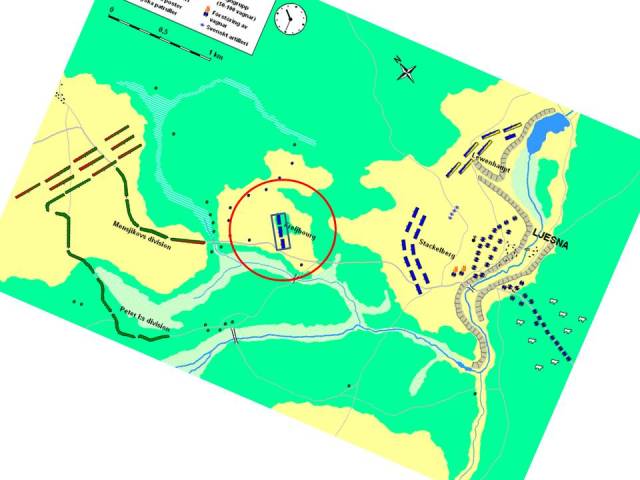
The first thing I wanted to do was to overlay my conceptual 4 by 8 feet (120cm by 240cm) battle board space over the map and see what area this would cover – would it be enough to play the battle on? In this case I simply use the Freijbourg Rearguard as the basis for my battle board (marked in the red circle) for my calculations. The Rearguard consisted of 2 No. battalions of De la Gardie’s Regiment and 1 No. battalion of the Närke-Värmland 3-männing Regiment. In the Polemos Rules each battalion is represented by a 60mm frontage base and in the Twilight of the Sun King rules this is (at battalion level) represented by a normal unit (2 No. 60mm frontage bases) and a small unit (1 No. 60mm frontage base). Giving some space between the battalion I used a length of 20cm for the 3 bases.
The Rearguard Battalions
In the PowerPoint files I used to do the exercise the length of the Rearguard Box (in the picture) was 1.4cm and I multiplied this with 6 to get the equivalent of 120cm (or 4 feet) length, this is 8.4cm and I created two squares (with 8.4cm sides) and overlay these on the map to represent the area the board would cover. To my (happy!) surprise the area covered (as shown in the picture below) was spot on for where the fighting actually occurred. Sometimes it does not work and you may not have enough space – you could easily cut this board down to a 6 by 4 table by taking away 2 feet of on the left hand side. The first notable encounter between the opposing armies was at the location of the rearguard. In addition it could be possible to reduce the depth as well but we did not have those problems on this occasion. All the Russian forces will not start on the board!
Following a deeper review of the overall battle from the start to finish with regards to the known locations of fighting, the area covered is sufficient to represent the fighting on the day.
The area captured!
But wait!, you may say… In the In the Twilight of the King Rules a base width (60mm, or 6cm, in our case) is about 150 meters, meaning that the frontage for our 3 bases (18cm) is about 450 meters. As we measured 20cm this equates to about 500 meters width for the set of three bases with some space in-between. We can clearly see that the width of the rectangle is far less than the 0.5km length based on the ruler in the to left corner. So in terms of adherence to real scale it does not work but in terms of ground scale and playability it does – I think that makes sense?
Case Study: Fraustadt 1706
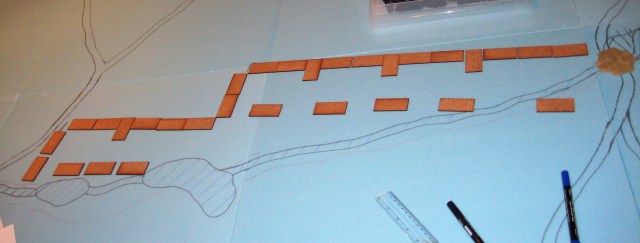
Another example is when I did the wintery Fraustadt 1706 Battle a few years ago where the main feature was the line of Saxons and Russians between the two Villages (Rörsdorf and Geyersdorf). The key design feature of that battle board was to be able to fit all the based miniatures for this line the space available. I physically put all the bases on the table and used this to draw the features on the board, this gave me the “correct” measurements to play the game efficiently. I recall that I took some liberties on the Saxon/ Russian left flank to make the it work, but overall the battle board reflected the terrain features of the battle.
Working on the Fraustadt Board in 2012
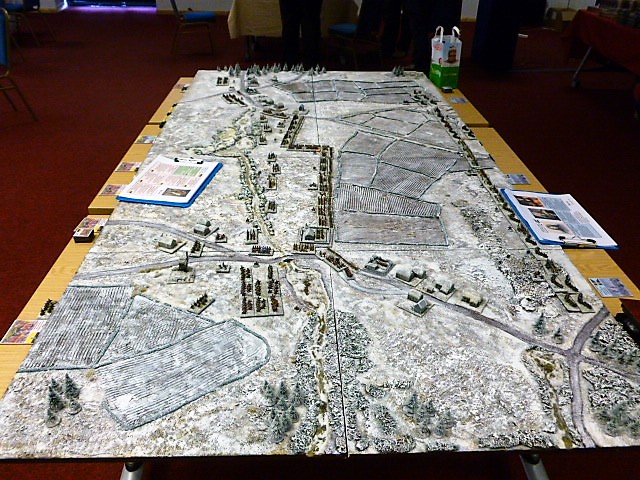
Joy of Six 2012 – Battle of Fraustadt 1706. The Saxon-Russian line was not straight as it did not fit the available space. You can find the Ordre de Batallie (OdB) here. It is a map from the excellent book (Fraustadt 1706 – Ett fält färgat rött) on the battle by Oskar Sjöström (only available in Swedish). I used this OdB and the map as a basis for doing the terrain boards. The only change I did was to make move Rörsdorf to make the overall line slightly straighter. All in all the table showed a (1) historically feasible set-up with the key terrain feature present, rivers, roads, pond villages, etc (2) it was playable and the table was based on the frontages used for the battle, (3) it fitted on the table allocated and (4) I think that although the table perhaps leaves you cold (with the pun intended) it is spectacular enough!
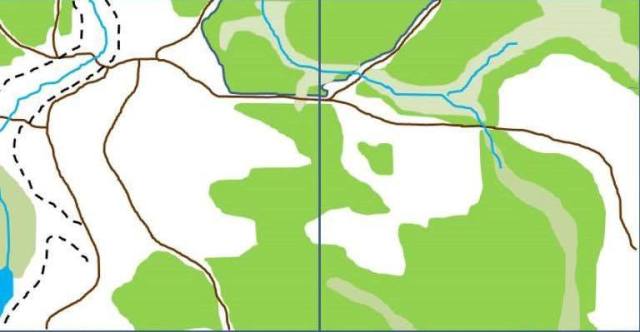
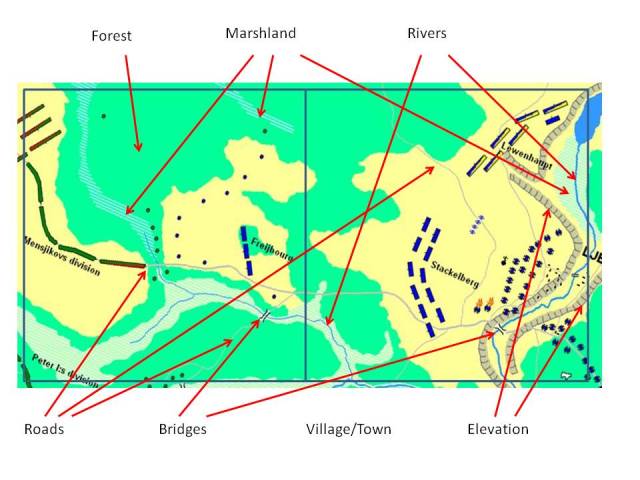
Back to the Lesnaya table and the next step which is to highlight the key features of the battlefield that are needed on the final battle board. The board will contain a lot of forested areas (!), roads (important as they cut through the forests), rivers and bridges and the elevation around Lesnaya and the river.
Key Features
After this I mark out the features (I did not include the bridges or Lesnaya itself at this stage) and we are ready for the tools and the materials.
Sketch for further works
I have previously made the Great Northern War tables as 8 No. 2 by 2 feet boards but decided to do a mat this time in the same way as the Saga mats last year (See link here https://rollaone.com/2016/06/19/saga-in-6mm-part-7/ ).
The mat will incorporate the forest areas and make these darker than the general white areas (these will incorporate a few fields) the marshland will be a in yet a different colour and I will create separate river tiles to put on top of the mats (with bridges), including the elevations around Lesnaya.
I have not yet started the mat, instead focused the weekend on basing some trees – I will need a fair few.
Hope to show some mat progress soon.
I am working on some 6mm fantasy stuff in the background, here are a few pictures of work in progress (I will do a write-up later).
I do apologise if you are a follower of this blog and got sent an update earlier this week. I did a draft based on what I intended to do this week and instead of saving it to add some more text and pictures to over the weekend (when I actually had something to show) I pressed publish. Anyway here is the real update, hope it is of some interest.
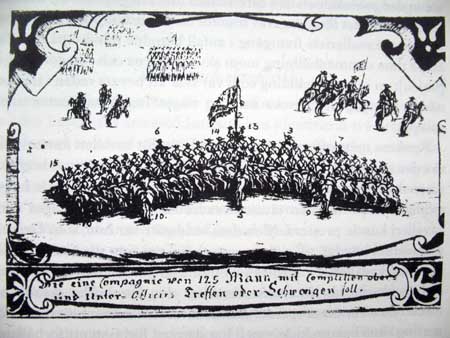
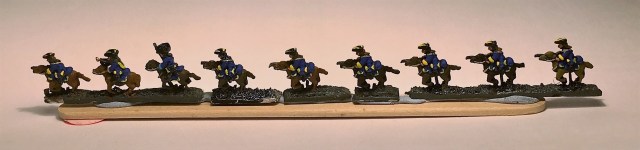
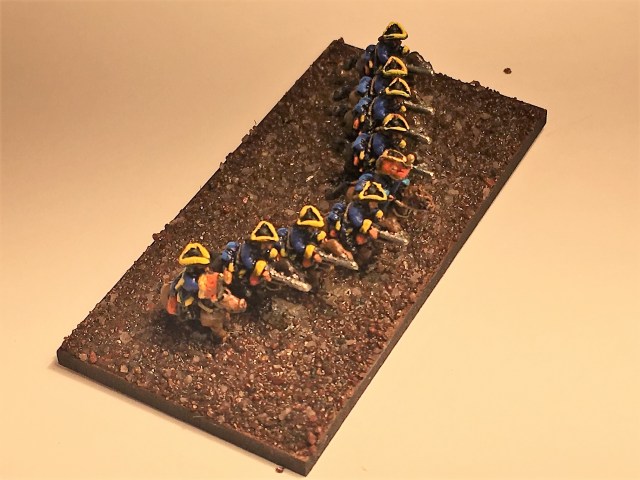
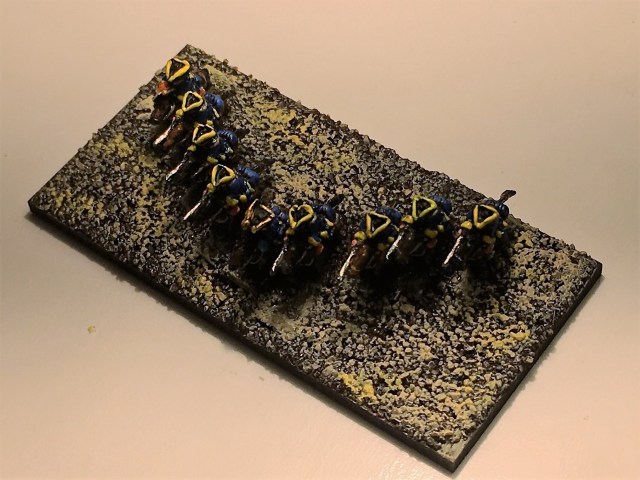
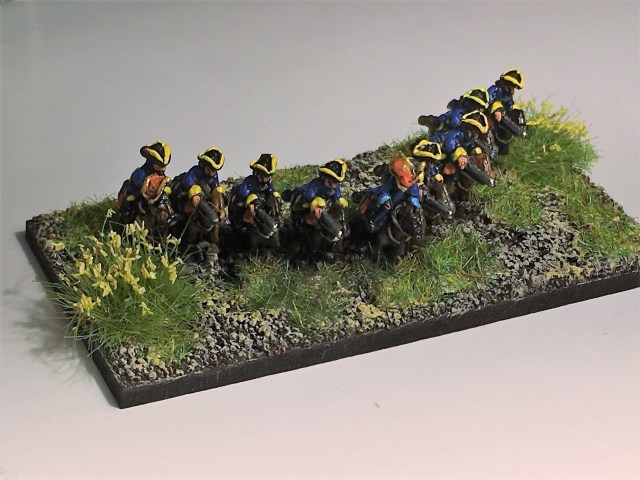
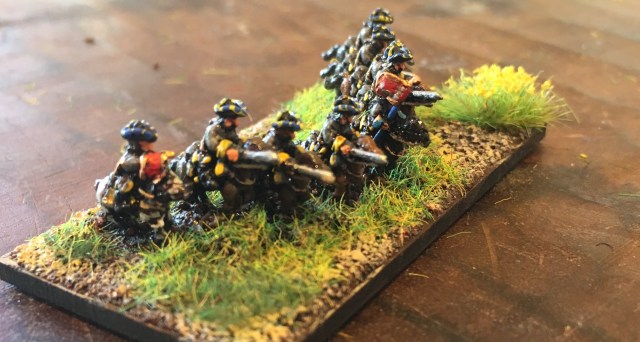
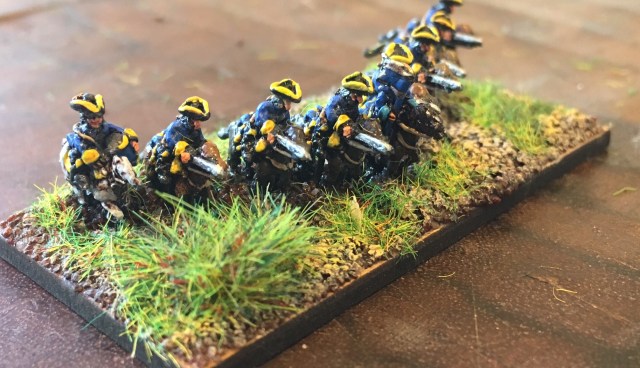
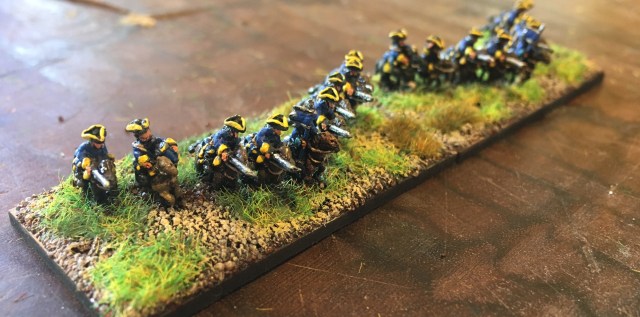
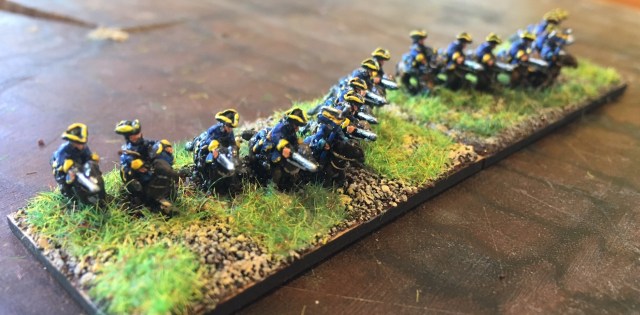
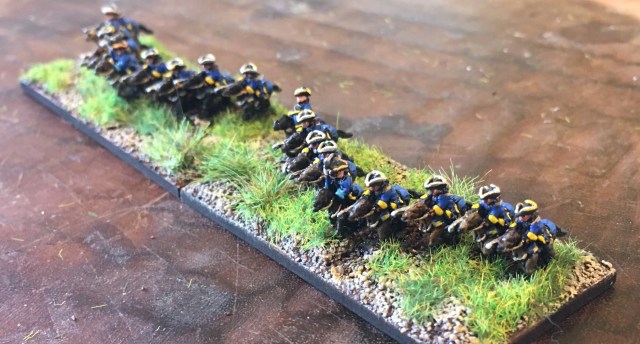
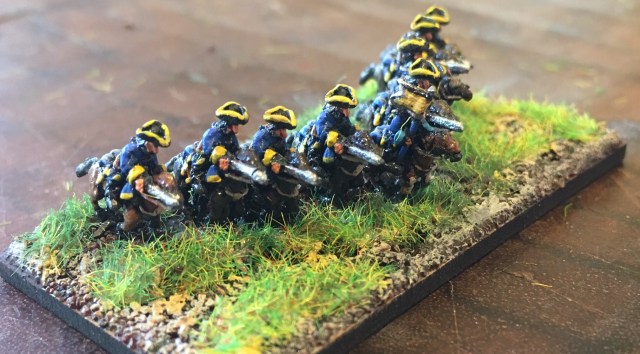
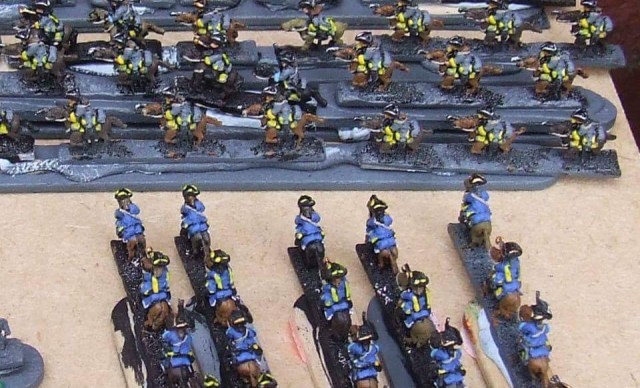
Back to basics again and a update on the progress with the Lesnaya battle, this time the hard-hitting Swedish Cavalry. All based in a wedge formation. This formation represents the way in which the cavalry (and dragoon units) attacked (knee-behind-knee) as part of the overall Gå–På–method focused on aggression and shock.
Picture by Krigsarkivet (Swedish War Archives) from 1707, Public Domain (link here)
All these miniatures were part of a commission I received from Chris at Marching Colour (link here), this is the third batch he has done for me and I have nothing but praise. I know I said it before, but it has given me time to explore some alternative stuff I normally have no time to do.
My remit to Chris was “Block painted neatly not with layers, hightlight, varnish or basing”. I also asked for the flags/standards to be left blank.
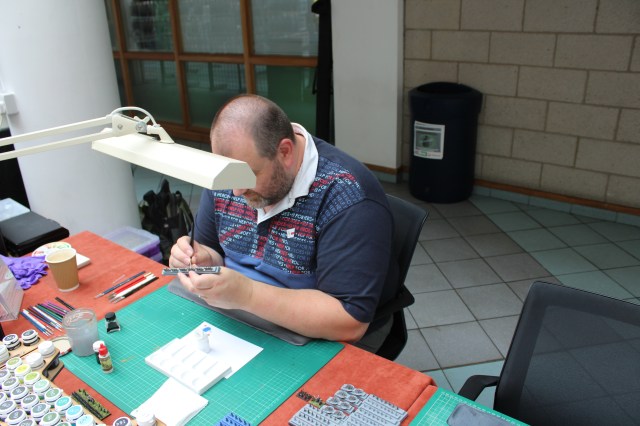
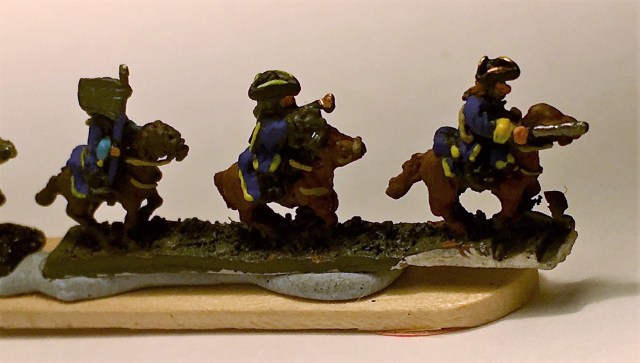
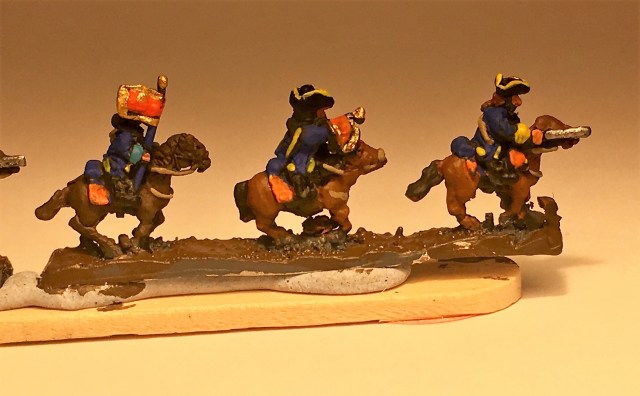
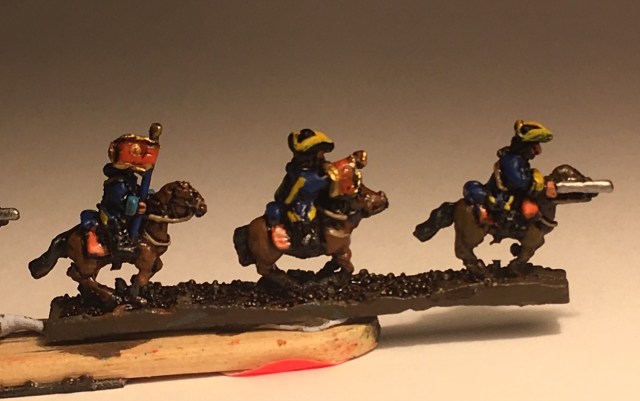
My job is the pleasurable task of doing some final touches (including flags), ink them, some highlight and base them up. Before I show the individual overall units, I will go through these steps. The models from Chris are more or less ready to be based without doing these additional steps – but to me it makes a difference and adds some satisfaction in having provided some kind of input into the overall production process, whether you can actually see it on the table when you stand up and look down at them. A kind of flat pack approach to miniature painting, but hopefully more enjoyable than those Billy Bookcases from IKEA. I am using the brave riders of the Åbo och Björneborgs Kavalleriregemente as an example. With regards to painting guide there are some reasonable information but a lot of gaps (see the discussion here, on the Tacitus webpage that also shows a reasonable interpretation of the material available for this and many other battles). I am also lucky enough to have copies of the eminent Acedia Press books The Great Northern War 1700-1721 : colours and uniforms Part 1 and Part 2 that contains a lot of further information. The books are long since out-of-print.
Step 0 – Done by Chris – block paint miniatures neatly (the longest step)
Step 1 – do the flags and any repainting (e.g on some occasions I have changed the colour of a horse etc)
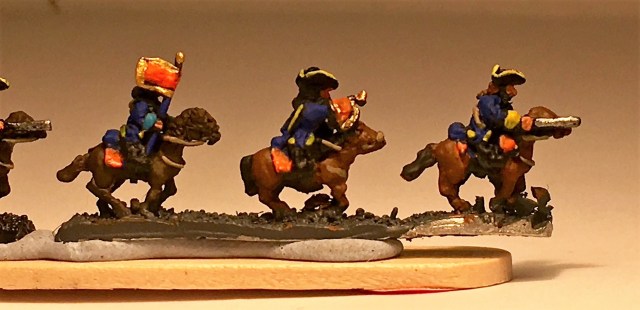
Flags (a orangy standard for these guys)
Trumpeter (or drummer) details
Light Silver on the swords (adds to the overall effect)
Highlight the hat lace (in this case yellow)
Horsetails in dark grey (german grey)
I changed the schabraque and pistol covers to Orange although I had told Chris something different (no information and perhaps unlikely but Orange it will be).
Step 2 – Paint the bases of the miniatures brown (I use a burnt umber or chocolate brown for this – same as for my base terrain colour)
Step 3 – Apply Nutbrown Ink – let it dry. Apply generously, avoid the metal parts (no soldier would keep his, mostly men in this case. sword rusty). I sometime add some highlights if the ink makes it to dark or messes something up.
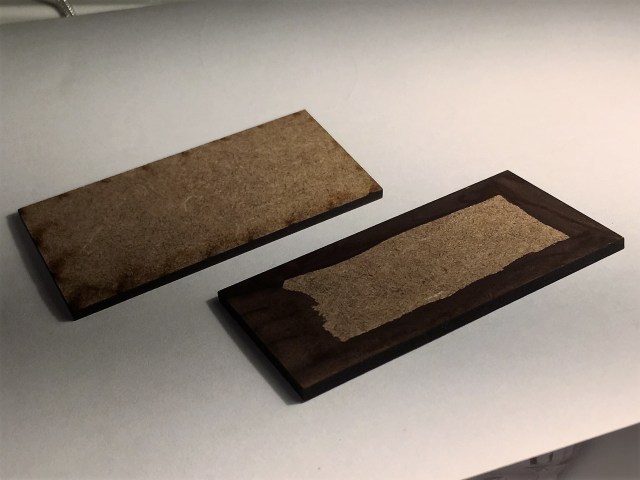
Step 5 – Prepare base. I paint the edges brown as it saves time later. I use 2mm laser cut 60 by 30mm bases.
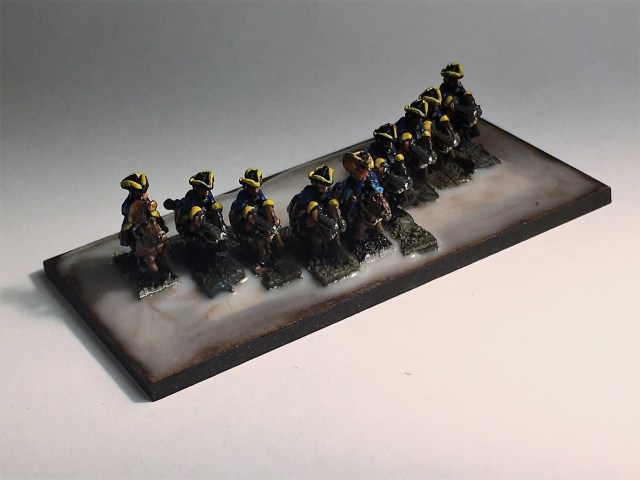
Step 6 – glue to base. Well first you have to cut the strips into the individual riders, make sure each of them can stand on a flat surface so they do not fall in the glue later. Apply glue all over the base when you are ready to put them on the base. Note: The miniatures forms a shallow wedge shape (in line with the picture above) with the trumpeter on the right and the Kornett in the middle and furthest ahead holding the standard. The Kornett, or Cornet in English, was the lowest commissioned officer rank equivalent to a Second Lieutenant (or Fänrik in Sweden) . The rank was also used in the British army up to the late 19th century. It has nothing do with the family of wind instruments with the same name.
Step 7 – Apply sand as soon as possible. Carefully flip it slightly so that excess sand falls off. If any bare metal still shines through or the bases are too obvious apply a little bit more of glue in these places and apply some more sand, “flip away” the excess carefully and then let dry.
Step 8 – Paint the sand brown (I do not as I have some chocolate coloured sand)
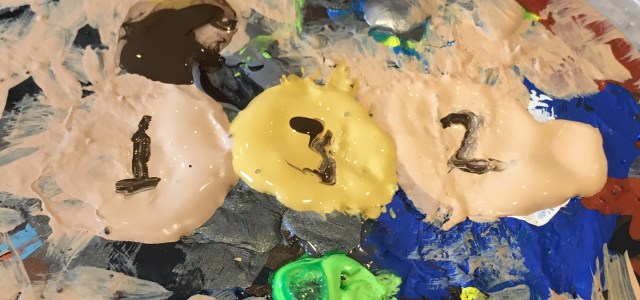
Step 9 – dry brush Colour 1 to 3 (decide on a set and stick to it, all your stuff will look the same whether you do them today or several years ago. The picture does not really come out well. The colours are a very pale brown, a little more yellowish brown and fnally a light yellow. But try out your own combo.
Here are the colours I use.
Step 10 – add PVA glue where you want the static grass. Apply Static grass and shake off excess (same here get a lot of a brand and stick to it, I use Busch light and dark grass. Mostly the light) I then stick on some flowery tufts when I feel for it (they are a little bit overwhelming scalewise, but I like it!).
Step 12 – Add base to your collection (here with the other three bases of the regiment).
Anyway here are the other ones I have done this week in no particular order,
Cavalry Regiments
Karelska Kavalleriregementet (4 bases)
Adelsfanan i Sverige och Finland (1 base) – a company was part of Lewenhaupts army. So a base may be excessive. But why not.
Adelsfanan i Livland och på Ösel (1 base), this is the Cavalry Corps of the Nobility in Livonia and Ösel. Strictly speaking Adelsfanan means the Nobel Banner.
Dragoon Regiment / Squadrons
Skogh’s Dragon Skvadron (1 base)
Karelska Land Dragon Skvadron (1 base)
Damn, forgot to this one. Well…..
Schreitterfeldts Dragonregemente (2 bases)
Schlippenbachs Dragonregemente (2 bases)
Upplands Ståndsdragoner (2 bases)
Öselska Land Dragon Skvadron (1 base)
Light Horse Regiment
Vallack / Vollosh Regementet (2 bases) – light cavalry unit formed from Polish and Lithuanian Free Companies. I have plenty of these from the past already so I will be using a few of those on the day.
I did the Swedish infantry before (see here). So all that remains for the Swedes are some commanders and that dragoon base I forgot!
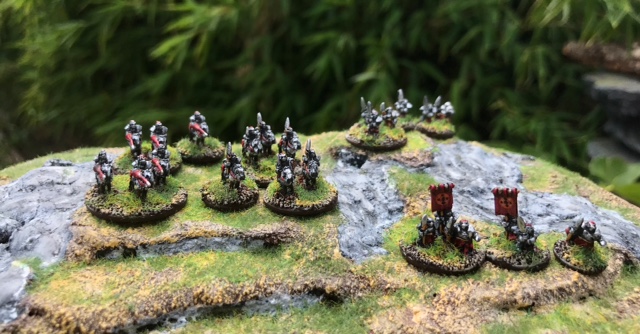
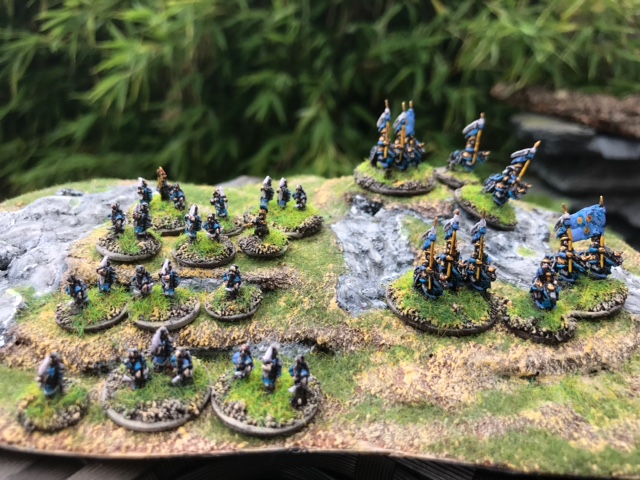
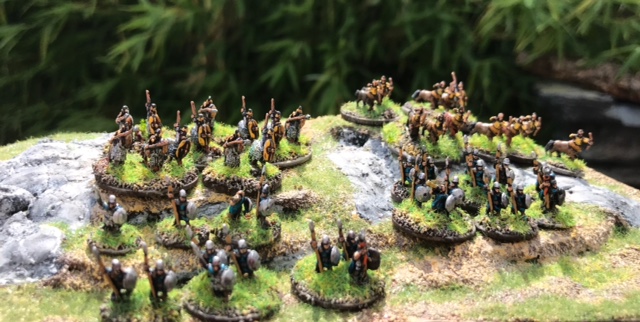
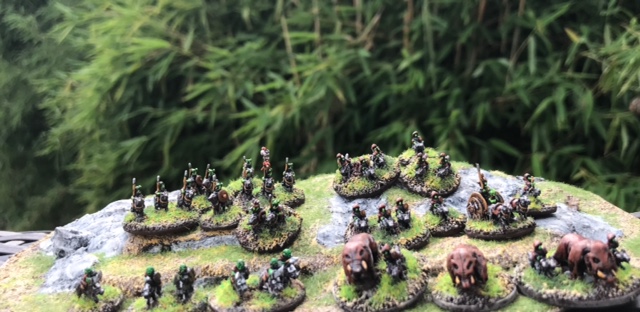
In the previous blog entry (see here) I set out the forces and the miniatures I intended to use for this project. I have just completed these units this week and hope to get a game with the Little One in the near future. Same approach as always in trying to achieve reasonable results not individual master pieces. The units I planned to do were as follows, based on some possible small encounters during the Pruth Campaign 1711.
Ottomans
No
Pts/ unit
Total Pts
Unit Size
Total Models
Baccus Pack
Veteran Shot
5
6
30
12
60
OTT02
Trotters
4
4
16
6
24
GNP05
Total
9
–
46
–
84
–
Russians
No
Pts/ unit
Total Pts
Unit Size
Total Models
Baccus Pack
Dragoons
4
4
16
6
24
WSS12
Forlorn Hope
3
6
18
6
18
WSS03
Raw Trotters
4
3
12
6
24
WSS08
Total
11
–
46
–
66
–
I am very happy with the result and I am tempted to make a small Swedish “force” from the same era (with some pikes).
Perhaps something like this.
Swedish
No
Pts/ unit
Total Pts
Unit Size
Total Models
Baccus Pack
Shot
5
4
20
12
60
GNS01 (Tricorne) or GNS02 (Karpus)
Pike
2
4
8
12
24
GNS03 (Tricorne) or GNS04 (Karpus)
Aggressive Elite Gallopers
3
6
18
6
18
GNS05 or GNS06
Total
9
–
46
–
102
–
Sorry trying to avoid drifting, back to the Pruth stuff.
Russians
For the Russians I decided to go for units with red as a common denominator and painted them as based on units that took part in the campaign (based on a list from the draft of Nick Dorrell’s upcoming book – discussed in the previous blog, here). All these are from the “new” Baccus WSS range – I had not yet painted these but I must say that they are a joy to paint. I have so far used the old WSS range for my GNW stuff as I have a fair few of the ones lying around from previous purchases with hybric flavours.
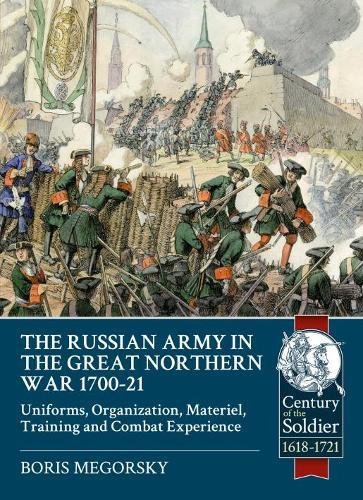
On the subject of the Russians of this era I did notice a book currently on pre-order due out in November this year. The book is titled The Russian Army in the Great Northern War 1700-21 with the subtitle Uniforms, Organization, Materiel, Training and Combat Experience. I hope this will have some more information on uniform colours than what is currently available. Although I have to admit that I pre-ordered it based on the title, what is really interesting is the background of the author. I let you read it yourself.
Boris Megorsky was born in Leningrad, USSR in 1978. He lives in St Petersburg, Russia with his beloved wife Olga and three-year-old son Vadim. He did his PhD in Political Science and works in Human Resources, but his true passion has always been military history. As a scholar, he specializes in the everyday life of the Russian Army, its uniforms and siege warfare of the Great Northern War period; he has written dozens of articles and theses on these subjects. His book about the siege of Narva in 1704 was published in Russia in 2016 and, as a re-enactor, he is a member and sergeant of the Preobrazhensky Life Guard Regiment, 1709 ( Russia’s leading re-enactment society of the early 1700s). His passion for miniatures makes him pay great attention to details both in research and in reconstructions, be it re-enactors’ kit or graphical illustration consultations. He has consulted on a number of films, museum and publishing projects, and has worked with miniature manufacturers and artists. – From the Amazon Webpage
Here is a link to it at Amazon (but there are probably other places where you can buy it too, like the book depository). Worth having on your radar, but a long way from being out. Would of course be useful for the Pruth campaign too. Back to the key thread again.
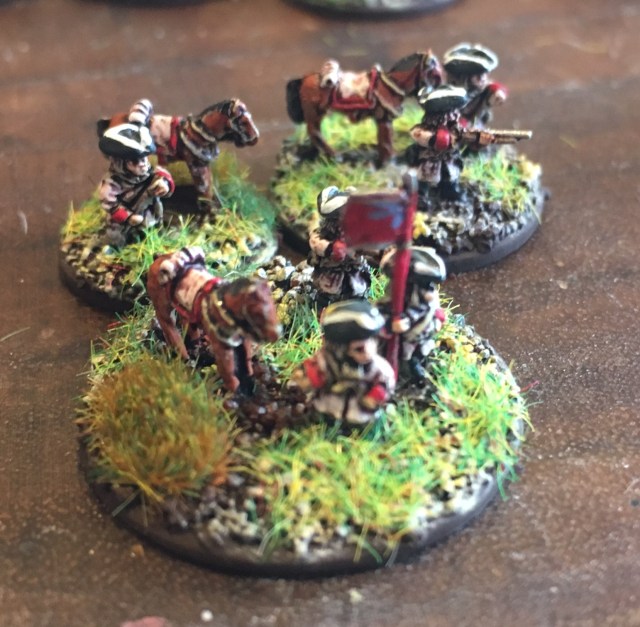
Permski Dragoon Regiment (Dragoons)
The Permski dragoon regiment were present in the 1711 campaign so I decided to make my dragoon units represent a detachment from this regiment. They had white coats with red cuffs. I have already painted some of these for the Lesnaya Battle but they are based on 60 by 30mm bases. As these represents the Dragoon in the traditional role of being more mounted infantry than cavalry they have been based with unmounted figures but with a horse present on each base. I have used the 1-2-3 system (shown in the Pikeman’s Lament rulebook), modified to fit the 6mm scale, and as discussed in this blog entry if you do not have the book at hand.
4 units of 6 dragoons, based with the 1-2-3 method (15mm, 20mm and 25mm bases)
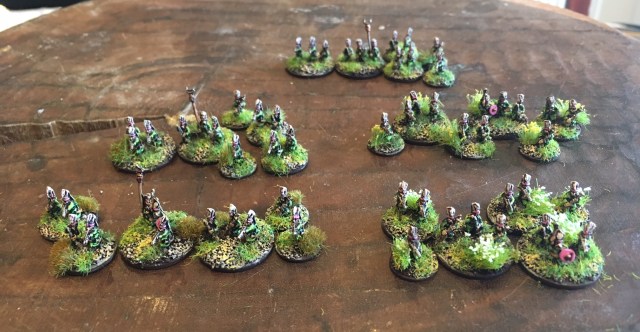
Repnin’s Grenadiers (Forlorn Hope)
I painted these to represent Repnin’s Grenadiers that had red coats with (speculative?) blue cuffs. Named after the Russian General, and eventually Field Marshal, Prince Anikita Ivanovich Repnin who commanded one of the Russian centre commands at Poltava in 1709 (you can read more about him here). These were also based with the 1-2-3 system.
3 units of 6 Forlorn Hope, based with the 1-2-3 method (12mm, 15mm and 20mm bases).
General Sheremetev’s Dragoon Squadron (Raw Trotters)
For these I wanted them to represent General Sheremetev’s Squadron, I painted them with red coats and white cuffs. Potentially these could be classified as non-raw (or even Veteran) assuming that the General’s squadron may be more potent than the standard dragoon unit. Boris Sheremetev commanded the overall centre at Poltava in 1709 and led the main army in the Pruth Campaign (more about him here).
4 units of 6 trotters, based with the 1-2-3 method (15mm, 20mm and 25mm bases).
The Ottomans
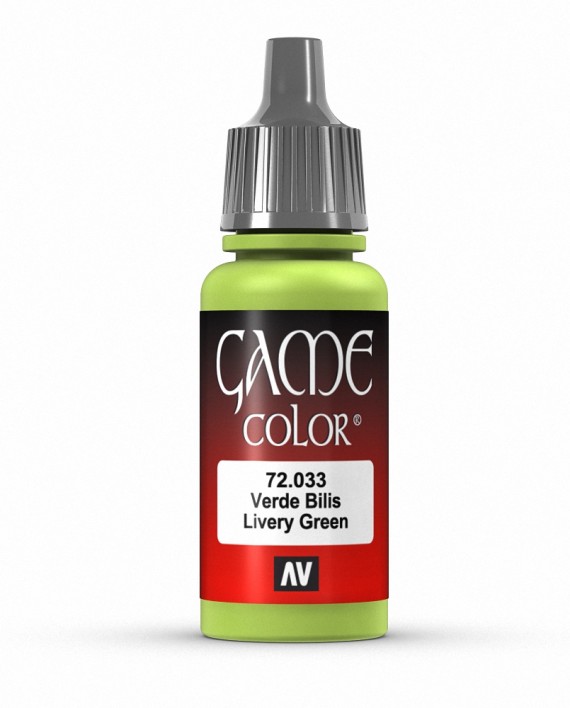
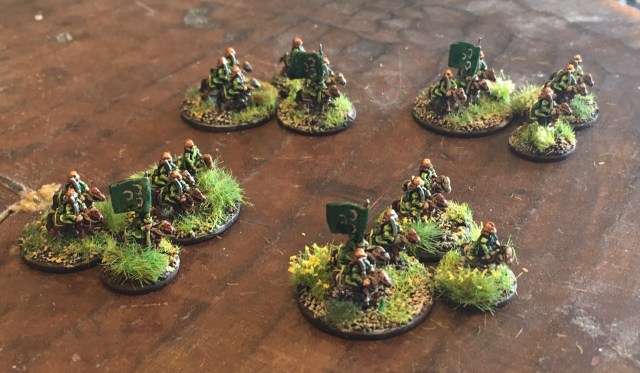
I do not have a lot of information of who wore what for these units – so I did a quick decision to paint them based on a basic livery green (green ink on the clothing and then picking out some detail with Livery Green). Finally got to use this fine Colour!
I would be very keen to get some comprehensive information on detailed organization and uniform guides from this conflict – but until then artistic freedom will do. I you have any views or suggestions please do let me know through the contact option on the blog of find us on facebook and ask away.
Janissaries (Veteran Shot)
I painted these in a green coat with the traditional white headgear with some simple pink detail/ There is a little story about how models were developed by Master 6mm painter Dr. Mike also known as Cranium (here). He is the man who runs the SMS (Small Model Soldier) painting clinics at various shows, teaching people how to paint “something so small”. I developed most of the techniques I am using in painting 6mm from reading his entries on the old Baccus forum (I do not find these anymore) – my favourite is the use of Windsor & Newton Ink (Nut Brown) after the painting is done – the army painter quick shade equivalent for smaller scales (kind of!) . It really makes the models “look better than they are”, in my opinion. Try it for yourself – go nuts!
5 units of 12 Veteran Shot, based with the 1-2-3 method (12mm, 15mm and 20mm bases).
Sipahi (Trotters)
Again a green colour scheme with bronzed helmet. I painted the flags green with three crescents as I had seen this for an Ottoman unit many years ago at a wargames show and liked it. Having done some research I am not 100% sure it is a valid flag for the Ottomans – but I like it so it stays until I have better alternative. The bronze helmets also looks good and, like the pink and white on the Janissaries, show that these uniforms where not designed to blend into the countryside but to look stunning!
4 units of 6 trotters, based with the 1-2-3 method (15mm, 20mm and 25mm bases)
Hope that was of some interest, another read of the rules and we have to hit the table with these. Not the same splendor as individual 28mm bases for skirmish, but it works for me. The fact that I have produced two opposing forces of almost twice the recommended starting size in a week of hobby-time is perhaps the biggest advantage.
I did a similar project for the Men Who Would be Kings rules that you can find information about (here, here and here).
Next week I will be showing some progress on the main project (a proper large battle). As the package with models came through from Marching in Colour last week (see here) and I have started slowly getting my act together again this week (afterthought – as if it ever was there!).
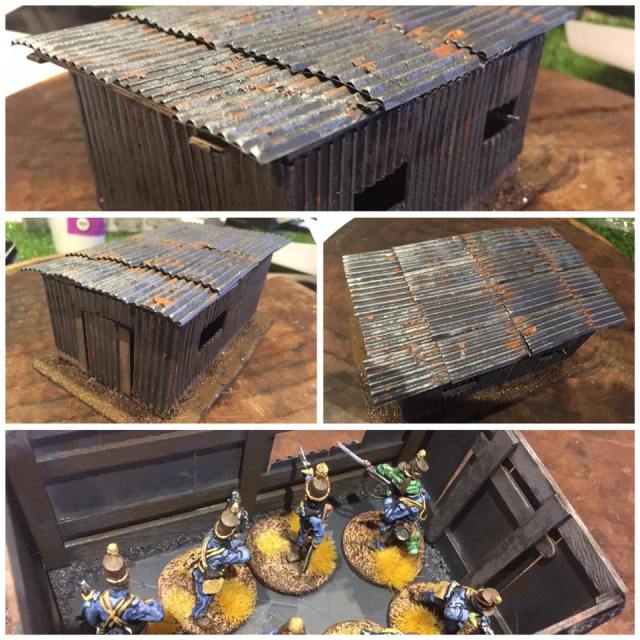
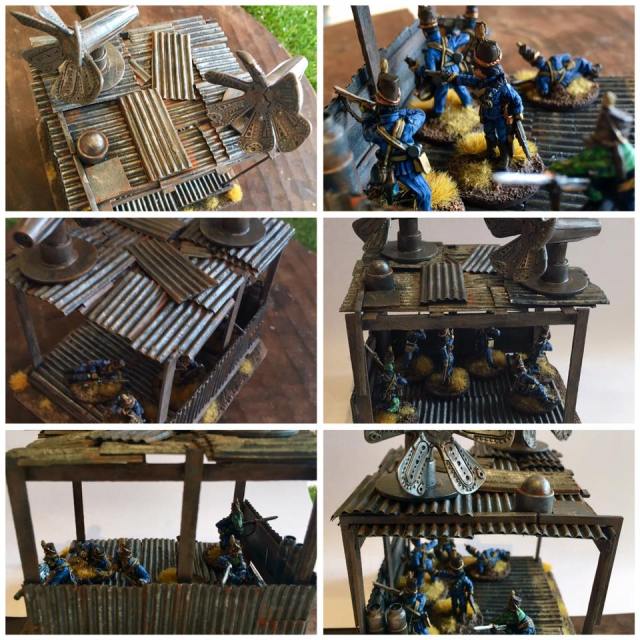
I have decided to give the Mutant 1984 project a break over the Summer – I did paint the two little structures/buildings I did a few weeks back (here) and showed them on the Facebook page. For completeness I include them here as well. I think we are getting closer to having the terrain we need for a proper game with these rules. I am excited to start a campaign with some Pyri Commonwealth Soldiers – The recollections of rifleman Crocodylus. However there is something rather therapeutic in doing some terrain so perhaps there will be some pieces done in the background of everything else.
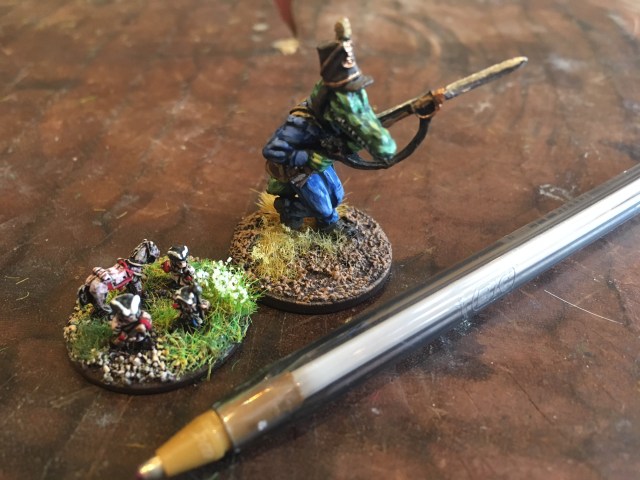
The picture below shows the good Rifleman Crocodylus himself next to to one of the 6mm Dragoon bases above and a BIC pen for size comparison, as I occasionally get questions about this through the site. The Rifleman is a converted Warlord 95th rifle model (28mm scale) with a head from a crooked dice model.
Pikeman’s Lament in 6mm – Planning and Buying Stage
Another batch for the Towards Moscow Project from Marching in Colour
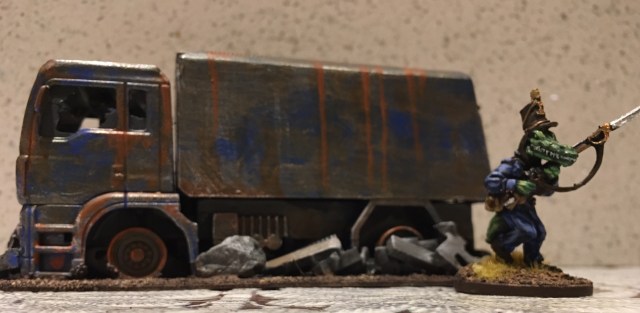
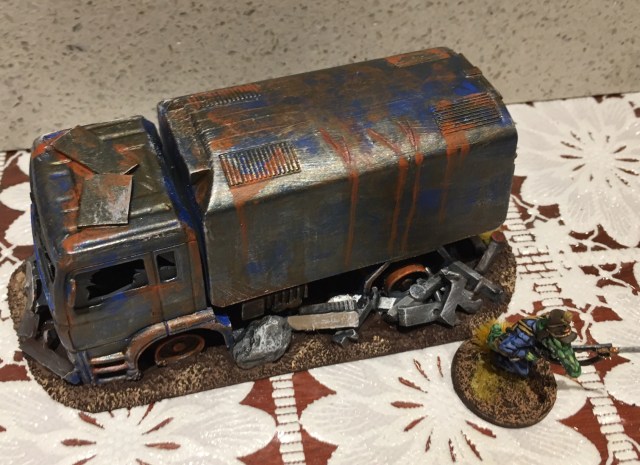
Mutant 1984 for Scrappers, some more “terrainish” stuff – a Citroën, oil tanks and some old Trucks
Pikeman’s Lament in 6mm
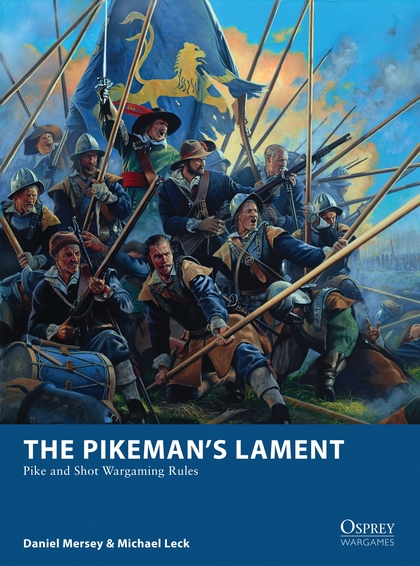
I bought a copy of The Pikeman’s Lament by Daniel Mersey and Michael Leck a few months ago. It is, as the title hints, a Pike and Shot period skirmish level game and in the sample companies provided it covers the Thirty Years War (TYW), English Civil War (ECW), the Deluge (Northern War 1655-60), Scanian Wars, King Williams War (the First French Indian War) and the Great Northern War (GNW). Being a Osprey book it has the typical style and layout of their other wargames books.
The rules are derived from the very popular Lion Rampant rules created by Daniel Mersey (who also wrote the Dux Bellorum and Men Who Would be Kings that the Little One and I really enjoy playing having had a few goes, see here for our first game) and on a quick read these rules caught my interest sufficiently to get me thinking about trying them out.
Michael Leck is, perhaps, more famous for the fantastic stuff he presents on his Dalauppror blog (here) and his articles in the Wargames, Soldier and Strategy magazine where he has presented snippets from the rich Swedish military history and how to adapt some popular rule set to play in these, more than often, unknown theatres. You may recall that I put up a picture of his fantastic, and award winning, game at Salute in the last blog update (here).Michael, and I, used to roll dice and use our imagination in the same role-playing club many moons ago.
There is a comprehensive review of the rules on the “I live with Cats blog”, that I found useful (link here). I wanted to give them a try doing two small starting forces in line with the Men Who Would be King stuff I did before. I just needed to find a period – a pleasant problem looking for a solution.
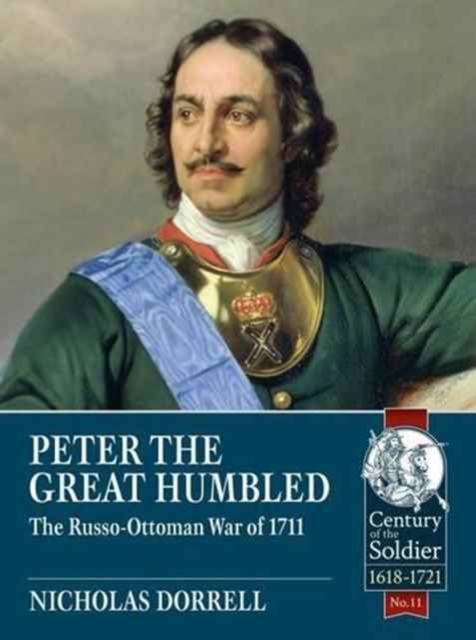
Last week Nick Dorrell, and I, were talking about some (far) future projects and we discussed the Russian Pruth Campaign. This was whilst we were running our Salute Game (more here). Nick has a book soon to come out called Peter the Great Humbled: The Russo-Ottoman War of 1711.Nick’s book tells the story about this campaign that led to the surrender of the Russian forces near the Pruth river. It also presents the forces involved in the conflict, their size, actual composition, and tactics used. It is not a very well known conflict but due to the natural link to the Great Northern War I find it very interesting and I am looking forward to read the final book (I pre-ordered my copy of Nicks book from here).
Although the engagmement were mainly attacks on fortifications some “what ifs” or special scenarios could be played – but then I thought why not do a few units from this period and try out the Pikeman’s Lament Rules. Following on from this I went ahead and actually bought a few miniatures from Baccus at Salute that will be perfect for a very small diversion to try out the Pikeman’s Lament rules. Arguably more shot than pike as the Russian left their pikes at home for this campaign (if my sources are correct), but why not?
Miniatures
I got the following packs from Baccus (pictures taken from their Webpage, as I have not yet even opened the packs):
Ottomans
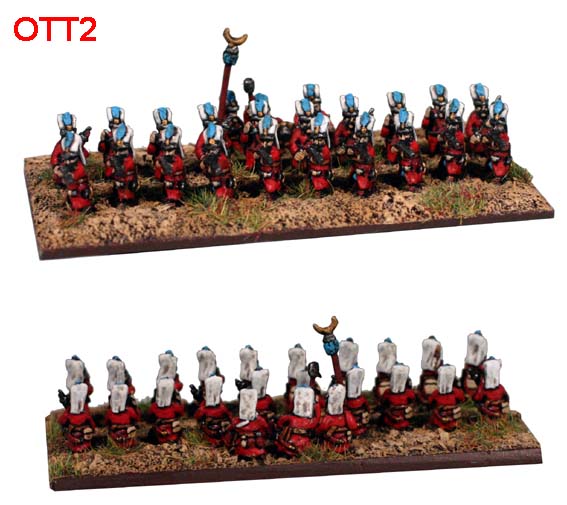
OTT02 – Janissaries, musket – firing and loading
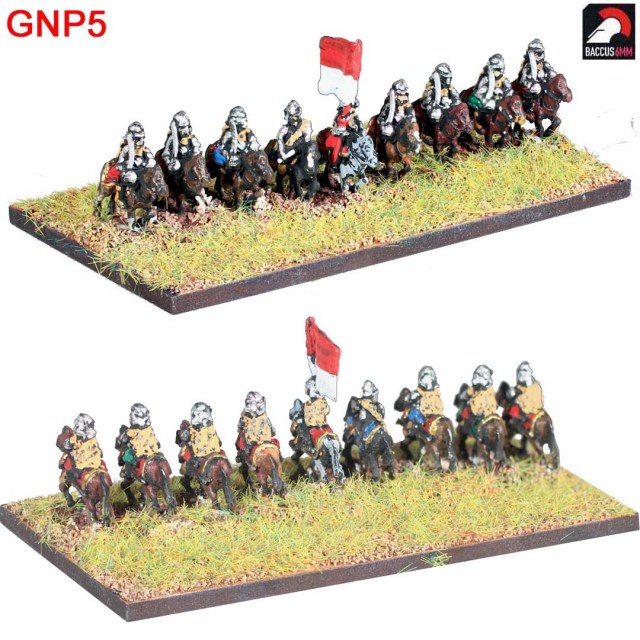
GNP05 – Hussars – to represent Ottoman Sipahi cavalry
From this I will do:
5 Veteran Shot @ 6 points each (Janissaries; may form Close Order)
4 Trotters @ 4 points each (Sipahis cavalry, the Polish Hussars without wings being used as a reasonable proxy)
Russians
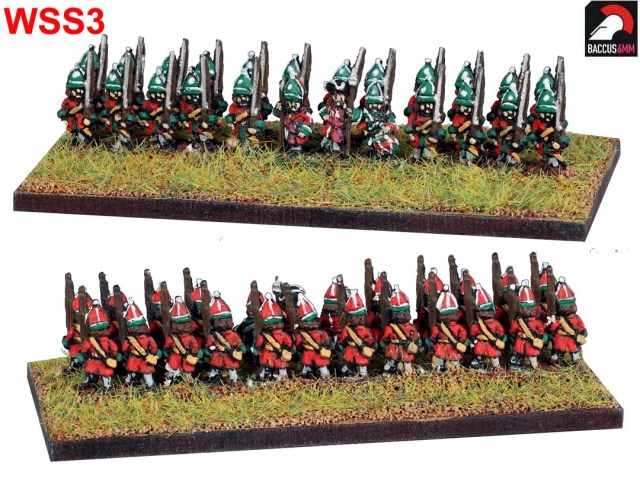
WSS03- Grenadier (Tall Mitre)
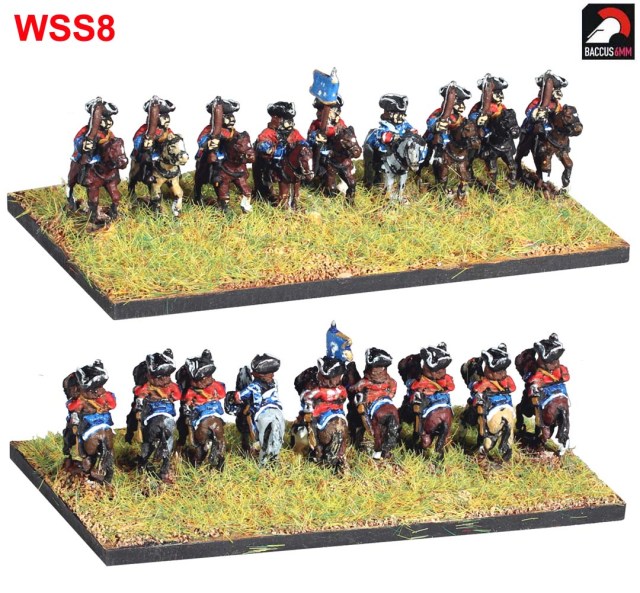
WSS08 – Dragoons
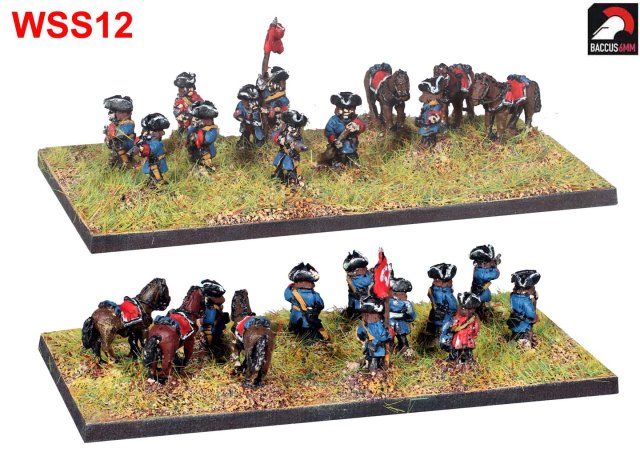
WSS12 – Dismounted Dragoons
Forces
From this I will do (note the models are from the WSS range not the GNW Russian Range, as these works perfectly well for Russians of this period. I also wanted to get a chance at seeing these):
4 Dragoons @ 4 points each (these are Dragoons in a traditional dismount to fire role as per the rules)
3 Forlorn Hope @ 6 points each (Grenadiers)
4 Raw Trotters @ 3 points each (In reality also Russian Dragoons but to simulate a more active cavalry role classified as Trotters. The Russian Dragoons did practice some all out cavalry attacks and by this time it seems reasonable but still classified as raw).
This gives me 46 points for each side (starting size is 24 points so should be more than plenty to give me some variety in size). There is also enough to do another few Shot units and Trotters for the Ottomans and some more Trotters and Forlorn Hope units for the Russians.
In summary:
Ottomans
No
Pts/ unit
Total Pts
Unit Size
Total Models
Baccus Pack
Veteran Shot
5
6
30
12
60
OTT02
Trotters
4
4
16
6
24
GNP05
Total
9
–
46
–
84
–
Russians
No
Pts/ unit
Total Pts
Unit Size
Total Models
Baccus Pack
Dragoons
4
4
16
6
24
WSS12
Forlorn Hope
3
6
18
6
18
WSS03
Raw Trotters
4
3
12
6
24
WSS08
Total
11
–
46
–
66
–
Basing and Notes
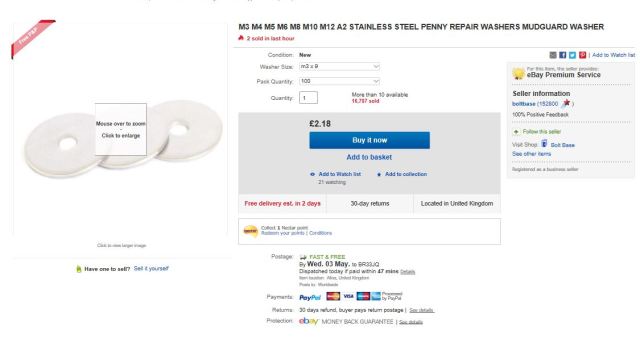
These will based as I did my Zulu war stuff based on the 1-2-3 method discussed in a previous posting (see here). I have had a few questions about where I get bases of small size like 9mm etc. Basically I order Penny Washers from ebay, here is an example (I have no association with this seller) but I have successfully bought stuff from them.
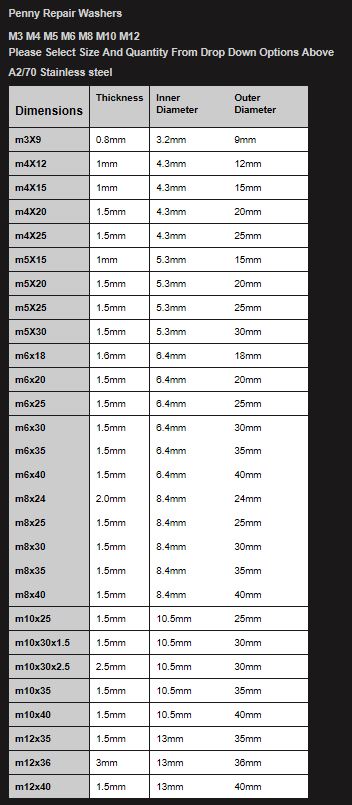
In the detail provided the following list is given, we can see the diameter we may need (outer diameter). Just pick the one you want.
With regards to the little hole in the middle I put a magnet inside and cover it with a sticker on both sides (see here to get the idea, Step 6 in the “Shock Marker” tutorial). I think the washers are also sometimes referred to as fender washers.
Another batch from Marching in Colour
As discussed in previous blog posting I have decided to use Marching in Colour painting service (link to the background to this decision here and to the Marching in Colour Website here) to help me with the Towards Moscow Project and Chris sent me through the pictures from the latest batch the other day. I have to admit that my experience in using this service have been second to none. I am looking forward in getting these and complete the miniatures needed for this and next years Joy of Six. I will get to this in the next few weeks (as I have to!) and will post updates as I progress and also discuss the next stages of production to final based units. Here are the pictures (Russians and Swedish), I let them speak for themselves. Although it is a little bit of a luxury this is the best decision for some time I have done with regards to my hobby time (and budget!). Thanks for your help Chris!
More about the Towards Moscow Trilogy (TMT) Great Northern War project can be found here.
Mutant 1984 for Scrappers
I did a few more pieces for the Mutant 1984 project inspired by three recent purchases (see more about this project here).
Muddy Car
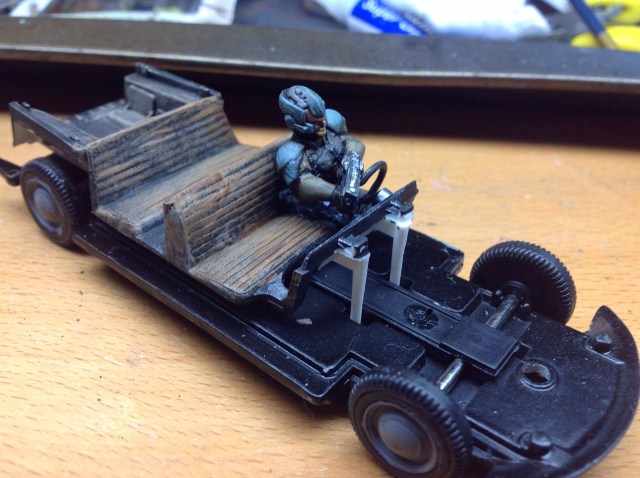
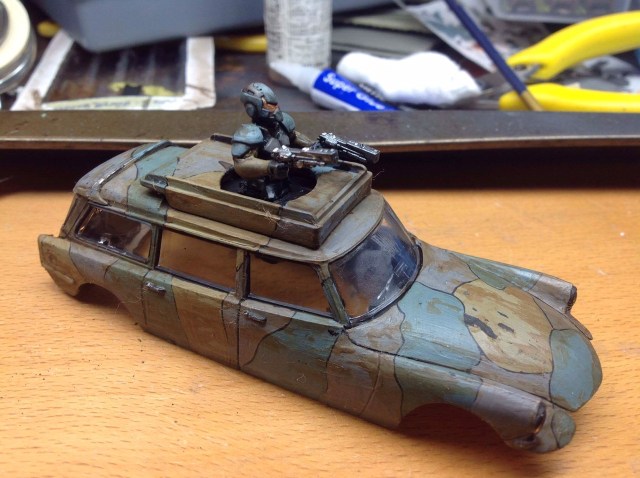
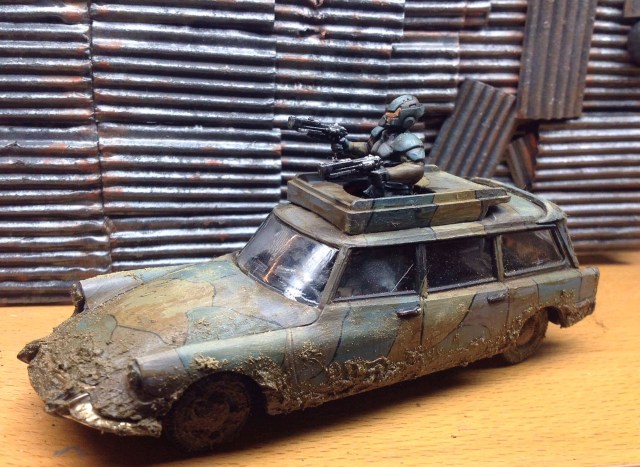
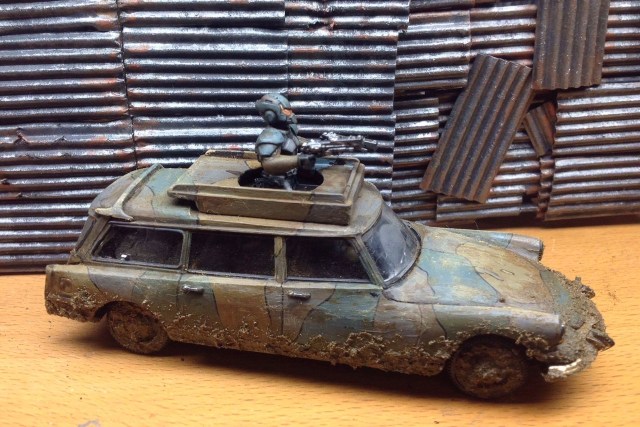
When I went to South of France a few weeks backs I went to a French Market and found one of these for a few Euros. It is a Citroën ID19 and is in 1/43 scale. I love the look of these cars.
I thought it would be weird to make it into a military vehicle and found this little pack with two plastic (28mm) miniatures given out for free at some show a few years back.
I carefully opened up the car and added one of them as a driver and the second one standing on the top. Then I painted it in three colours and gave it a Sepia Wash.
Then I put the two pieces together and applied some mud. Job done and weird enough.
Oil Tanks
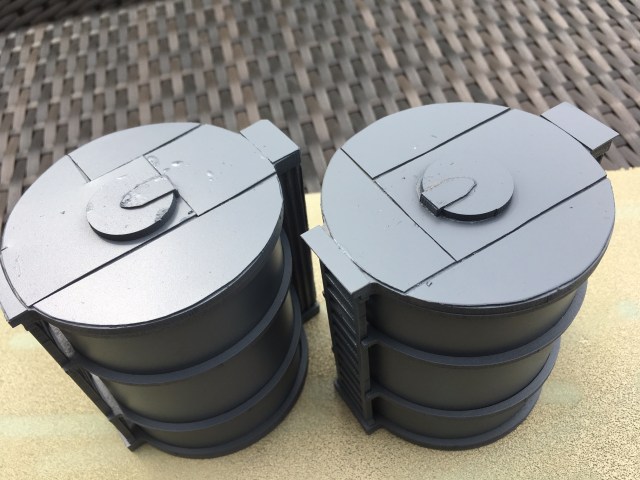
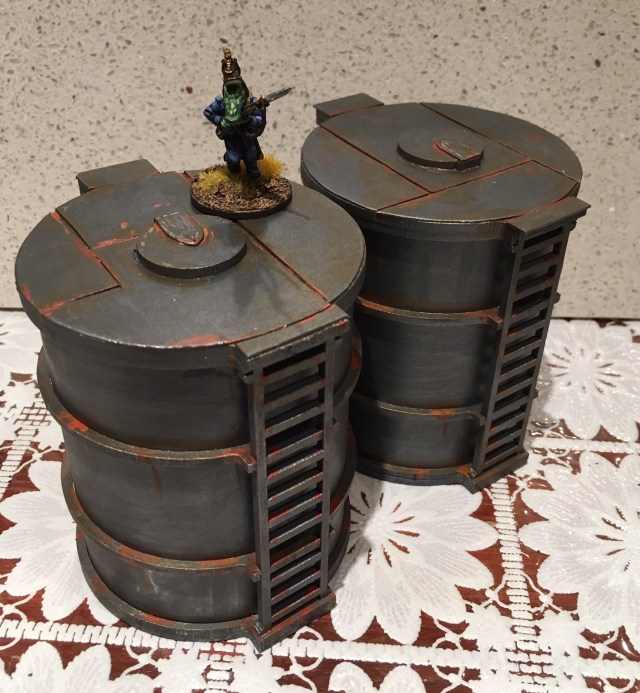
Our Salute table was next to a demo table showing some oil tanks from Bandua wargames. I convinced myself that I needed some of these. You can buy them from Wayland Games (here).
These are ready painted and the looked great with the other ready painted terrain on the table. When I had assembled them I got some second thoughts and decided to modify them slightly. I cut out some plastic (from a DVD box) and added this on top and then did some detailing on the hatch (a little piece of plastic). This created a little more detail to the piece and took 5 minutes.
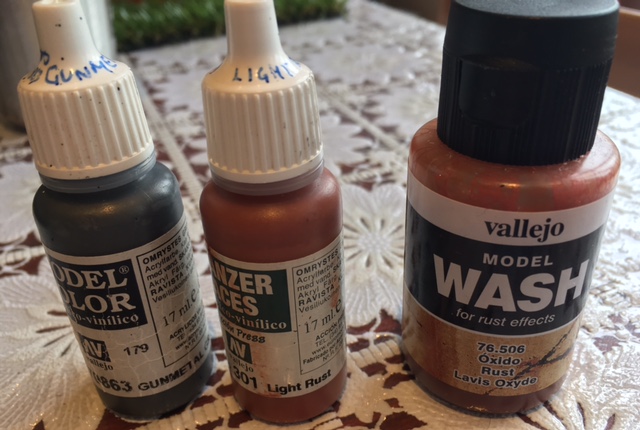
Then I dry brushed it with Gunmetal and added some dots of rust (light rust from the Vallejo range) and then applied a light wash with Vallejo rust effect.
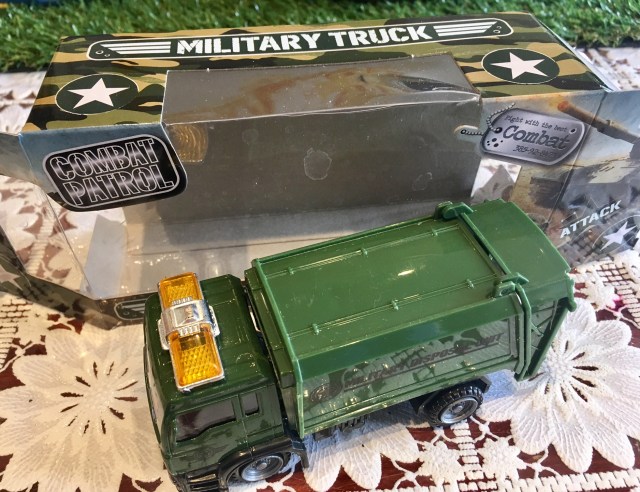
Poundland Trucks
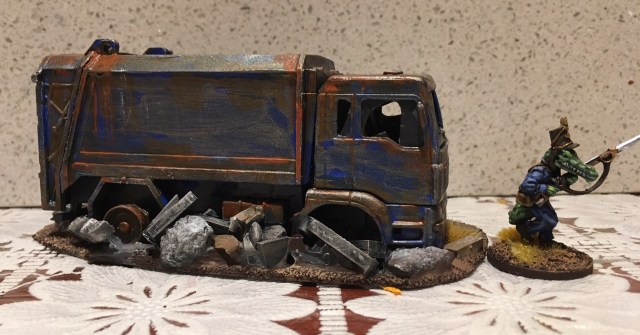
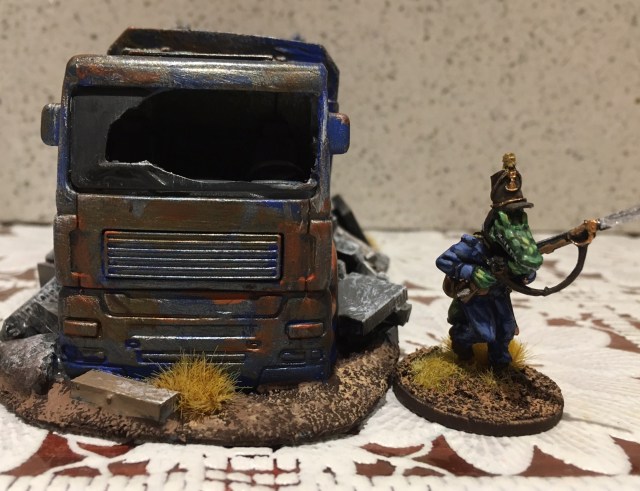
We (I and the little One) bought some grey spray paints from Poundland here in the UK. We noticed some trucks and thought we could do something with them – we splashed out and bought two of them.
And turned them into two terrain items (good value indeed).

























 Roll a One - Wargaming Blog