Any follower confused from an earlier update this week of the blog?, I am too. It seems like a series of unfortunate clicks made me publish some kind of blog entry – I deleted it quickly but I suppose you still got the notification – Sorry!
I did the Great Wargames Survey this summer and I recall it asked about what aspect of the hobby I enjoy the most. I do like most of the elements of the hobby but the planning/research and the consequential buying stage has a special place in my miniature wargaming heart – it is those stages that invariably has lead to huge piles, or mountains, of obscure books and unpainted lead. The trawling through books and surfing the net looking at Orders of Battles and army lists, trying to interpret this to work with whatever rule system you are planning to use is a very rewarding way to pass your time. In addition the very satisfactory activity of searching for options with regards to models to be used, basing options, terrain and building considerations, etc. This is then followed by the ordering process, the anticipation, the arrival, the checking and sorting into boxes & bags, ….and then followed by the great betrayal when the boxes are put away in a dark corner with at best a coat of primer added to the miniatures. Perhaps not a betrayal in the order of that which lead to the fall of Constantinople in 1204, but nevertheless still a betrayal.
Fall of Constantinople in 1204
After careful deliberation, I respect but I do not envy my friends who buy new stuff only when they have painted the old. I even know of someone who only buys new stuff when he has finished painted and playing with the old and then sold it. I do understand that there are budgetary constraints and not just a matter of organisation and efficiency that limits the accumulation of lead mountains. Luckily I can afford a little bit of a buffer (that phrasing makes it sound like something prudent, or even efficient, to do) and occasionally have even offloaded some old stuff and sold it on eBay. However, you guessed it, I end up spending what I make on things I had no idea I wanted, or more unlikely, needed.
Overall this whole thing for me is a mess far removed from any rhyme or reason but I really enjoy it and it takes me to that la la land away from it all – I think that is what a hobby is, or at least should be all about.
I suppose I am digressing again, and we will shortly be moving swiftly on to some Rommel stuff, …. there is an interesting two-parter on Game Dilution theory (GDT) that you may find interesting, and perhaps linked to the above, on the Meeples and Miniatures webpage, see here and here.
In Sweden we say that it is “..best to forge the iron whilst it is hot!”, so I have been pressing on with the Rommel project (see part 1 here) covering:
Decision on base size
Basing and Marker Convention
Getting on with doing some of the bases for the Deir er Tarfa scenario (that can be found in the Rommel rules or downloaded from here – click on the A SAMPLE ROMMEL SCENARIO link)
I made a few decisions on basing and based on the rules set some ground rules for how I would do the bases and markers, etc. However with some overdue housework and the season of Rugby starting for the Little One we had limited overall progress on the practical side of things. Anyhow, here we go.
Base Size
To enable standard play on a kitchen table (3 feet wide) you can get away with 110mm squares (this will give a 88cm by 132cm table (Call it about 3 by 4 feet), I decided to go with 50mm by 40mm bases. This would also work well on larger 15mm squares for a 4 by 6 feet table. The base size works well for 3mm miniatures.
I have decided to go for 4 tanks on each armoured base. I got some 2mm MDF laser cut bases from ebay (don’t they smell nice when they arrive?).
Basing and Marker Conventions
I actually do not mind playing with labels and markers, but I do try to minimize this as much as possible, for Rommel the following things are important for the game itself (based on a first pass of the rules). By the way I really like the format of the rulebook and the overall feel of it – it was a delight to read through.
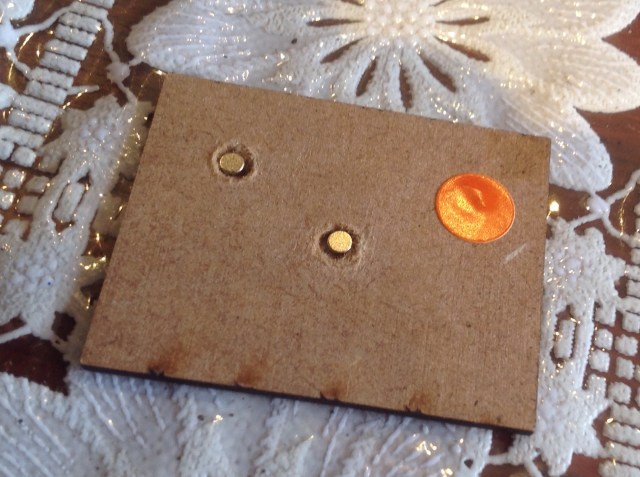
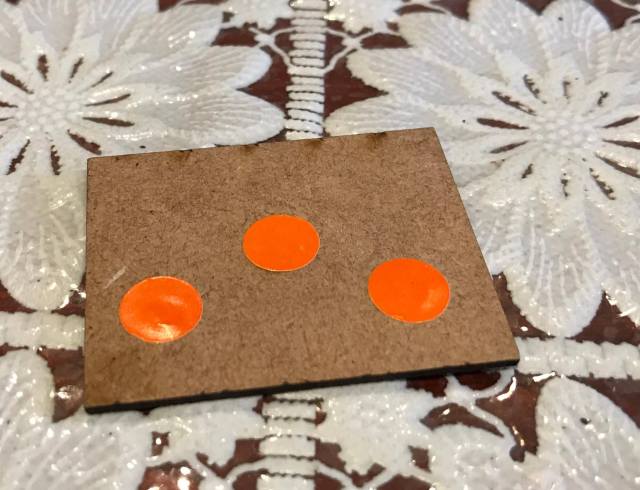
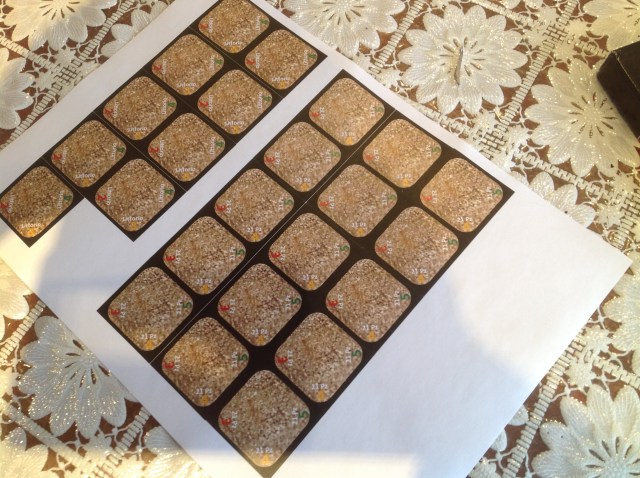
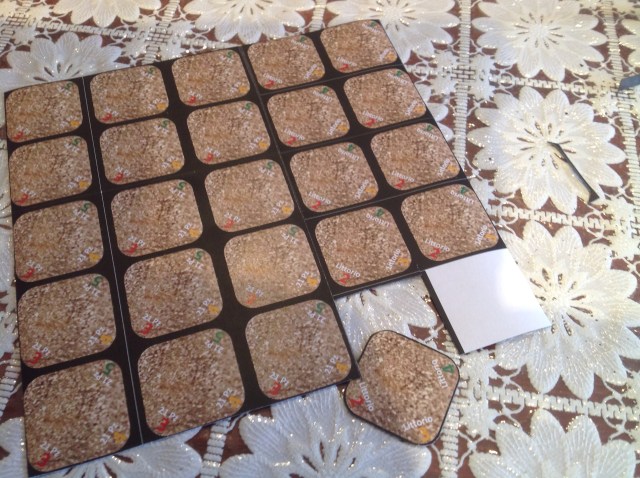
Combat Strength & Unit ID – this is normally three values (sometime two) that changes as the unit takes “damage”. I will use the following approach and have a magnetic label under the base that I can move around. I will also combine this with the unit ID information.
There is a powerpoint file (link here: rommel) that contains labels for all units for the Deir er Tarfa scenario, that may be of some use (do what you wish with it, you may want to change the texture to fit whatever basing you are doing).
Here are a few shots on how I did my test base.
I will use my hobby drill for the mass produced ones, here and just made the holes with the knife and put the magnets in the base with stickers on both sides.Like this on both sidesI printed out the file above on a sticky label (sheet with 1 label) and stuck on top of a magnet sheet I had. Make sure the sheet is thin.Cut it out neatly, I left a little black around. You can use a black permanent marker and do some touch up afterward around the label.They snap together nicelyThe other side, I put a little bit of the magnetic sheet on the front to make the base “Stable”.
The base below show a base of Semovente 75 Tanks, of the Littorio Division, at full strength (4). …but what about the armor value(s)?, wait for it!
A finalised base of Semovente Tanks. The models are the Oddział Ósmy 3mm models (WIT 615 Semovente 75/18 Assault Gun x15), I bought them from Magister Militium in the UK. I suppose that the added value is that in another level of game where I would like this represent a platoon, I could do so and if needed print out another label with some totally different information and even shape.
Armor value (Armoured units) – this range (based on the lists available) from 1 to 6 – and I will show this with the number of Tufts on each base (where the armor value is different from attack and defense there will be two types of tufts, the darker for attack!). If you look at the Semovente tank base above you can see this in “action” (this unit has an armor 2-3, where the two dark bases are for the attack and the 3 lighter bases are for defense).
Barrage (Artillery only) – this range from 2 to 5 and as this only applies to Artillery, that has attack value at 0, I will use Tufts in a dark colour to indicate barrage value and light colour to indicate Armor Value.
Range (Artillery only)– Apart from rocket artillery there are three ranges 8, 12 or 16. Call them short, medium, long and indicate this by the number of towing vehicles on the base, 1 for short range, 2 for medium and 3 for long. For rockets range will be the number of models (e.g. 3 for heavy rockets and 4 for light rockets) on the base
Legs– some infantry units are not motorized – this will simply be any infantry unit without a vehicle on the base. Other motorised infantry will have a truck on the base to indicate status.
Armored unit– a halftrack on the infantry base indicating status instead of the truck (default for all infantry).
Rare– I will just put three tank models, instead of 4, on each base (as they are rare!)
Self-Propelled Artillery– again based on the model used, towed artillery will have separate towing vehicle(s) on the base.
Infantry Support Capability– these tank models will have a few infantry models on the base.
Rockets – defined by model used.
Recon unit– 5 models in a square formation with a leader in the front (instead of the normal 4 – this is normally small vehicles anyway).
Cavalry – again will be defined by models used.
Pioneer – I do not want to make this into a permanent feature so any infantry unit that will have the ability will be allocated a marker at the beginning of the game. Still to be developed.
Unreliable– one of the tanks will be placed going in a different direction on the base (as it is unreliable).
Other Game Markers
I will make some markers as follows for Supply Points (using some HQ models, lorries and some boxes), Low Supply Markers, Isolated Marker, Boat, Prepared Positions, Objective Markers, Construction, Fortification and Demolition markers. More on those later..
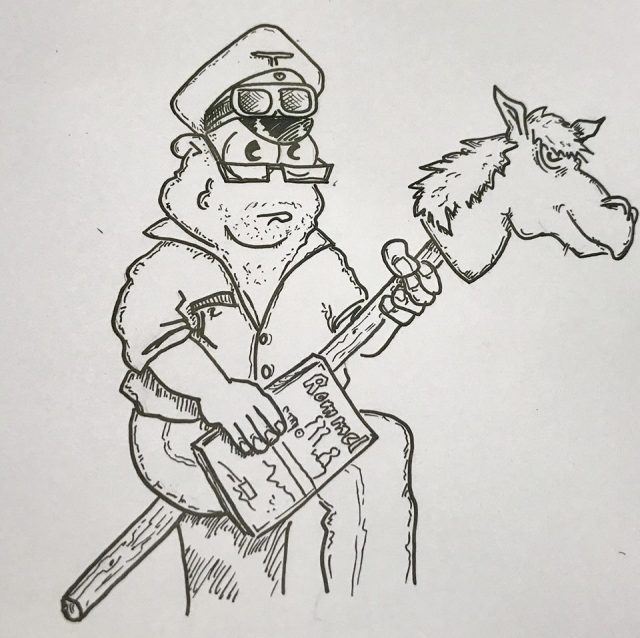
/ Hope that was of some use, I will be riding off towards the sunset on my current hobby horse.
I did put the final touches on the two basic DreadBall teams this weekend, I am now ready for Season One! The season was originally “aired” in 2014 or something like that. I am looking forward to this! If you know nothing about DreadBall then check it out here. However if you are late to it, there are other variants and I believe a second edition in the making. Having had a little look this weekend, the second hand market on eBay is favourable if you want to pick up some of the older stuff.
I promised the Little One a game but he fell asleep long before I had finished splashing paint – maybe we will get another opportunity this coming week! I did put them on the board to see how they would look. Well what can I say it is me doing 28mm so I feel like the object of that famous Sting/Police song about the possessive lover – Every Breath you Take (slightly modified I must admit).
Every brushstroke you make and every detail you overpaint Every mold line mistake, every inky stain, I’ll be watching you Every layer you add, every wash you make, I’ll be watching you
I’ll be watching you!
I am very happy though and the Little One will love thrashing me on the field!
I wanted the RefBot to look a little bit C3POish! It is a mean looking lady!
However, as always, when I do get the finger out and finish an old project I tend to get some new inspiration so I got about 6 additional MVPs from eBay – they are mercenary veteran players that can be used to enhance a team. The cosmic order will be restored on the lead, or in this case the plastic, mountain. Old Shiny never rusts!
I suspect I will get the Ratmen (Veer-Myn) and the Dwarves (Forgefathers) team as well in a not too distant future – but I have decided I would do so as a reward when the MVPs are home and dry following the paint job (Sounds far too disciplined, doesn’t it?). As stated already, I am looking forward to this and the Better One did say that she would like me to do more sports – so here we go!
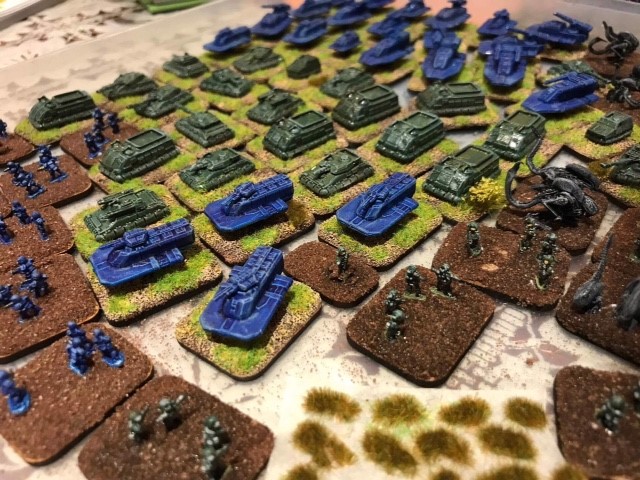
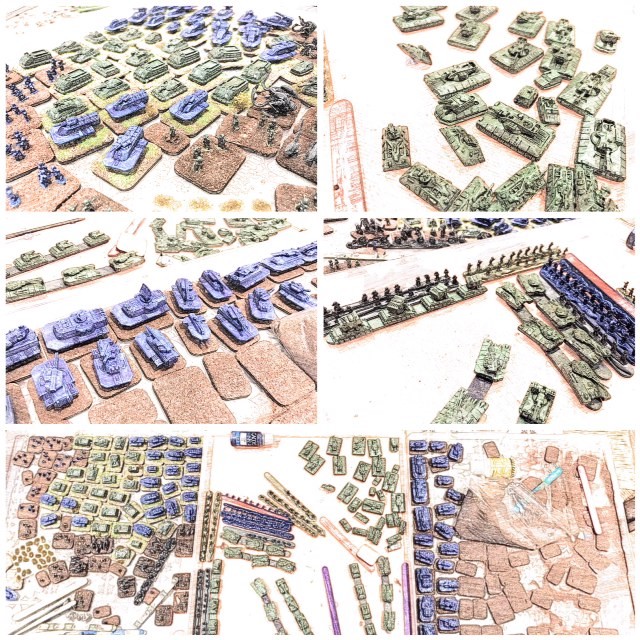
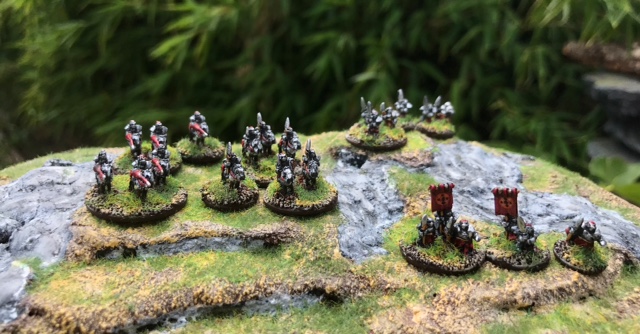
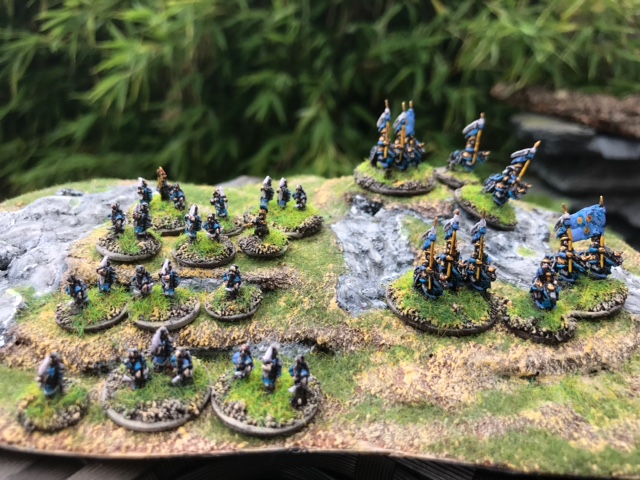
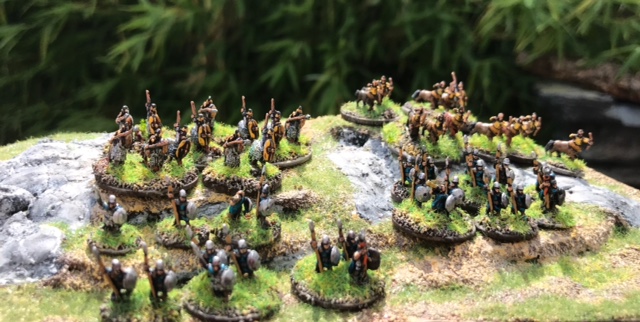
I also did some progress on my 6mm SciFi project – the Blue and the Green army. We intend to give the Future War Commander rules a go using these.
Next week I hope to start the Rommel bases (as discussed last time here, I got the miniatures this week but wanted to get some things off the workbench before getting into it. The 3mm tanks are SMALL!, but I suppose they should be) and also do some aircraft for the Sci-Fi project as I have some nice models I got before the holiday. I want each army to have recon forces, infantry, tanks, artillery and air forces to allow combined arms type of games.
And yes I need to get started with this years large GNW project at some point – but not yet!…Not yet! (as Juba said in the Gladiator!).
In a recent Meeples and Miniatures episode, that I mentioned in the last blog update (here), the hosts interviewed Sam Mustafa about his upcoming Rommel rules (link to the podcast here). Sam has done many interesting wargames rules and in particular I have enjoyed Maurice and Might and Reason (I discussed these with regards to GNW battles in the past in an earlier blog post, here). Invariably his rules are well presented, original and solid – and as we find out from the podcast they are thoroughly tested as well! Following this I also listened to some of the podcasts Sam has produced on his Honour website (link to the Honour Webpage, here) – I got very tempted to give these a go and started to plan what I need in terms of miniatures (and bought a few, see below) and I am also thinking about basing etc.
A few hours ago I found out that the rules are out and I got myself the bundle (a physical book and a PDF), it seems like a few others did too as the website crashed. I suggest you have a read around on the Honour webpage and listen to the podcasts, to see whether this ruleset is something for you – I am giving it a go!
Rommel is a tabletop game of great battles in the European and Mediterranean theatres of the Second World War. The player takes the role of a general commanding an entire division, or elements of several divisions, or an entire corps or even an army. Units represent companies and battalions. Tens of thousands of men and machines clash for control of miles of territory. Make decisions about the application of air power, engineering, the use of reconnaissance, the commitment of mobile reserves, and many other things.
From the Honour webpage.
I have decided to do enough bases to play the two example scenarios (both in North Africa) from the book and available as downloads on Sam’s homepage (Introductory Scenario: “Operation Brevity” and A Sample Rommel Scenario, see here) using 3mm miniatures from Oddzial Osmy (O8), these are sold by Magister Militium in the UK (link here).
I could have done it in 6mm, or used some of my early war 15mm WW2 stuff, but I fancied a little bit of change for this project and the North African campaign is virgin territory with regards to miniatures . Yes, I could have tried the rules out using flat cards but what is the fun in that ;).
In my browsing on the net of relevant stuff I have come across Doctorphalanx’s interesting postings on basing (see here) and will base my units in a similar way. Basically 3 tanks per base, two or three guns, and as may infantry I can reasonably fit with a vehicle or two indicating a motorized unit. However the final basing approach is still open as I need to study the rules and see if there is some way I could incorporate some unit features/stats into the base itself (i.e. using tufts, or number of vehicles/figures, etc.).
Having got used to minimalistic table sizes, with my recent 6mm skirmishes (e.g. the Pikeman’s Lament stuff, see here for an example) I want to make sure that the bases can fit in a 11 cm square. The reason for this is that the Rommel typical game is played on an area divided into squares and the standard table size is 8 by 12 squares. By using 11 cm it will fit the width of a normal dinner table (creating an 3 by 4 foot play area).
Below is the map for the Deir el Tarfa scenario, showing a typical set-up.
The following pictures show a few options for basing (3 is the maximum number of bases in a square – I believe!) vs an 11 cm (110mm) square. My favourite is the 40mm by 30mm or 30mm square as this allows key terrain features to be indicated efficiently and I hope it will look good too. However, I want to get the miniatures and get a feel before I make up my mind.
I need the following units/bases for these two available scenarios:
British
6 No. Grant tank bases
3 No. Cruiser tank bases (A13)
2 No. Vickers tank bases (MK VIC)
2 No. Matilda tank bases (II)
2 No. 25pdr artillery bases towed by artillery tractors
13 No. Motorised Rifle bases
German/Italian
5 No. Pz III bases
2 No. Pz II bases
2 No. Pz IV bases
3 No. Semonvante 75 bases
3 No. Towed artillery 10.5cm bases
6 No. Bergsaglieri Infantry bases with trucks
6 No. Panzergrenandier bases with Sdkfz 251s
3 No. Regular Italian infantry bases (walking, I will use bergaglieri model as there are no normal Italian infantry in the O8 range)
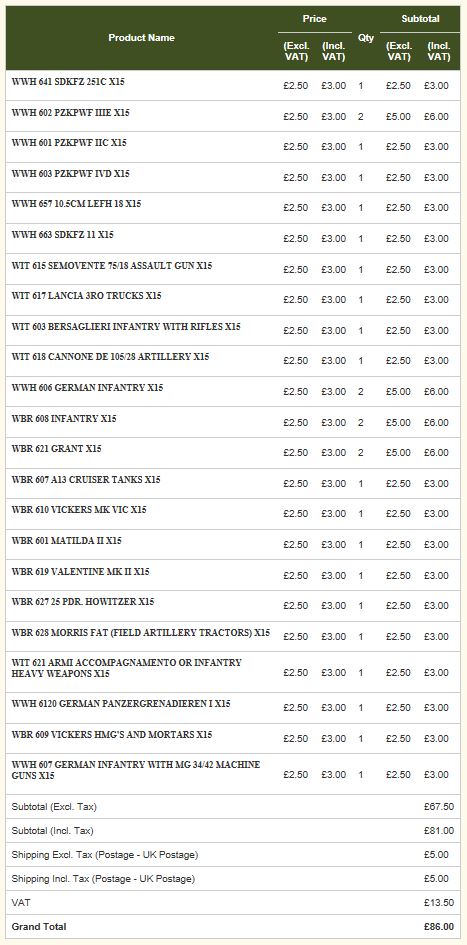
The shopping list, as always, got longer than I initially thought. But it resulted in the following order. There will be a lot of left overs, but that is good for further growth!
Having done this I realised that I forgot a few packs but a quick call to Magister Militium the following day sorted it all out (adding another pack of Valentines -WBR619, some Bedford Trucks, 2 packs of WBR631 and a pack of Universal carriers – WBR613). I am a little nervous about the scale and how to get them to look good on the table – well time will tell!.
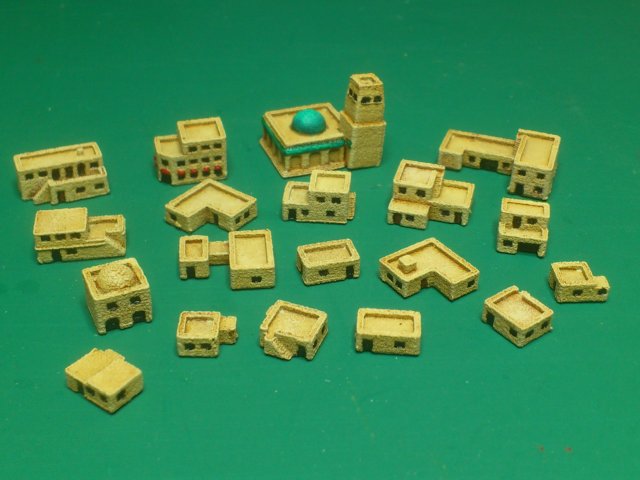
Further considerations will be the actual gaming table/mat (not sure how I want the squares – marked with line or a more discreet option?). I will probably do a mat from scratch in line with previous projects (see more here and here). I will elaborate more on this in further posts – but check out Brigade Games Middle-Eastern village in 1/1000 scale (Obviously this is a different scale than the 3mm miniature that are in 1/600 scale, but I think it will work, see link to it here).
The monies have been spent and the ambition is there – we will see when I take that next giant leap for one modelling mad man but a small step for mankind!, and get them painted and based. I do not think it will be a massive task to get this done! I will start reading the rules this weekend. I will do an update at some point in the future to let you know how I am getting on!
I just finished one of the longest holidays I have had for a long time, however on the first day back it still feels like all the others – too short.
I have to admit that the idea of doing one of the Great Sieges with the Knight Hospitaliers and Ottomans in attendances (like Rhodes 1522 or Malta 1565) seemed to have planted itself in my mind. We will see for how long! Got myself a little prop just in case.
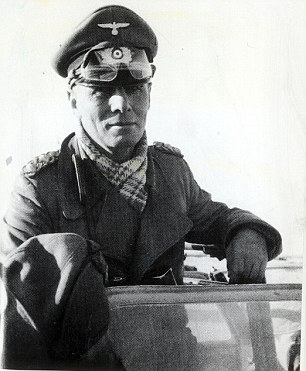
In addition I listened to the latest Meeples and Miniatures podcast about Sam Mustafa’s new ruleset Rommel (see link here) and I am currently in some wonderful la-la land with 3mm or 6mm miniatures on a desert board fighting out the North African campaign. I also listened to the latest podcast from the guys at Wargames Soliders and Strategy (WSS) and amongst other things learned about the Origin of Rommel’s legendary goggles (see a link to an newpaper article here and a link to the podcast itself here).
I also caught up on some other podcasts including Wargames Recon (here) and the Veteran Wargamer (here). I really like the stuff Jay Arnold of the Veteran Wargamer is doing and he has now done more than 20 shows now – all good.
I did improve on my travel battleground following a visit to a shop that seemed to sell everything – even wargames mats!. They had been labelled door mats in error and they only had one in green left. I parted with 3 coins of that euro currency and it was mine!
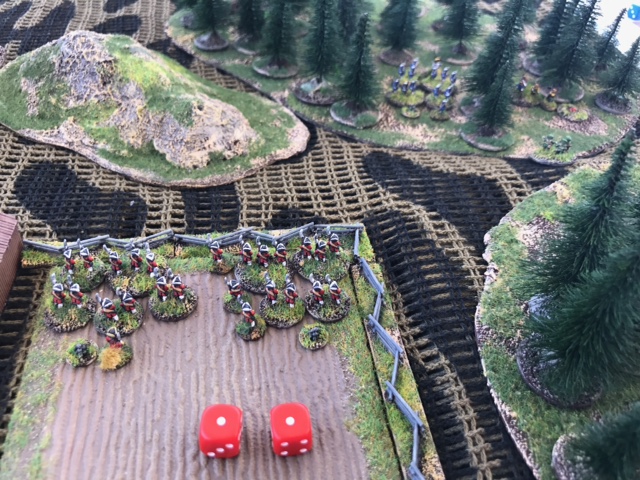
Worked a treat and we played a few more battles of Pikeman’s Lament with our 6mm French and British forces travel set-up. Having used these as presented in the last post (see here) we have really enjoyed our games. Veteran Commanded Shot (we used this category for the Indians) can be very annoying (for the opponent) if you have rough terrain/forest present, as they can move faster than other units and use their skirmish ability. Here are a few action shots from one of these games – including a typical damage roll from my perspective with two dice missing probably showing “ones”.
Regretfully the doorma… oops the battlemat had to stay behind. I do hope the next guests will put it to some good use – it would be a shame if it was not shown proper respect and was actually treated as a door mat.
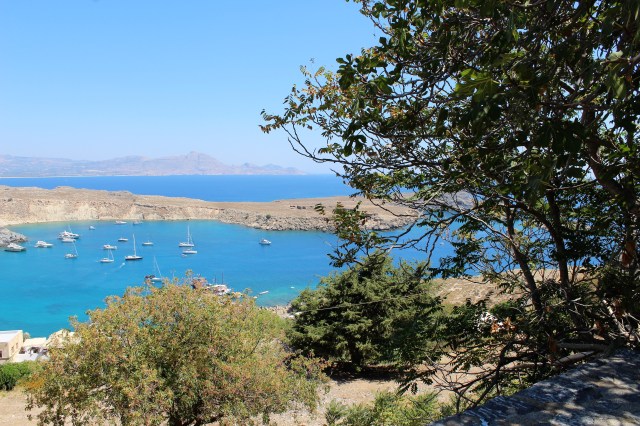
Still on holiday in Rhodes and the Better One had arranged a little bit of a birthday party here on the island and, to my happy surprise, some friends from Sweden and France came along as well. Great times! Thanks to all involved.
I learned about the legend about Anastasia of Rhodes that I found interesting, she was a heroine and died during the Siege in 1522. She had taken her dead husband’s armour and sword, killed her children to prevent them from being taken by the Ottoman invaders, and fought like a lion until she was cut down.
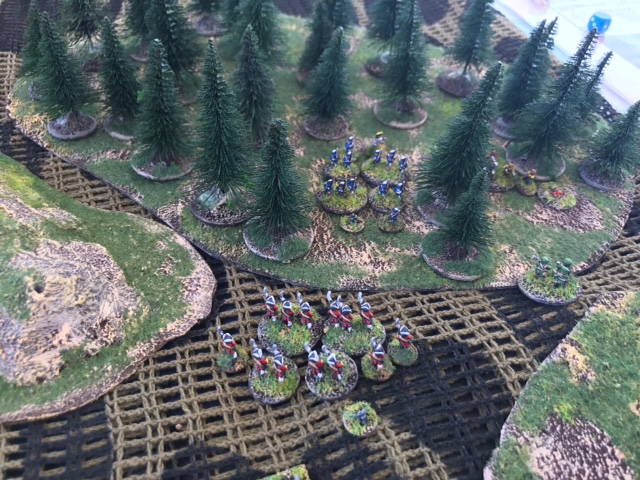
However, I did bring some toys, so when my friend from Normandy showed up I took the opportunity to do a little French Indian War (FIW) action using the Pikeman’s Lament Rules. You may recall the picture from last time? (here).
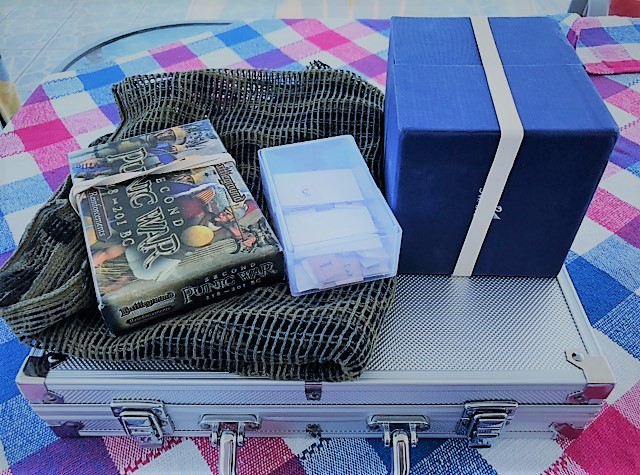
In this little set-up I had some Punic War cards for Battleground – I have been using these in the past to learn some ancient rules – this time Sword and Spear and Basic Impetus 2 (but more about that some other time).
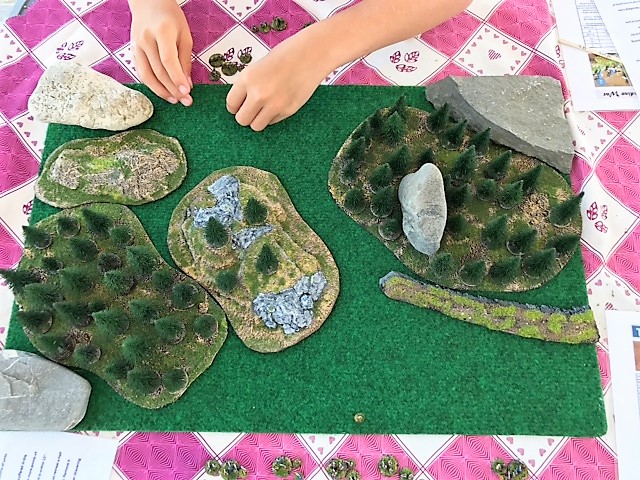
The main ingredient for any FIW game is a forest!, so luckily I brought some trees and some miniatures too.
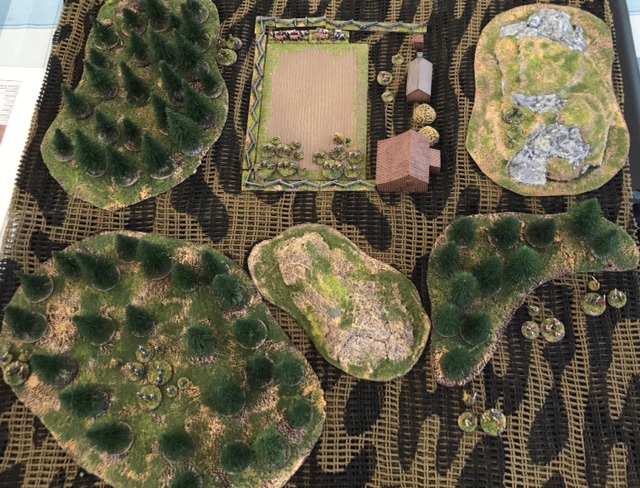
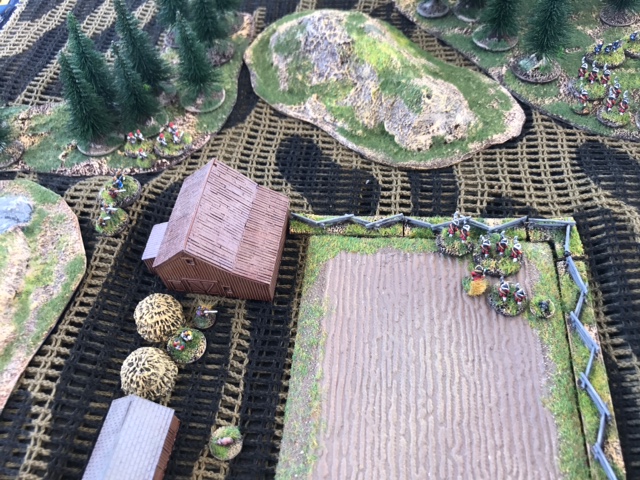
The only thing I did not think through properly was my ground cover as all I had that was even remotely passable as ground cover was some kind of camouflage net thing – but it had to do.
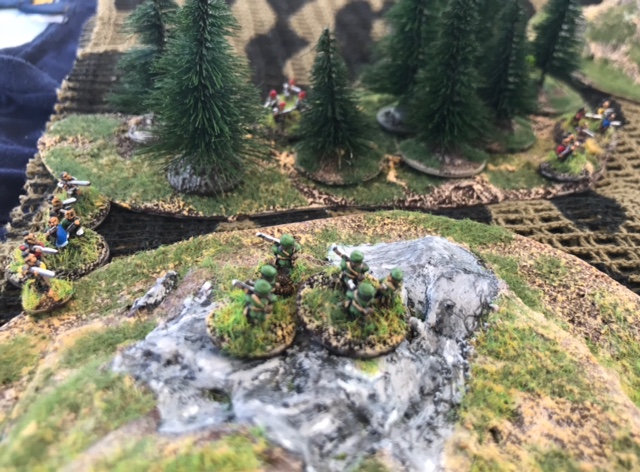
Basic Set-up – Farm in the upper middle being held by two units of British Veteran Shots (Regulars, 12 models per unit, in cover behind the snake rail fences), flanked by two units of Forlorn Hope (Rangers) one on each side (one being on the top of the hill to the upper right and the other between the field and the forest on the upper left). The French are advancing from the south (Bottom) and consist of (from left to right) a unit of Indians (these were in fact veteran commanded shot), a unit of French marines ( veteran shot), another indian unit, a unit of Canadian Militia (Fornlorn Hope) and a final third unit of Indians. Both sides at 24 points.
I included a file with the forces, note that for the British we did not use the militia and only 3 of the native Indians for the French (file can be found here FIW PL).
Here is a short summary on what happened – well the key moments from my perspective. Basically I wanted to draw my French opponents two Indians out of the forest and then withdraw with my Rangers and use their ability to attack Ferociously (and overall superiority in terms of attack and stamina) in the rough terrain and then hopefully have enough punch left to at least do some damage to the Canadian militia unit.
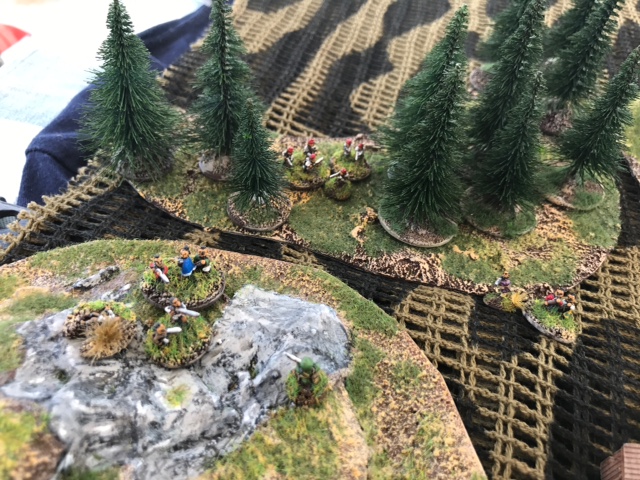
Note I turned the table around 360 degrees – the Rangers are awaiting the Native Indian attack.
Well after a lot of “not-so-successful-rolling” it did not really work out that well for the Rangers in the end and the unit was decimated and on the picture below a very short-lived last man standing moment! – perhaps last man wobbling would be more like it?
So what about the fighting in front of the farm? Well I had two units of veteran shot with their first Salvo ready to fire at the French as they breached the forest. However on activating the first unit to shoot I rolled, not just a, one but two. This leads to a random event and a further roll showed this to be attack, so the redcoats jumped the fence and charged forward straight into range and the waiting French firing line. The Rangers had done some fighting with the Indians but with their evade and skirmish abilities they can be very annoying, especially in the forest.
This was then followed by the other regular unit being attacked on the other flank and the rest is history.
I enjoyed the game and the fighting in rough ground (forest and hill) made it interesting and it felt ok, although this is not strictly the pike and shot period.
I take my tricorne hat off for Sous-Lieutnant Dupont who yet again outfoxed me on the Battle Field. He gave it a thumbs up! The rules are easy to pick up and they gave the right feeling to the little skirmish.
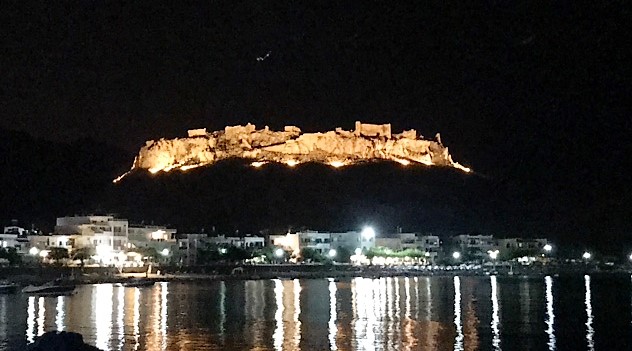
A little delayed update this time, but for the right kind of reason. Occasionally we get an opportunity to get away from it all and this time we headed to Rhodes. A familiar place I have visited a fair few times and I love the Old Town of Rhodes and the history of the hospitaliers – who ruled this Island during the 13th and 14th century and caused the Ottoman Turks all kind of trouble before they were kicked out (Siege of Rhodes 1522) and set up shop on Malta and continued causing trouble. It is too hot to write any essay but if you are interested there is a good summary about them here.
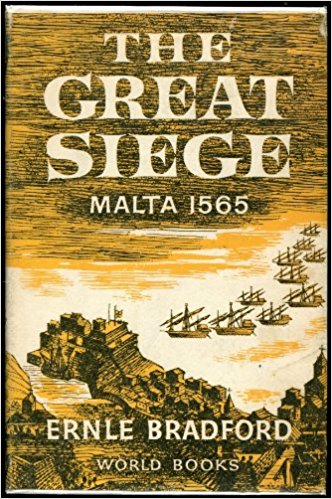
I have a little potential idea of doing a project about the Siege in Rhodes 1522 or the more epic one in Malta 1565. The book – the Great Siege Malta 1565 by Ernle Bradford is one of my all-time favourite history books and I really recommend giving it a go.
When in Rhodes go and see the Grand Masters Palace and walk the old Moat. Very nice and whilst at it you may go for a swim as well, there are a few beaches here and there. The museum of archaeology, the Butterfly Valley, Lindos with the wonderful Akropolis are also places not to miss.
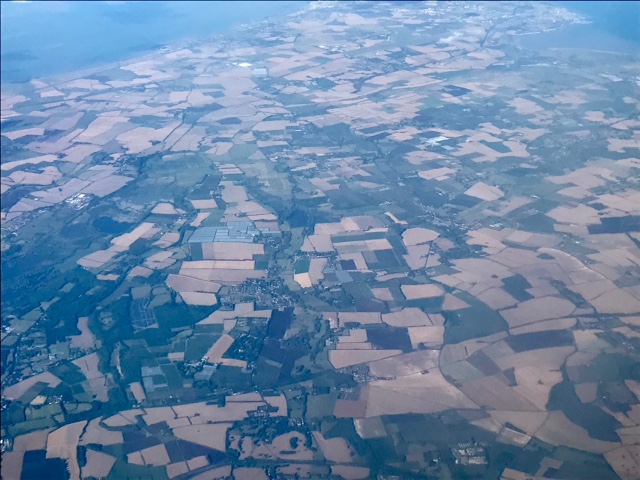
I always get reminded on how rare square shaped fields are when flying.
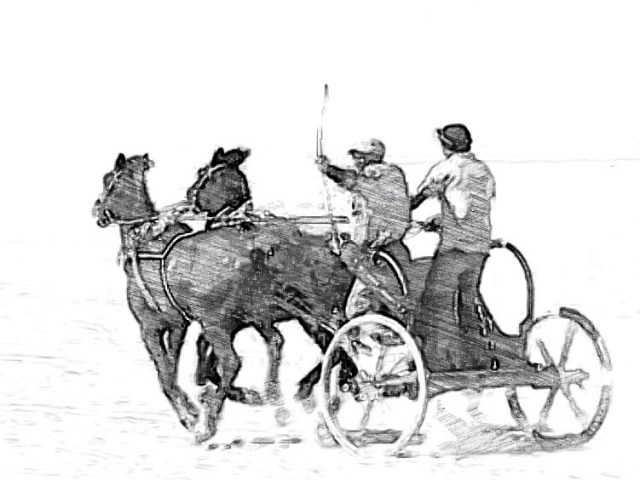
Another idea I have had brewing in my head for some time, using Baccus and Rapier miniatures, is to the do the Battle of Kadesh (see here). Browsing around on Netflix I found a documentary that I really enjoyed watching whilst flying, about the Egyptian chariot. The programme follows a team who recreates a (well actually two) chariot and tries it out (you can also find it on YouTube if you search for Building Pharaoh’s Chariot). Mike Loades, who was part of the recent time commander series, is giving the chariot some trial runs to better understand how they may have been used on the battlefield. I find this kind of experimental archaeology/history very interesting and I really wish more similar programmes were available. Let me know if you know any good ones.
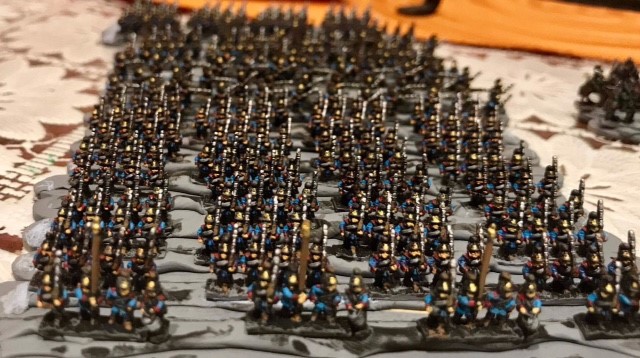
Before setting out I did progress on a few fronts with my Sci-fi models from Brigade Games (I have done two more orders since Joy of Six!) and I also did some of Baccus late 19th Century Bavarians. Great little models overall and a Joy to paint!
Bavarian Infantry
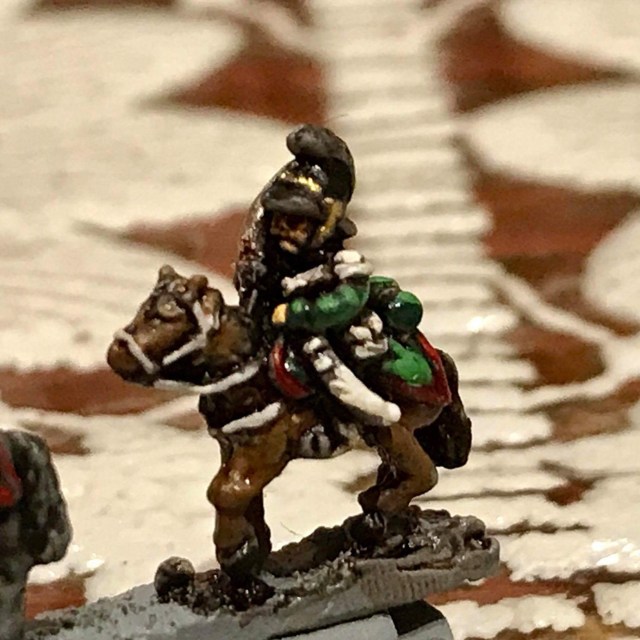
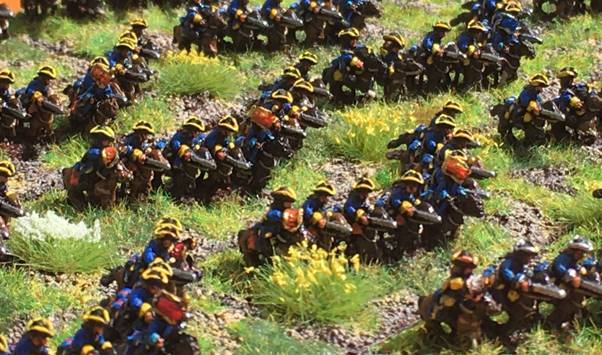
Bavarian Chevauleger
We did not leave home empty handed and I hope to have an AAR available at some point after this weekend, describing some French Indian War skirmish action. We brought a little bit of stuff allowing us to roll some dice and move figures around – but more of that next time if we have had time to have a game.
It seems like ages ago that we went to Sheffield for the Joy of Six 2017 and I have had my head down into work and some neglected duties like 1800mm terrain modelling (gardening) and real life painting (some feature walls instead of shield walls) with a limited amount of any useful hobby time. However, there is always some progress on some front in the Roll a One world (but more on that next week).
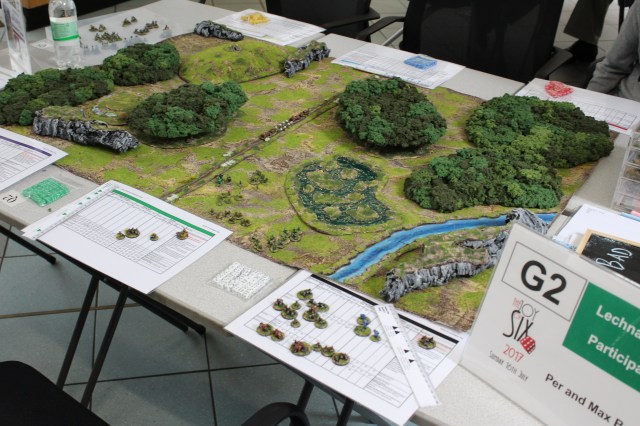
This is my take on the fantastic spectacle that is the Joy of Six – it is very biased as I frankly spent most of the day around the two tables I had brought. I had a few round trips but failed to take more than a few pictures of the other offerings – mainly because I ended up having a chat and then feeling bad that I had left the tables and rushed back. However, this was a little bit of an unnecessary mitigation as the games were running pretty well without my interference. The Wyre Foresters running the Lesnaya Table and the Little One the Lechnaga bash. So as far as a proper show report goes it is a limited one. For a better overview check out the report on Baccus page (link here and here).
A tale of two tables
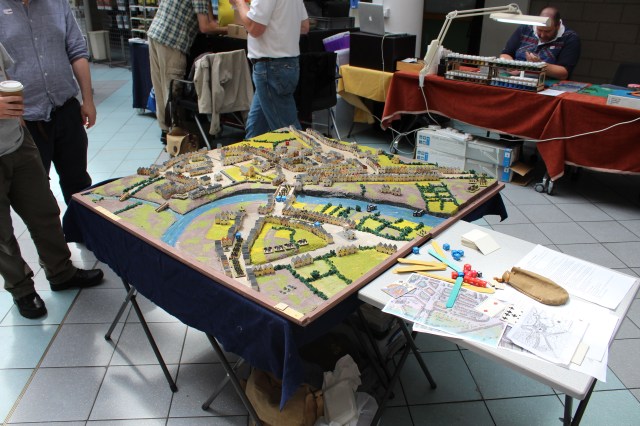
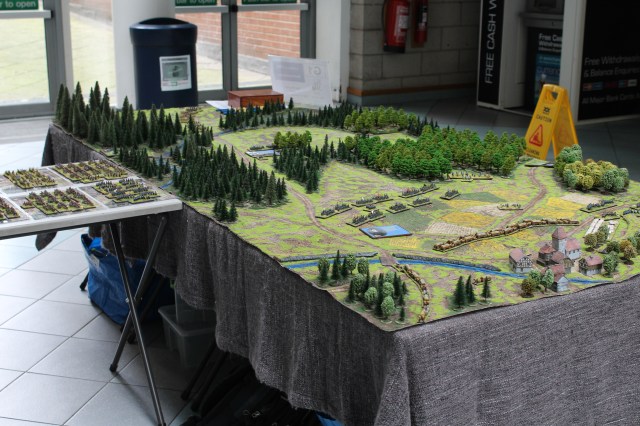
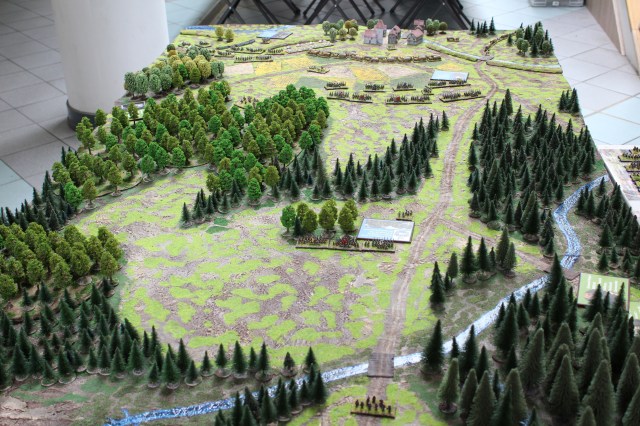
It was a nice and sunny day in Sheffield and we woke up early as we actually managed to get to bed relatively early. The mat for the Lesnaya Battle was rolled out and it was so refreshing compared to the usual 2 by 2 feet boards I have been using in the past – that invariably have warped a little bit and/or the underlying tables being uneven leading to some interesting and unintended elevations.
I had some fears about the varnish and the rivers but it all seemed to work very well – I think I have convinced myself that I will do mats from now (more on this adventure here).
When we had put on all the trees, the houses, the wagons and the starting units I took a step back and I have to admit we were pleased. “It is GEFAG!”, the Little One said – Good Enough For A Game!
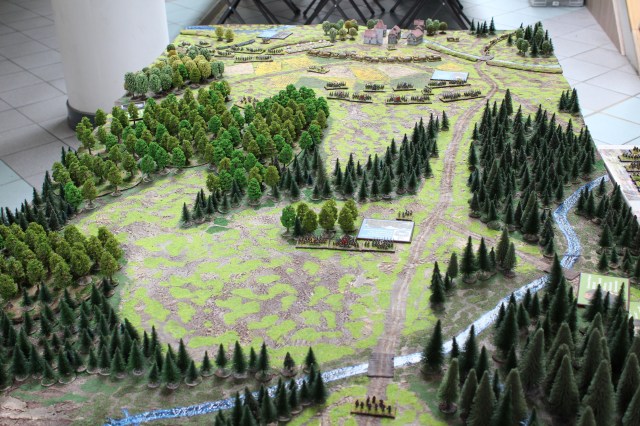
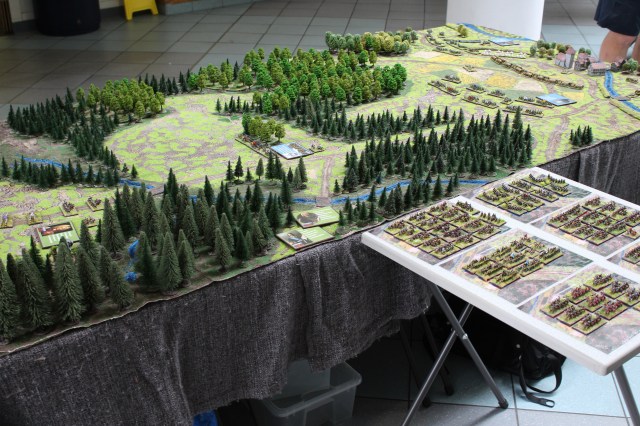
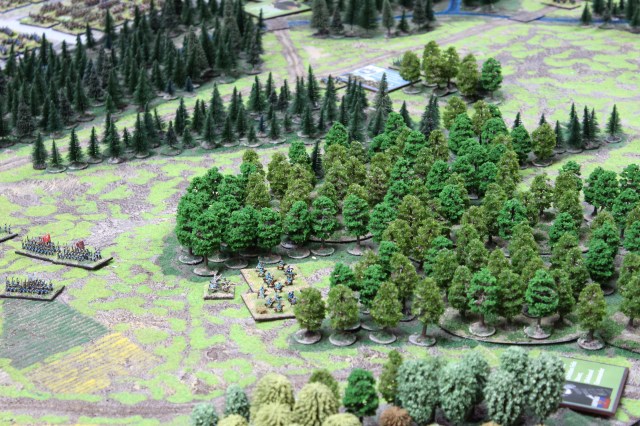
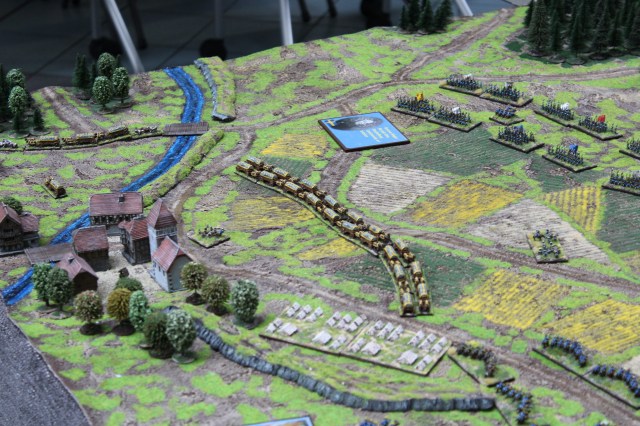
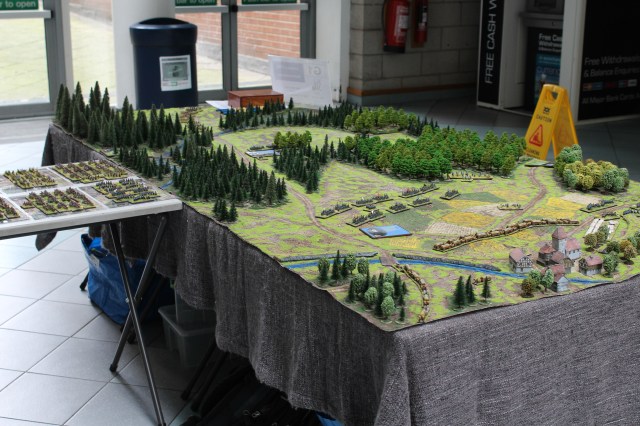
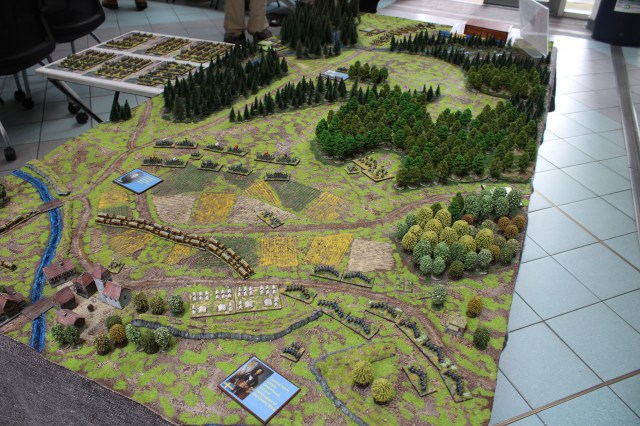
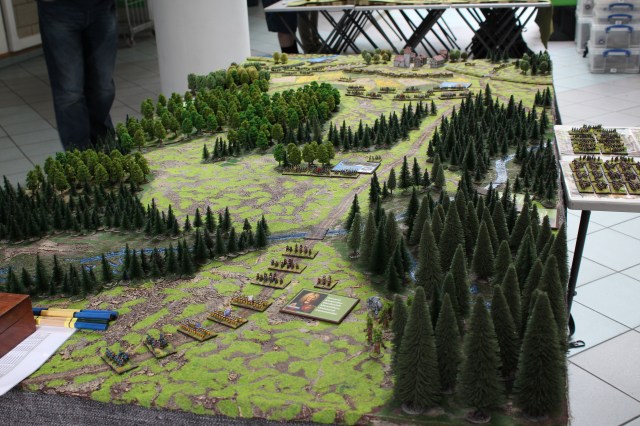
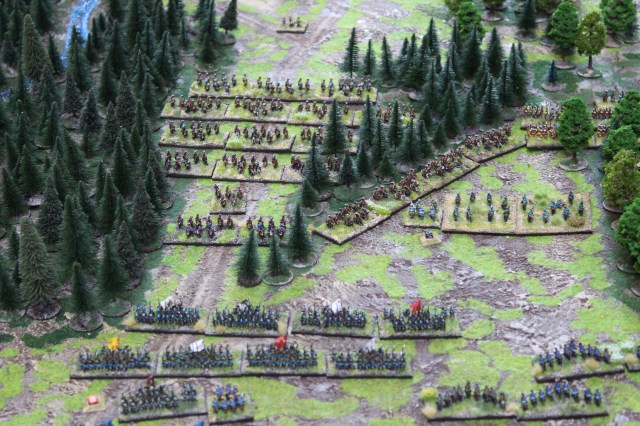
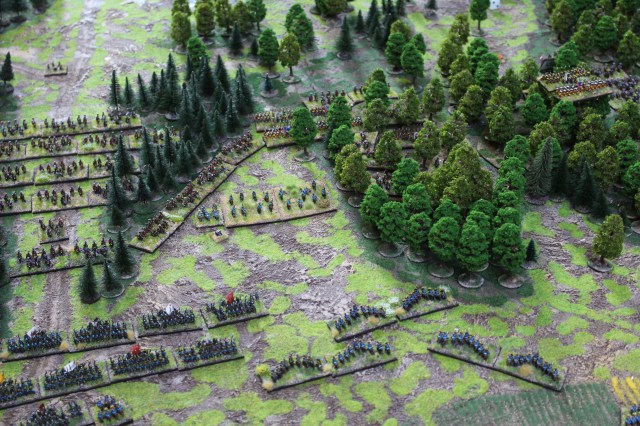
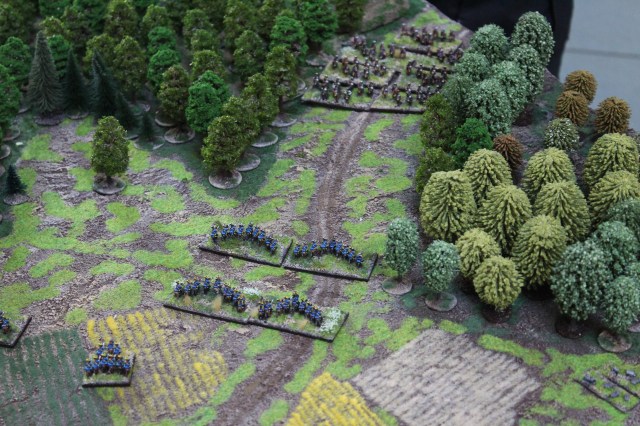
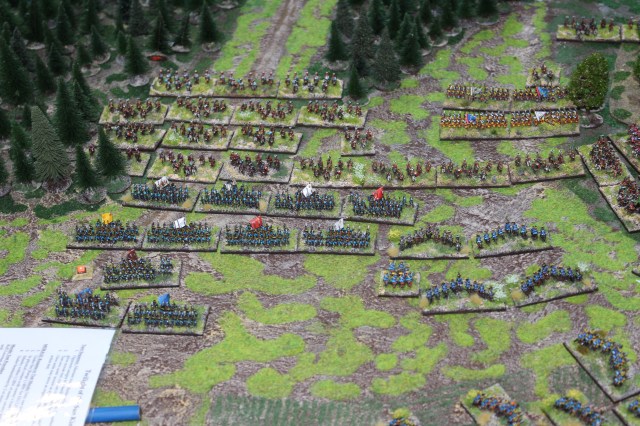
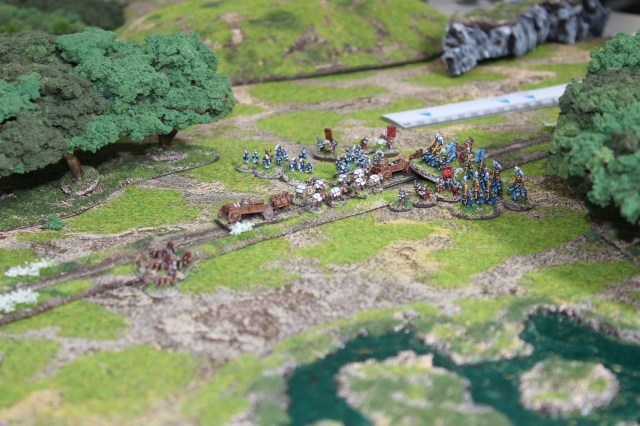
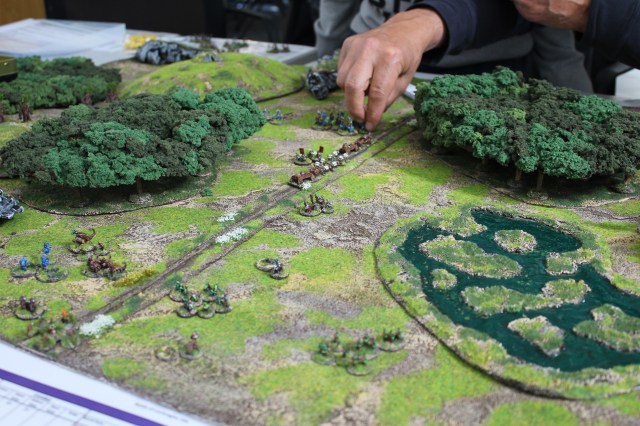
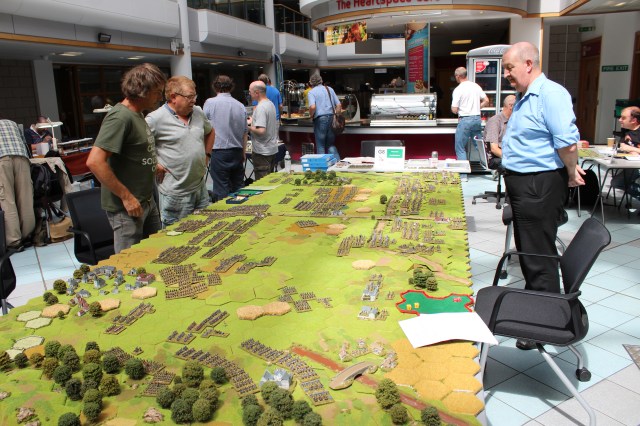
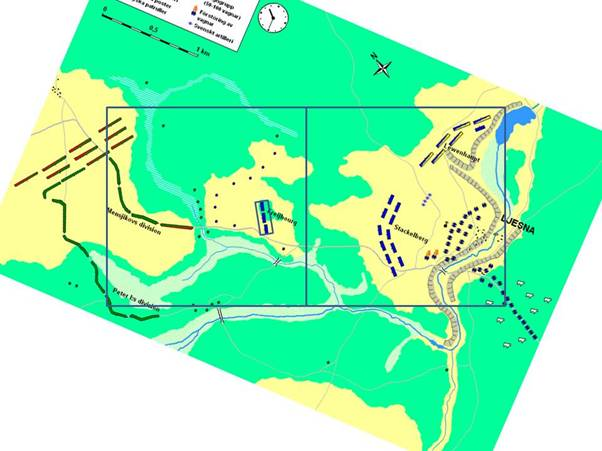
View with Lesnaya at the far end. There was a nice shine in the river and the simple bridges (made from thin Spaghetti) worked really well! In the middle Freijbourgs rear-guard awaiting the onslaught of the Russian war machine.Side table for the Russians as they were coming onto the table during the Battle from the directions – Golitsyn’d Division with Tsar Peter, Menshikov’s Divison and Bauer’s Division. There were also few Swedish enforcements (on the top left hand corner).Bauer’s eventual entry point in the left corner.Shot showing the defensive lines of Wagons, Lesnaya and Stackelberg’s Infantry (Swedish) as well as some of the Cavalry.Another AngleWith the Cavalry commanded by General Lewenhaupt himself.The density of the forest really worked
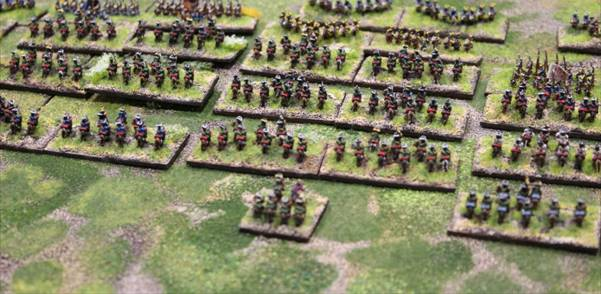
The Wyre Forrester, under the guidance of Nick Dorrell, got on with the job. Most of the time was spent talking about the table, the war, the mat and the Twilight of the SunKing Rules that was used on the day (the basing I use is the Polemos “standard” but this works equally well for the TotSK rules – one base is a small unit, two bases a normal unit and three bases a large unit).
At the latter part of the day the game started moving in earnest but did not reach a climax before we packed up.
Here are a few pictures from the action.
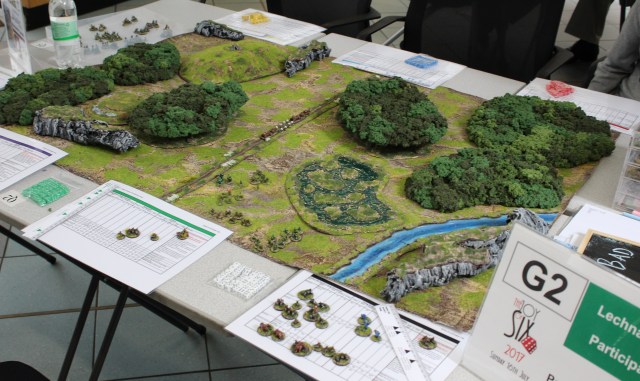
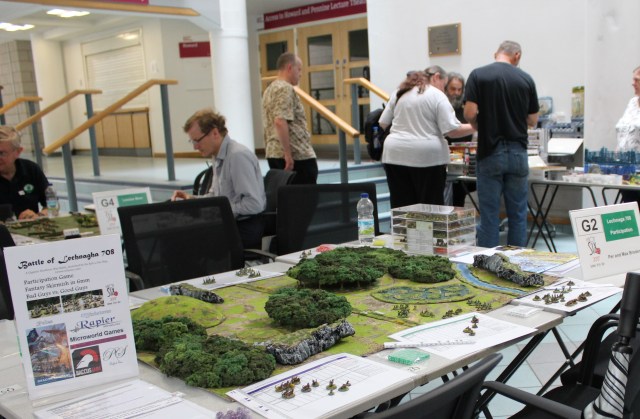
For the Lechnaga battle (see background here and here) we used one of the mats I did for the Saga stuff last year and the canopy forests (see more here on this terrain). The actual gaming area was the middle half of the 3 by 4 foot mat.
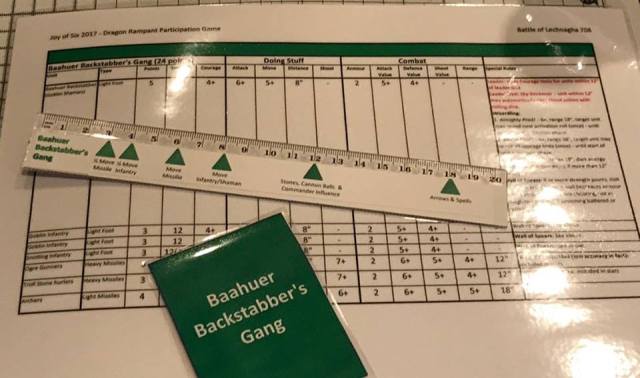
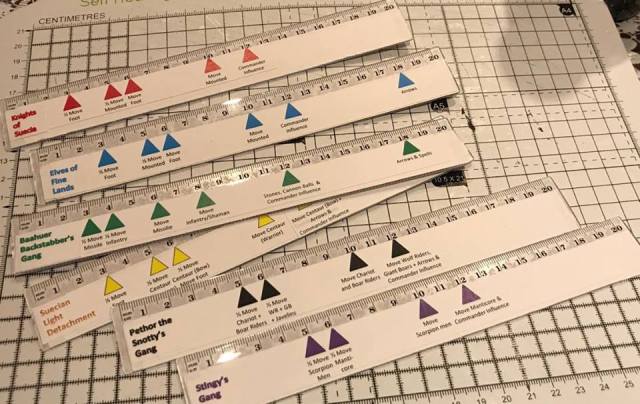
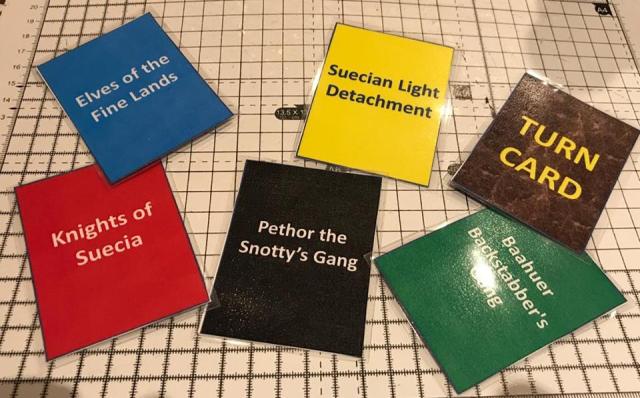
We decided to run the game (using Dragon Rampant Rules) with a war band/force sheet for each player and did a bespoke measuring stick based (we used centimeters instead of inches) on the units in the war band. We also did cards that to use to agree the order in which a player had a go – this created another layer of friction to the game. All, of course, colour coordinated! I have provided the files if you are interested in doing something similar.
I bought some cheap 20cm rulers for 50 pence each and printed out the file (download files here in PDF and Powerpoint – Dragon Rampant Rulers and Dragon Rampant Rulers) on some sticker paper (normal paper and glue may do as well!) and put them on the rulers where appropriate.
A then the file with the factions used on the day here Factions and here Factions .
We had a few good games – the Little One was in charge. Here are some pictures – a big thank you to the few who dared to sit down and roll a few dice with the kids. The future of the gaming community and industry salutes you! The Little One would like to give a special thanks to Oliver and Chris!
Other tales
It was a very good day, but it always seems to end too quickly, here are a few of the things that I managed to capture.
Arguably the warmest smile for miles!, but this is how we most commonly see Dr Mike in action. His posts on the Baccus forum in the old days got me inspired enough to get on with painting my first set of 6mm units. Grey primer, black wash, block and Nut-brown ink and base it nicely and consistently.My first contact with Waterloo was through that famous Abba Song and my mother moving like a Dancing Queen in front of me. Dan Hodgson’s (on the front left) Waterloo was equally brilliant and was an absolute treat. Chris Grice, on the right who wrote the Polemos Napoleonic rules, looked like a true General pondering on his next move of the day. Here is the blur from the Baccus page. I am a fan of Dan!Mr Peter Berry himself doing the Raffle and the many thanks session! Never in the field of human table top conflict have so many had so small toy soldiers to thank for so much!
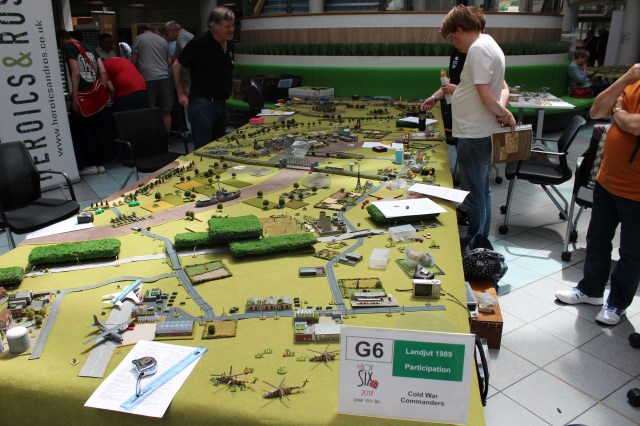
Cold War Commanders – Landjut 1989 (Always having a good time and game, link to their blog here). As a Swede I love when the Danes get a little harmless kicking on the table top.
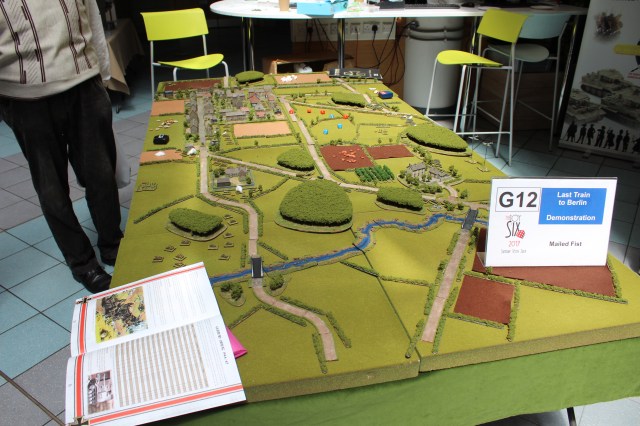
Mailed Fist – Last Train to Berlin (always very nice games and detailed terrain). I should have taken a picture of the town but got star struck and just stared!
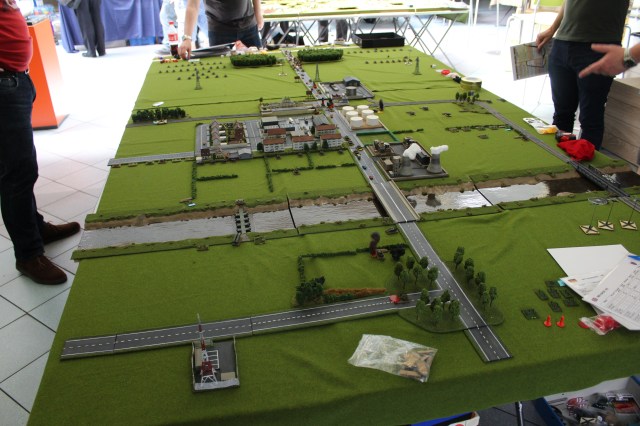
South London Warlords – Neustadt Crossing 1985 (Excellent!). More about it here. Iain we should meet up for a game at some point!MADgamers – Eastern Front 1700 (Trevor, thanks for the little chat). Always happy to see you Gents at Joy of Six!
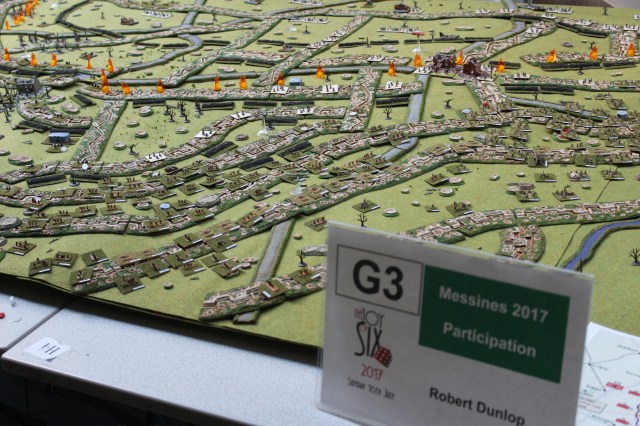
WW1 Grand Style (I think the sign had a slight error – I let you go and figure). Very nice!
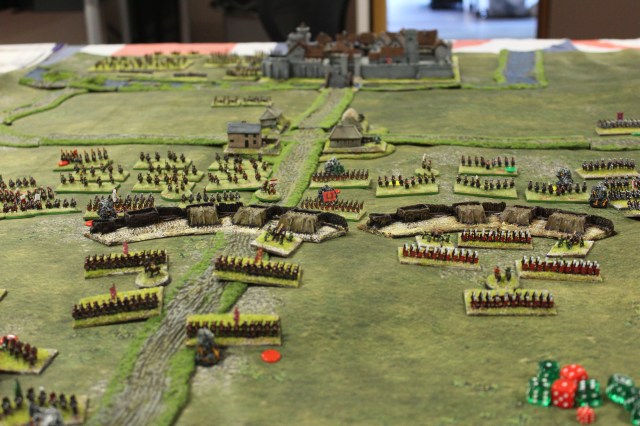
Salford 1642 – Excellent and so many houses! Link to some more blur here.
Of particular interest to me was the Battle of Issus using Command and Colours (or is it Colors!) by the Wyre Forest gang. This really got me inspired to do something similar for the Punic Wars (but I save this discussion to another time – when I have not clue what to write about!). There is a picture of it on the Baccus link above.
Yet again a very good event indeed. Thanks to Baccus, Wargames Emporium and all the other people that makes it all happen. I have to extend the thank you to my two Little Ones – one doing her second year in the Yellow Joy of Six Jersey, selling entrance and raffle tickets, and the other for running one of the games. Also a big thanks to Nick and the other merry men from the Wyre Forest!
Finally and big thank you to all of you who came around and said hello and told me you were reading this blog and liked it. I really appreciate it and all you others who seem to come by every now and then!
We will back next year!, did I say thank you?
/ Have a good week!
Postscript (15/10/17): I have had a few queries on the sources of the trees I used for this project, I got these from various sources on eBay. Here are a few screenshots done on the date indicated above of what I used. None of these are based (apart form the Orbicular ones have a little of a root section) and I did it by using washers with a bit of Milliput and make a hole in, let it dry, glue on some sand and paint it up, flock it and stick in the tree with some glue. Some boring hours of work but I do think it is well worth it.
The fir trees were from Busch and I think I got 3 or 4 packs of these – shop around as I recall I got mine somewhat cheaper.
The other main tree was of this variety.
I also got a few packs of the following:
Another postscript a little bit later:
These are the blur for the two games we ran on that day.
One of the highlights of every Joy of Six is Per Broden’s annual exploration of his Swedish heritage as he stages wonderful games with a distinctly Scandinavian feel. At the Joy of Six 2016 he went one further and produced two games.
He is repeating this feat this year, with two very different offerings in scope and subject matter.
Here is what you can expect to see this year in Per’s own words:
‘Lesnaya 1708
I, Nick Dorrell and the very decent chums of the Wyre forest Wargames club will be doing three battles (two that took place and one that could have been) from the Great Northern War covering the, from a Swedish perspective, ill-fated Russian campaign 1708 to 1709. Each of these battles will be presented at the Joy of Six show over the next three years.
The campaign is the invasion of Russia by Charles XII of Sweden starting with the crossing of the frozen Vistula river in early 1708 and ends with the Swedish defeat at the Battle of Poltava in the Summer of 1709. It is the beginning of the end for Sweden as a dominant military power in north-eastern Europe.
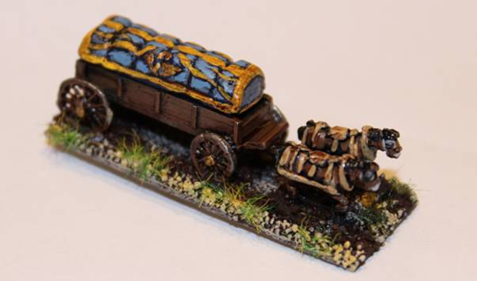
The first battle is Lesnaya 1708 and is interesting as it is, in effect, an ambush by a Russian flying detachment, led by Tsar Peter himself, on a smaller Swedish army that is travelling through the forests of the Polish-Lithuanian Commonwealth. The Swedish army is led by General Lewenhaupt who is escorting a supply column of more than 4,500 wagons to support the main Swedish Army. From the perspective of doing the battle we need a lot of forest as well as about 40 or more bases to represent the supply column itself.
In writing this the miniatures (from the Baccus range) are about 95% complete with a few more Russian dragoons to go. The main thing remaining is the gaming area itself and a large number of trees is being finalised (there will be about 500 trees on the table!).
Overall the forces consists of:
Russians, a few leaders and artillery as well as 10 bases (24 miniatures, on 60 by 30mm bases) of infantry and 57 bases of Dragoons (9 miniatures, on 60 by 30mm bases).
Swedes, a few leaders and artillery as well as 10 Polemos bases (24 miniatures, on 60 by 30mm bases) of infantry and 57 Polemos bases of Dragoons (9 miniatures, on 60 by 30mm bases)
We will using Nick Dorrell’s adaptation of the Twilight of the Sun King Rules published by the Pike and Shot society, to play the game.
The game, and it’s very uneven progress, is being reported on the roll a one blog (rollaone.com) – you can follow it there and see if we make it over the finishing line in July.’
So game number one, is another of Per’s GNW epics. His second production couldn’t be more different both in scope and subject matter, although I do detect a little Swedish influence creeping in…
‘The Skirmish at Lechnagha in the Year of 708, since the birth of Suecia, during the Gigantic Northern War 700-721
A black arrow with red feathers suddenly hit one of the pack mules and it fell violently to the ground as its legs gave away to the heavy load it was carrying. This was shortly followed by hideous laughs and taunts from the surrounding forest – the same damn laughs he had heard so many times before. With the black and red arrow signature there was no doubt what was coming next. Prior Lewen Hauptmann of the Knights of Suecia, threw his red cloak over his shoulder, raised his warhammer and turned to his men and screamed; “Get ready for the Greenskin’s attack! Push them back to their rotten holes! Give no pardon as it shall not be given to you! From earth they have come and to dust they will go!”. He pulled down the visor of his helmet and gave a short prayer and looked around at his men – ironclad battle hardened Knights ready to fight to their last dying breath. “For the Glory of Suecia, give us your strength of battle!” he yelled out the blessing and his brothers responded concurrently; “We accept your strength”, to complete the linkage to the divine plane. For a moment a reddish glow could be seen from their swords and spears as they were imbued with the spiritual power.
The Prior reflected for a moment on the stupidity of this wretched mission and how he had been forced into it by the Knight Marshal Carrophlus following his failure holding the Fort at Narvay. He had chosen to spare his men from slaughter and made a deal with the treacherous Steward of Polesh, Arghaust the Strong who, he was the first to admit, surprisingly had let them go after opening the gates. The enemy had grown stronger under the combined leadership by Arghaust and the mighty Warboss Pethor the Brute, a tall Orc whose organisational skill, cunning and patience was remarkable for his kind. Pethor had manage to organise the Goblin and Orc rubble into a formidable fighting force. It had only been a matter of time before the Fort would fall and enough of his brothers had already been slain and reinforcements had not been forthcoming. The Fort was of limited strategic importance and he had chosen to live to fight another day.
As penance for this “disloyalty”, in addition to the demotion to Prior, he and his surviving men had been ordered to bring supplies to the cut-off townspeople of Lechnagha. He had no retinue of servants, squires, men-at-arms or Sergeants as was the custom for these kind of soul purification missions. It had been a hellish journey through Goblin infested forests with constant harassment. He had lost half the men they started out with and only half of them still had their horses. If their calculations were correct they were only a few miles away from the Town itself. It had a small regular army garrison and since he had felt the presence of evil watching them for the last few days he had sent a rider for some enforcements. But now that seemed to have been in vain. He thought back on the situation at Narvay and how his death there would have qualified his name into the songs of the minstrels but instead he was facing death here in the middle of this despicable forest – for what?
He was quickly brought back to reality as yet another arrow hit another mule. He looked around and could see Greenskins on both sides of the road riding their growling dire wolves closer. They always got excited at the beginning of the fighting and intensified their laughter, reminiscent of that of a raving lunatic, that normally stroke fear into their opponents. However, this was not what frightened him the most, it was the otherworldly scream he could hear from within the forest itself.
This is a participation game using the popular Dragon Rampant fantasy wargame rules by Dan Mersey (played to satisfaction not perfection). The main purpose is to have fun but also to showcase that 6mm can be used for games normally associated with the larger scales not just replacing individual miniatures with bases of many (like we did for Saga last year) but also scaling it down and still being able to enjoy a game. With a 2′ by 2′ board (the size of a small coffee table) playing in centimetres instead of inches is in fact like playing on 4’6” by 4’6″ board. We figure if you can have a few blokes taking a flag for a walk representing a regiment in some scales, why not do skirmish in 6mm?
We (the Little One and I) will run a few session over the day (with up to 4 participants each time) and welcome anyone to have a go. 1 to 2 players will control the Knights and 1 to 2 players will control the Greenskins. It will serve as an introduction to the rules and we will limit each session to about 45-60 minutes (including a high level rule go-through). We happily mix fantasy miniatures from Baccus, Rapier, Irregular Miniatures, Perfect Six and Microworld on the table.
We have blogged about 6mm skirmish extensively on the roll a one blog (rollaone.com) – I will bring some of the other miniatures for other periods for you to have a look at should you wish.’
Another relaxed week and a memory card with Joy of Six pictures on the run – but hopefully back by the end of the week.
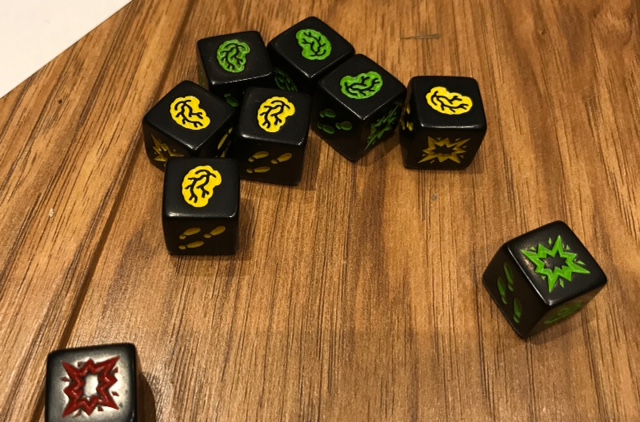
The Little One and I did a few rounds of Zombie Dice this weekend to keep our dice rolling capabilities in good shape. Zombie Dice is a nice little game that takes about a minute to figure out but the occasional, for us compulsory, “Brain!” scream, seems to keep us entertained.
The Little One wanted some Sci-Fi so I got some stuff from Brigade Games (link to them here) at Joy of Six – some tanks and infantry from the Mercs and PacFed ranges. Check them out – they have a very good range. I slowly started working on these over the weekend, at least spray painting and some initial coats.
I quickly did two test bases for the two armies (the Little One approved!) – a Hover Tank and a Grav Tank.
I also got some NSF7 Attack robots from Irregular Miniatures (see here) when I ordered the Ogres for the Fantasy stuff, now where did I put that guy in scarf from Angel Barrack miniatures? The comparison miniature is from Brigade Games (Polish Infantry).
I also got some beauties from Pendraken (link here) that could be used for Aliens!
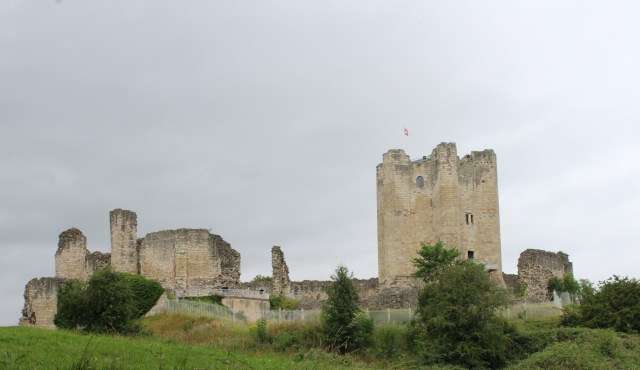
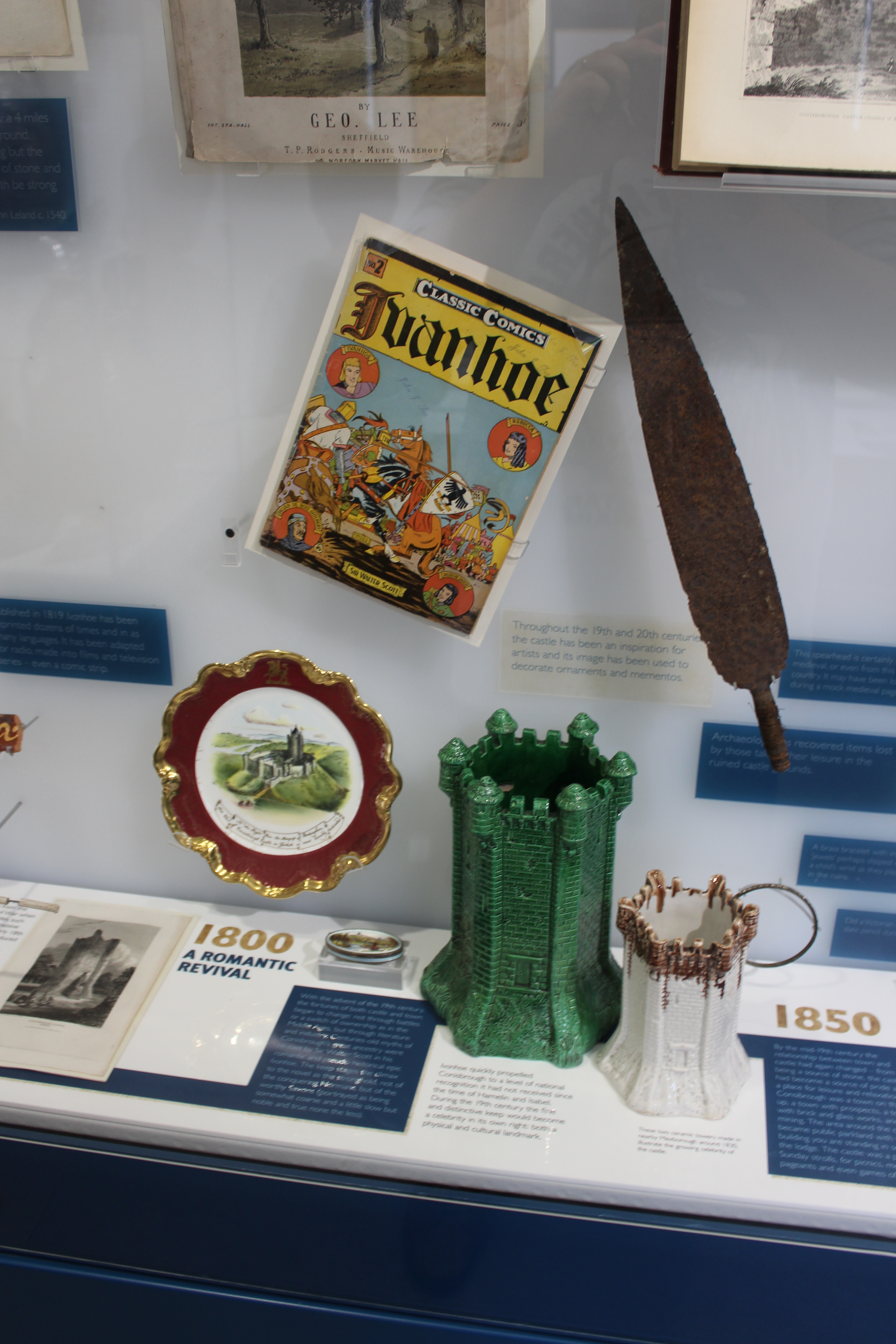
We had a very nice weekend up in Sheffield with the Better One and the Little Ones going to the Joy of Six show – now back to work and a hectic week ahead. Will write about any potential thoughts in due course, over the weekend. In summary we had a great time and even had time to sneak into Conisbrough Castle just outside Doncaster. I had wanted to go there for some time as it is the setting for the classical novel Ivanhoe, by Sir Walter Scott.
Ivanhoe has a special place in modern Swedish tradition as the 1982 movie (with Anthony Andrews, Olivia Hussey, Lysette Anthony and Sam Neill) has been shown every New Years day since 1988.
We did set up the tables and had a fantastic time – the mats worked well!
/ A proper reflection this weekend, all the very best
Next weekend Joy of Six and time for us to head up to Sheffield and run some games with Nick Dorrell and the other Chums from the Wyre Forest Wargames club – we are looking forward to it!
A write-up of the two games can be found on the Baccus homepage (see here), I suggest you go there and have a look at these and the other things that will be going on at the Joy of Six.
I have spent the last week finalising the units we will field for the fantasy game and also completing the battle mat (discussed last week, here).
I have varnished the river sections using Liquitex High Gloss Varnish, I hope it will not crack to badly when the mat is rolled up! As per the tradition I have to bring some terrain made out of spaghetti to Joy of Six! This time all the bridges on the Lesnaya table are partially edible! (Al Dente!, more on spaghetti terrain here, here and here!).
As for the Fantasy game we will be running a participation game using Dragon Rampant. The rules are fun and easy to learn and I think will work well in this setting. As this was a last minute change I have done a lot of short burst brushwork the last two weeks and had some great fun with the Little One preparing it all. I think we need a break after Joy of Six!
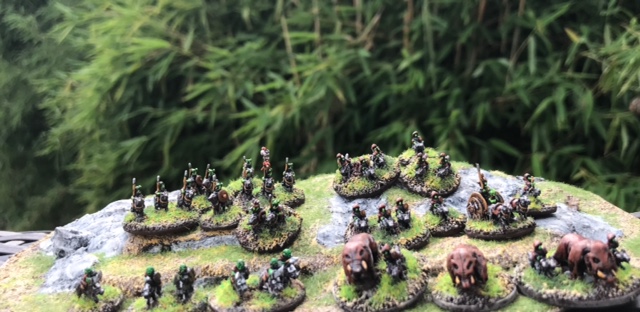
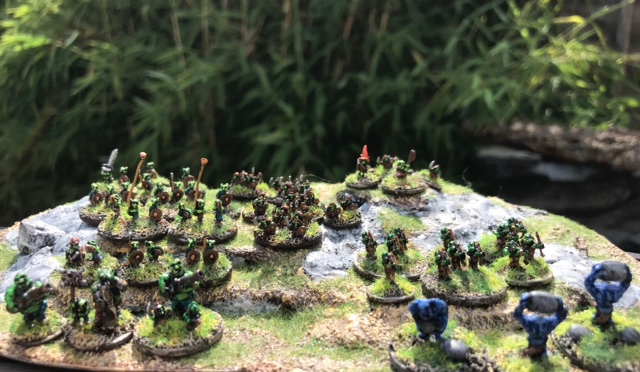
Here are a few shots of the units we have been working on (not all made it to the final war bands below).
However for the game on the day, we will allow a maximum of three players per side (Good vs Evil) using the following warbands (notation based on the dragon rampant rules):
The Good Guys
Knights of Suecia (24 points)
Leader: Prior Lewen Hauptmann (18/00 Strength leader trait, actually a blessing from Suecia, giving him re-rolls in battle).
“He pulled down the visor of his helmet and gave a short prayer and looked around at his men – ironclad battle hardened Knights ready to fight to their last dying breath. “For the Glory of Suecia, give us your strength of battle!” he yelled out the blessing and his brothers responded concurrently; “We accept your strength”, to complete the linkage to the divine plane. For a moment a reddish glow could be seen from their swords and spears as they were imbued with the spiritual power. “
Leader unit – Elite Foot (6 points)
Second Unit of Knights on Foot – Elite Foot (6 Points)
2 No. Units of Knights on Horse – Elite Horse (12 points)
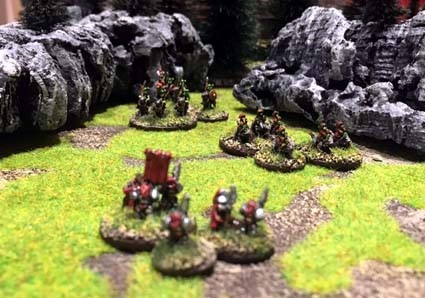
The Knights – all the models are from Perfect Six (here is a link! – great growing fantasy range!)
The Men and Centaurs from Lechnagha – All models from Rapier Miniatures (Link here – Centaurs from the Greek Mythology Range and Footsoldiers from the Ancient range. Lovely models and the Rapier guys are really nice chaps overall!)
The Bad Guys
Pethor the Snotty’s (Son of Pethor the Brute) Gang (24 points)
Leader: Pethor the Snotty (Strong leadertrait).
Leader unit – Warchariot – Heavy Rider with Chariot upgrade (6 points)
Boar Riders – Heavy Riders (4 points)
2 No. Wolf Riders (short range missiles, javelins) – Light Riders (6 points)
Wolf Rider archers – Light Riders (4 points)
Giant Boars – Lesser Warbeasts (4 points)
Pethor’s Gang – A mixture of models with Goblin Wolfriders from Baccus (See link above) and Microworld (link here, fantastic range of fantasy stuff, I am getting some undead next!), Chariot from Baccus, Boar Riders from Perfect Six (see above) and Giant Boars from Irregular Miniatures (see link here – Ogres Mounted on Large Boars).
Leader unit – Light Foot, with Wizardling Upgrade (5 points)
2 No. Goblin Infantry – Light Foot (6 points)
Snotlings – Light Foot (3 points) – this are modelled with double models (i.e. 24 in total instead of 12 models).
Ogre Gunners – Heavy Missiles (weighty projectiles, simulating very bad accuracy with a short range, 3 points) – 3 ogre models but small snotlings on the bases still allowing the 1-2-3 basing.
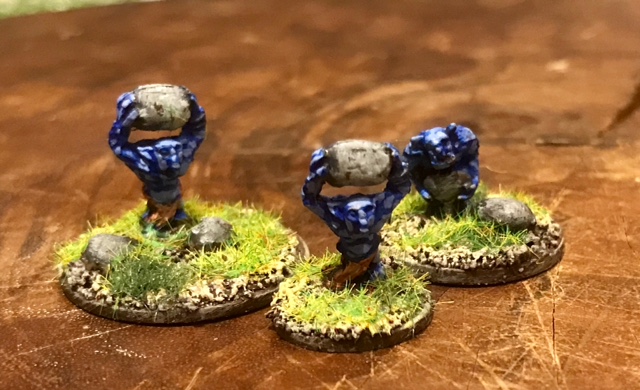
Troll stone hurlers – Heavy Missiles (weighty projectiles, stones, 3 points) – 3 troll models, with stones on the bases allowing the 1-2-3 basing to work.
Archers – Light missiles (4 points)
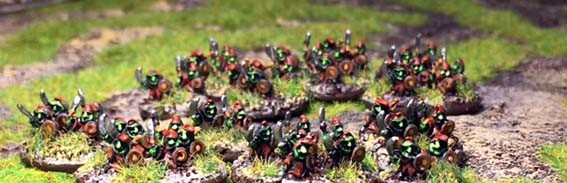
The Backstabber’s Gang – Goblin infantry from Baccus, Snotlings from Microworld (actually Goblins), Ogre gunners from Irregular Miniatures, Stone Hurlers from Perfect Six and the Backstabber himself from Microworld. I will try to remember to give the infantry some flags (the poles look a little bit empty!).
Stinghy’s Gang (24 points)
Leader: Stingy Stjartdell (Goader leader trait).
Leader Unit – Heavy Riders (Scorpion Men, with Venomous Upgrade, 7 points)
Scorpion Guards – Heavy Riders (Scorpion Men, with Venomous Upgrade, 7 points)
Ferocious Manticore – Lesser Warbeast (Flying, Venomous, Hatred of Elves, 10 points) – using Harpys to mark Strength.
The Stingy Ones – All models from Rapier Miniatures. These are my favourite models – the Manticore and Harpys from the Greek Myth Range and the Scorpion Men from the Glorantha Range.
All the very best. come and say hello if you come to Sheffield next week. For those who do not, I will write some updates in the next few blogs!





























 Roll a One - Wargaming Blog