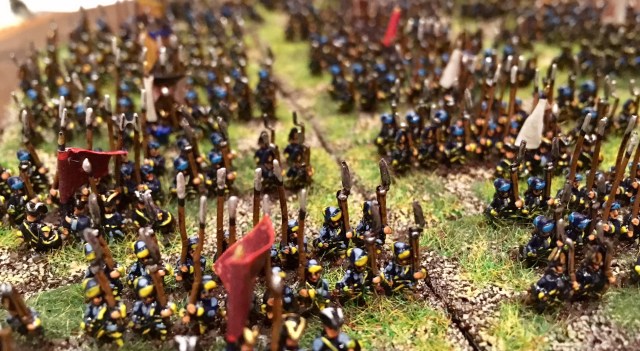
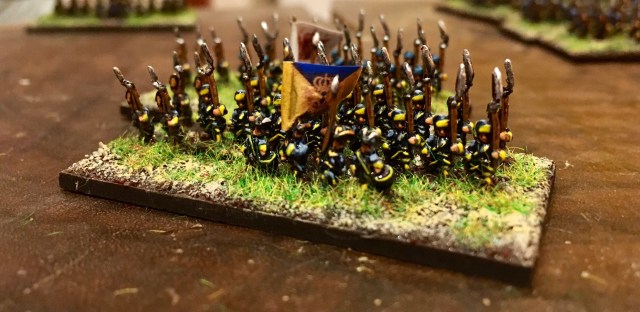
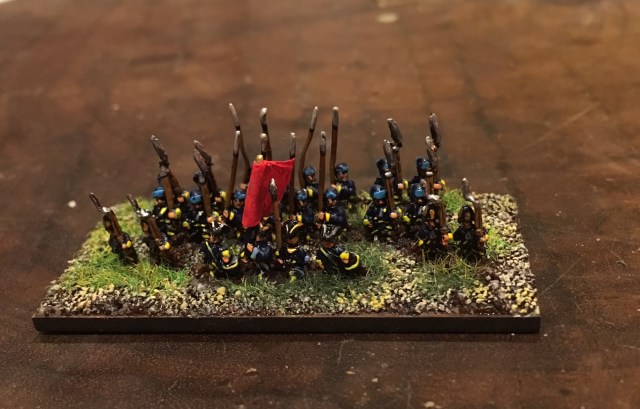
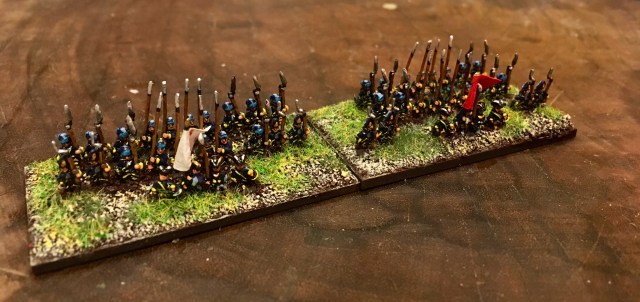
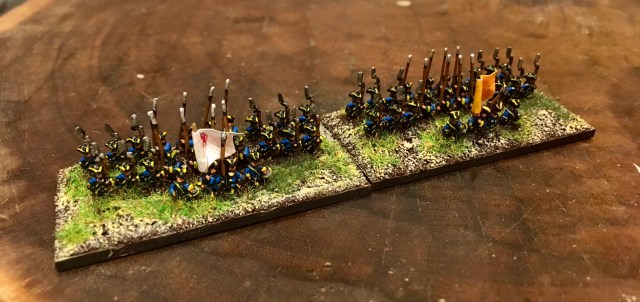
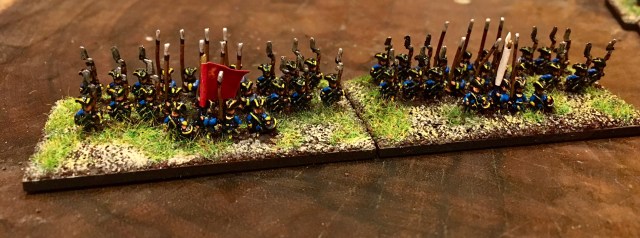
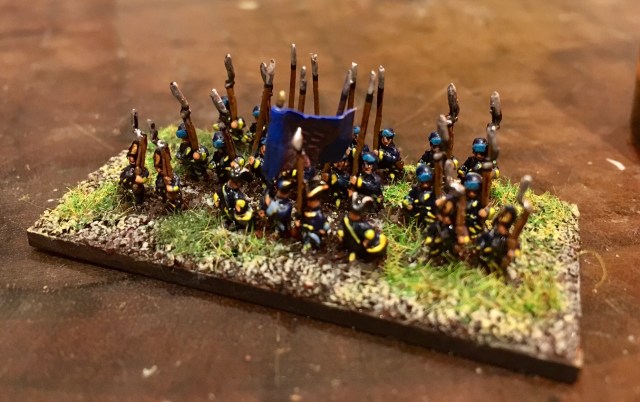
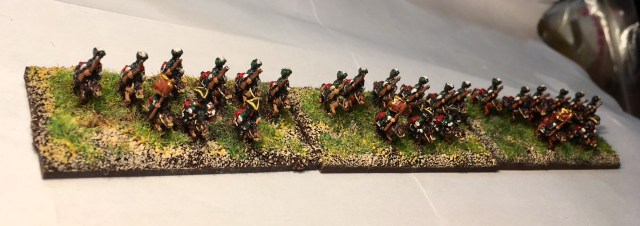
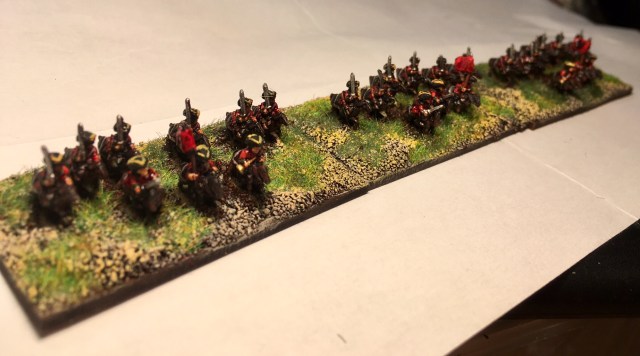
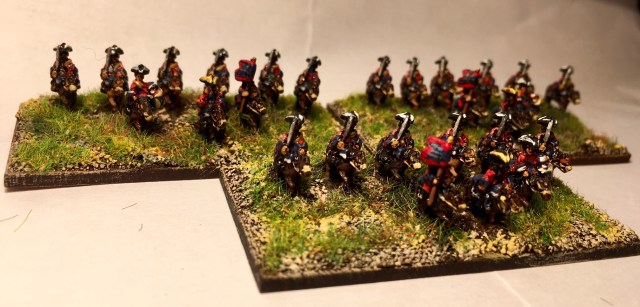
True to my words, at least this time, last weeks effort were focused on the main project. 17 bases of infantry inked, highlighted, based and flagged this weekend from the base painted pile. More on this below. It is nice to do some 6mm again.
I am really happy I managed to get that famous finger out of that dreadful place and get these done. I have had too many diversions lately on the hobby front with the Terminator stuff (did I say Terminators, Sorry!) and other pleasant non-priority things. On the personal front I had to go to France for a funeral earlier in the week. This was for a very special Lady who touched many hearts and inspired me in so many ways over the years, she truly was a manifestation of her own favourite poem “A thing of beauty, is joy forever” (link to it here). Hats off for you Dr. Bardaux!
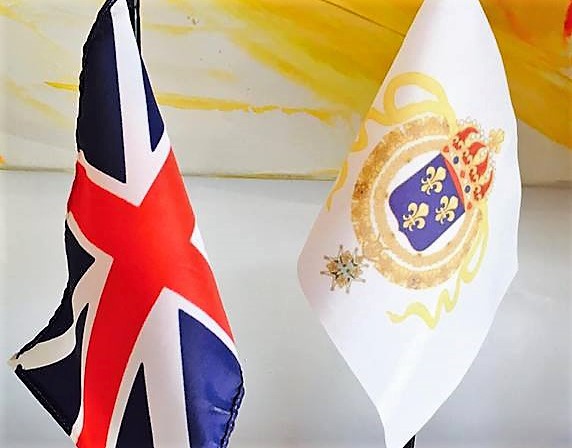
I also got those flags I talked about to use for the French and Indian War games, one Nouvelle France flag and also the Kings Colours (looks very good, me thinks!).
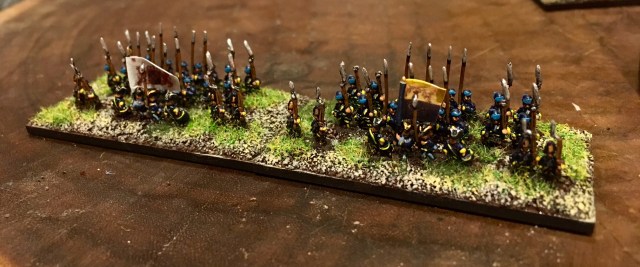
Swedish Infantry at Lesnaya
The following are the infantry made for the Lesnaya Battle (with some facts from the eminent book by Lars-Erik Höglund and Åke-Sallnäs, The Great Northern War 1700-1721 – Colours and Uniforms).
Estlänskt Infanteriregemente (de la Gardie), 2 battalions.
This was an enlisted regiment and raised in 1700 by the Governor General of Estland A.J. de la Gardie. After the Lesnaya Battle the regiment, due to heavy losses, where incorporated into the Västerbotten Regiment and fought in the Poltava Battle in 1709. They did not carry pikes and both battalions of the regiment were present at the Lesnaya Battle. The regiment, together with a battalion of the Närke-Värmland Tremänning regemente, formed the rearguard that were first attacked by the Russians.
Närke-Värmland Tremänning regemente, 1 battalion.
This was a temporary regiment that was raised in 1700 and had been reduced to one battalion in 1705. Was, due to losses, incorporated into the Livgardet (Lifeguard) after the Lesnaya battle. As mentioned above, part of the rearguard, that first had contact with the enemy at the battle.
Hälsinge Regemente, 2 battalions.
This was a regular indelta (provincial) regiment and had its origins from the 16th century. The survivors from the battle was transferred to the Dalregementet. The regiment was one of three regiments that first came to aid to the rearguard that was being attacked by the Russians.
Upplands, Västmanlands och Dalarnas Tremänning regemente, 2 battalions.
Another temporary regiment raised in 1700 and the survivors after the Lesnaya Battle was incorporated into the Livgardet. Was part of the early support force sent to help the rearguard.
Åbo Läns regemente, 1 battalion.
A regular provincial (finnish) regiment created in the 17th century. It had one battalion with the Lewenhaupt army (the other retained for fortress duty). As for the two regiments above part of the early support force.
Småland Tremänning regemente, 2 battalions.
Yet another temporary regiment that was raised in 1700 and you guessed it, due to losses, incorporated into the Livgardet (Lifeguard) after the Lesnaya battle. This like the other 3 regiments below was at Lesnaya during the Battle.
Åbo, Björneborg och Nylands Tremänning regemente, 2 battalions.
Temporary regiment that was raised in 1700 and it is not perfectly clear whether one or two battalions joined Lewenhaupts Army. Survivors after the battle were incorporated into the Västmanland regimente.
Öselska Lantmilisbataljon, 1 battalion.
This was a militia force raised in 1702 and took heavy losses at Lesnaya and after this was incorporated into the Västerbotten regimente. They did not carry pikes.
Österbotten regemente, 1 battalion.
A regular provincial (finnish) regiment created in the 17th century. It had one battalion with the Lewenhaupt army (the other retained for fortress duty). Survivors from the Lesnaya Battle were put into the Närke-Värmland regimente.
Nylands regemente, 1 battalion.
A regular provincial regiment created in the 17th century. It had one battalion with the Lewenhaupt army (the other retained for fortress duty). Was sent to enforce the troops at Lesnaya. Survivors after the Battle were placed in the Västmanland Regemente.
Björneborgs regemente, 2 battalions.
A regular provincial (finnish) regiment created in the 17th century. As for the Nylands regmente it came as an enforcement to the troops at Lesnaya. Survivors after the Battle were placed in the Västmanland Regemente.
Neil Shuck doing Sharp Practice in 6mm at Joy of Six
There are some very good news indeed with regards to Joy of Six this year, from my and I believe many others perspective, as Neil Shuck will be running some Sharp Practice in 6mm using my French Indian War stuff I did last year. You may recall that I and Neil did the Saga in 6mm last year. Neil will be developing a scenario so we are not yet fully sure what will happen on the day, but we will let you know as and when the mystery unfolds.
Most of you, I suppose, know that Neil Shuck is the man behind the, in my opinion, best wargames podcast available called “Meeples and Miniatures”. If you have not listened to Neil and his co-host give it a go, it is more than worth it (there is a link below). I have been listening to it for years and it has given my joy, inspiration as well as sound investment advice.
There are of course other podcasts out there, including the new, and equally, addictive Veteran Wargamer as well as the long running Wargames Recon show that are also very good. As I have said before listening to podcasts and audiobooks is my way of keeping my hands free to do painting and modelling.
Joy of Six is a show that from one perspective could be seen as an exclusive 6mm event but that would be a very (did I say very) narrow view, instead I, and perhaps you should too, see it as a fantastic event that bring something to all wargamers. To get an idea what it is all about you should check out the link to the show report from 2016 below. Personally it is another chance to see Dan Hodgson’s amazing Star Wars stuff that I totally missed out on last time due to the demand around the Saga tables.
Thanks Neil! Looking forward to seeing you again.
I will be running the Great Northern War Battle of Lesnaya 1708, if I ever get there!
Here are a few useful links with regards to the above:
Bare Winter Trees for my Chain of Command Winter War Project
I am finishing of the stuff I need for running some Winter War battles with regards to terrain and markers (see more background here and here). Trees are very important to get the right feeling and my current focus are on these. I already have a fair few pine type of trees (Christmas trees) and these are just the same Summer and Winter apart from some snow flock on top, but also wanted some bare (leaf less) winter trees. To get the right look I have considered Sea foam (but it seems to brittle for my requirements), making it with wires (but it seems too time consuming to do large quantities) or to go out looking for twiglets (but this gives limited amount of branches, unless you look very hard!). What follows is how I intend to do my bare forest.
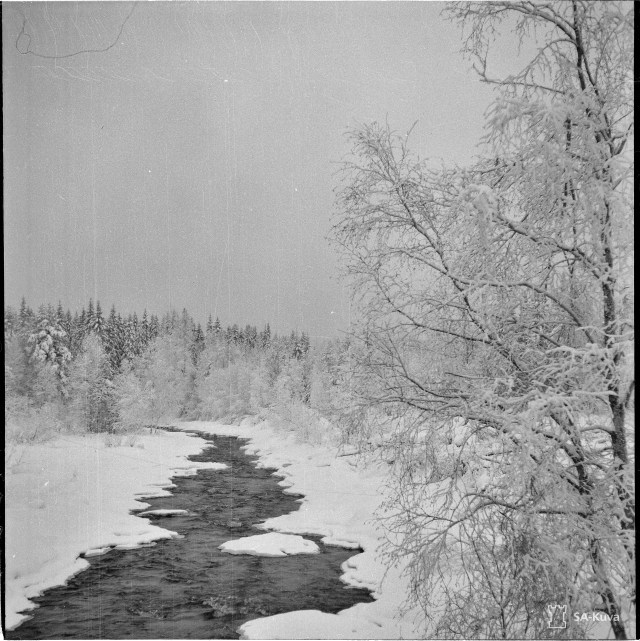
A picture of a river with some bare trees in the foreground during the Winter War, the objective of this little note. Picture taken from SA-kuva (Finnish Armed Forces Photographs) and you can find their webpage here.
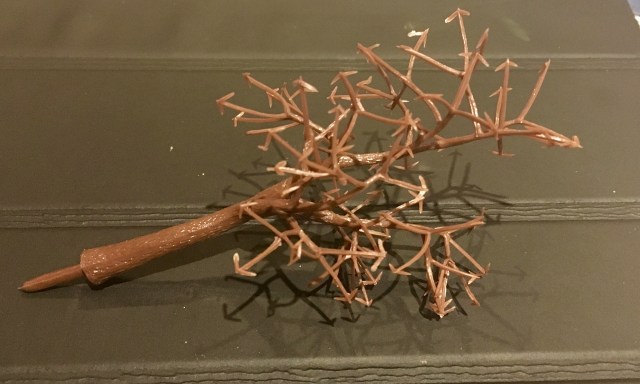
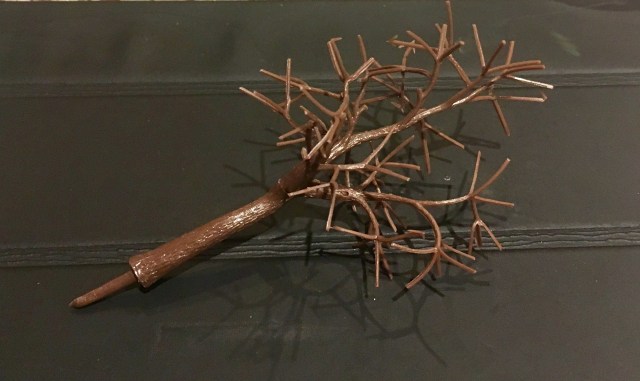
I went to eBay and found these trees (see below) and thought I give it a try. As they come from China it could have taken a while to get them in the post – but I was pleasantly surprised to get them delivered in a week.
The look pretty much like the picture and if you were in severe rush you could probably base them and field them like this. I took a few more steps and I have written a narrative of what I did in the text for each picture on what I did. I thought this could have some general interest.
What you need:
The trees shown above (go to ebay and search for them, you can by other quantities, the one above is for 50 trees 5X 10X).
Something to cut with (whatever you have clippers, nail scissors, etc. The plastic is very soft)
Washers (for bases) mine were 25cm in diameter.
Super glue
Putty or green stuff
Primer (I used Black Gesso)
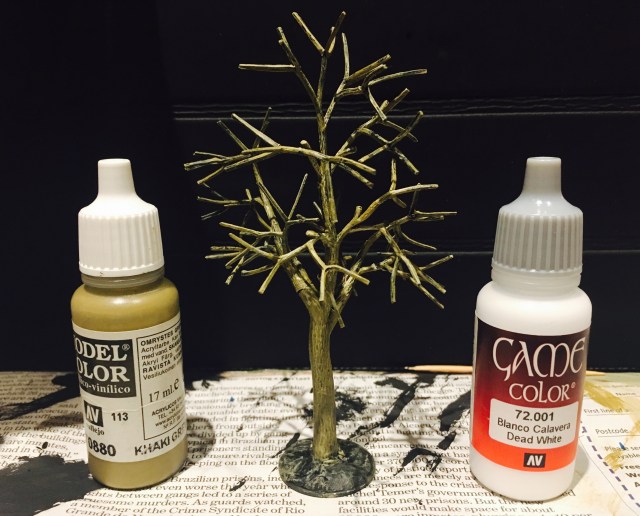
Paints for the trunk and branches (see below for the ones I used)
Modge Podge (Matte), but perhaps PVA is as good
Modelling Snow Flock
Some sealer (have not done that yet) – maybe a matte spray varnish would be best?
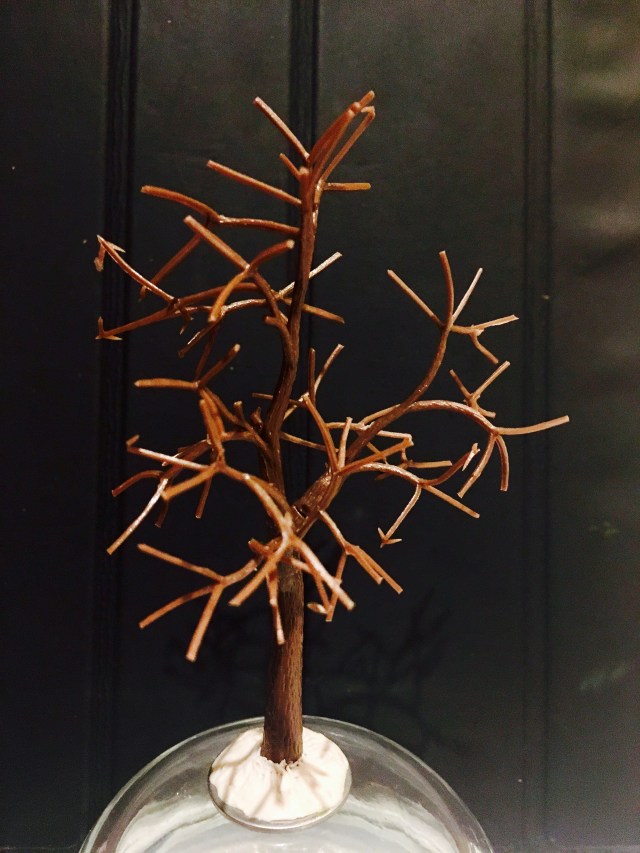
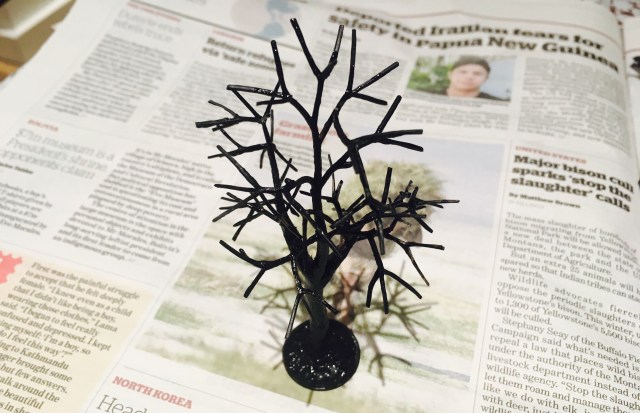
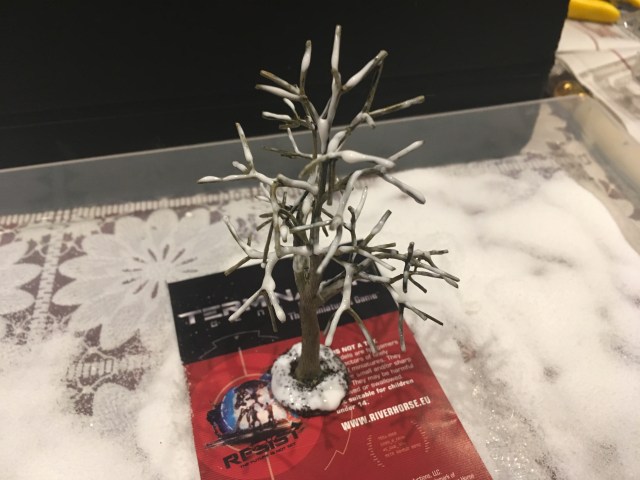
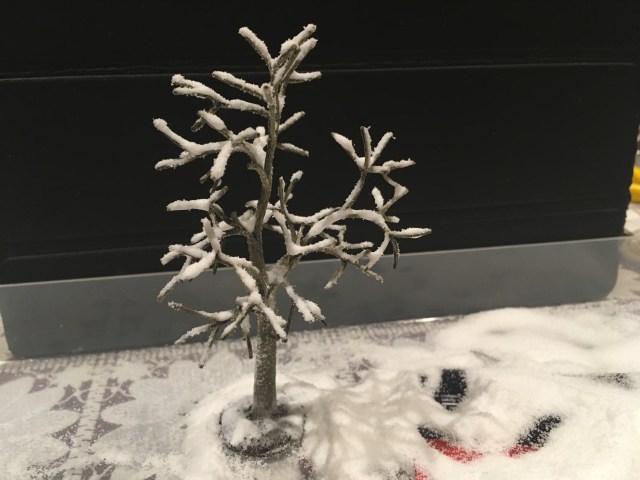
As they come, a plastic brownish feel and those arrow heads at the end. I suppose they are there to help keeping it together if you apply clump foliage. There is some nice structure on the trunk making it look like a tree.I cut away all the arrow heads (and also the bottom part that is still present on the picture).I superglued it on a washer (yes I did forget a few of the arrowheads but sorted that out later) and put some putty to support it at the bottom.I prime it black using Black Gesso. I find Gesso very good for priming plastic stuff.I used Vallejo model colour and did a heavy drybrush over the whole tree and then a 50/50 mix with whire of light drybrushing. I feel this is a better generic tree colour than the brown before! I may do a few to look like birch trees when I do full production later.I applied Modge Podge (Matte) on the branches where I wanted snow to stick. Do not cover everywhere as it more effectful to see some of the branches too. Put some on the base as well. Try to put on generously wihout too much drip (if that makes sense!).Let it snow, I use spoon to apply the snow modelling flock from above. Shake off and apply more Modge Podge until you are happy with the result.
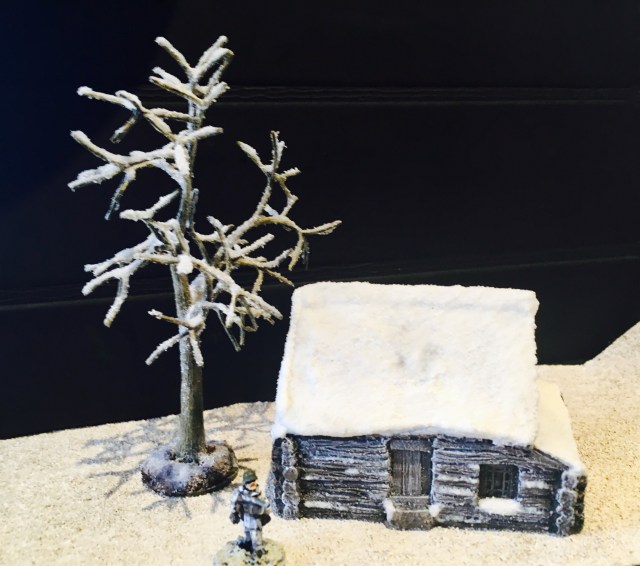
The finalized tree next to a little Cabin (I do not remember who produced these and it broke my heart covering the nicely modelled roof with Modge Podge and Snowflock!, but now I think it was worth it) and a Finnish Submachine gunner in 15mm (from Resistant Rooster I believe with a Peter Pig headswap). Maybe the trees would work in 28mm too? I will try to make the bases less bulky in the future and will not put on any sand and keep them as they are after applying the putty as they will be covered with snow anyway. All I need to do is to put the production machine on and do another 119 of these!
Tiger Lillies
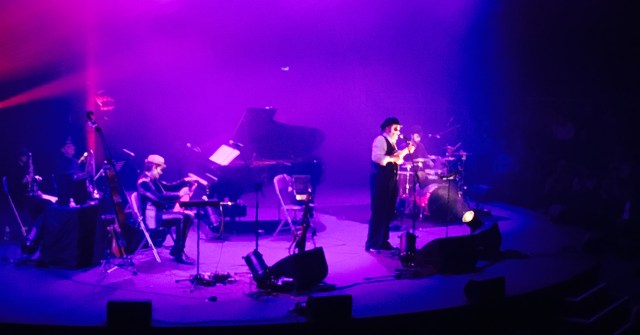
I went to see Tiger Lillies perform at the Camden Roundhouse in London this Friday. The concert was in celebration of their latest album released last week called ‘Cold Night in Soho’. It was their only gig in London as was advertised and promised as a night to remember. As I may have uttered before, the first time I heard them I was not sure whether it was absolute rubbish or bloody brilliant – I settled for the latter and this concert yet again proved that decision was the right one, being a mixture of old and new and I really enjoyed every minute.
This is one of those very fine British cultural treasures and to quote the roundhouse webpage, “The music they produce is a mixture of pre-war Berlin cabaret, anarchic opera an gypsy music, echoing the voices of Bertholt Brecht and Jacques Brel”. Check them out here.
Could not resist chopping some heads
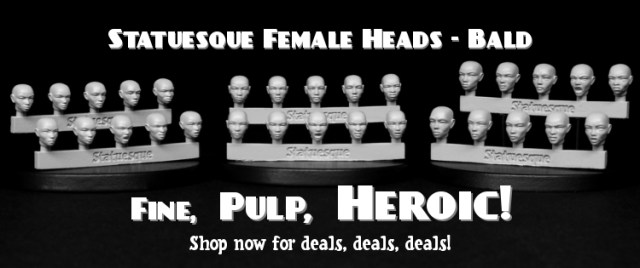
With regards to the Genisys project I did say I did not need any more miniatures, but I got a good deal on the John Connor and a Lieutenant set the other day so I could not resist getting these. What would the resistance be without John Connor?. Also I thought I would convert some of the resistance soldiers by using heads from Badsquiddo games (link here., I recommend a visit) to bring some gender balance in the resistance to the machines. Just as a note, one of the miniatures on each sprue in the box is a woman, but I wanted some more variety. I had also waited for an opportunity to use these heads since became aware of what Annie at Badsquiddo is doing.
Here are the shots of the resistance miniatures with the headswaps done (have not yet started painting them).
You may think the heads are a bit too big, and perhaps they are? They are good enough for my purposes. However, and this is great, they are sold in three different sizes fine, pulp and heroic. I bought the heroic ones and perhaps a size or two down would work better.
Incoming ships
I also got my order of “wave whatever” ships for the X-wing miniature games, I have lost count of what wave it is (I think it is Wave 10!). However, they are very nice indeed and I suppose we have to test fly them soon.
The Quadjumper and Upsilon-class Shuttle from the Force Awakens movie as well as Sabine’s TIE fighter from the Rebels series.
I also got some plastic toy cars that I intend to use for the Winter War project, but more on that another time.
Thanks for not asking about progress on the TMT project!
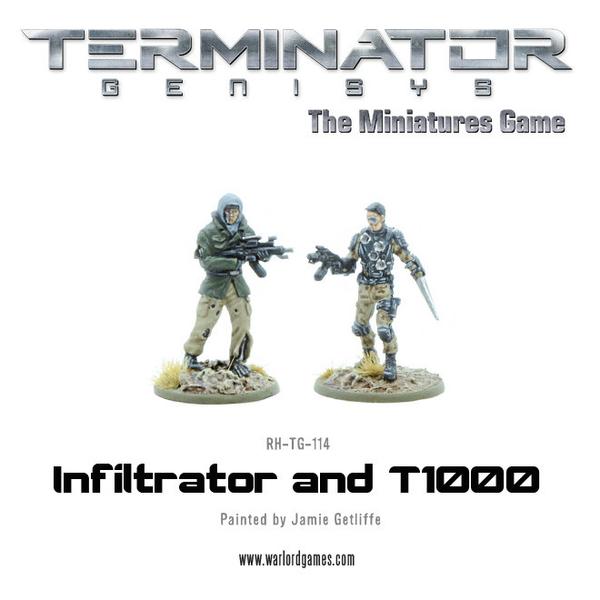
Following on from the last blog about terminators, the Little One and I have been doing a few more games of Terminator Genisys and we are still enjoying it. I actually ended up buying two more miniature sets, the T1000 (the liquid metal one from the second movie or to be correct mimetic polyalloy) & Infiltrator as well as the Special Endoskeletons set. I have also dusted off the old movies and although the first one (here) feels a little bit dated, with regards to the CGI, it is still a damn good movie. The second movie (here) I think is brilliant and the Little One is looking forward seeing the rest.
I have realized that if I want the Little One to get into this hobby it is not by trying to force feed him with 18th century linear tactics battles where we abstract the unit with a few models representing many or elegant mechanisms with built-in firing, damage, moral etc. Instead I think I need to, as well, offer him simple skirmish type of rules where each model represents a man, or a woman or in this case a machine, in a setting that excites him and he understands (the key here is ..as well!). It is fantastic when he gets it and we have not had so much fun since we first played X-wing or Saga together.
Finnishing (and Sovietic) touches
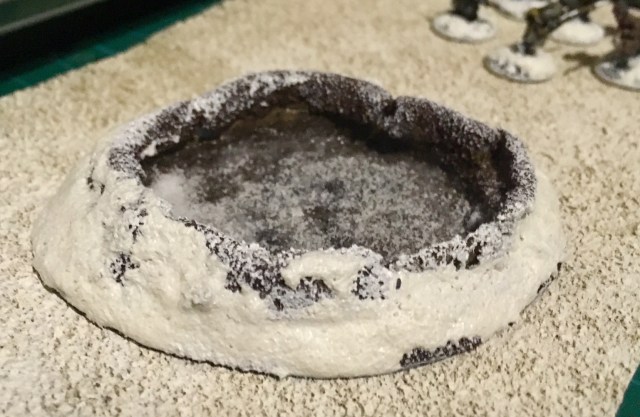
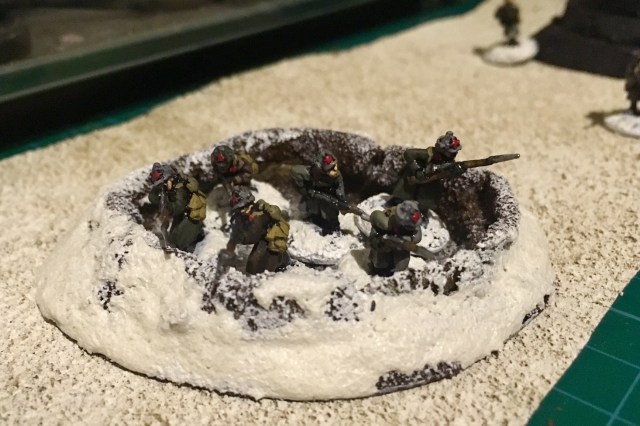
However, science fiction aside, I did feel obliged to continue my Chain of Command Finns and Russians so I could get some games of Chain of Command under my belt – I added some snow flock to the bases and made an entrenchment with some floor insulation blue polystyrene and a plastic base from a DVD cover (Terminator 2 – who needs covers anyway!) – I think I will make more like this. I covered it with glue and added sand, painted it chocolate brown and dry brushed it white and then added some snow around it (actually a mix of snow flock, matte modge podge and a few drops of off-white paint). Here it is.
The entrenchment in its full glory! The surface under is a trimmed part of a Snow Mat from Terrain Mat (link here) I bought many years ago to do some GNW winter battles on. I will use this mat for my Chain of Command battles as I think it looks very good.As above with some Soviets enjoying its protection!
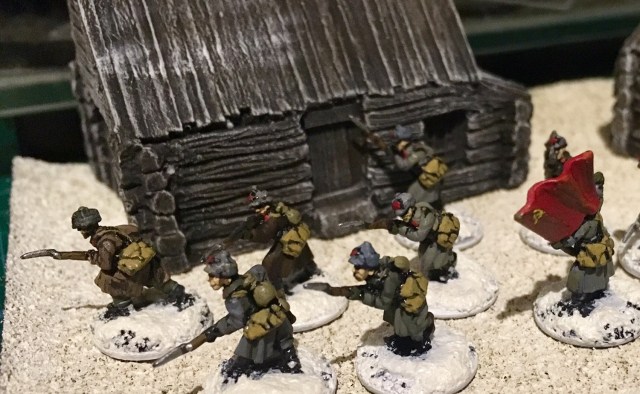
Here is the first picture in Colour (I need to add some snow to that roof, to make it look authentic).
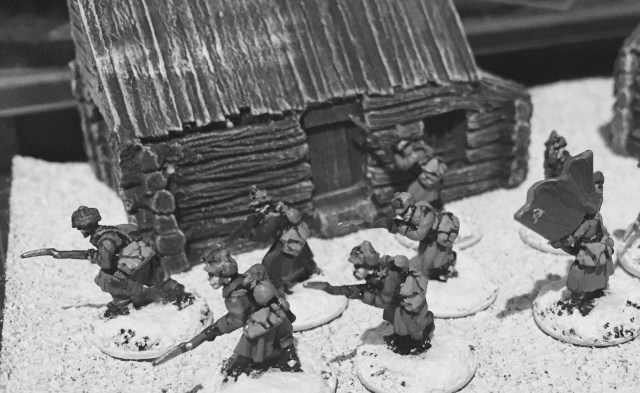
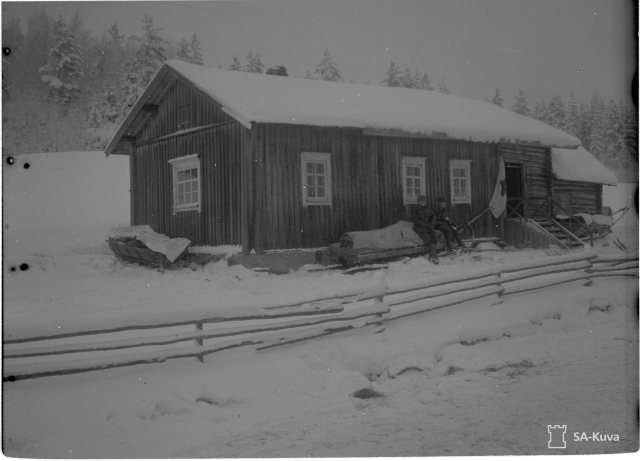
A section of Soviets advancing through a Finnish Village.House during the Winter War, the picture is from SA-kuva (Finnish Armed Forces Photographs) and their webpage is here.
Chevaux de Frise
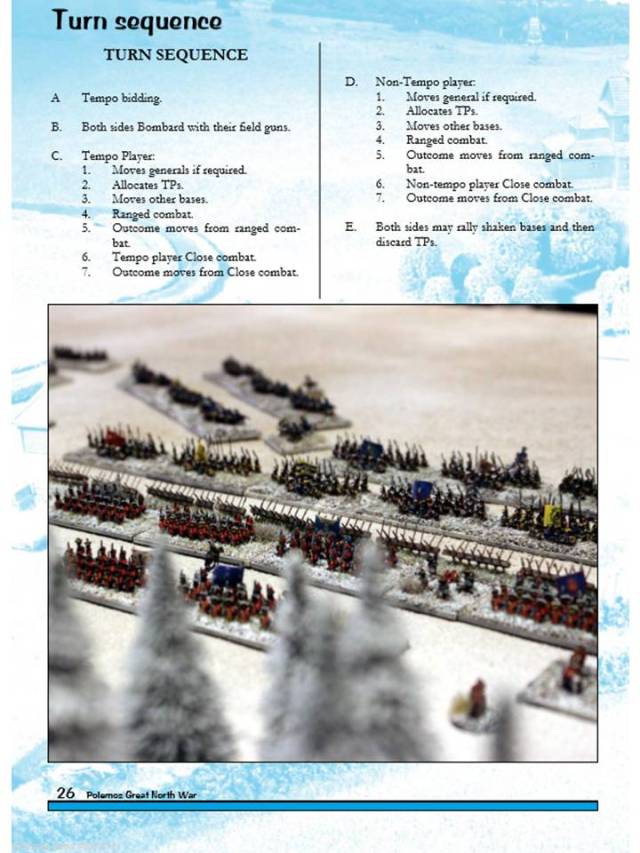
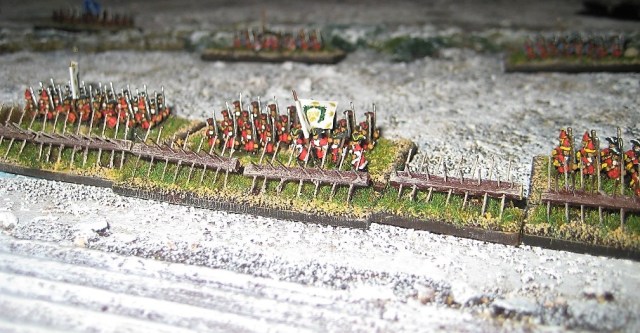
I got a question through to the blog last week that I thought potentially had some general interest. The question was about how I did the Chevaux de Frise (link to Wikipedia here) shown in some of the pictures in the Polemos Great Northern War rulebook (link here). These were shots based on the armies I did for the Fraustadt 1706 battle where the whole Saxon/Russian front line was standing behind these mobile defensive structures.
Peter Berry kindly included some pictures taken by my daughter of Swedes battling Saxons and Russians in wintery conditions as well as some Polish Panzerni and Winged Hussars in a more summery setting.
A page from the Rules
This is a high level, but I hope sufficient discussion, on how I made them (but first a few notes):
They are based on 60mm by 10mm bases, these are 2mm thick (the same thickness I use for all my bases)
They are not to scale, i.e. these are in fact large compared to the models. However, in my opinion, it does work visually.
Be careful when if you embark on trying to make these. Plan your work to avoid drilling or cutting your fingers. Also when you cut brass rod pieces make sure you are careful as small pieces may fly all over the place and cause direct damage whilst in flight or indirectly when they plant themselves into your foot at a later date. I speak from hard earned experience on (all!) these matters.
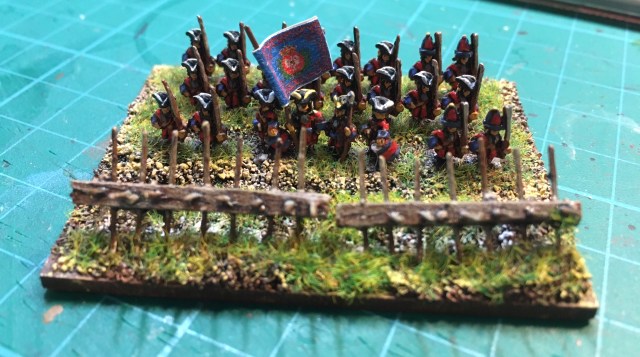
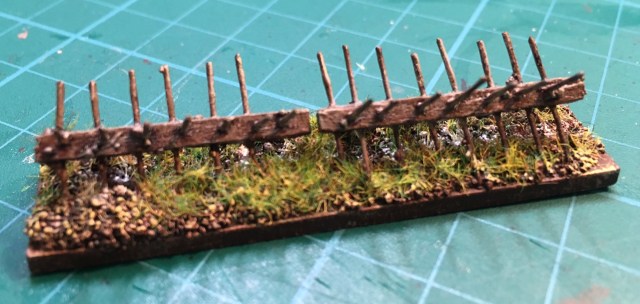
The finished product with a base of Saxon Infantry
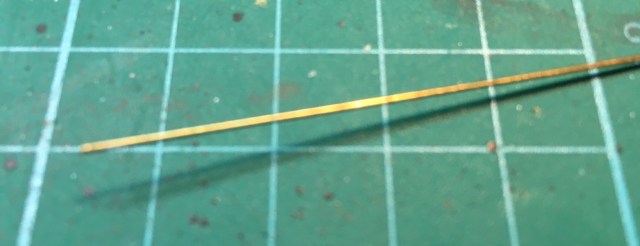
They are basically done by using model making matchsticks (That are about 5cm x 2mm x 2mm) – you can buy about 1000 of them at ebay for about £4. You need one matchstick for each base. You also need round brass rod (0.5mm) or equivalent. You will need a more than you think – normally they are sold in lengths of about 30cm and each will give you 25 pikes/spears at 12mm. Each chevaux de Frise base will need 28 pikes. 10 No. 30cm rods will give you enough to do 8 to 9 bases.
0.5mm round brass rod
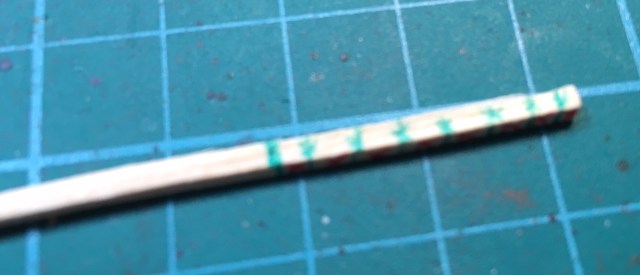
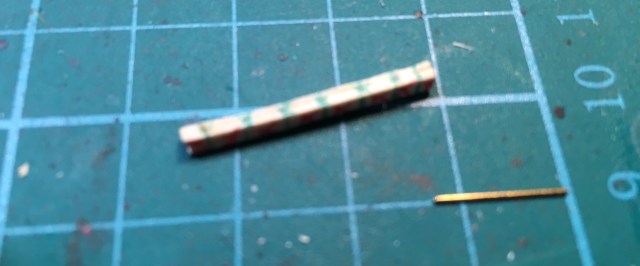
Mark up the matchstick in the middle and make seven lines with the same distance from each other and make a mark on the line in the middle.
Green marking
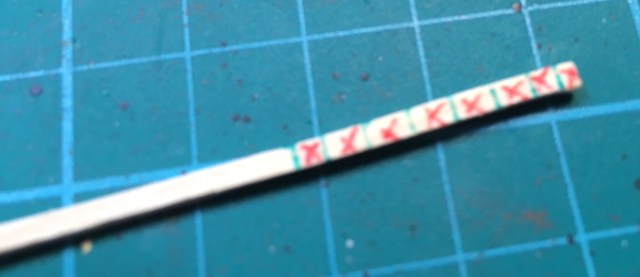
Flip the matchstick 90 degrees and extend the original lines and make a mark in the middle between the original lines (I used a red pen to do this).
Red Marking
Cut it in half (do the same mark-up for the other side, or do both at the same time) – use a razor saw and cut it gently to avoid damage – do not use clippers.
Drill the holes using a 0.6mm drill bit with a model drill. It is tempting to use a sharp object and pierce through a hole but it more than often damages the matchstick, so go for the drill approach.
Drilled matchstick piece and a brass rod piece
Cut small pieces from the brass rod. I made mine about 12mm long and stick them in your holes.
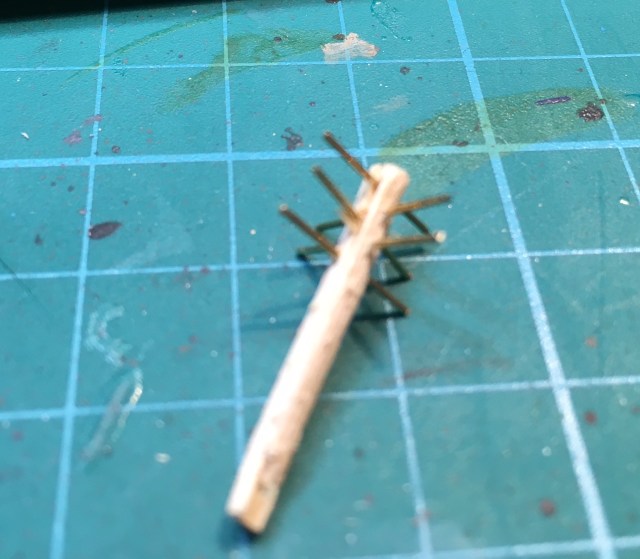
Nearly there… (you could stop here and use it as an improvised hand weapon for your larger scale miniatures!)
Then do the rest and slab on some PVA/White glue to make it sturdy and avoid the rod pieces to slide off, then paint it and base it up and you are done.
Just as last year was nearing completion I got an e-mail from Warlord Games indicating that they had a sale on the Terminator – Genisys game that was released last year. It was reduced from £70 to £20 and although my understanding of economics is that price is an information carrier (i.e. if the price is low the product is usually not that good) I ordered a box. I checked today (17/01/17) and it looks like there is still a deal on the Genisys game but the cost is now £35. I also bought a copy of the Pirates of Nassau board game that was reduced significantly too, but that is still in its shrink-wrapped state.
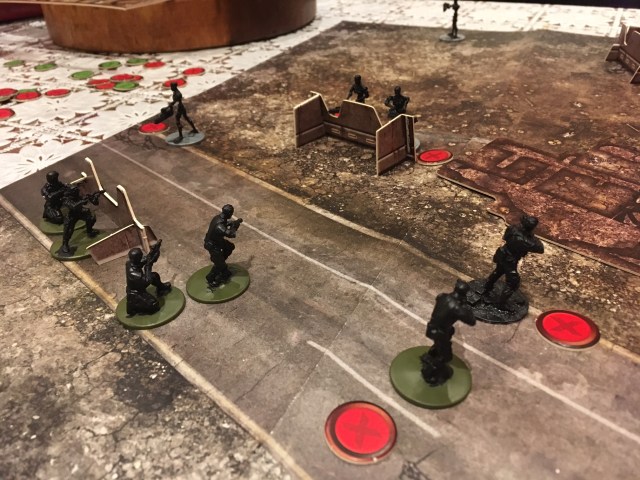
Left flank action with some Resistant Soldiers taking on some Machines. The red markers indicate that the model has carried out an action in the turn.
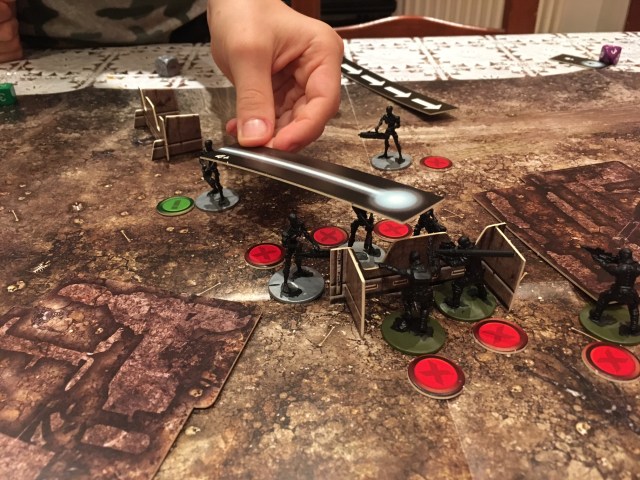
The Genisys box comes with literary everything you need to start playing the game, including miniatures for the resistance (17 No.) and the machines (10 No.), a 2 by 3 battle mat in thick paper and some terrain tiles. The Little one and I had a go at the basic rules and we were in full swing within minutes – we played two of the starter scenarios and had a good time overall. The rules are simple and you can activate 0 to 2 models per pulse (part of a turn) depending on a dice roll (with the possibility to activating more if you have leaders). The robots are hard to kill, but with overwhelming fire there is a decent chance of denying the model an action in the turn and hope for that lucky killing shot at some point. Terrain is important and a model in the open is soon taken down.
Marker for shooting at point blank range or moving at normal speed during an activation.
I think we have found ourselves a little fun game to play every now and then. The small playing surface makes it very easy to set up and play without upsetting any of the other going-ons in the house. A game with the number of miniatures we currently have does not take very long to complete.
I spent an evening painting them up to a basic standard – it is always better to have some paint on the miniatures than not.
The ten Terminators
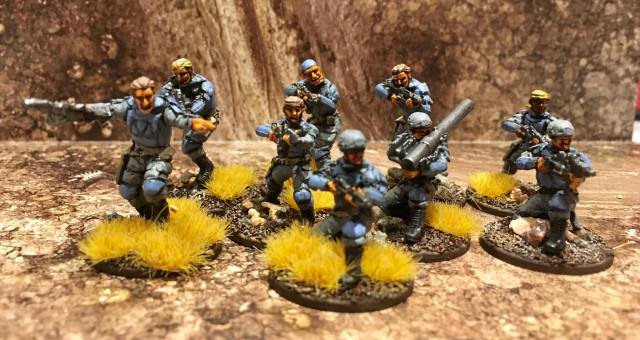
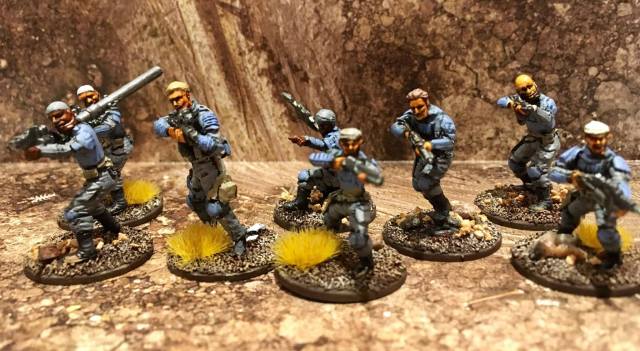
Some resistance soldiers
Some more resistance soldiers…
More Metal to the People
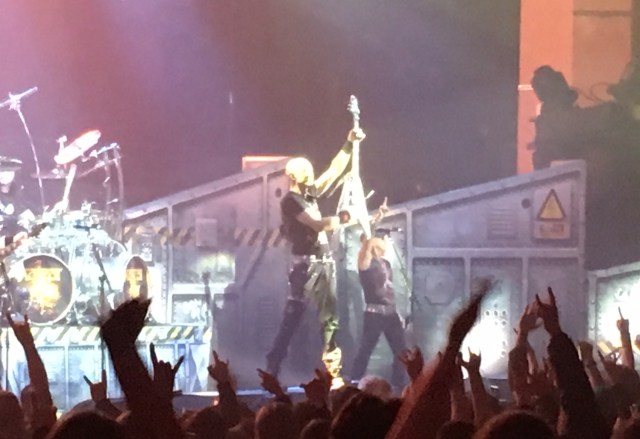
We also had the pleasure, well not the Little Ones, of seeing Sabaton at the Brixton Academy this weekend. They were supported by Twilight Force and Accept. Due to events outside of our control we arrived too late to see Twilight Force but instead our first dish of the evening were served by Accept – I have not seen Accept since my younger days and I have to say I was positively surprised and yes they did Balls to the Walls! Powerful and very seasoned.
Accept at its best with Wolf Hoffmann at the front!
Then the onslaught started!…
Fast as the wind, the invasion has begun
Shaking the ground with the force of thousand guns
First in the line of fire, first into hostile land
Tanks leading the way, leading the way …
… They are the panzer elite, born to compete, never retreat – Ghost Division
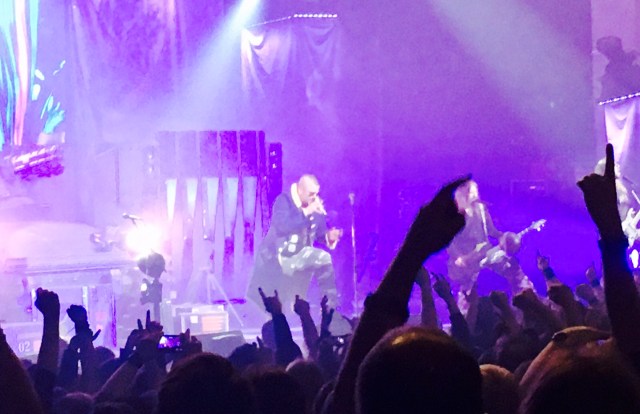
In good tradition Sabaton unleashed themselves upon the audience with the eminent song Ghost Division. The song is about the 7th Panzer Division that both the German Command as well as the French constantly lost track of during the invasion of France in 1940, due to its speedy advance.
Thirteen songs later a break and then a triple encore with the classic Primo Victoria about the D-Day invasion, Shiroyama the final battle of the Samurai and then the sad but brilliant To Hell and Back about the Battle of Anzio.
In short – “Awesome!”.
Joakim, the Singer of Sabaton, with a coat similar to those worn by the soldiers during the Great Northern War, signing the fantastic title track from the epic Carolus Rex album. “I was chosen by heaven, say my name when you pray, to the skies, see Carolus rise!”
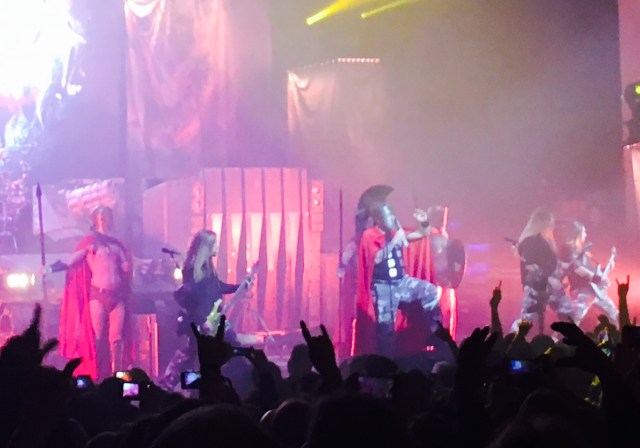
Anther costume this time depicting another Warrior King, namely Leonidas of Sparta.Absolutely brilliant show and engaging as always! Well done!
Marching in (Brilliant) Colour
Last week I got my second batch of painted miniatures from Marching in Colour (link here) you may recall from a few updated ago (if not have a look here!). I am really enjoying this experience and it is nice not needing to do all of it myself – for a change. I have asked Chris to provide a basic paint job. This allows me to add my chestnut brown ink and to do some final touches before adding/painting flags and basing them to make them seamlessly blend into the existing stock. I will start working on this batch shortly – I currently have 90 Polemos bases worth of miniatures to complete – 45 cavalry bases (with 9 mounted miniatures to each base) and 45 infantry bases (with 24 miniatures to each base). I have plenty to do and will post about getting through this pile next time.
Birds flying high you know how I feel Sun in the sky you know how I feel Breeze driftin’ on by you know how I feel.
It’s a new dawn It’s a new day It’s a new life for me
It’s a new dawn, it’s a new day, it’s a new life for me And I’m feeling good
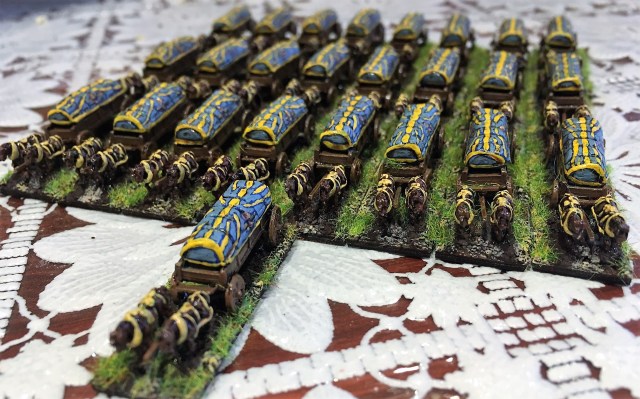
The radio served me this song the other day whilst I was battling a cold and getting used to the concept of needing to get back to work after the Christmas break. It was the Michael Bublé version of the song that Google, ever so kindly, tells me was originally written by Anthony Newley and Leslie Bricusse for the musical The Roar of the Greasepaint – The Smell of the Crowd (Now that is a title!). I decided to get up and continue doing those damn supply waggons I said I would do in the last TMT Part (see here) a few weeks ago.
I had already done 24 canopies using the moulds I had made. It takes a while as the plaster ideally needs about an hour to set properly. I had to do some post moulding filing but overall it was easy and very satisfying.
I painted them as I had done the prototype one and in summary I can say that I am happy with the overall result…
…And I’m feeling good
I will do another 12 that will give me a total length of about 1.5m worth of supply train – that is meters and not millions!. I will also do more bases for the column with some pulled artillery, cattle, sheep, pack horses/mules etc. But that is for another day.
On the musical note
I do not go to as many music concerts as I used to. However the next few weeks I have a fair few musical outings to look forward to:
I am debating with myself whether I have seen Sabaton eight or nine times in London. I think Sabaton is a brilliant band and a joy to see live. It is metal and their songs are about warfare and this is not everyone’s cup of tea (or pint of beer) but it is certainty mine. This time they are playing at the Brixton Academy supported by the German metal band Accept – most famous to me for the Balls to the Walls song many years ago. There is also a third band called Twilight Force that I am looking forward to see as well. Good night! I really got inspired when they released their Carolus Rex album and my Fraustadt table at Joy of Six a few years ago was inspired by the song “Killing Ground” (incidentally I put in a link to a video from youtube here if you like 18th century uniforms and some metal ).
Next up are the legendary Black Sabbath doing their “The End” gig at the O2 Arena. I am really looking forward to this and hope it will evoke some of that magic I felt when I first listened to the early songs like Paranoid, Children of the Grave and Iron Man to mention a few. I let you google Black Sabbath for yourself if you have no idea what I am talking about.
The next one is an odd one (for me) and I first came across them whilst browsing for the Rats in the Wall story by H.P Lovecraft a few years back (I did find it here). I found this band called Tiger Lillies performing their song Rats (in the Walls, with a link to youtube here) and was not sure whether it was absolute rubbish or bloody brilliant – I settled for the latter and it seems like the stars have aligned this year and I will be able to see them in early February at the Roundhouse in London. I wonder what the Better One will make of it? If you could stand the above why not try these, Bully Boys and Crack of Doom. I told you it was odd, did I not?
….And I’m feeling good
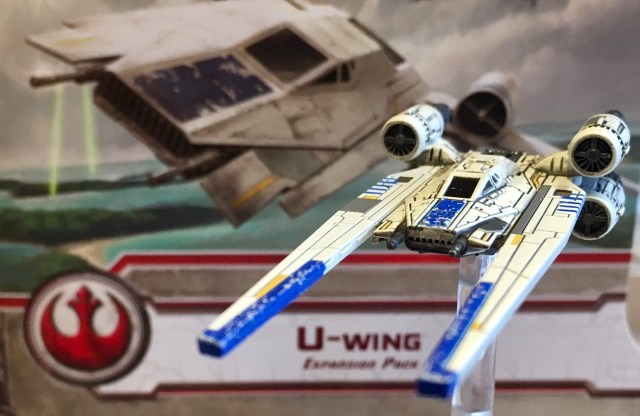
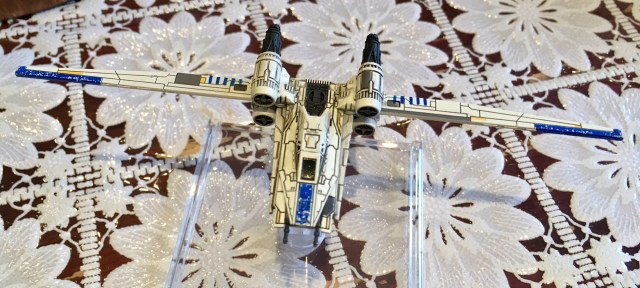
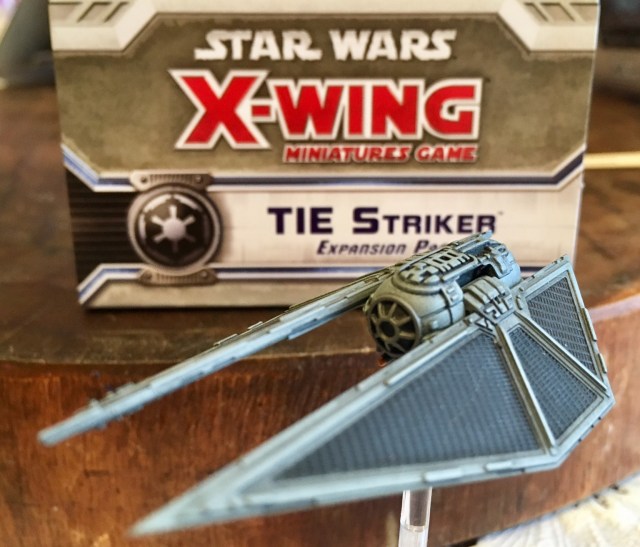
I and the little one are off to try out our new Star Wars Ships (from Rogue One) for the X-wing miniatures games. A shout-out for Andrew Wood at Board game Extras (link here) who I have ordered most of the X-wing miniature ships from since the early days. His prices are more than competitive and their customer service, in my experience, is brilliant. One large ship, the U-wing, and a small ship, the TIE Striker. They both look cool and the title ability for the TIE ship seems interesting and potentially useful as well as the new rebel crew cards.
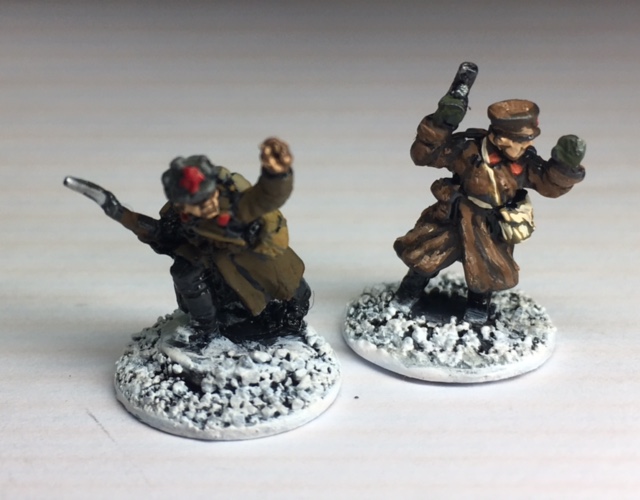
Red Army Soldier with the typical pointy Budenovka hat that was still in use during the Winter War period. The picure is taken from SA-kuva (Finnish Armed Forces Photographs) and you can find their webpage here.
Towards Moscow Trilogy Progress
I considered just putting up some old pictures and change the titles – I might get away with it for individual units but I am afraid it would fail en masse at the Joy of Six in July next year. Anyway, joke aside and in line with the promise I solemnly made to myself I did force myself to complete a few more bases for the Project. This time 3 No. Russian Dragoon regiments (As before these are from Baccus 6mm).
Astrachanski Regiment
Nevska Regiment
Kievska Regiment
Winter War – Chain of Command
A little bit of an intro
The Winter War was the invasion by Soviet Union of Finland in 1939 (30 November) to 1940 (13 April) in order to protect its interest as it, amongst other things, perceived Leningrad’s proximity to the Finnish border being a security issue. This short war showed the difference between a bad & overoptimistic plan, inadequate equipment & training for the theatre of war, unmotivated & badly led men (remember Stalin’s 1936 t0 1938 purges of the Red Army leadership) against a disciplined, trained and mobile force of highly motivated soldiers who used the arctic conditions to its advantage. Although the Soviet Union won the war it was not the quick and total victory that had been expected.
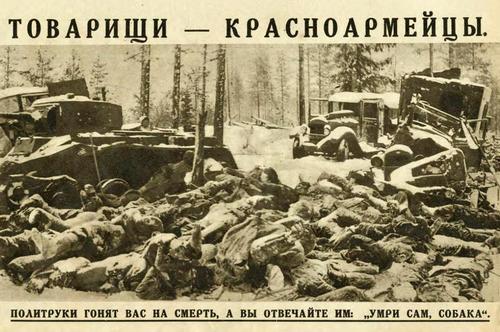
Finnish Propaganda poster from the Winter War saying something like “Comrades, Red Army Soldiers. The Political Commissar drive you into death, and you say “Die yourself, you dog”.
Onlookers marveled at the Finnish resolve but more importantly the incompetence and seemingly badly preparedness of the Red Army was noticed by the Germans and this is traditionally seen as one of the contributions to the start of the Barbarossa Campaign in 1941. However, although the lesson was correct in 1940 it did not consider that the Red Army had learned a few lessons too. The sobering and embarrassing experience of the War led the Red Army High command to review its performance and from this implement a number of reforms including changes to tactics, logistics, communications and training of officers. It also introduced the wider use of field mortars to support infantry, toned down the role of the political commissar, as well as the wider use of submachine guns. Although these changes were not fully implemented at the start of the Barbarossa campaign, the Red Army in 1941 was not the same army that invaded Finland in 1939.
The family on my mother’s side are Finnish and I have heard many stories from this period – some heroic but most of them being about the sad realities of war and the people that had to endure them directly and indirectly. For example one of my relatives, a pioneering educationalist working in the Finnish border areas, had to take home his two sons in coffins during the war – both of them were volunteers and the youngest was 17. My hobby is very much related to war and I think it is important to remember that in reality it is far from a game. This awareness does not take out the fun of it but adds respect to how I deal with it.
I recommend you read more about the conflict here and why not get a copy of the Talvisota/Winter War movie while you are at it. There is a good youtube video with Sabaton’s Talvisota with clips from the Talvisota movie – you can find it here (this is a good one, did I say that?). Other sources on the net that are worth checking out to start with are:
Sami Korhonen’s Battle of the Winter War webpage, here (lots of links to other useful stuff) – very good source.
The Jaeger Platoon webpage – weapons, formations and some battle write-ups as well as links to other information, here.
Some war stories can be found here. It forms part of the Axis History Forum’s Winter and Continuation war forum (here) with over 1800 topics.
And three relevant and good papers:
New approaches to the study of Arctic warfare by Pasi Tuunainen, here.
Elimination of pockets in Western Lemetti during January – February 1940: Use of German Experience with Storm Troops by the Finnish VI Army Corps, by Pasi Tuunainen, here.
Finland in the Winter War by Ville Savin, on the Lardies website, here.
I find the following books useful and a good start:
The Winter War: The Russo-Finnish War of 1939-40 by William R. Trotter, link to the publisher here.
Finland at War: The Winter War 1939-40, by Vesa Nenye, Peter Munter and Toni Wirtanen (the second in the Series about the Continuation War is good too). Link to the publisher here (but could perhaps be bought cheaper elsewhere).
From a Wargaming perspective I intend to use the Chain of Command rules from Too Fat Lardies (they are really good and you can find them here). I also have a few other resources including the Skirmish Campaigns book Finland 39-40 The Winter War (This was not written for the Chain of Command rules but can easily be used for the system, and this have been discussed to some extent at the Chain of Command forum, here search for “Skirmish Campaigns and Chain of Command”).
Miniatures Used
I decided to do this project in 15mm and got myself a few packs of miniatures from Battlefront (yes 15mm Flames of War miniatures, sometimes you can find packs on ebay and other alternatives but if this fails buy it directly from Battlefront) as they were doing early war Finns and Soviets for their Rising Sun supplement (Well I got a fair few actually). The packs are still for Sale and I think they are ok – in addition buy some loose heads from Peter Pig of the German WW1 helmet and you could even buy some Japanese helmets without netting (to simulate the Swedish helmets worn by some units, the Swedish M-26 helmet is being used to make fake Japanese helmets being sold on the collectibles markets), and some German field caps and fur hats and you have some headswap options to create some variety with the same poses. Similarly for the Russian side you can get some early Sovietic helmets (known as the M-36, these were replace by the more iconic SSh-39). Your winter war Russian looks best with the pointy hats and/or the M-36 helmets.
Peter Pigs head range can be found here – snip off the head and drill a little hole, put some superglue and attach the new head (be careful and you will be fine, it is worth it).
I have added some additional things using more Peter Pig (main page here) stuff, some old Resistant Rooster stuff (here) as well as a few really old True North stuff (here, but I am not sure they are still in business?). But this is really for variety – the only issue with the Battlefront miniatures are the lack of LMGs.
Battlefront Finnish Packs Used
FI721 Jääkari Rifle Platoon (Winter) – main pack
FI722 Jääkäri SMG Platoon (Winter)
FI724 Machine-gun Platoon (Winter)
FI727 Tank-Hunter Platoon (Winter)
FSO113 Finnish Anti-tank Gun Group (Winter)
FSO112 Finnish Artillery Group (Winter)
FSO115 Finnish Sissi Troops (Winter)
SU500 45mm obr 1937 gun
FI570 76K/02 (76mm gun) (x2)
Battlefront Soviet Packs Used
SBX28 Strelkovy Company (Winter) – main pack
SSO120 Greatcoat Command & Komissar Team
SSO152 Artillery Group (Winter)
SU560 76mm obr 1927 gun (x2)
SSO153 Anti-tank Group (Winter)
SSO192 Soviet Dismounted Tank Crew
SSO151 Flame-thrower Platoon (Winter)
SU766 Sappers (Winter) Upgrade
SU301 BA-10
SU040 T-28
SU002 T-26S obr 1939
SU422 Zis-5 3-ton truck (x2)
Now to some more detail on the platoons, the Soviet Platoon this week and the Finnish Platoon next.
The Soviet Platoon
You can find the full army list from Too Fat Lardies here (The Platoon Force Rating is +6 for Regular and -2 for Green, 5 Command Dice when regular and 4 when Green. The Winter war forces are regarded as Green during the initial phase (Nov-39 to Jan-40) and can be regarded as Regular after that). These are not elegant maneuvering elements – this is brute force! UHRAAAAH!
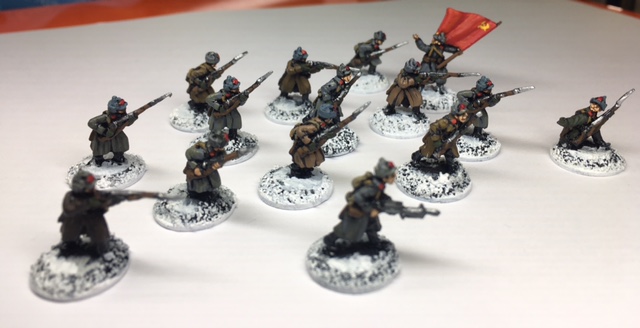
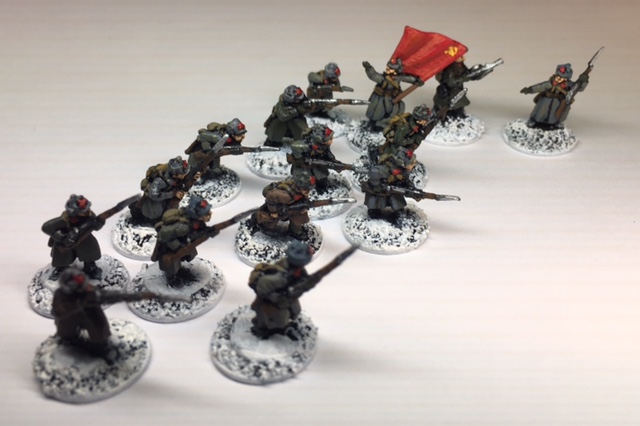
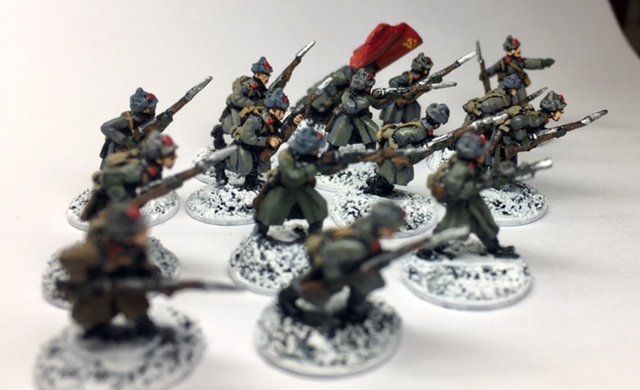
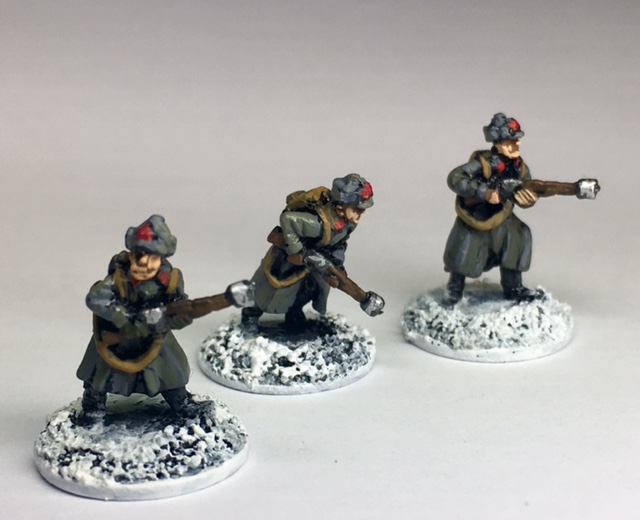
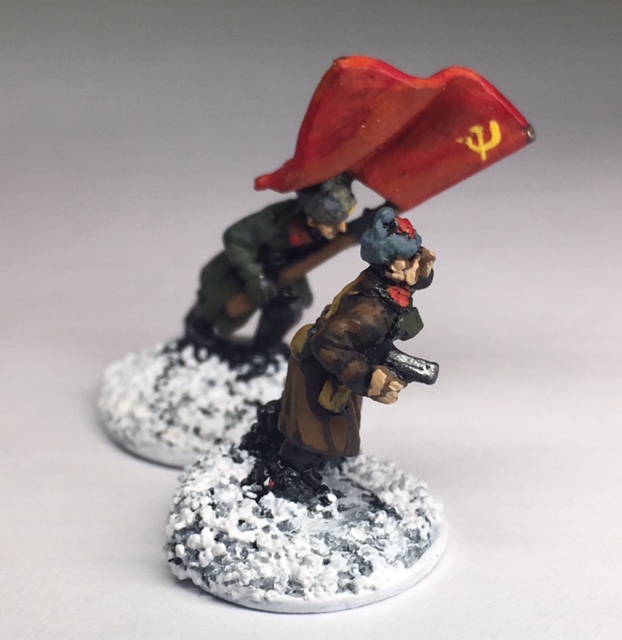
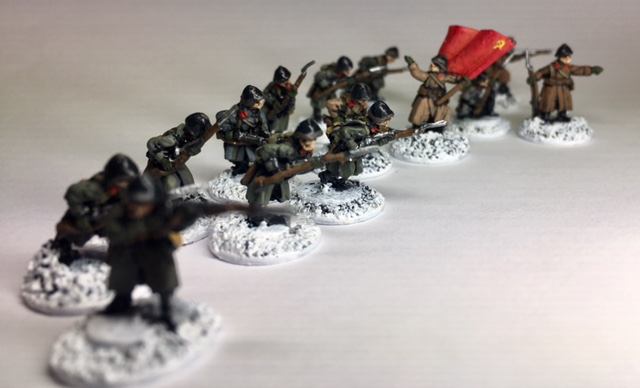
I tried to go for some variety to the coats but painted the pointy hat in the same colour (with the red star) using a field bluish colour – it gives a somewhat uniform look to the units. It works for me. I got some inspiration from some nice photos from this site – it shows some reenactors of the conflict – both Finnish and Russian.
NOTE: The bases are in desperate need of some modelling snow flock – not done yet.
Platoon Headquarters – Leytenant Tretiak (Senior Leader with Pistol), Starshina Fetisov (Senior Leader with Rifle). The Starhina is from Battlefront and the Leytenant is from Peter Pig.
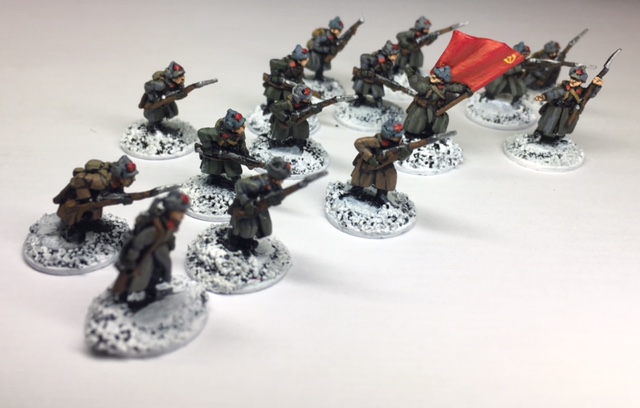
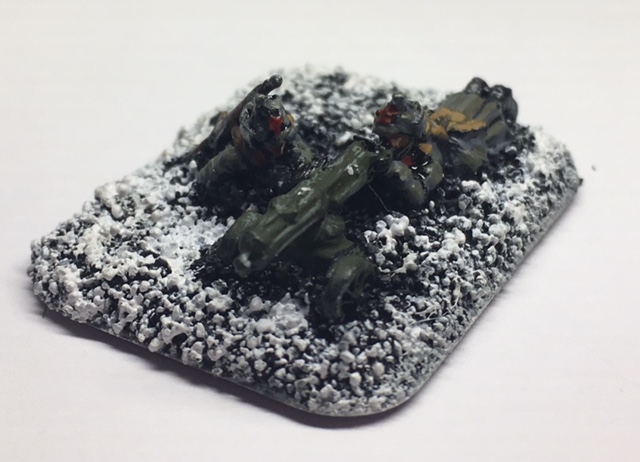
Squad One – Serzhant Kasatonov (Junior leader with Rifle), DP-28 LMG with two crew, twelve riflemen. All are from Battlefront.
Squad Two – Serzhant Krutov (Junior leader with Rifle), DP-28 LMG with two crew, twelve riflemen.All are from Battlefront I added a flag bearer to each squad for show, not sure this is realistic – but it looks good.
Squad Three – Serzhant Larionov (Junior leader with Rifle), DP-28 LMG with two crew, twelve riflemen. All are from Battlefront.
Squad Four – Serzhant Makarov (Junior leader with Rifle), DP-28 LMG with two crew, twelve riflemen. All are from Battlefront.
Support Options
List 1
SMG upgrade – PPD SMG – I made a few SMG armed ones based on Peter Pig winter war Russians with headswaps (using heads from the Battlefront Peaked cap miniatures or the Early Russian Helmet Head packs from Peter Pig). Not a very common weapon at this time of the war.
SMG Troops
SVT-38 Semi-auto rifles – did not do specials for these. They were being tried during the Finnish Winter War. If they are used we just make a note and get on with it. Slightly longer than the normal rifle and a with a cartridge magazine. The initial reaction of the troops to this new rifle was negative as it was felt it was cumbersome, difficult to maintain and the magazine could fall of the rifle.
Engineering Teams – 3 men for each (Mine clearance, Wire Cutting, Demolition or what ever). These are from the Battlefront Sappers pack.
Engineering Teams
Other more terrainy stuff have to wait until I do my next battle (Minefield, Barded wire, entrenchments)
List 2
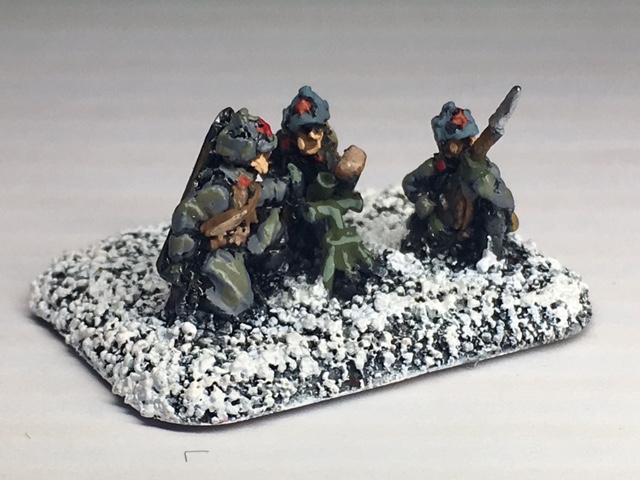
Mortar teams using the 50-PM 38 (50-mm company mortar model 1938), comes in the base winter infantry pack.
Mortar Team
Mortar Team 2
Flamethrower team, armed with the ROKS-2 Flamethrower designed to be easy to conceal on the battlefield (22.7kg, effective range 25 meters, but could fire up to 30-35 meters). The Finns captured some of these and they were later put in use as the Add to dictionary M/41-r. Nasty weapons. The are from the Flamethrower platoon pack.
Flamethrower team
For the pathetic but charming T37 see picture below, do not have a T-27 Tankette or a BA-20.
List 3
Sniper Team – this is just a standard infantry model from Battlefront without the bayonet and his spotter.
Sniper Team
M1910 Maxim MMG (Will do a few more) – very dark picture again from Battlefront.
MMG Team
Political Commissar/Officer – I think this is a headswap story with a Peter Pig body and a Battlefront Peaked hat head. He is screaming out communist propaganda whilst running into the sights of the White Death.
Political Comissar
For the T26 see the tank picture at the end. These are Battlefront.
List 4
Another infantry squad – Serzhant Pushkin (Junior leader with Rifle), DP-28 LMG with two crew, twelve riflemen. This time with the early War Russian helmet bodies from Battlefront and heads from Peter Pig – Early Russian helmets.
I need to paint the 45mm AT Gun and the 75mm infantry gun, I got both these from Battlefront.
Additional Infantry Squad
List 5
For the Kht-26 flamethrower tank and the T28 see the tank picture at the end. The Flamethrower tank is from Zvezda and the T-28 from Battlefront.
List 6
T28E (using the T28 again), see the picture below.
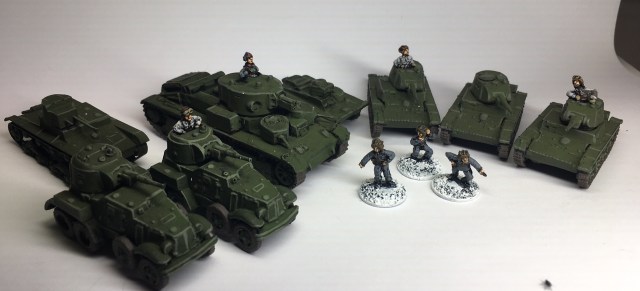
The Garage and some tank crew from Battlefront. The T-28 commander is from the Winter Infantry Set (just cut off the top part and actually looks more the part). As for the bases I need to winterize these at some point.
I hope this was of some use, I will show the Finnish Platoon next week…
/ All the very best, and seasonal greetings! Keep toy soldiering on!
I have just reviewed the children’s Christmas wish lists to do some final clicks on Amazon trying to support the market in its constant struggle to achieve equilibrium. I have not done a wish list for myself for a long time, my mother still asks me what I want every year and I normally answer peace on earth! – the best battles are fought on the tabletop with toy soldiers.
I tend to cherish experiences and last year I enjoyed the visit we did to the reenactment of the Battle of Hastings (see here for some notes from the day) or another example is when we went on the Dreknor boat in Caretan (Normandy) a few years back. I like to get an insight in how things looked like, worked and/or felt, it is sometimes difficult to capture this from the pages of a history book. So I do hope to get a similar experience of some kind in 2017.
Talking about experiences I took the children to watch Rogue One this evening – overall I thought it was fantastic fun and so did the kids (well, except the middle one!). I have to admit that Episode VII and this movie has reinvigorated my faith in the Force again. Although I do not think I ever lost it! A Light Saber that would be nice, I think I put that on my wish list.
I had a splendid day a few years ago on the Dreknor that is a ‘genuine’ replica of a Viking Longboat and offers a unique experience of being in a seafaring vehicle that for its time was pretty amazing and capable of maneuvers in shallow rivers as well as on the open ocean. I do hope I will get an opportunity to get out with the crew again at some point in the future. Here is a link if you are in Normandy and interested.
I have a friend who used to compete in long distance motorcycle off-road events whose motto used to be, and I suppose still is, “Accelerate or break!”. It dawned on me that I was coming to a position with the Towards Moscow Trilogy project (see here for a summary of what the heck this is all about) where I had to get real and stop faffing about. So after being told off by myself I will stop this wishy washy stuff and get on with some painting instead.
I actually have not completed any bases of miniatures since August for this project, so I decided to complete at least ten bases by the end of each week. Here is how I got on this week (in red bases completed this week):
Russian Units for Lesnaya, TMT Part 1
Type
Need
Done
Preobrazhenski
Infantry
3
3
Semenovski
Infantry
3
3
Ingermanlandski
Infantry
3
3
Astrachanski
Infantry
1
1
Menshikovs livskvadron
Cavalry
3
3
Vladimirska
Cavalry
4
4
Sibirska
Cavalry
3
3
Nizjegorodska
Cavalry
4
4
Vjatska
Cavalry
3
Nevska
Cavalry
3
Kievska
Cavalry
3
Novgorodska
Cavalry
4
Rostovska dragonregementet
Cavalry
4
Ustjuzjska dragonregementet
Cavalry
4
Smolenska
Cavalry
3
3
Troitska
Cavalry
3
3
Jamburgska
Cavalry
3
Karpolska
Cavalry
4
Tverska
Cavalry
3
3
Koporski
Cavalry
2
Narvski
Cavalry
3
Olonetski
Cavalry
4
And the mandatory proof (All 6mm scale from Baccus).
Menshikov’s Life Squadron
Vladimirski Dragoon Regiment
Nizjegorodski Dragoon Regiment
I am currently at the final hurdle of finishing of a Finnish and a Sovietic platoon for Chain of Command in 15mm – so I may do a few notes on these in the next few blogs.
I also got my order of Waggons from Baccus so we will continue doing the Supply column in the next few weeks or so.
Swedes attacking a defended Saxon position (Miniatures from Baccus)
With a little help to my friends
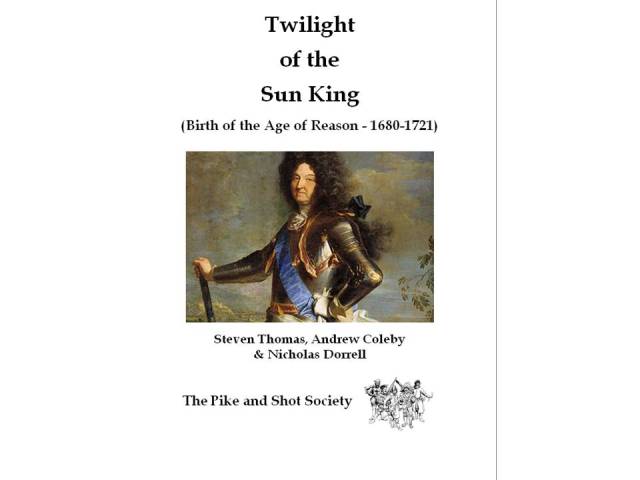
Twilight of the Sun King Rules
Nick Dorrell’s adaptation of the Twilight of the Sun King Rules I talked about in an earlier blog (see here) are now published by the Pike and Shot society. I really enjoy these fast play rules that makes it possible to play large horse and musket battles during late 17th and early 18th century in a reasonable time. Basing is adaptable and the rules works at two levels standard/brigade and regimental scale. In the standard scale a unit represents brigade or its equivalent (2,000 infantry or 1,000 cavalry – so about 4 battalions or 8 squadrons). For the regimental scale a unit equates to 1,000 infantry or 500 cavalry. I play the game in the regimental scale, as I do GNW where the battles tends to be smaller and I have more than enough miniatures to play in this scale, using two 60 by 30mm bases for a unit with a total frontage of 120mm per unit. This is the same basing I use for the Polemos, Maurice and the Might and Reason rules. Further the units can be classified as small or large to allow for the variation in units sizes during the period, e.g. to deal with smaller elite units etc.
The rules are, to quote Nick from the Design Philosophy notes, “…radical, some would say reductionist, in their conception. It is based on the premise that during this time period, morale rather than numbers of casualties was the key to deciding combat and even the outcome of battles. Many wargames rules pay lip-service to this; however, these rules take the radical step of collapsing shooting and close combat into morale. This dramatically simplifies game play but does so, in the designers’ opinion, without significant loss of historical accuracy.”
The Rules as well as a Scenario book is now available from the Pike and Shot Society and can be obtained from them, http://www.pikeandshotsociety.org/, and other retail outlets.
The scenario book is called Louis XIV at War and features 10 battles – 4 of these are from the War of the Grand Alliance (1688 to 1697) and the other 6 from the War of the Spanish Succession (1701-14). Each scenario includes orders of battles and a map.
A second scenario book is being worked on and will cover the Great Northern War and the Ottoman wars.
and you can contact nick via wyreforestgamers@yahoo.co.uk
Collection Calculator
Another friend of mine, Peter Riley, came up with an idea for a Wargames collection calculator when he went to the Newbury show this year. As he walked and talked to gamers at the show it emerged from the many conversations he had is that we don’t know, in detail, what we have in our collections and what they are worth. So to keep a good record of all the elements we have in our growing collections seemed a good idea.
I think it is a brilliant idea and could be used to manage your collection, get an idea about its value for a sale or how much to insure your collection for. Try it out and if you like the general idea support it by letting them know how it can be improved.
In a recent Meeples and Miniatures episode the hosts discussed the issue about insuring your stuff when they were speculating what they would do if they lost their collection and got the opportunity to do it all again being given the full value from the insurance company. If you do not know what you have and are not adequately insured then this scenario could end it tears and not in speculation on what you would replace or not.
By the way Peter Riley is the author of a few sets of wargame rules, including the ACW rules Crisis of Allegiance and On They Came as well as the Franco-Prussian Wars rules Kommandant de Battaile and Kommandant de Armee. He is working on a few new sets including a colonial set called A Steady and Deliberate Fire.
Winter is coming
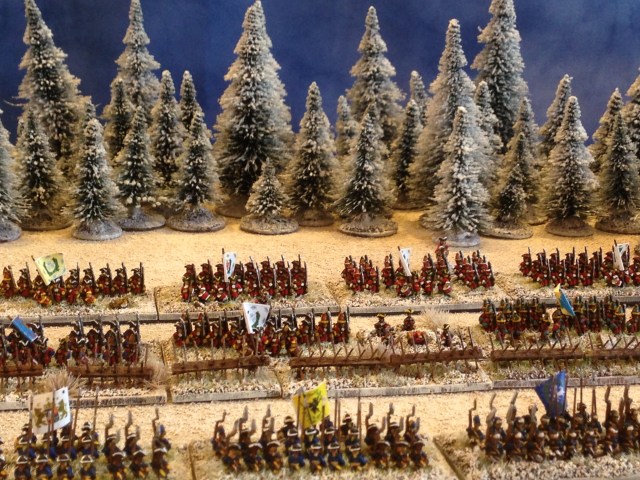
I have presented two Great Northern War battles at the Joy of Six show that took place during the winter season with snow and misery on the battle field – Fraustadt 1706 (with a mention in an earlier post here) and Gadebusch 1712. I really like wintery landscapes having been brought up in Sweden, where minus degrees and snow is a constant for a large part of the year. It engulfs the land and when Spring finally comes it feels like the land has been subjected to some form of annual cleansing.
When I first did the Fraustadt Battle I was hesitant in “winter basing” the armies as I was going to do Klissow where I could have “re-used” a lot of the miniatures especially on the Saxon side. However the contrast between a wintery table and the rectangular zone of summer really annoyed me when I had finished the table and set up the bases on it. So I got on with drybrushing all of the bases with white and then topped them up with some wintery tufts – it was worth the effort. Following the Gadebusch battle I now have fully sized GNW armies for the Swedes, Saxons and the Danes ready to rumble any time of the year.
The Saxon forces at Fraustadt did stand and wait for the Swedes for a while but I do not think that it resulted in the grass growing, or that they had some Astro Turf ready to roll out. I agree with the fact that basing should make the miniatures stand out but this a little bit over the top!
So apart from the snow ventures above I have a passion, or perhaps compulsion, for the Winter War 1939-40. It is a very interesting conflict and I went with the Baker Company Winter War 28mm Kickstarter a few years back – the project did not really go as intended and I only got part of what I expected. Instead I decided to go for it in 15mm and have recently completed enough to start playing some Chain of Command with a Platoon with some options for each side (I will do a future posting for the Finnish and the Russian/Sovietic platoon). I am also keen to try out the IABSM (I ain’t been shot Mum) rules from Company Sized actions. Both these rules are from the eminent makers of rules at Too Fat Lardies (Chain of Command here and IABSM here).
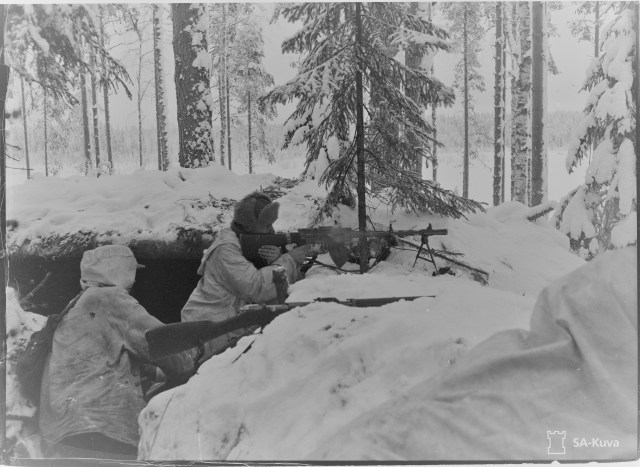
Finnish Soldiers from the 1939-40 Winter War. The Light Machine Gun is the M-26 7.62mm Lahti-Saloranta. The picture is taken from SA-kuva (Finnish Armed Forces Photographs) and you can find their webpage here. This is a conflict to which the lead mountain has attracted permanent visitors from a number of scales.
So for IABSM I have a few options, (i) expand the 15mm platoons for Chain of Command, (ii) use the Pithead 10mm ones I bought a few years back or (iii) try out the 6mm Finnish from Heroics and Ros.
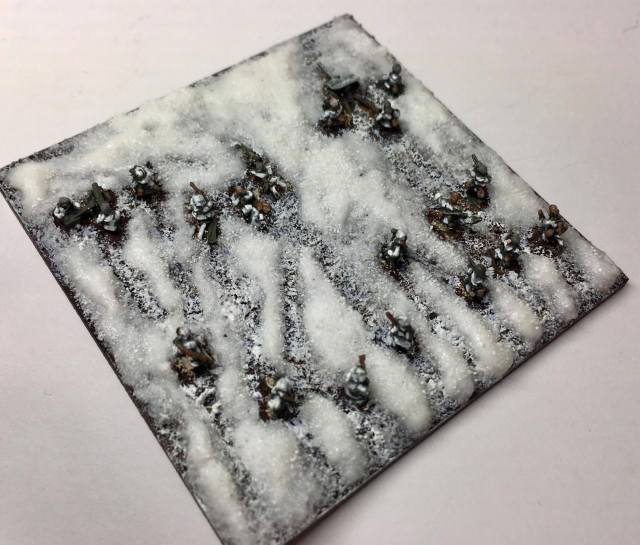
I bought a few test strips from Heroics and Ros from their Finnish Range and also a strip from the Snow/Ski Troopers. I decided to paint these and base them to see how they would look like and put them on a 65 by 65mm base. I am pleased how they came out and I think it will work well for the IABSM rules (although I would probably use 25mm bases) – I hope you agree (Note one of the pictures show some 15mm miniatures from the Chain of Command Finns). I used some snow flock mixed with Matte Mod Podge for the basing, it looks slightly better for real than in the photos. I am going to do a winter company for the Finns, Russians and Germans as they did some combined operations with the Finns. With this scale it should not take very long to complete a company worth of miniatures. It will look fantastic.
I think I have to order some more from Heroics and Ros. For the Pithead stuff, well I have no problem with it staying on the mountain for now! The 28mm Baker Company stuff I did get I will probably get rid off.
Not really Winter but cold as death
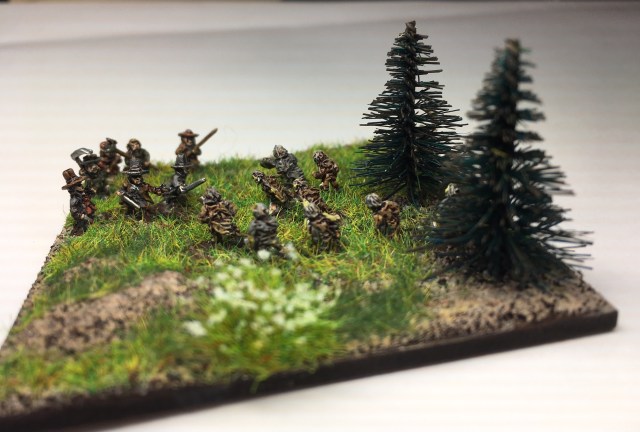
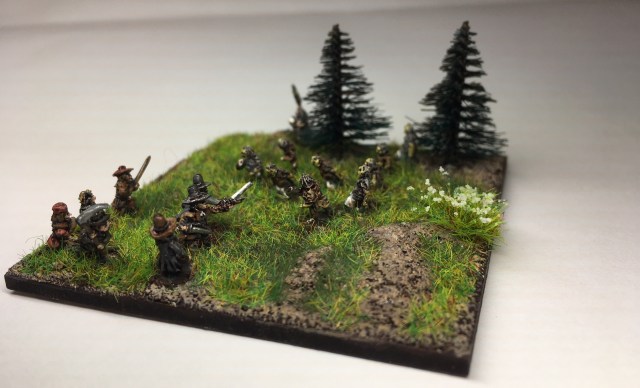
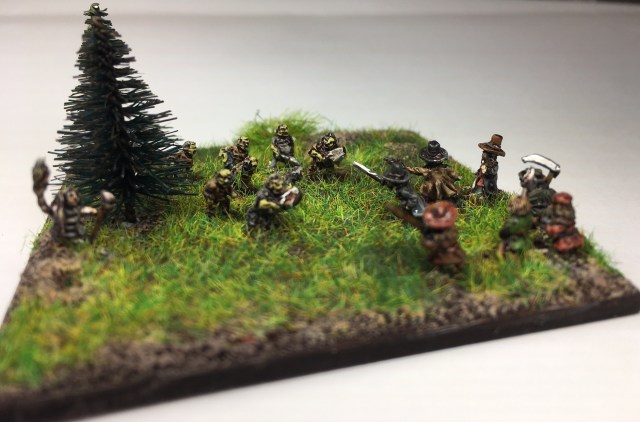
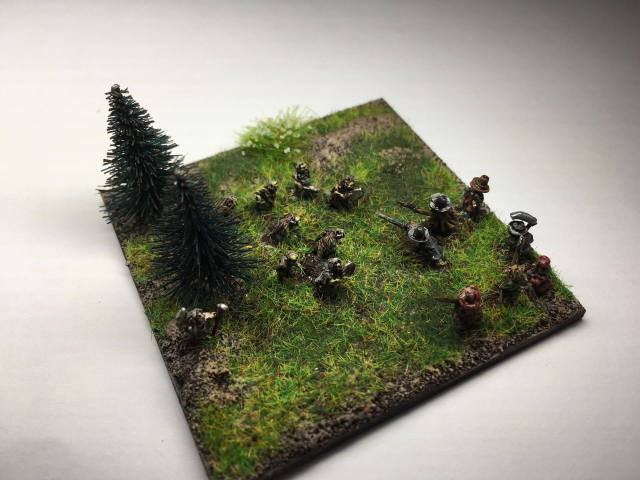
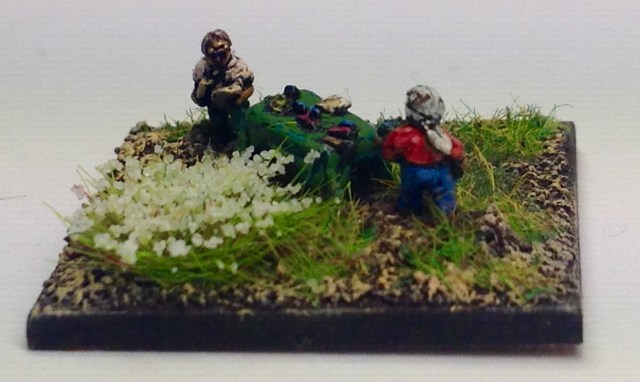
About 2 months ago I wrote about some new 6mm miniatures from Microworld Games (see here). I did not buy the Landsknechts this time but I bought the new duelists and peasants as well as a large number of zombies and ghouls for another little project I am working on (I am doing the Saga Revenants faction in 6mm when I have time). Anyway, I got them this week as it was a pre-order, and I really liked the look of the duelists and the peasants – some of these will be used for my Sharp Practice games. I could not resist painting up a little vignette on a 60 by 60mm base with some zombies controlled by a witch/necromancer (from Perfect Six) attacking three witch hunters (the duelists) supported by a few farmers. This is a homage to a roleplaying scenario I played when I was a kid (well at least a younger kid) and actually a Christmas present to a very dear friend.
Ok next time I will get on with some Great Northern War stuff and the Towards Moscow Project / Keep on toysoldiering!
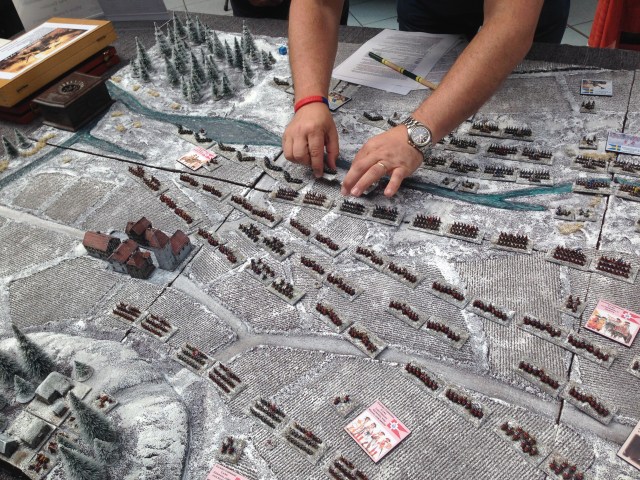
Gadebusch 1712 from Joy of Six 2015 – the Swedes advancing over the frozen fields towards the Danes.
Recently I have been rummaging around my various past projects and found a fair few forgotten ones – they all seemed like a good idea at the time. I felt myself obliged to consider whether I could reignite the fire/impulse that had trigger the start of these projects in the first place – if not I may as well get rid of them. These projects range from a number of unopened packs to being considerably started and with a few bases even being completed! I thought one way of going about this process was to paint a few models for each project and then see how I felt in taking them to the very end.
The World’s Smallest Wargame
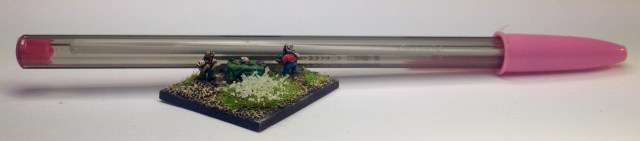
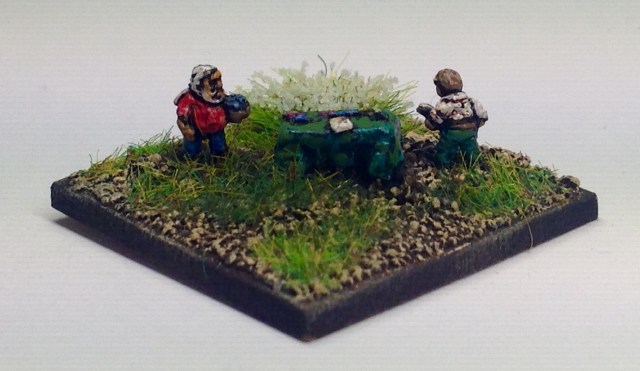
The smallest unfinished project I found was a little vignette Peter Berry gave me at the Baccus open day a few years back. This is normally held the day before the Joy of Six and gives a chance to see how Peter and Igor produce the little soldiers. The model depicts two 6mm scale war gamers playing a war-game. I decided to give it some acrylic love and base it up. I thought it would be fun to plant it on the table for the next outing and see if someone spots it. I wish they were all that easy!
Note: I added the BIC pen with a diameter of 9mm to the picture as I occasionally are being contacted by people who wonder how tall these guys are. In general when we refer to scale in Xmm it is the measure of the height from the base of the miniature to the eye level or the top of the head. Baccus in general are between 6 to 7mm and the two gentlemen here are 7mm (the bearded bloke) and 6.5mm (the accountant) respectively.
In the next section I will be showing 15mm soldiers and these are of course about 15mm from the base of the miniature to the eye level. But remember that these scales are indicative and the actual size of a Xmm miniatures can vary significantly between different manufactures and sometimes even between their ranges.
I used a BIC pen as it is probably one of the most known items on the planet (I made that up!) and based on my extensive research has sold over 100 billion pens since the 1950s that is enough pens to stretch 40 times the distance from the earth to the moon if laid end to end.
Western Front 1940
Another, and perhaps a better example, of these projects was to use the Skirmish campaign books and the Arc of Fire ruleset to do some early France 1940 WW2 platoon level scenarios. I had started painting a few of them but there was still some work to do.
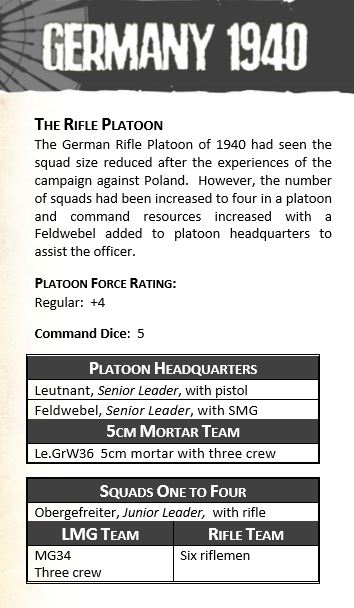
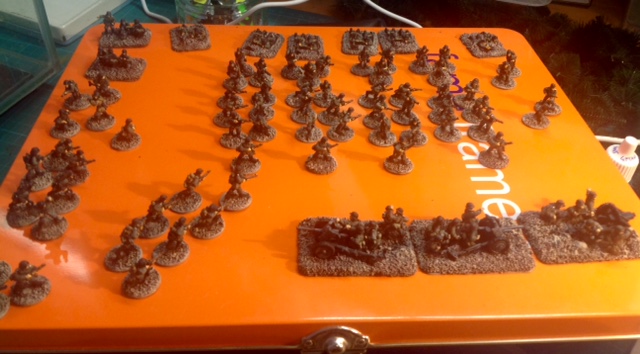
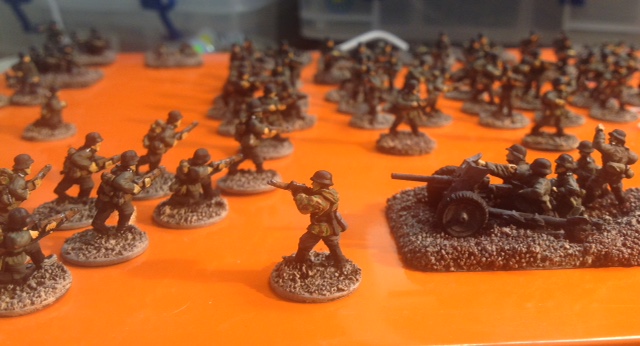
I intend to put some effort into this and use the excellent Chain of Command rules from Too Fat Lardies. I printed out the Chain of Command army list for the German 1940 platoon (you can download it here) and checked that I had the right amount of miniatures (these being 15mm and mainly from the excellent Peter Pig range) and realized I had most of what I needed and fairly quickly over the last few weeks got to a state of having them all block painted and based. This included some support options like anti-tank rifle, AT-guns, infantry gun, sniper team, heavy machine guns, flamethrower unit and a forward observer. What remains is some washing, highlighting and base detailing. They are individually based on 15mm washers (with a magnet in the hole) and prone LMGs, heavy machine guns, 50mm mortar and AT rifles on small flames of war bases. I base the AT and Infantry guns on medium flames of war bases. In addition I need to do some vehicles, but this should not be too difficult for early Germans!
From the German 1940 Army List for Chain of Command – you can download the full list here.
Painted batch to date.
Sniper in the middle, PAK 36 AT Gun to the right and a rifle section to the left.
I have also made good progress on the BEF 1940 Platoon using some old Skytrex and Peter Pig Miniatures. We should be able to wrap this project up in a not too distant future.
Joe Dever
I was saddened to hear that Joe Dever had died a few days ago. He was one of my childhood heroes who allowed me to become one as well every now and then in the fantastic world of Magnamund. I met Joe a few years ago at a gaming convention where he was busy taking pictures of the proceedings. We had a short but very enjoyable chat. Hats off to you Sir!
The picture is of the Swedish translation of his first game book “Flight from the Dark”.
Kalisz 1706 is a strange epilogue to the GNW Saxon Campaign or a prologue to the Russian Campaign. It will field a significant amount of bases with 6mm minatures (close to 200 bases counting leaders and artillery, a total of over 1,700 miniatures). It will have a large amount of Polish Pancerni and Hussars as well as a significant contingent of Russian Cossacks, Kalmucks and Dragoons supporting the Saxon cavalry force. A very small Swedish contingent (in relative terms) with an infantry section consisting of a large portion of prisoners of war from the Fraustadt Battle and with very few indelta regiments overall, supported by a Polish-Lithuanian contingent that historically were eager to fight but withdrew after the first enemy push.
This Battle (link to Wikipedia entry here) that was part of the Great Northern War is not very known as the outcome did not make a significant impact on the overall war. It is an interesting event in several ways:
Augustus the Strong (Electorate of Saxony) had agreed to a peace treaty with the Swedes following the decisive victory at Fraustadt 1706 followed by the Swedish crown army invading Saxony. But Augustus did not tell his Russian ally and instead tried to get the Swedish General Mardefelt to retreat to save his own face. The Battle was therefore unnecessary and considering an estimated 5,000 men died in the process it seems pointless.
The battle includes a lot of different fighting forces – Saxons, Russians, Swedish-Finnish, 2 Polish contingents (one on each side), Lithuanians, Kalmucks and Cossacks. It creates a very “colourful” table.
The Poles on the Swedish side fled the battle on the enemy side advancing although they had given assurances they would stay and fight to the last drop of blood. The Poles, whose country had been torn apart by the war, were perhaps not as motivated as those famous winged hussars who saved the day in Vienna 1683 or invigorated by the warrior spirit like the Polish soldiers who held back the Wehrmacht for 3 days at the Battle of Wizna 1939, when they were fighting 40-1 (Which incidentally is one of the best early Sabaton songs, you can find here), neither did they show the prowess nor resolve of the brave Poles of the No. 303 Polish Fighter Squadron that fought the Germans in the Battle of Britain 1940. There is no question about the quality of the Polish soldier throughout history – however during this conflict their heart was certainly not in it.
I presented this battle with Nick Dorrell and his merry men from the Wyre Forest Wargames Club at the Joy of Six in 2014. We applied to run it at Salute in 2017 and we got the acceptance letter this week. The Battle will be presented on a 8 by 4 feet table and there will be a lot of bases on it. Models by Baccus from the GNW codes apart from the Kalmucks that are made from the ancient/ rome’s enemies Hun range.
We got a positive mention by Neil Shuck (Famous for running Saga Games in 6mm at Joy of Six amongst other things and perhaps slightly more famous for the Meeples and Miniatures Podcast) in the Miniatures Wargames Magazine (September 2014) for the Kalisz Battle, who said “It’s a shame that it won’t be touring other UK shows, as this is a fantastic example of what can be achieved in this small scale. Not so much a war game as a work of art.”
[Note: However, he did not get the name of the battle or the year of the battle right in the article. 😉 ]
Salute, as you may know, is the biggest wargames show in the UK (you can read all about it here) and we have been “showing off” before as I and Nick presented a table with the Fraustadt 1706 battle in 2014. So if you are going there come and say hello. We will be presenting this as a Polemos (GNW)/Twilight of the Sun King Battle.
I will provide some more detailed photos of the various elements after I have found them and dusted them off.
Kalisz Summary Forces
Swedish Force (excluding command bases and artillery)
Polish – 22 cavalry bases (60X30mm bases, with 9 cavalry models on each)
Lithuanians – 11 cavalry bases (60X30mm bases, with 9 cavalry models on each)
Swedish Infantry – 6 infantry bases (60X30mm bases, with 24 infantry models on each)
Swedish Cavalry – 15 cavalry bases (60X30mm bases, with 9 cavalry models on each)
Saxon/Russian Force (excluding command bases and artillery)
Polish – 36 cavalry bases (60X30mm bases, with 9 cavalry models on each)
Saxon – 22 cavalry bases (60X30mm bases, with 9 cavalry models on each)
Russian – 36 cavalry bases (60X30mm bases, with 9 cavalry models on each)
Kalmucks – 22 light horse bases (60X60mm bases, with 8 cavalry models on each)
Cossacks – 14 light horse bases (60X60mm bases, with 8 cavalry models on each)




























 Roll a One - Wargaming Blog