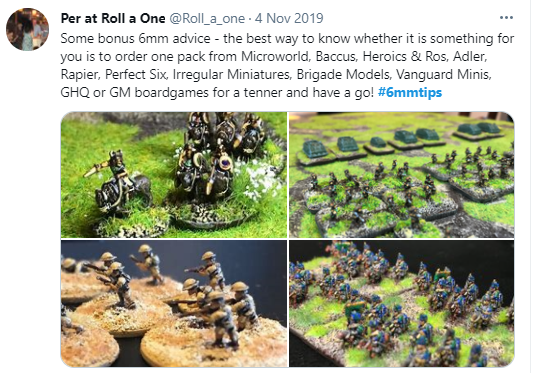
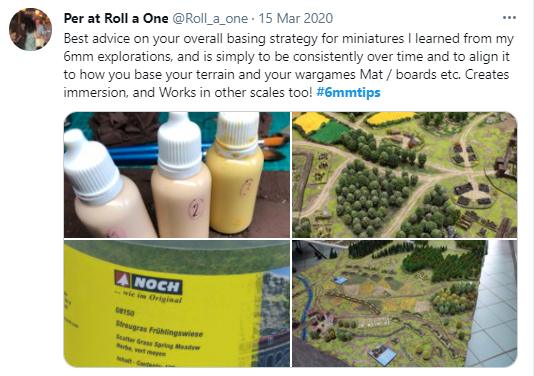
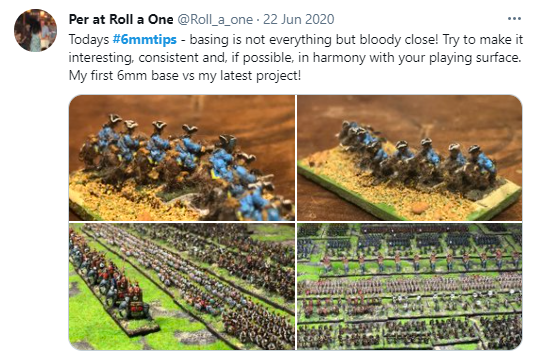
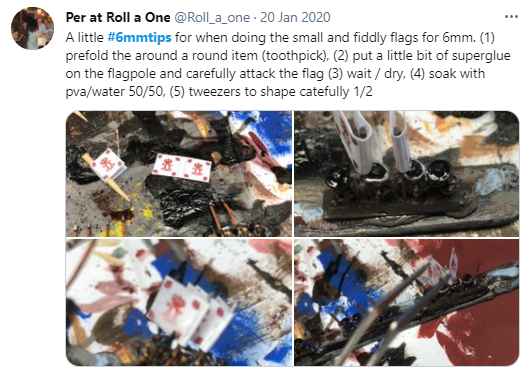
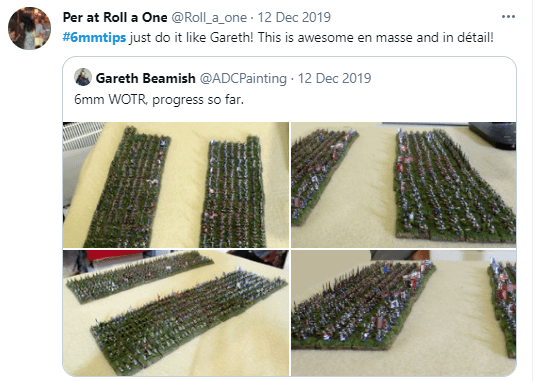
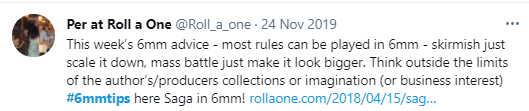
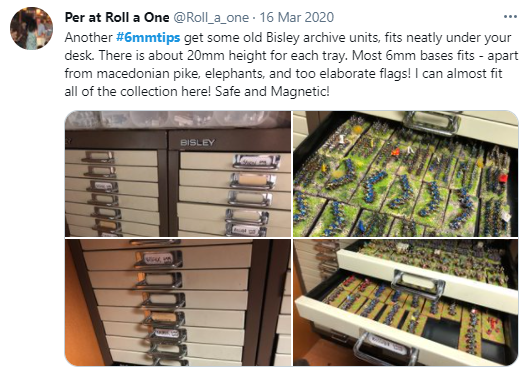
I have been running a little bit of an occasional series on Twitter (@Roll_a_one) giving some more or less profound advice with regards to the 6mm aspect of the hobby from my perspective, you can find these under the #6mm tips and were done in 2019 and 2020. I also asked the Hive Mind for some advice recently and I have used these two sources to write a little bit of a rambling post about some of the insights I have learned from painting 6mm miniatures over the last 15 years or so. They are my own views and your Glorantha may vary! I am passionate about the scale and try to share the love I feel for it as much as possible.
Thinking about 6mm
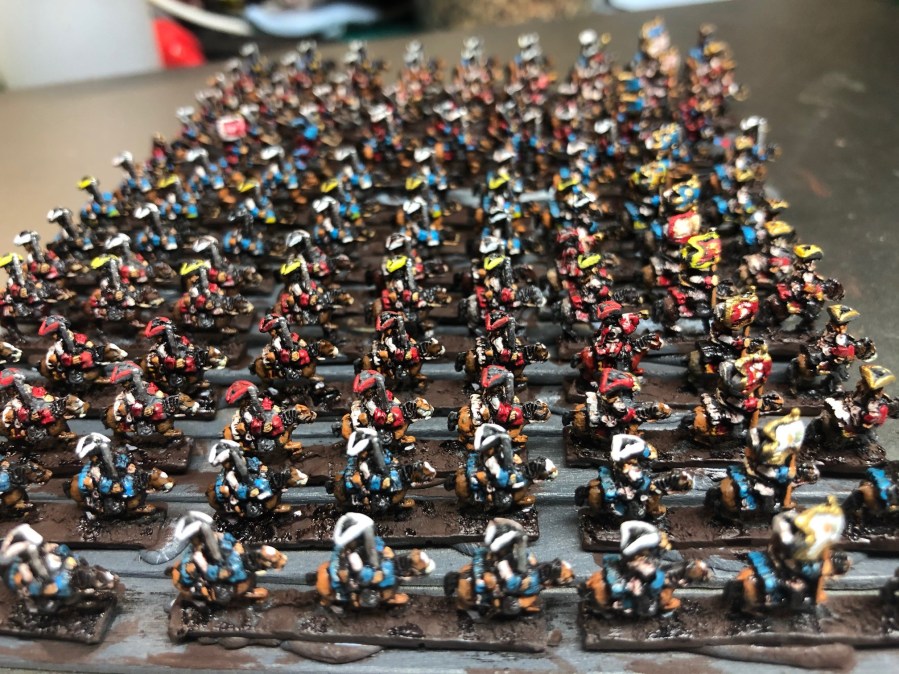
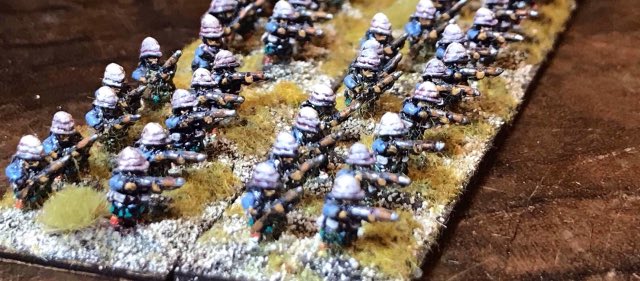
If you have never tried painting 6mm why not find a manufacturer and order a small pack and see if it works for you – you might be pleasantly surprised. The models shown below are Bison Riders from Rapier Miniatures, Sci-fi models from Brigade Models, 8th Army infantry from Adler and some SYW Mounted Grenadiers (used as Russians in my GNW games).
Approach to Painting
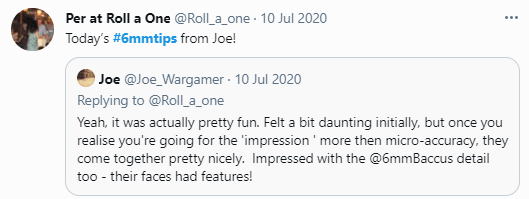
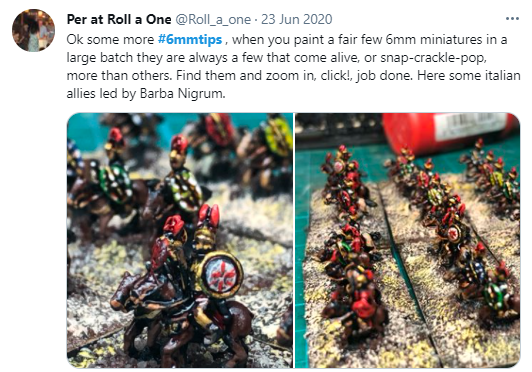
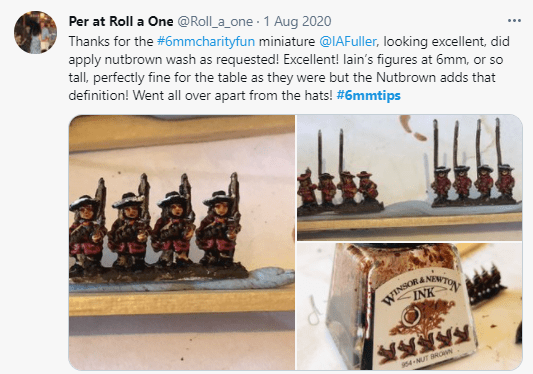
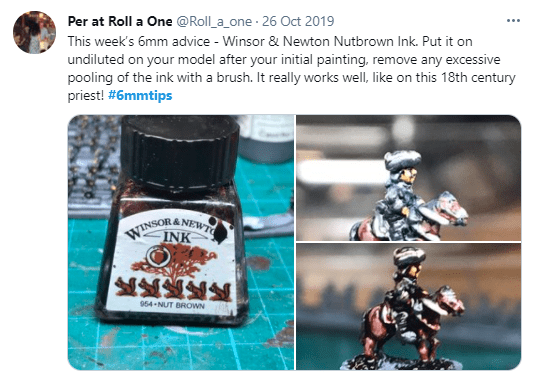
I think this summary from Joe about his first experience of painting 6mm is extremely useful for how I think 6mm is best tackled, of course some people are spending a lot of time on detail and there is no problem with that. I tend to do too large projects to be able to spend a lot of time on each little miniatures. Paint an army that looks good from when you stand up or sit back looking at it on the wargames table. The second tweet shows that every now and then you will achieve something that looks really good in detail even if you did not plan it.
Painting your Miniatures
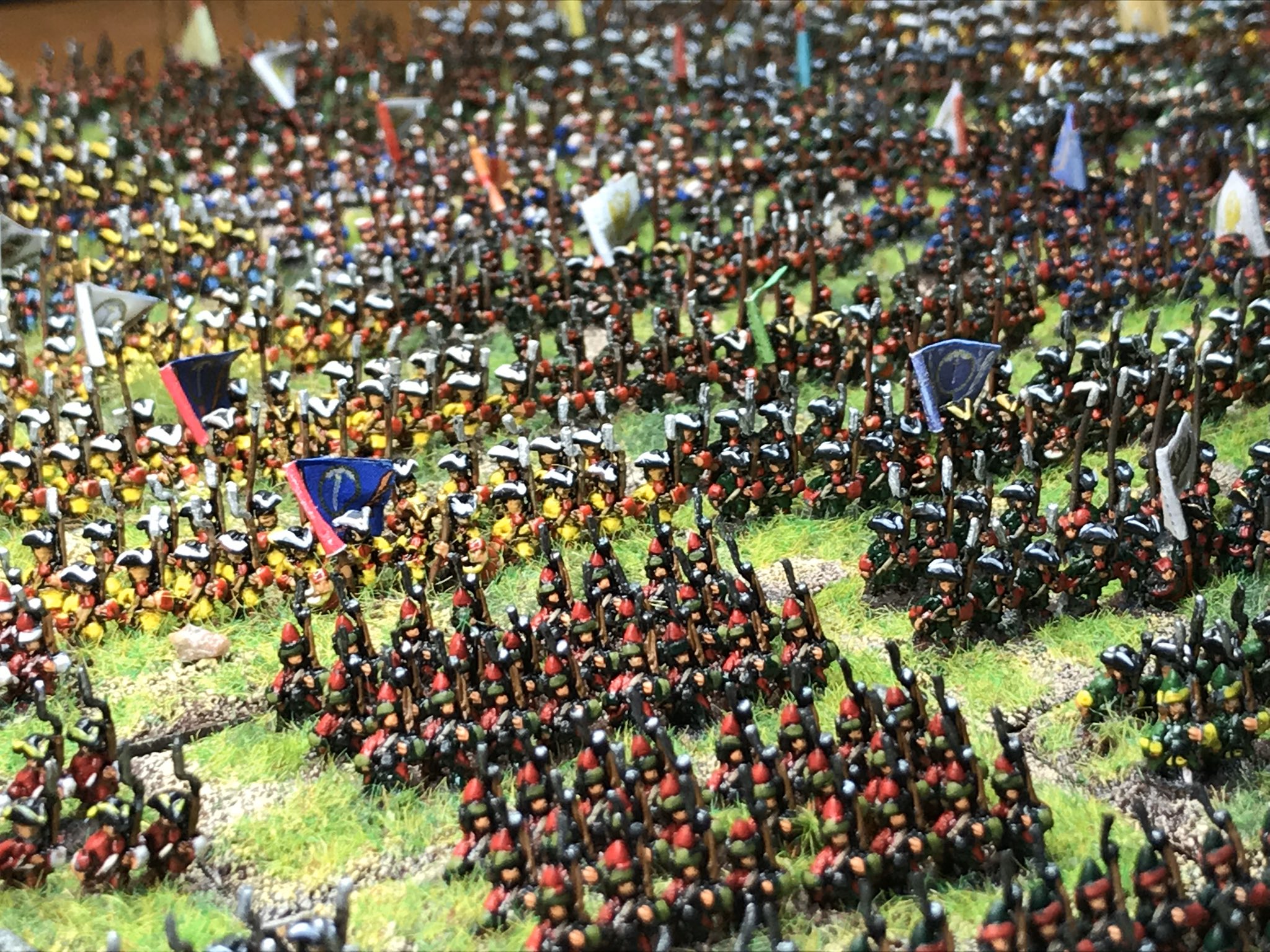
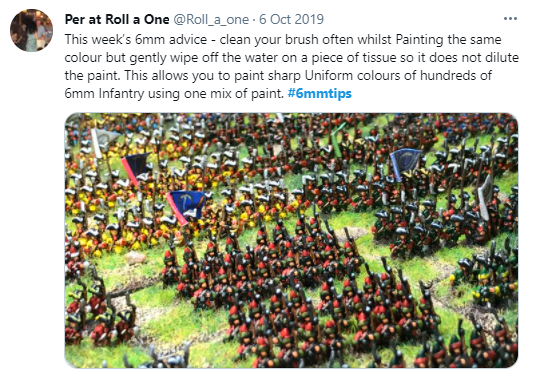
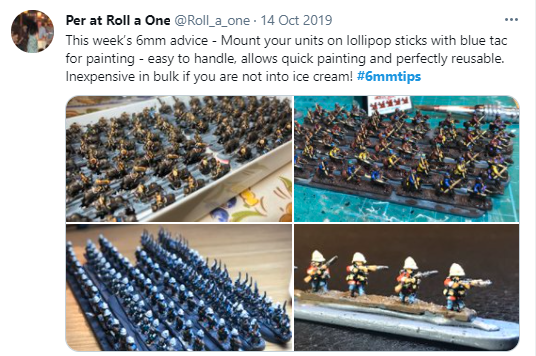
I did a few painting guides last year, showing “my” method with regards to how I tend to paint, but there are various ways of doing it. Below is a link to an old blog that gives links to the 4 guides I did. Use a good brush with a good point, try to get used using a Size 1 or even 2 for the majority of the painting. A 10/0 is just a waste of time in my opinion, wears out quickly and holds no paint – dip paint dip paint, instead of dip paint along! I use grey with black wash, some prefer black (perhaps drybrushed white), brown or white undercoat. I struggle with white as it is less forgiving than darker undercoats, but with some washed people can achieve some excellent results. As for the colours go a little bit brighter as this will look better from a distance, play with contrasts if you can, it works better than highlights if you do it right.
The first one relates to washing your miniatures or not (this is washing them as part of the painting process, not before your start working on them, which I heard you should but I never do). Some people paint their miniatures nicely and perhaps even do a few highlights and do not bother with a wash. I tend to block paint my miniatures as good as I can, then add Winsor and Newton Nutbrown Ink on top, make sure it does not pool too much and sometimes I add some highlights once it has dried. I find this method being the most efficient balance between a lot of work on detail and limited detail as the wash tends to do a good job and I just love the shine of the Nut. I never varnish my 6mm stuff – perhaps I should?
Detail when it matters
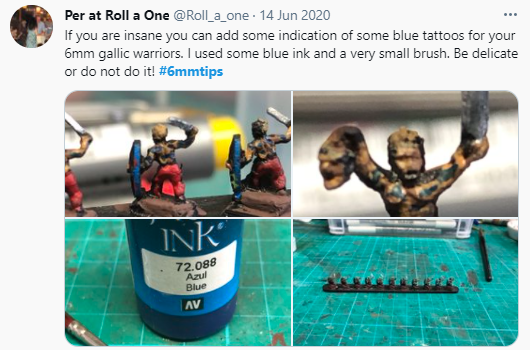
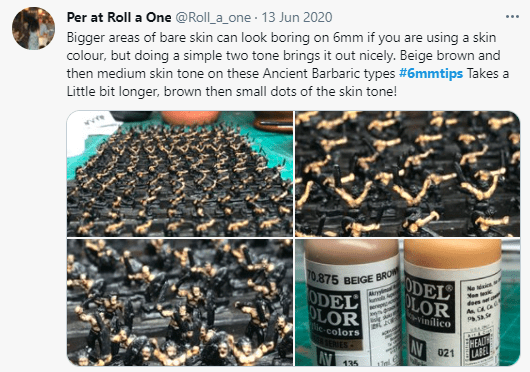
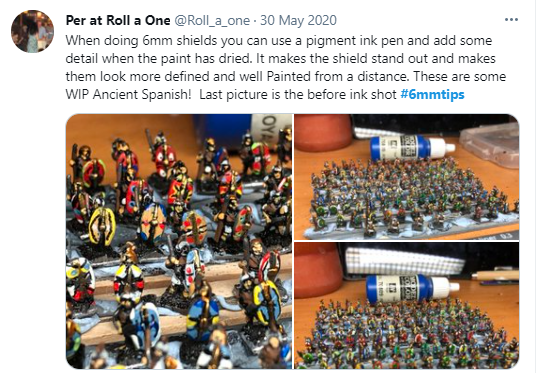
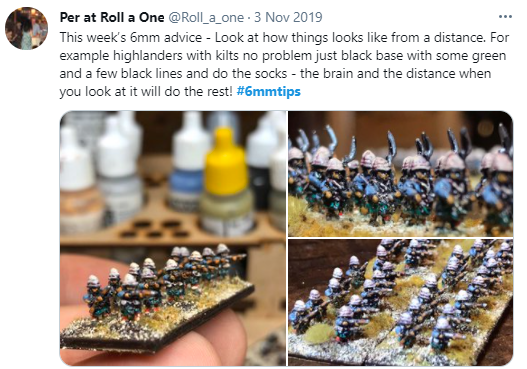
Some detail can really pay off and look ok even from a distance, for my Gallic warriors below I just carefully added some blue ink – upfront it does not look very well but from a distance you could image that those are some kind of tattoos. The second tweet show the power of using highlights on bare skin making a hell of difference to the final result. The final tweet is showing how powerful some nicely detailed shields can be. The last one about painting Tartan in 6mm, well actually it is not Tartan at all – the brain will fill in what is difficult to paint.
Basing is not everything but pretty close
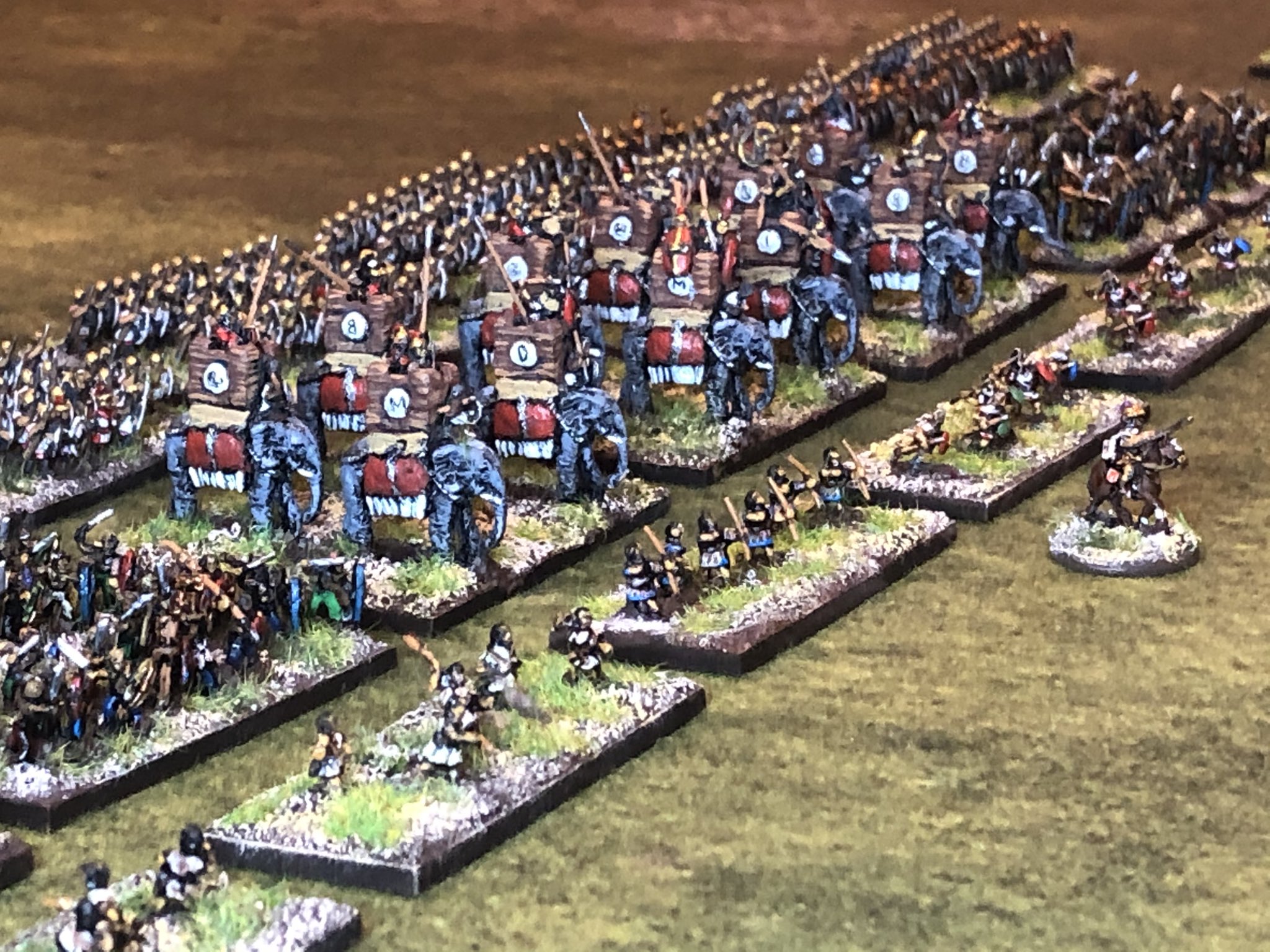
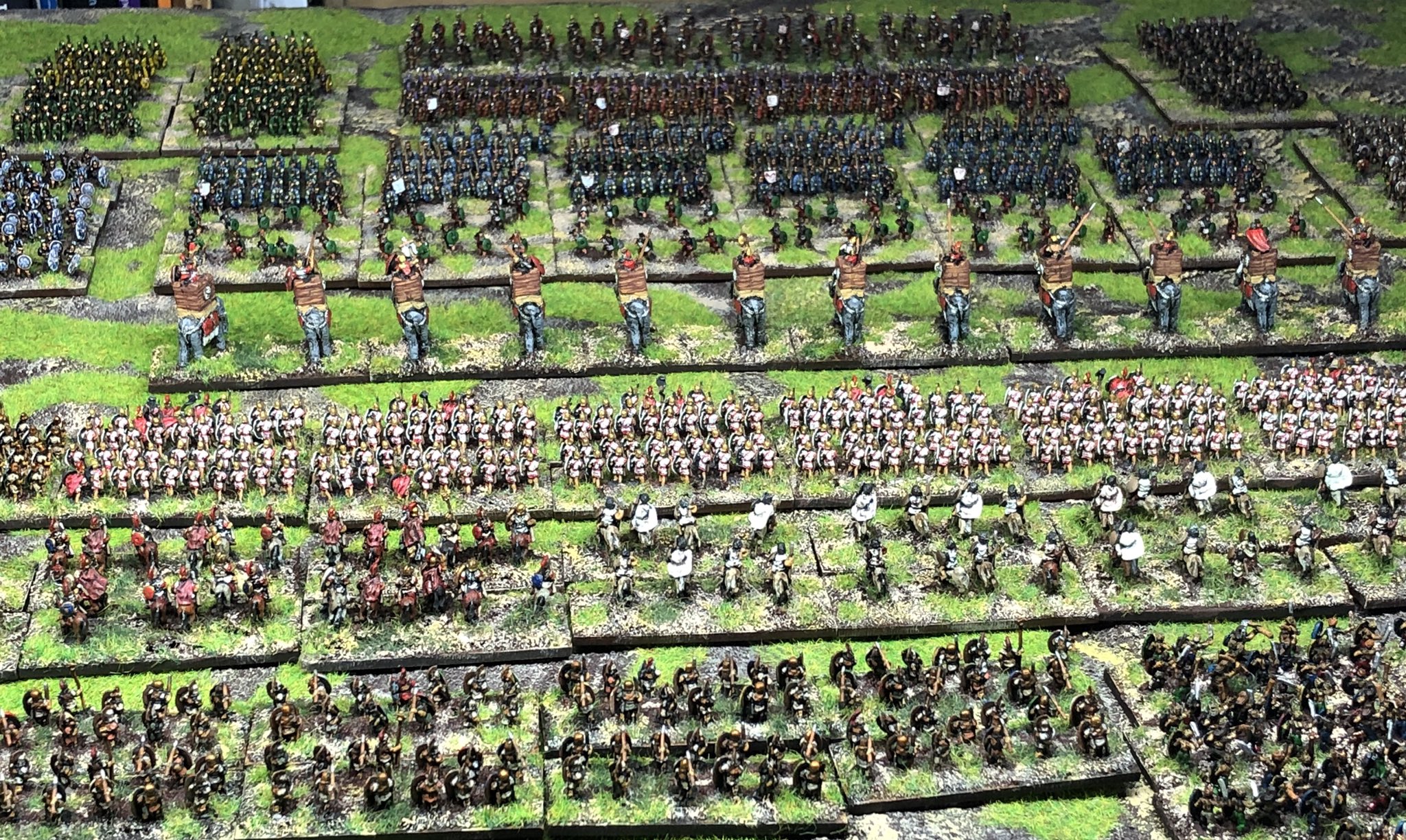
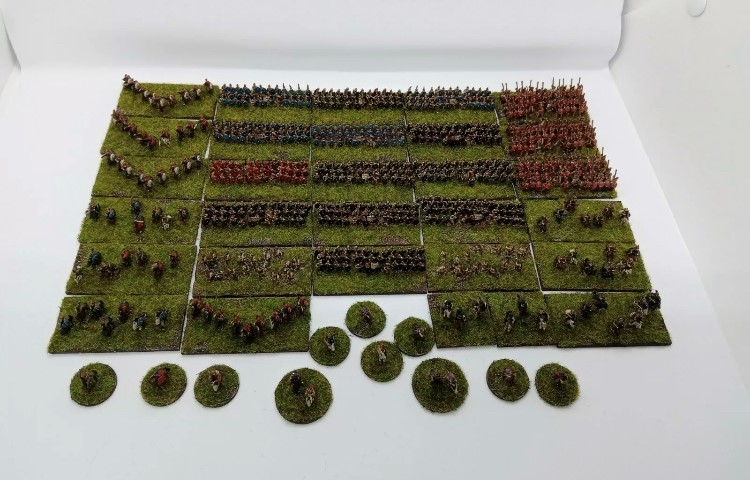
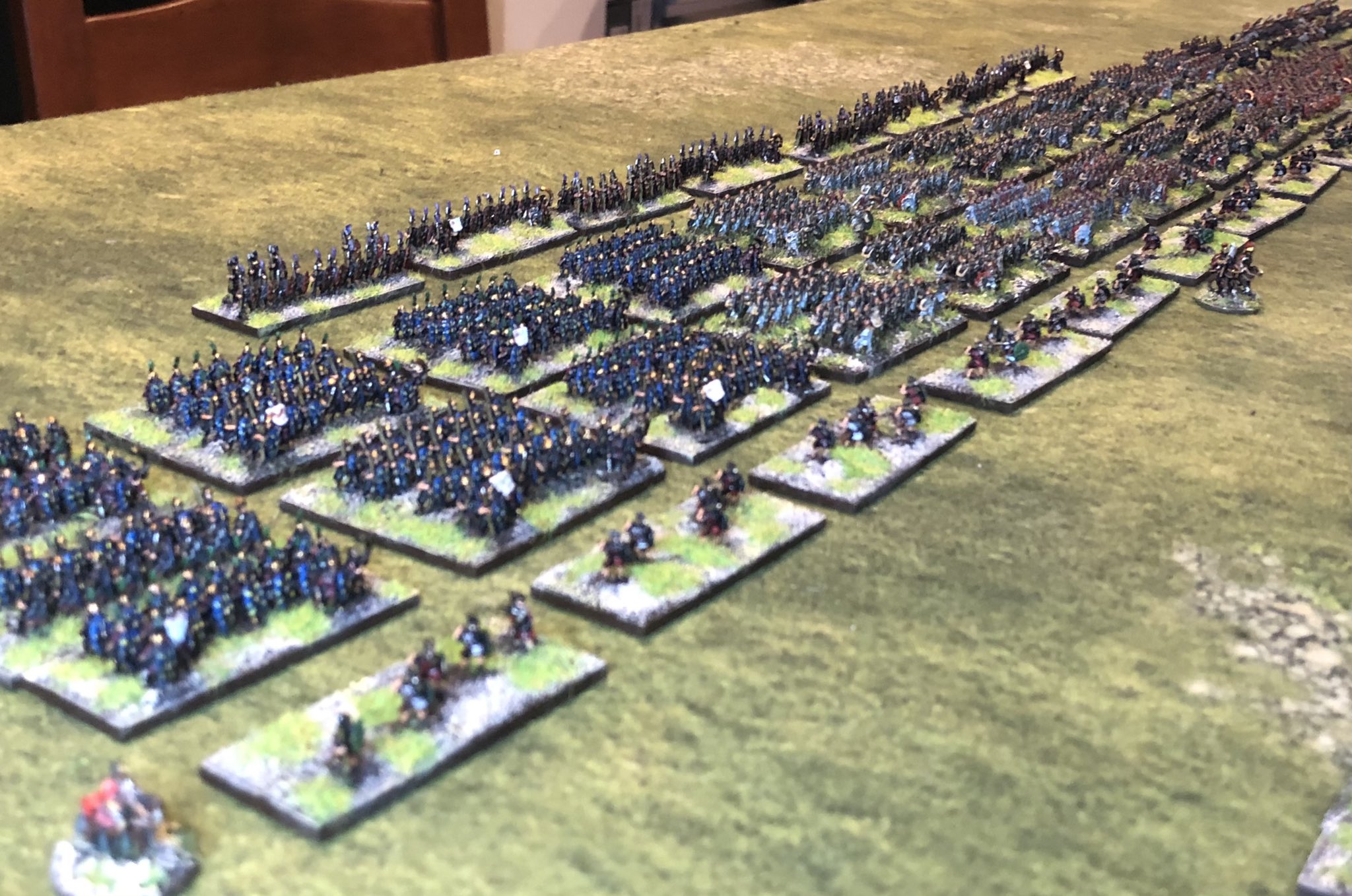
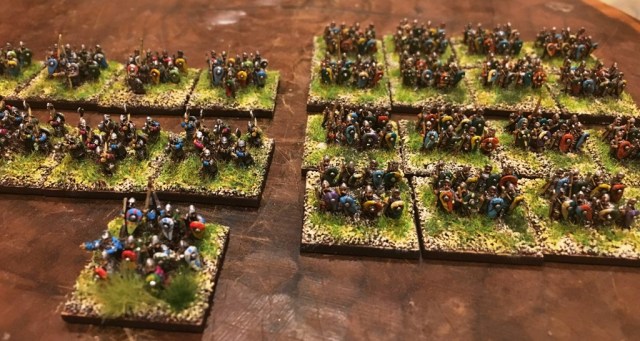
Some of my Punic Wars Collection
Make sure your basing is consistent and think about how it interfaces with your board/mat, well at least the one you are most likely to use. It is more powerful if the base blends into the playing surface and the army is aligned. All my 6mm stuff is more or less aligned, this includes the terrain – it all comes together.
Light and Sight
This is really important if you are not able to see properly your painting will suffer. First priority get a good daylight lamp, mine cost about £120 but I do spend a lot of time under it. Second if you are not able to see properly get some magnifying glasses to support you doing the work – I just use my normal glasses and it works fine at the moment.
Some Bonus Tips
Anyway, I do hope that was of some interest, please provide some tips and advice of your own in the comments.
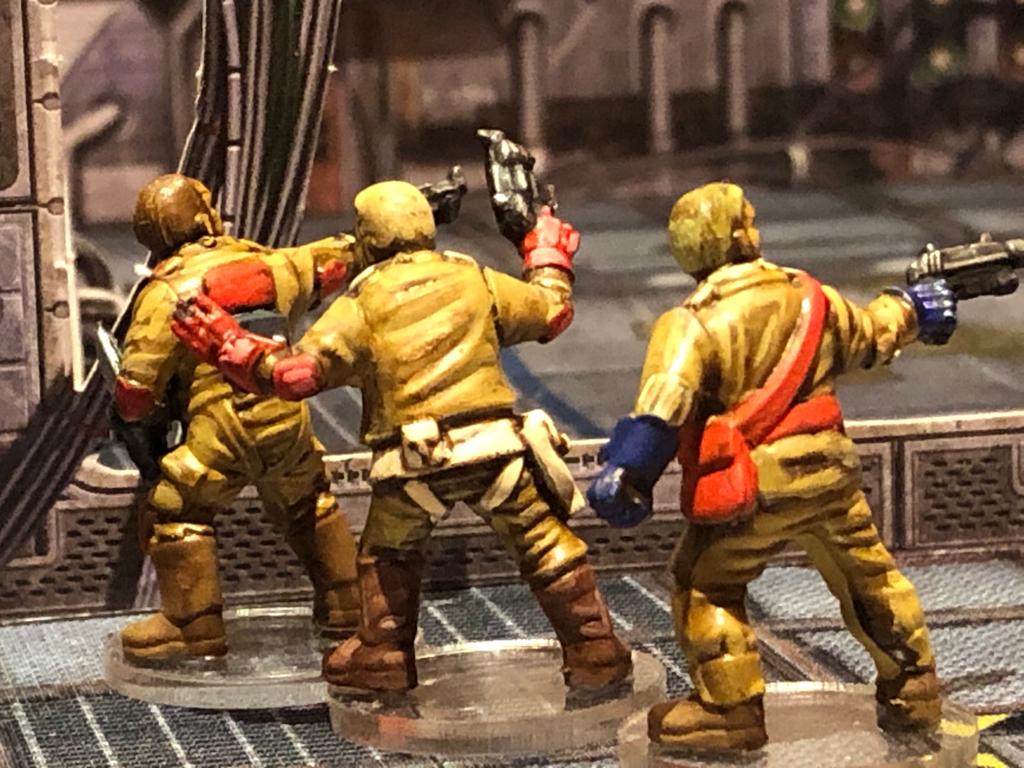
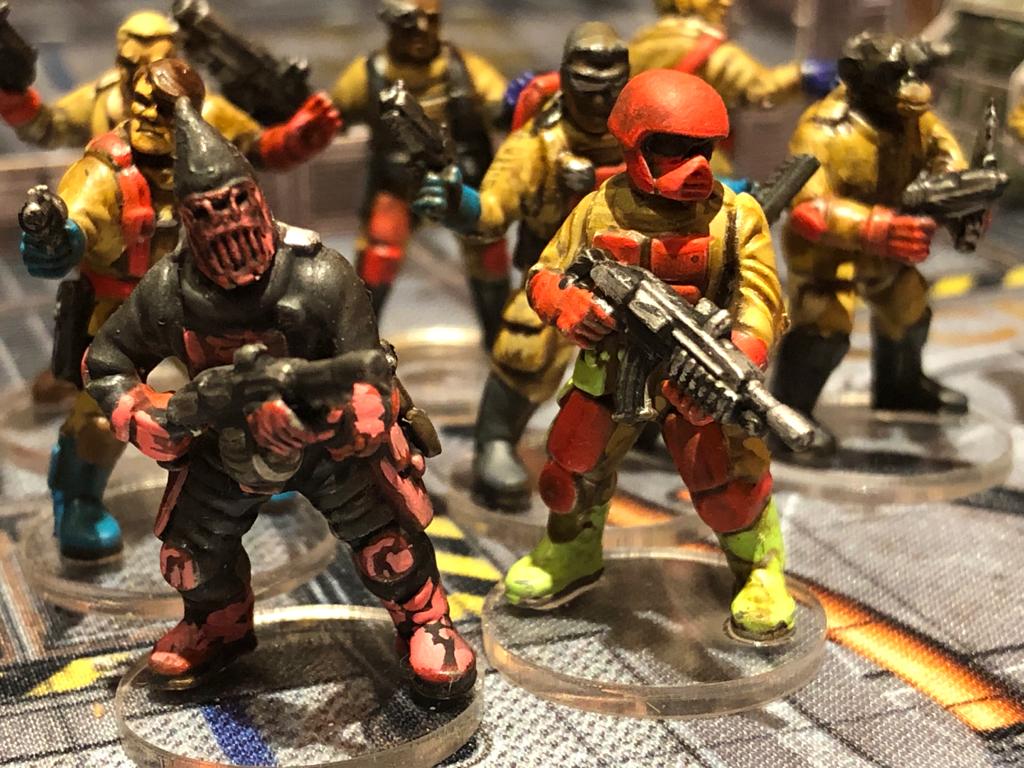
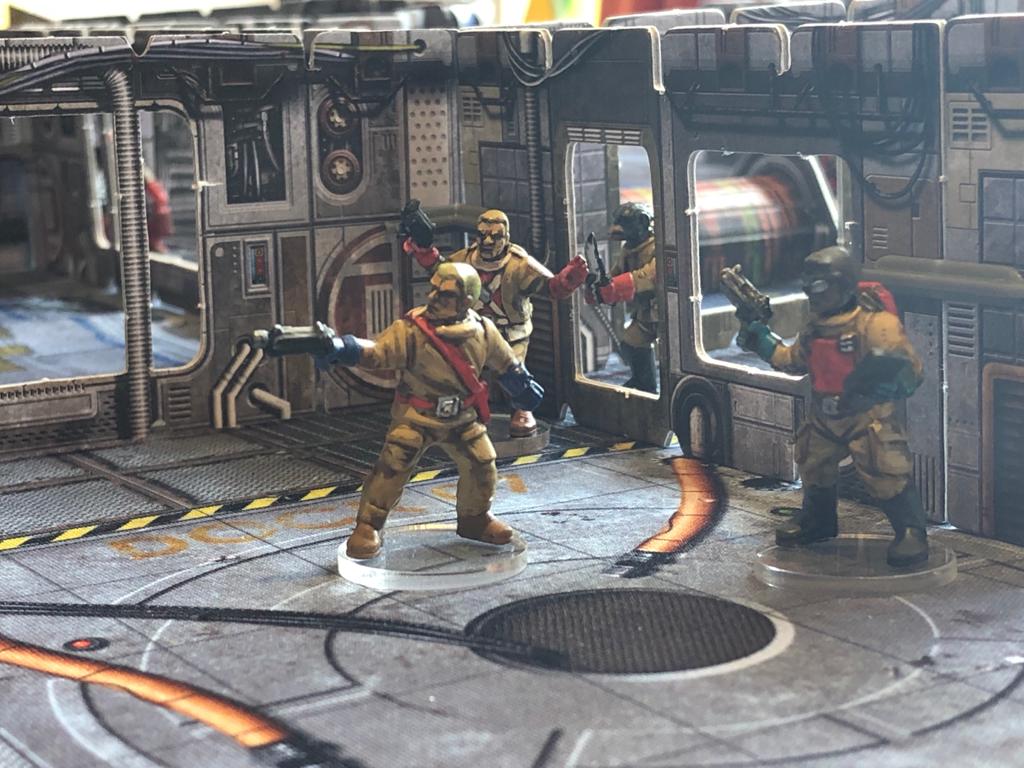
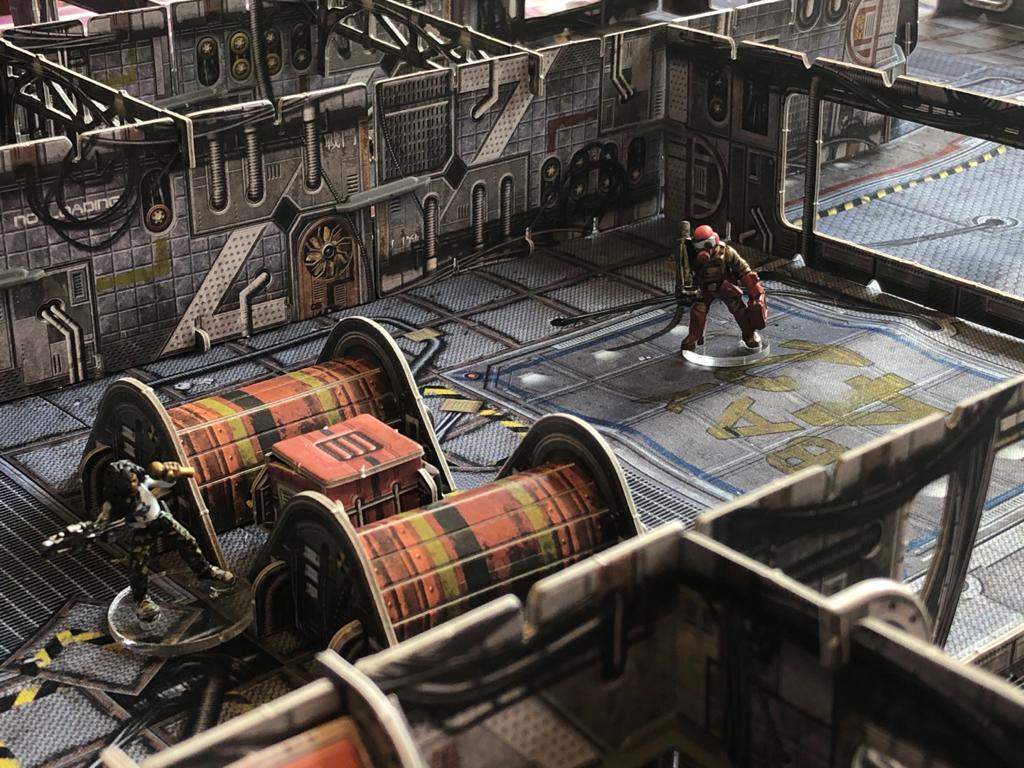
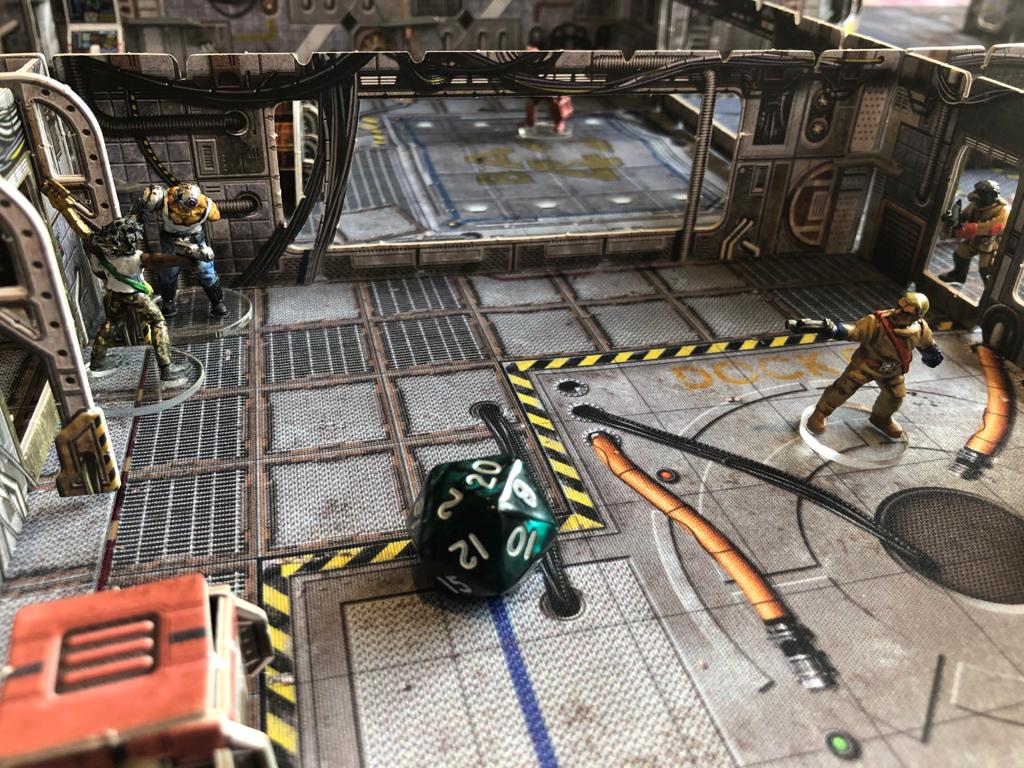
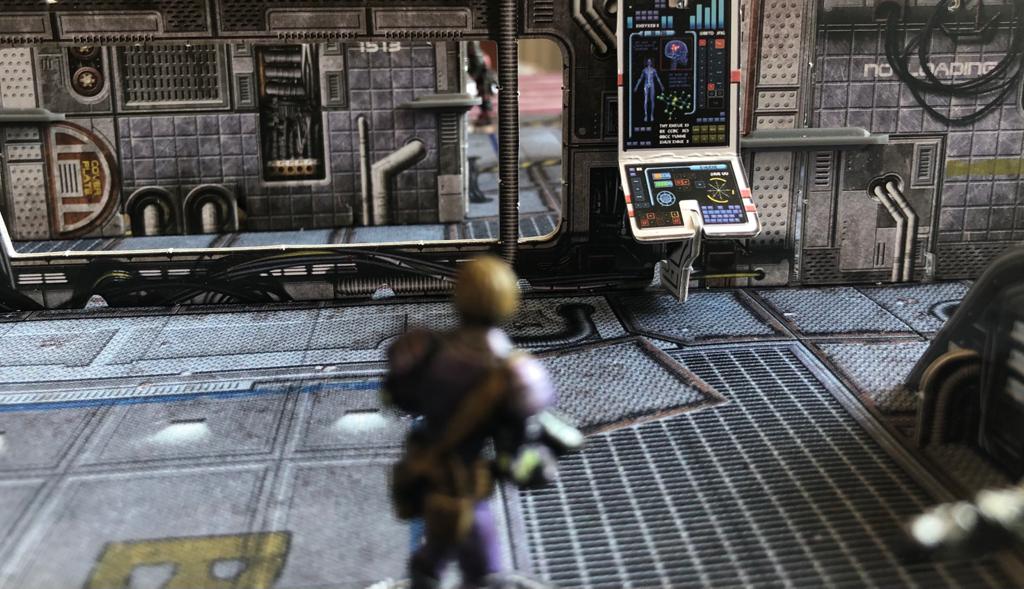
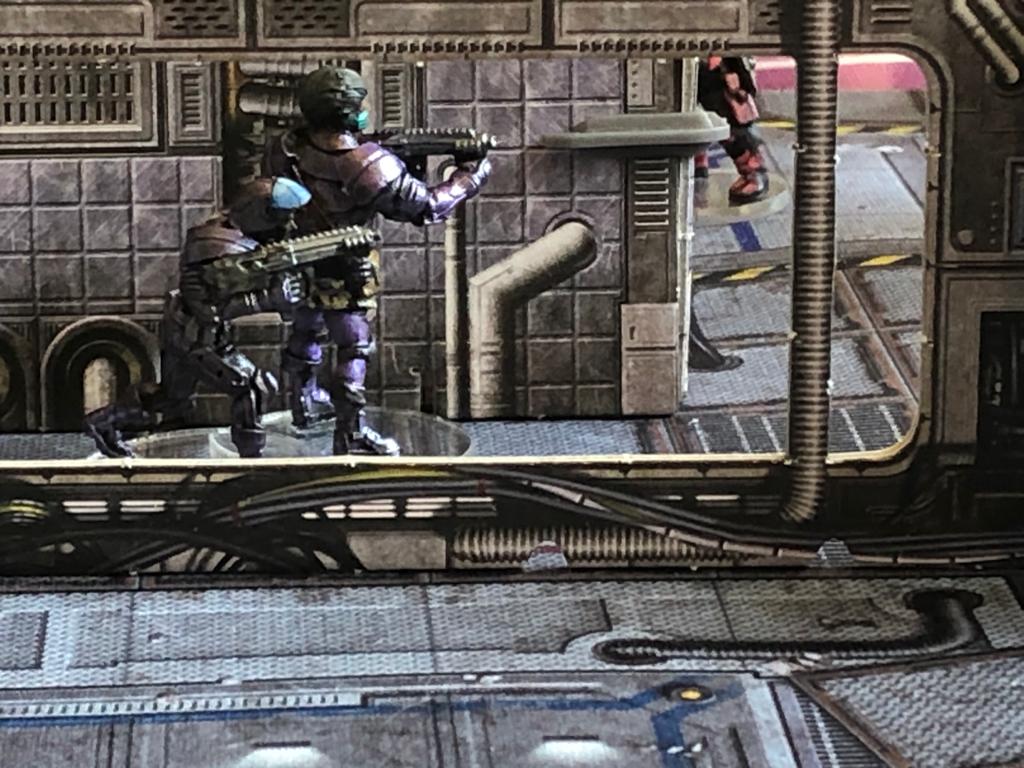
The Little One has been excited about trying out the new Stargrave rules (more here) with the crew he built and painted and yesterday we got an opportunity to have a go. Playing a simple mission of grab objectives and get the hell out of there, using his crew with “Big Man Pete” as Captain and “Hard Man Franky” as First Mate. This is just a few pictures from the game and a few comments, not a review or an actual battle report.
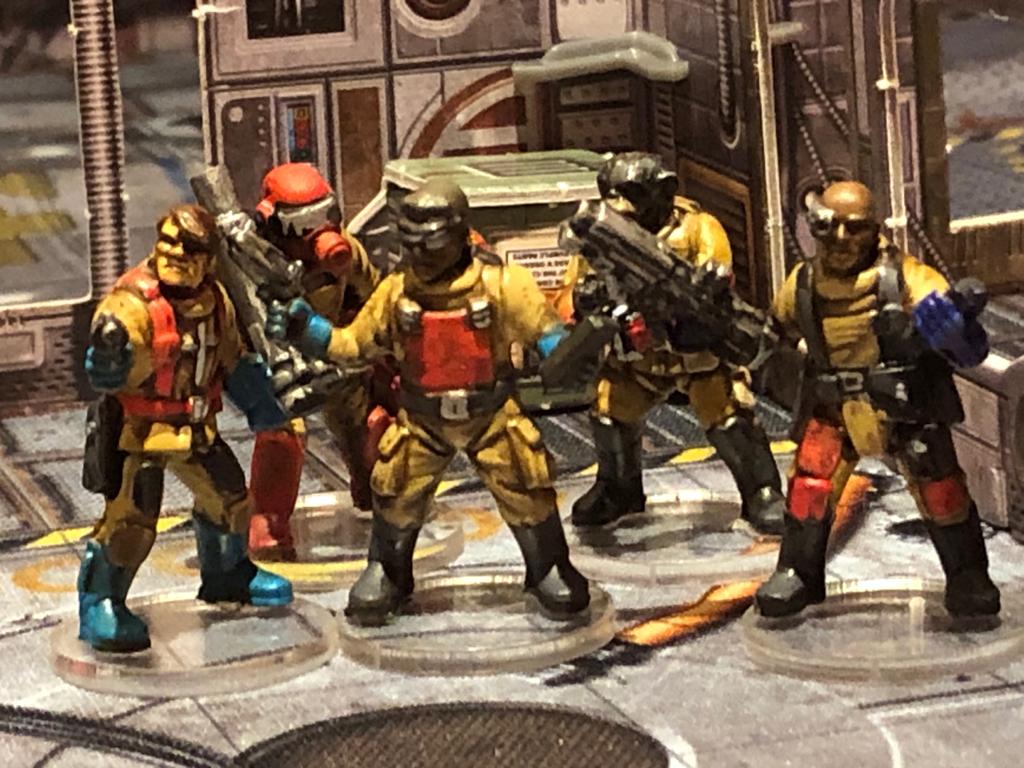
Big Man Pete and His Crew of Riff Raffians (these are made from the Crew and Mercenary Sprues from Northstar’s Spacegrave Range, here)
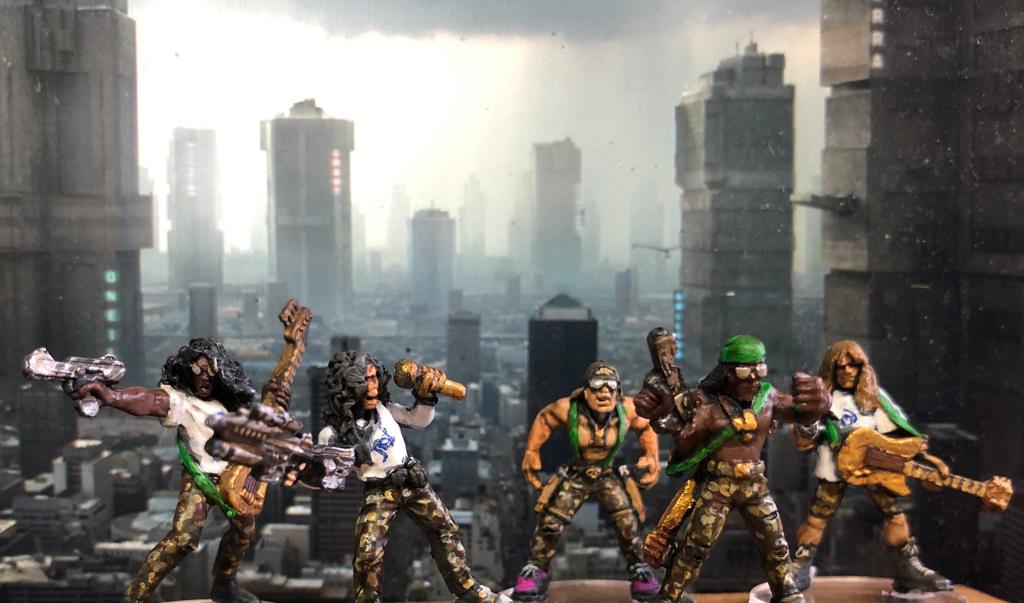
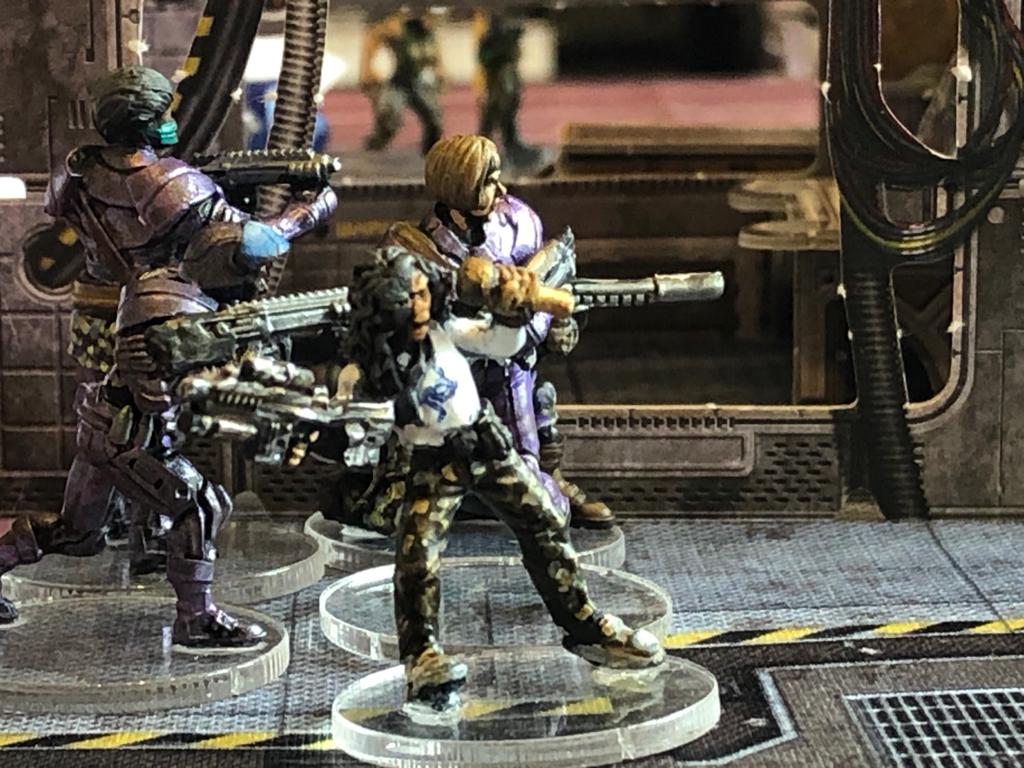
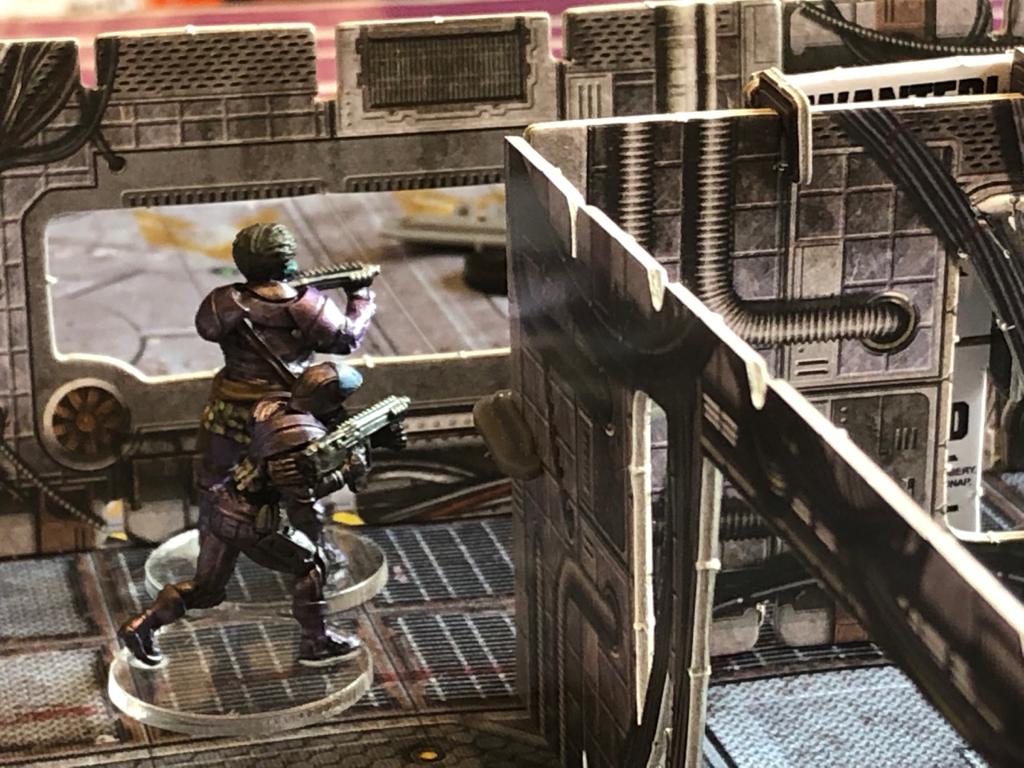
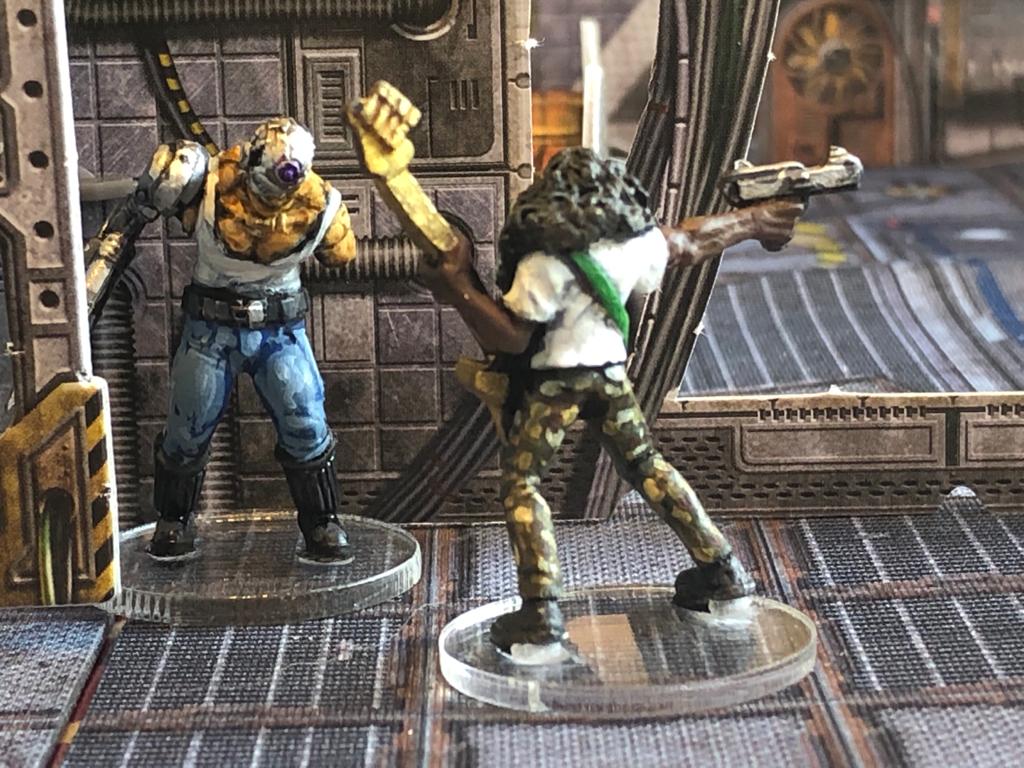
I did a crew based on the North Star plastics just the Little Ones above, but have to admit that they are not yet completed. Instead I enlisted the Galaxy’s best band “Spawn of Speed” for this mission – they are the meanest sounding band in the Galaxy but are known to take the odd job if they like the Rhythm of it, and there is some cash involved. Especially since the authorities have clamped down of their royalties following a series of aggressive and political songs. Led by the Singer, and “Captain”, Lemmy Araya and supported by the meanest Roadie in the Galaxy known as the Silver Machine (First Mate). They travel the galaxy in their Light Cargo Ship – The Slaying Hawk (named after their first album).
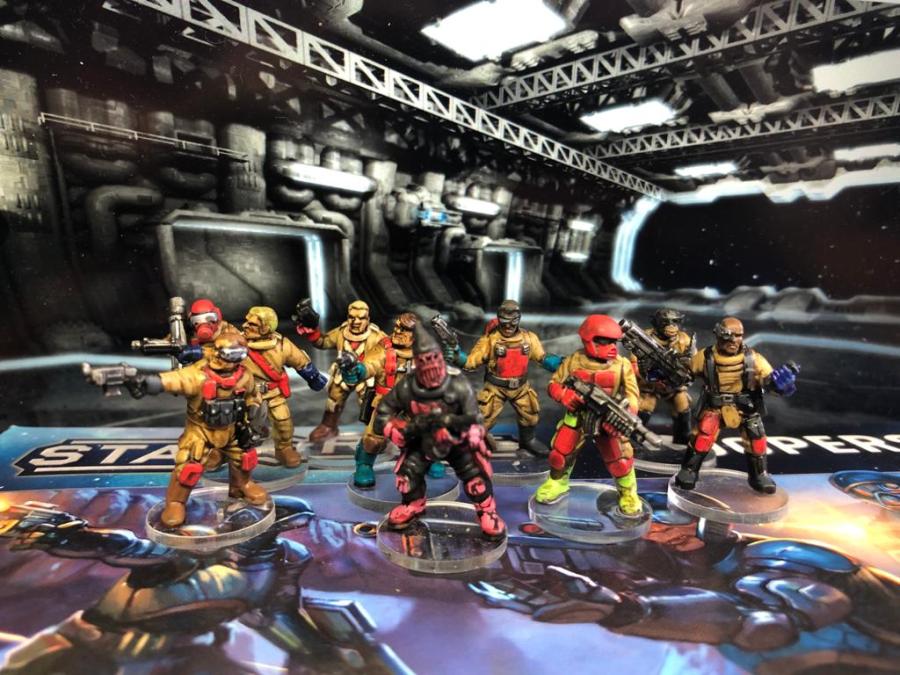
The Spawn of Speed (extra points if you can guess from where I borrowed the background art?, miniatures from the Future Warriors Rockers range here).
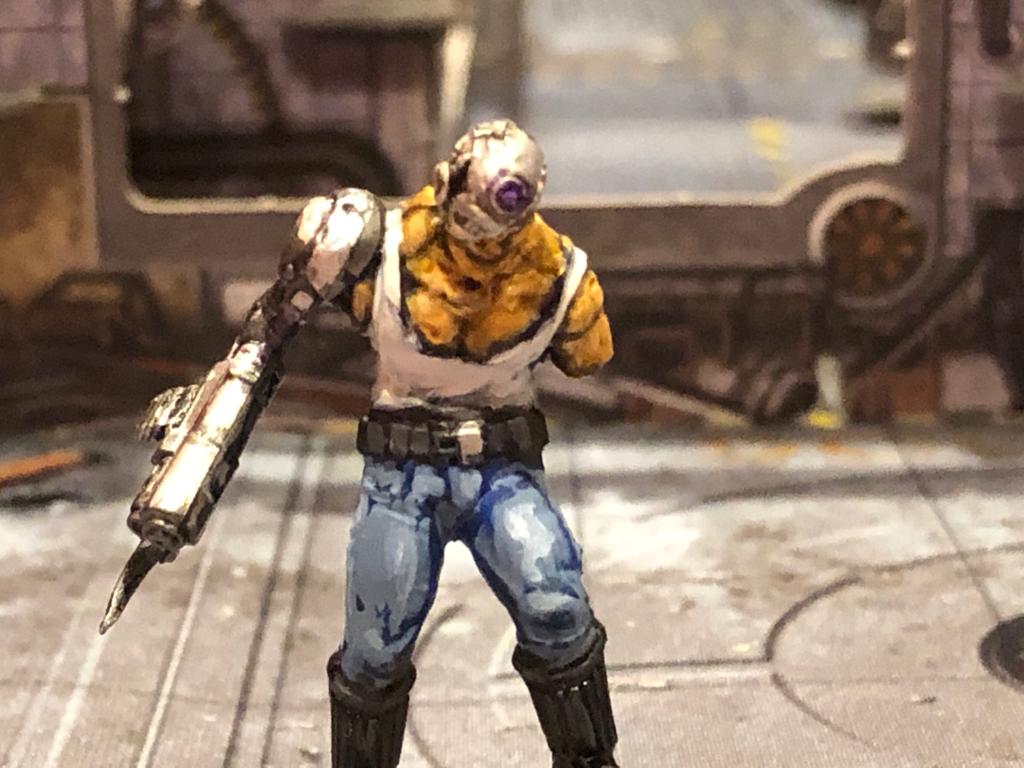
The Silver Machine (he is of course Mean Machine from the Warlord set “Dredd: Arch Villains of Mega City 1” , here)
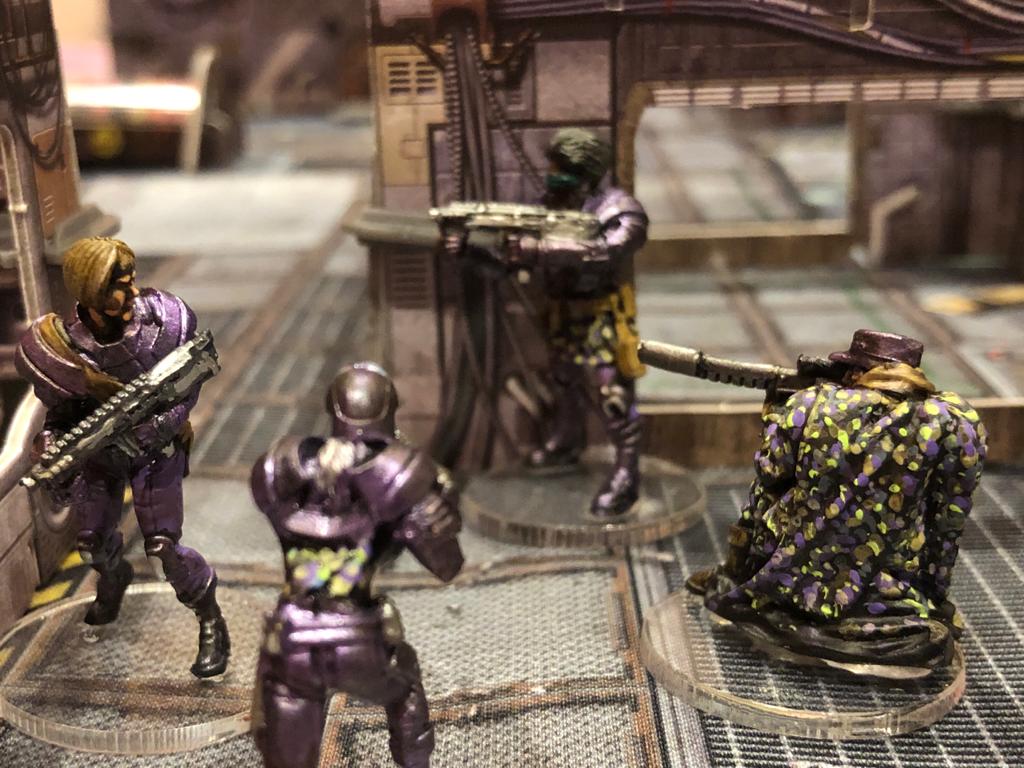
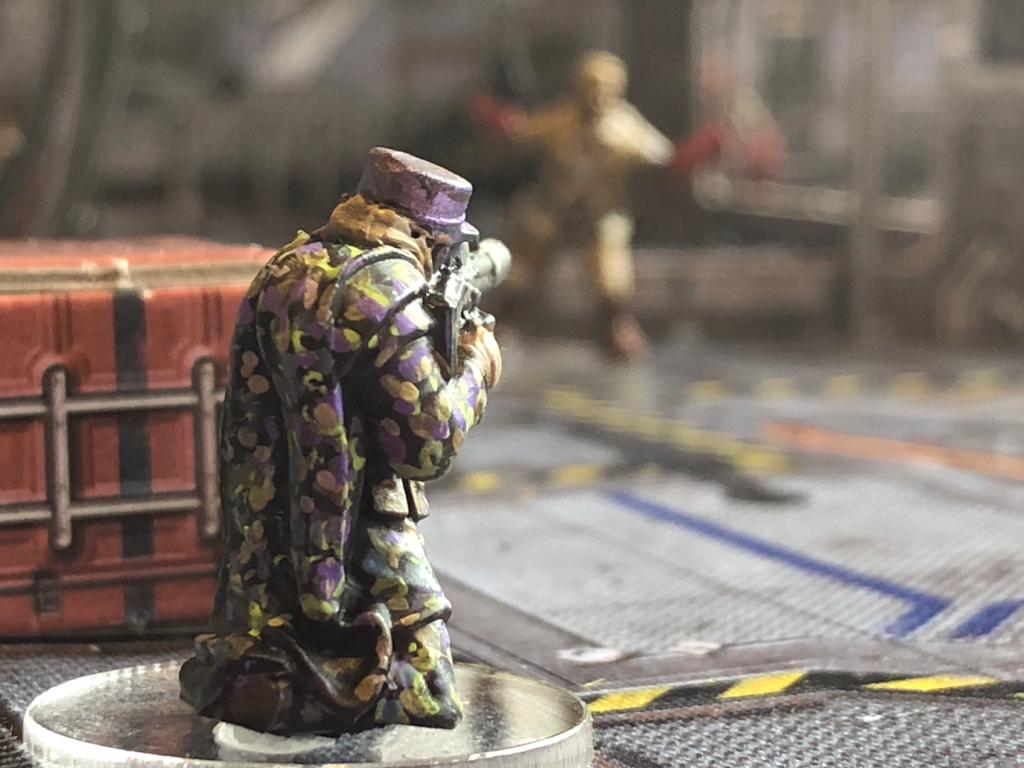
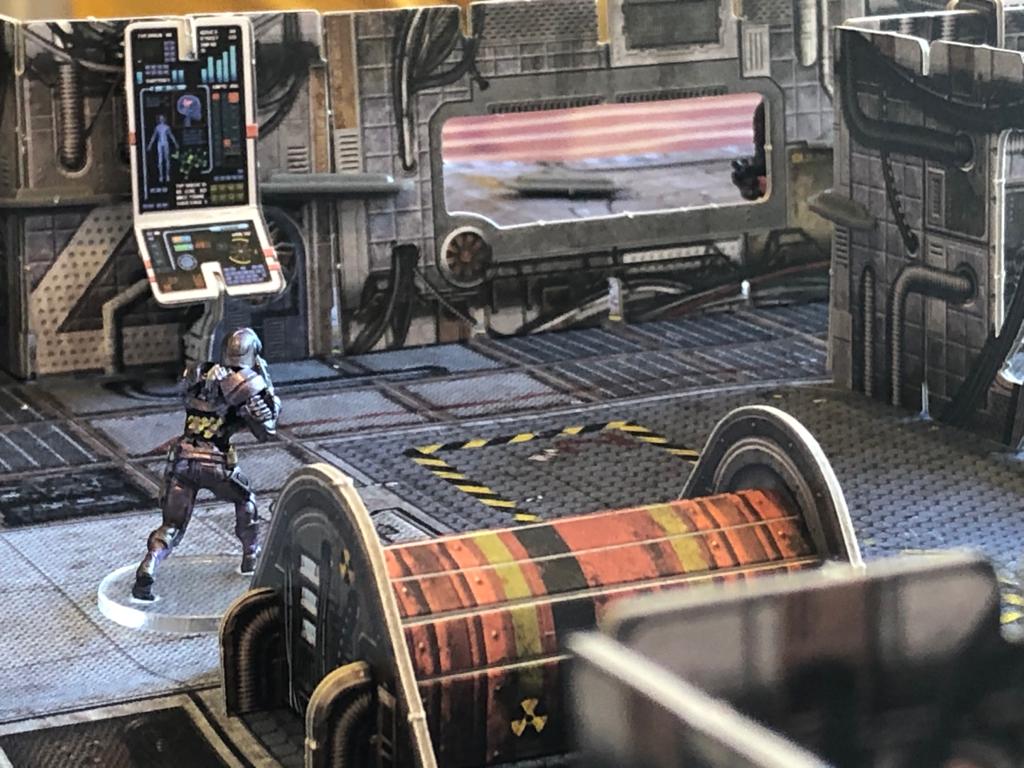
And some hired in soldiers for the mission – a Trooper, 2 Sentries and a Sniper.
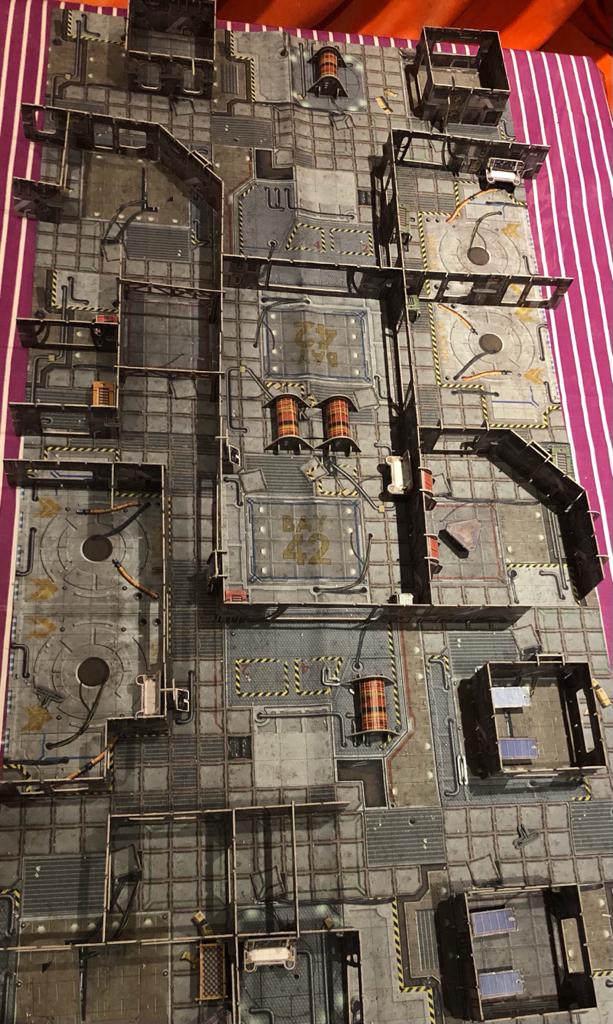
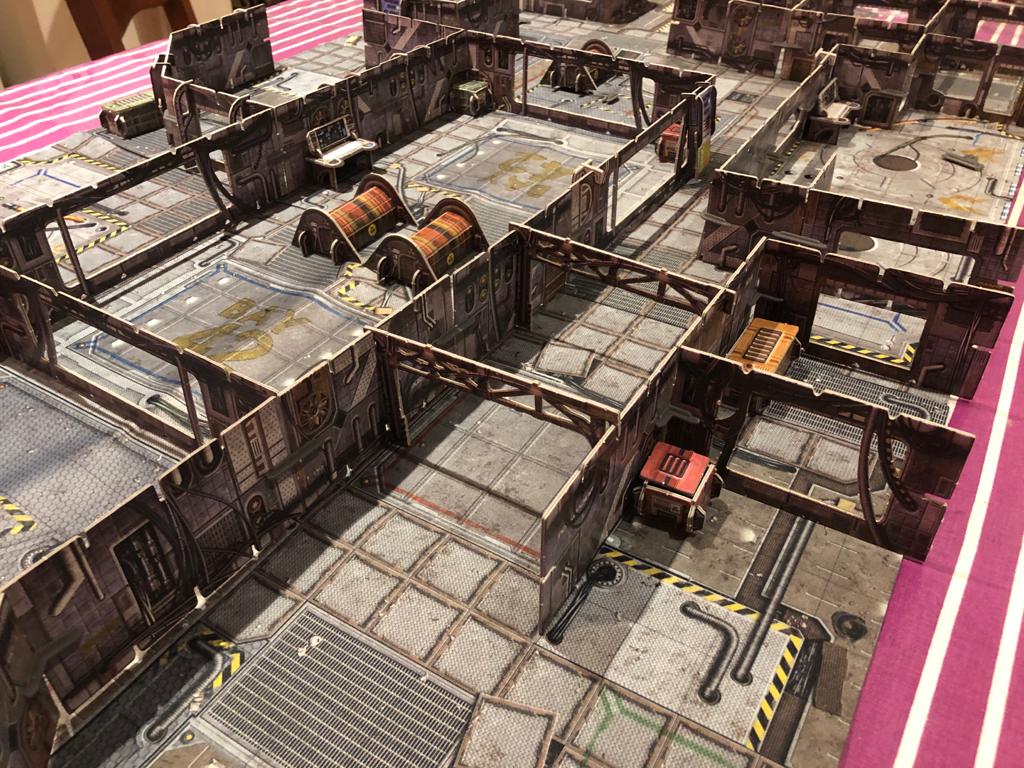
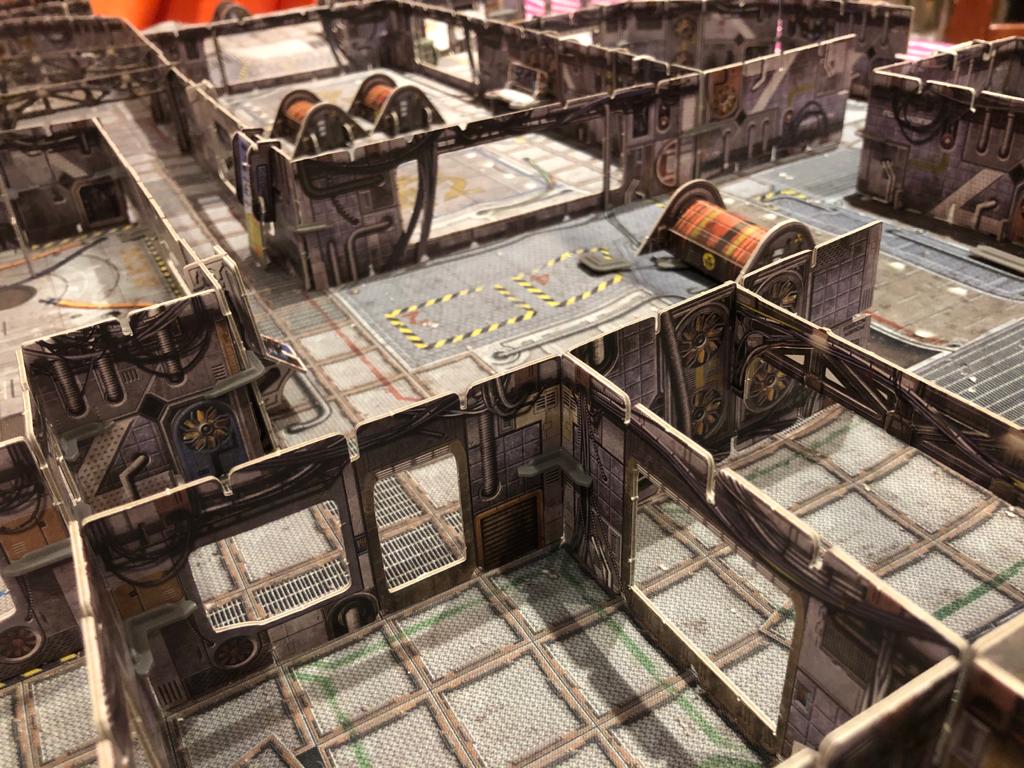
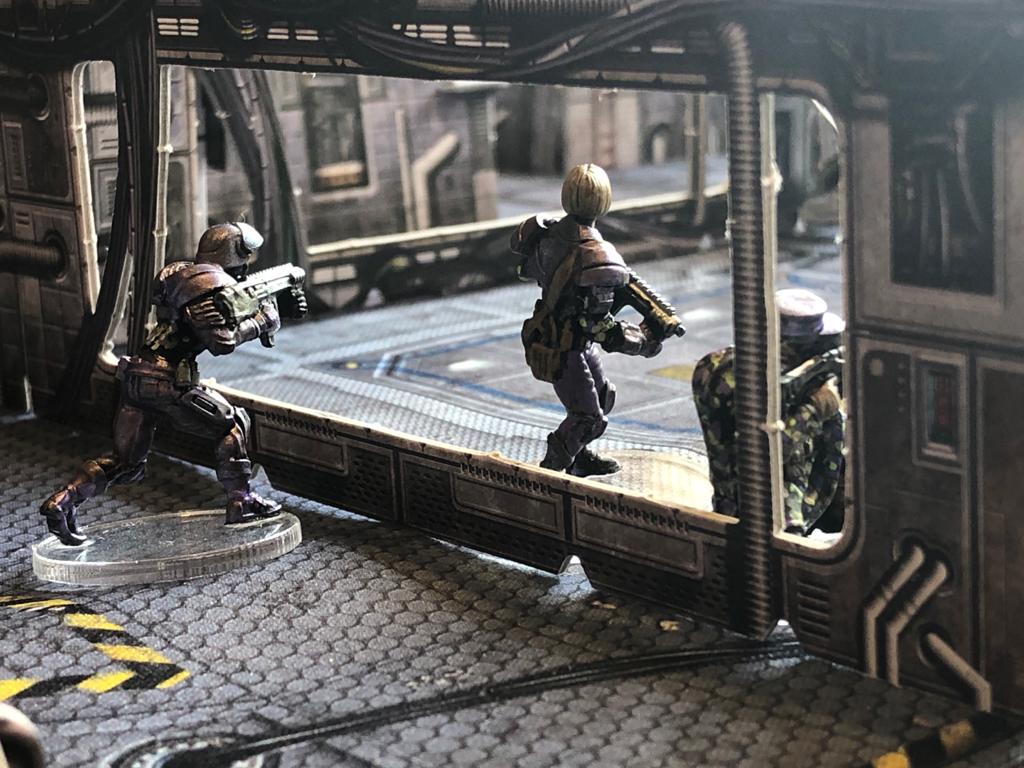
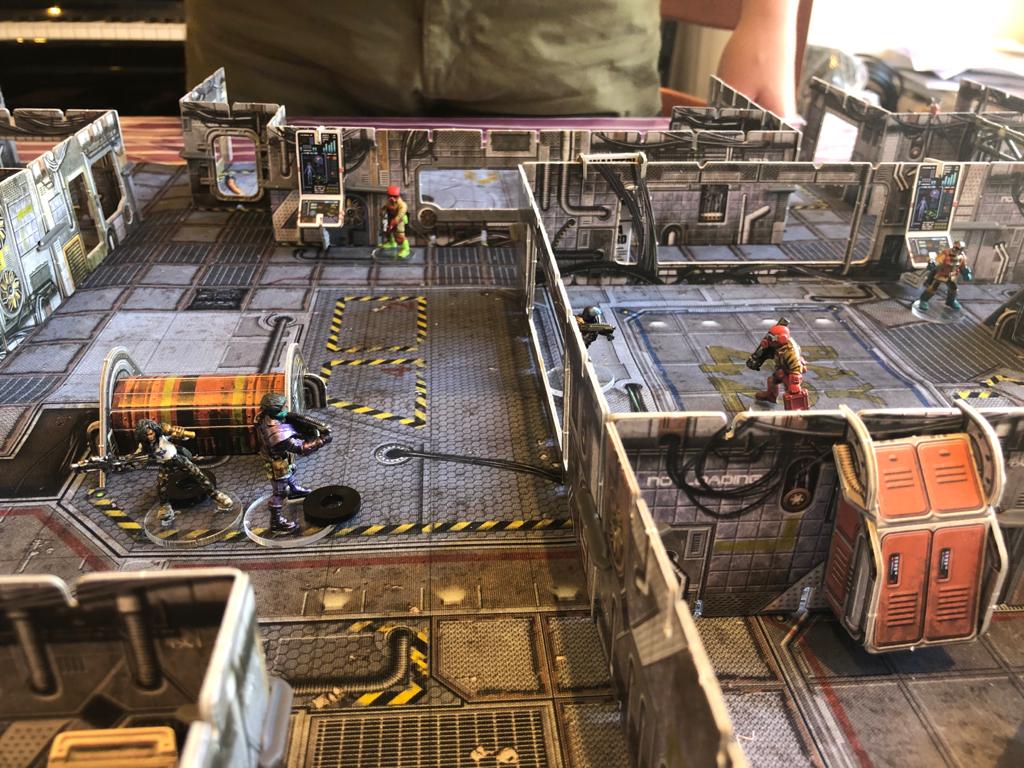
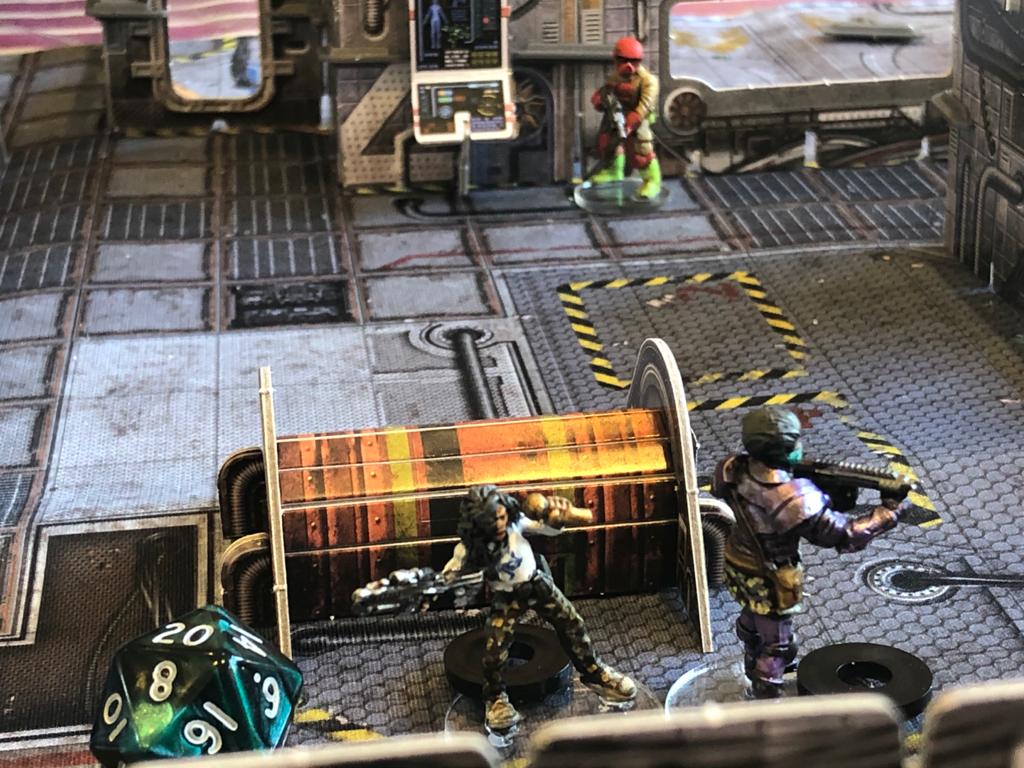
This the setup we used – a 2′ by 4′ table. This is using two of the Cyberpunk Battle Systems that is quick to set up and take relatively little space storing (more here).
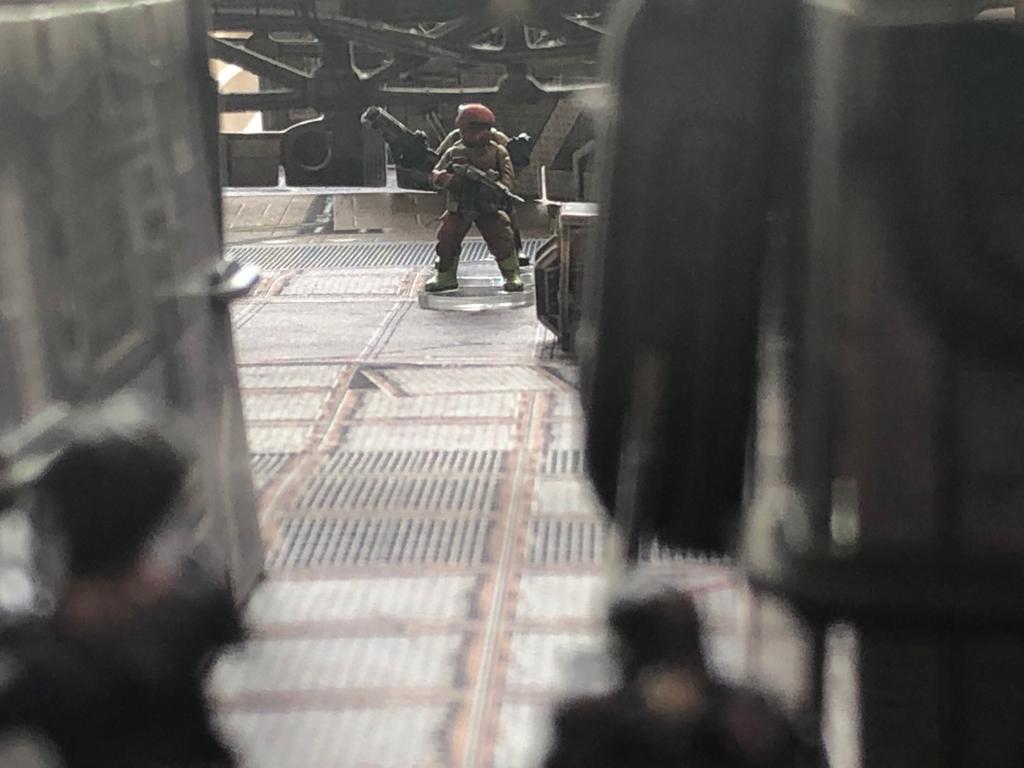
It creates a nice backdrop and breaks up Line of Sight nicely,
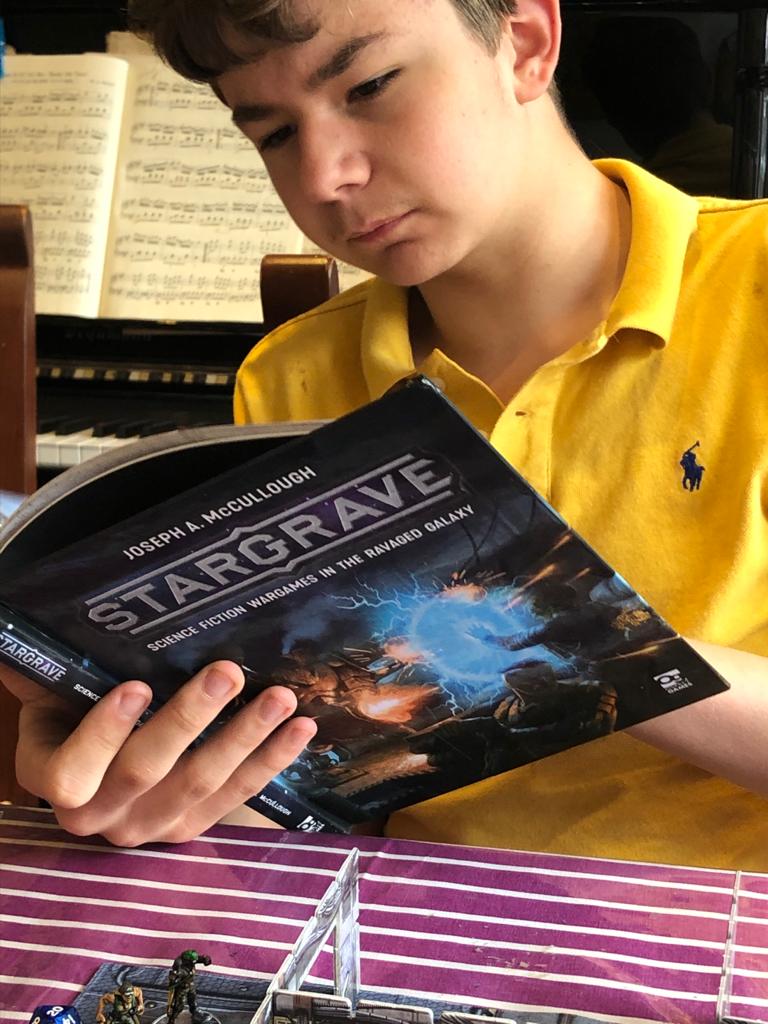
The Boy with the Rules
The game itself was fun and led by the Little One, I had only flipped through the rules but he knew them well enough for us to have a good game. I was badly prepared in how my Captain and First Mate powers worked and could have been more clever using those. I had some initial luck in my more aggressive strategy and at one point had 3 of the 5 loot markers but the Little One managed to turn the tides and ended knocking out the whole band and I conceded so I suppose it was a 0-5 loss in the end. We will definitely have a few more games and I encourage anyone to have a go – most of us have some old Sci-fi troopers and characters lying around and what environment you fight in does not really matter as long as there is some terrain features. We might do the next game in a forest or something like that. It has not yet blown or scared me away – so we will see how it feels when I have had a few more games and learned the subtleties of things like powers and the system itself. The Little One is a real fan of the rules. We had a good time which is the first rule or whether a set is fun or not, what follows are a few pictures of the game.
All clear Trooper
Initial probing through the research station
The Sentries managed to suppress the First Mate Frank in the first stage of the game
Making the Loot recover from the Box very tricky
Sniper doing what they do!
That Guy with the grenade launcher caused a lot of trouble during the game
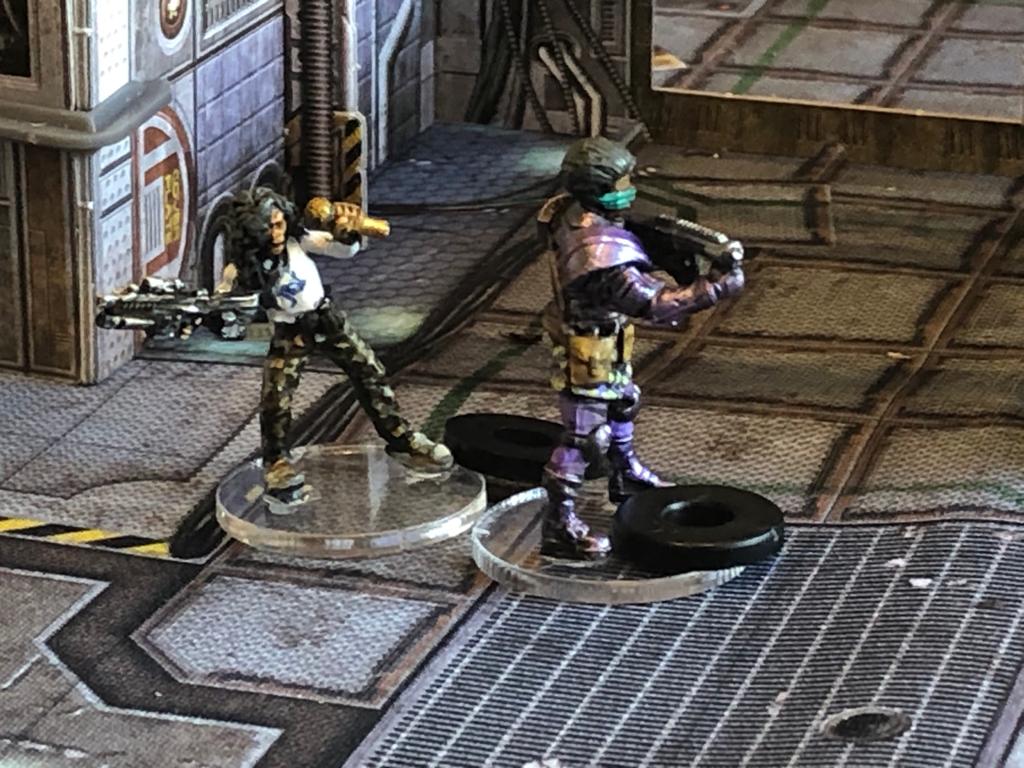
Duel in the Cargo Room, the medic was really doing some great shooting – you can always count on a base player.
Just about a shot from here
Sentries pushing on
Silver Machine getting bruised and the Medic continues doing some fine shooting
Sniper not so confident here, rolled a 1.
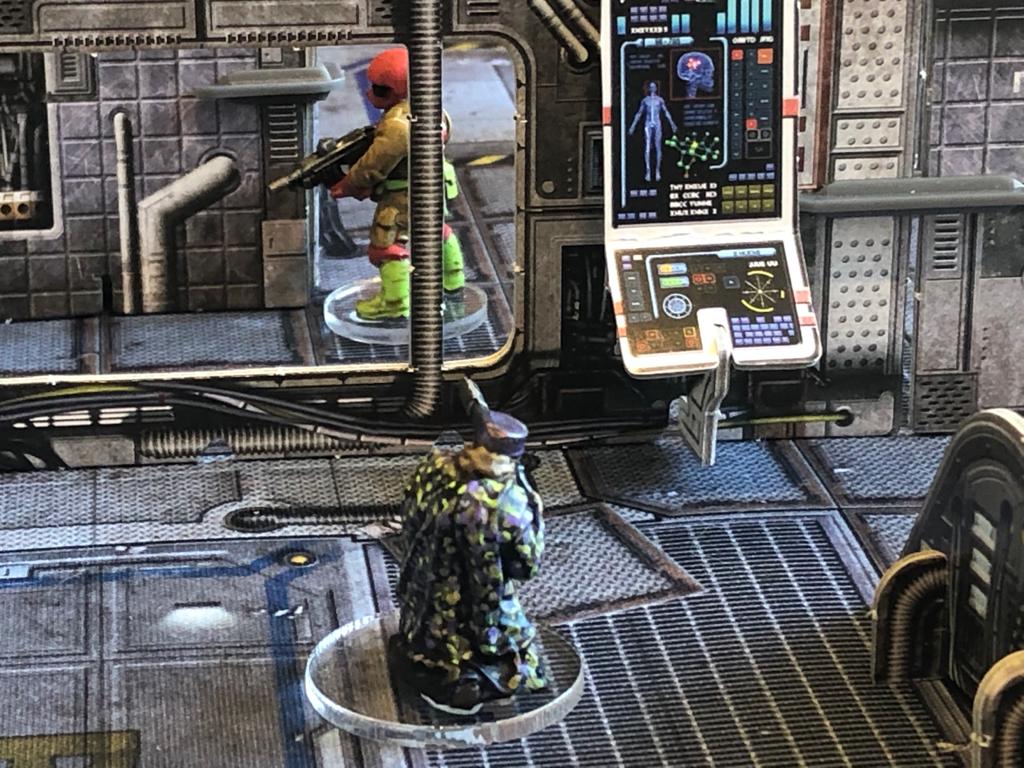
Big Man Pete shooting from behind the window.
Captain low on Hits taking cover behind the Sentry – not very heroic!
End Game
That is how you take the Captain Down – a natural 20. The follow-on grenade from the took out the Sentry too and the two Loot Markers where lost and the game too.
Last week I wrote about some fields I am doing using £3 doormats from B&Q (link to that blogpost here). The idea is to create something that look reasonable on your wargames table relatively quickly and I think cost efficiently. The approach presented in the original blogpost how to make the type of field shown below, and it is worth checking that out before you read this one.
Now this will allow me to produce a number of Green fields, depending on what flock/scatter I am using. The brown areas between the furrows works really well.
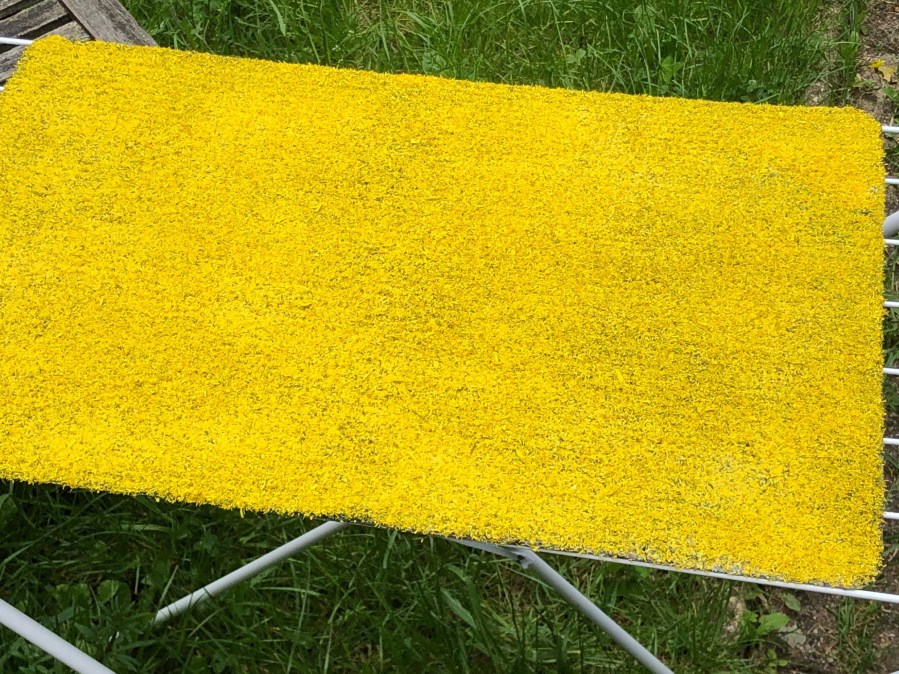
However I have been thinking about yellow fields that typically have a different look and feel to them. the contrast between brown and yellow would not be ideal. I would not even try it. Instead a typical “yellow” field tends to be more dense, i.e. furrows can not been seen just hinted and there is sometimes a green shine through (not that you could also do a more dense green field with this approach too).
I have used yellow pieces of fur, fleece etc but I did not really get a result I was happy with. Now with the door mat approach I realised that it would be relatively simple to do something that at least felt like the field above rather than a shit-brown surface with some strings of mustard.
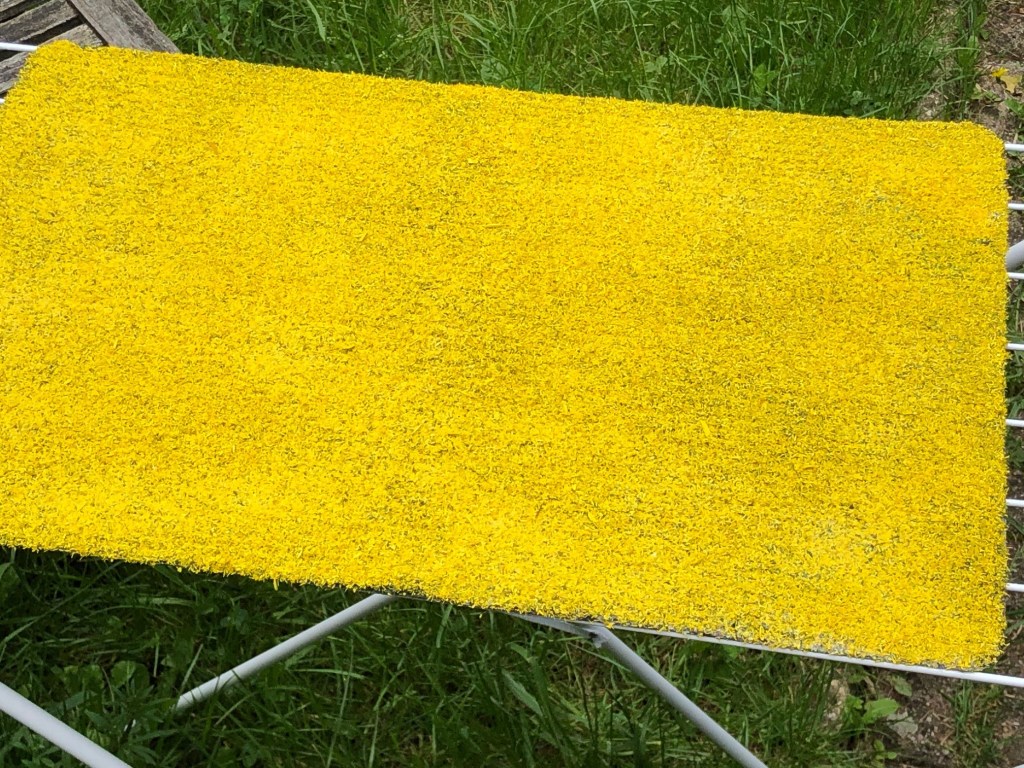
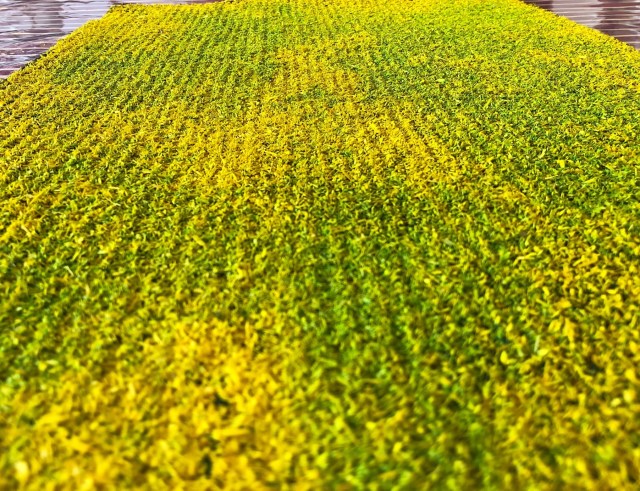
I ended up with something looking like this.
Anyway here are steps from Doormat to Yellow Field
What you need is
A structured door mat (as described in the previous blog, ok last link here)
Rough brushes
Green paint
PVA glue
And finally a bag of scatter/flock – needs to be relatively fine like fine turf / sawdust etc. I have ordered a fair few “yellow” varieties and have found that with regards to colour and overall look the Busch 7054 is really my recommendation. You can get a bag from £2 from railway modelling companies. Just search for “Busch 7054”. A bag should last for say 2 of these fields.
The Steps (the best thing would be to do over several days – day 1 (Step 1), day 2 (step 2), day 3 (steps 3,4,5) and finally day 3 (Step 6).
Brown it up – let it dry
Green it up – let it dry
PVA It – do it in stages half the mat 3,4,5 then the rest 3,4,5
Spread
Shake – after this is done for the whole mat let it dry properly overnight
Seal – let it dry (as this is very wet it will take a while to dry)
Shit Brown it
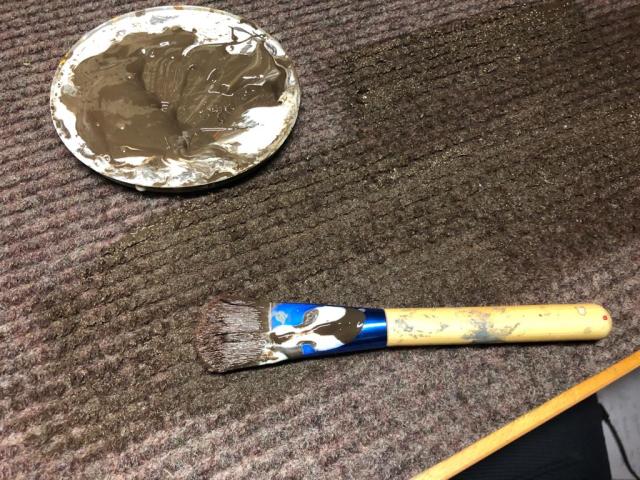
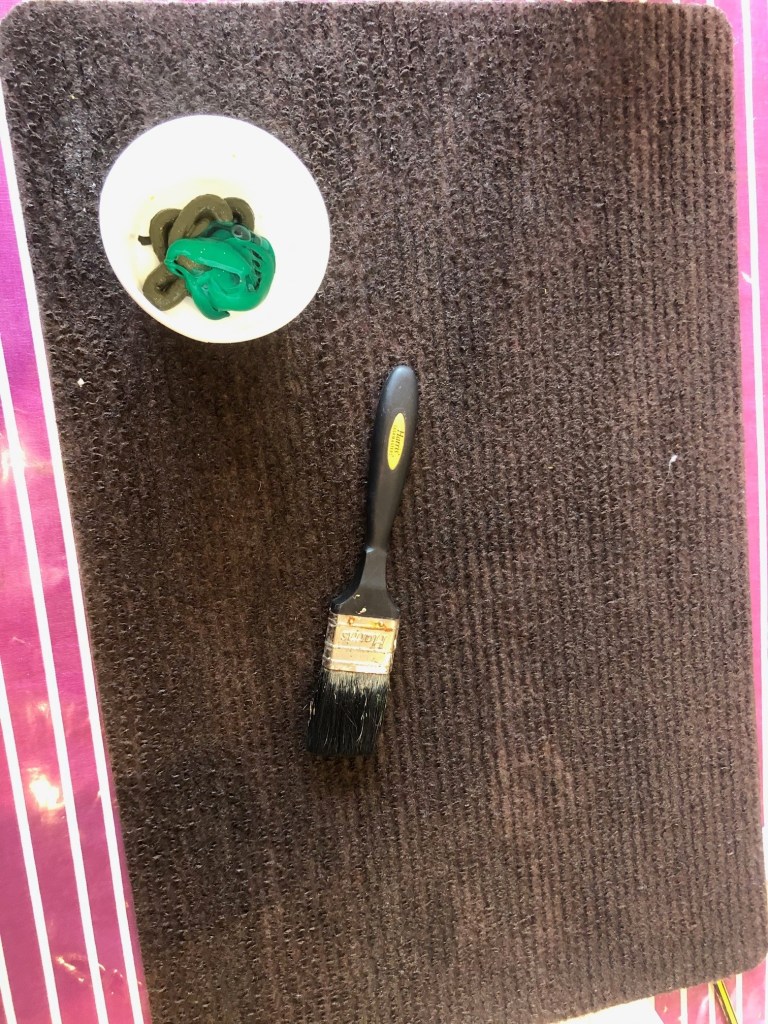
First I painted the mat in a dark brown mixed with PVA and let it dry, this serves to give some strength to the structure.
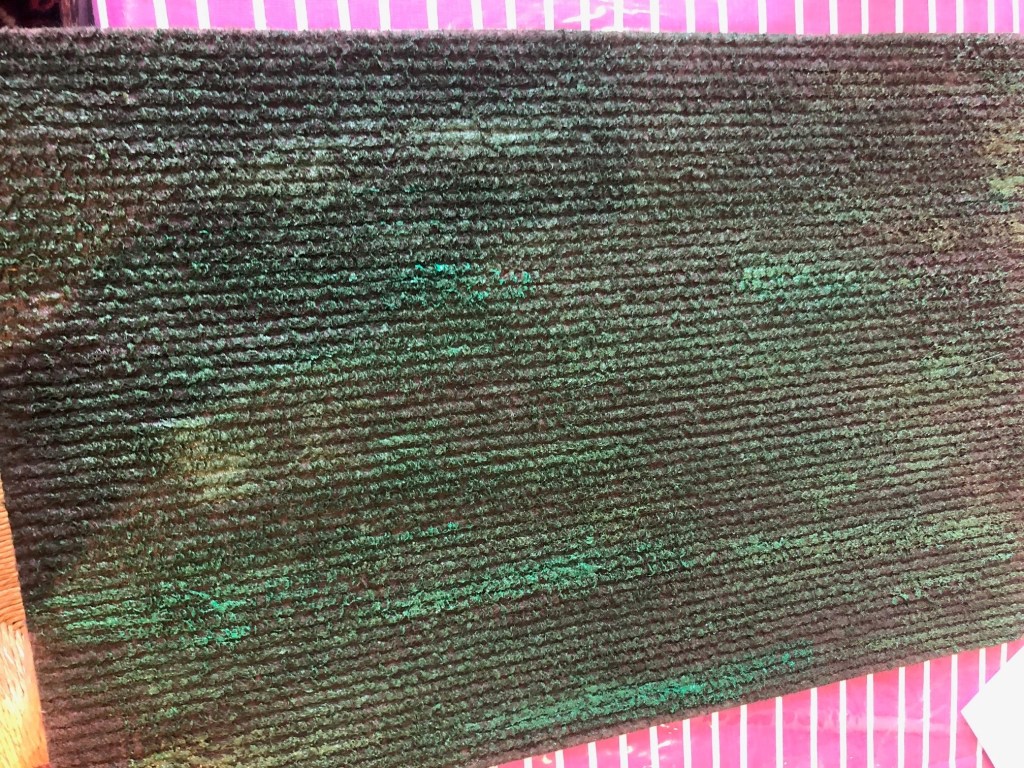
Green it up
This is really a rough wet brush, you want to have a strong green here, just a little brown coming through (you might be able to skip the brown and just start here).
PVA it
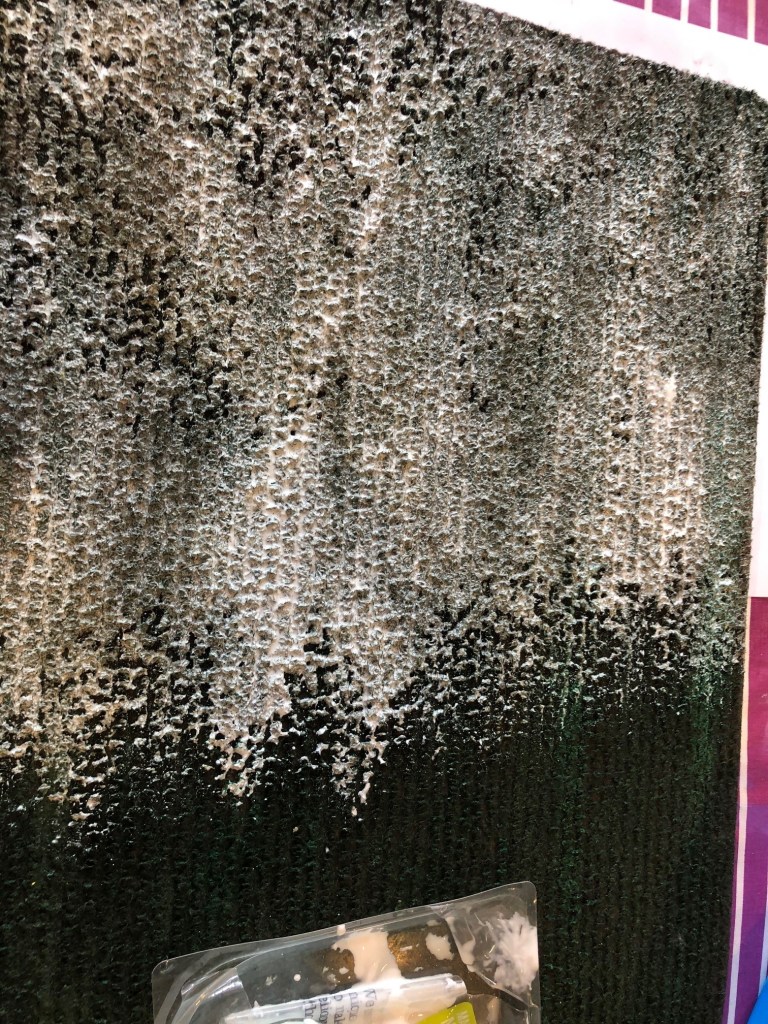
Now last time we applied with finesse, I am using 2 parts PVA and 1 part water mixed and just brushing it on. I did about half the mat before I went on to the next step then covered the other part with PVA. Remember to cover all of the mat not just the furrows.
Spread
Then just cover the mat with your flock
Shake
Shake off the excess
Seal
This is really important, dilluted PVA sprayed over the mat
The finished mat, there is a little hint of green shining through and alos we can see the lines, albeit faint.
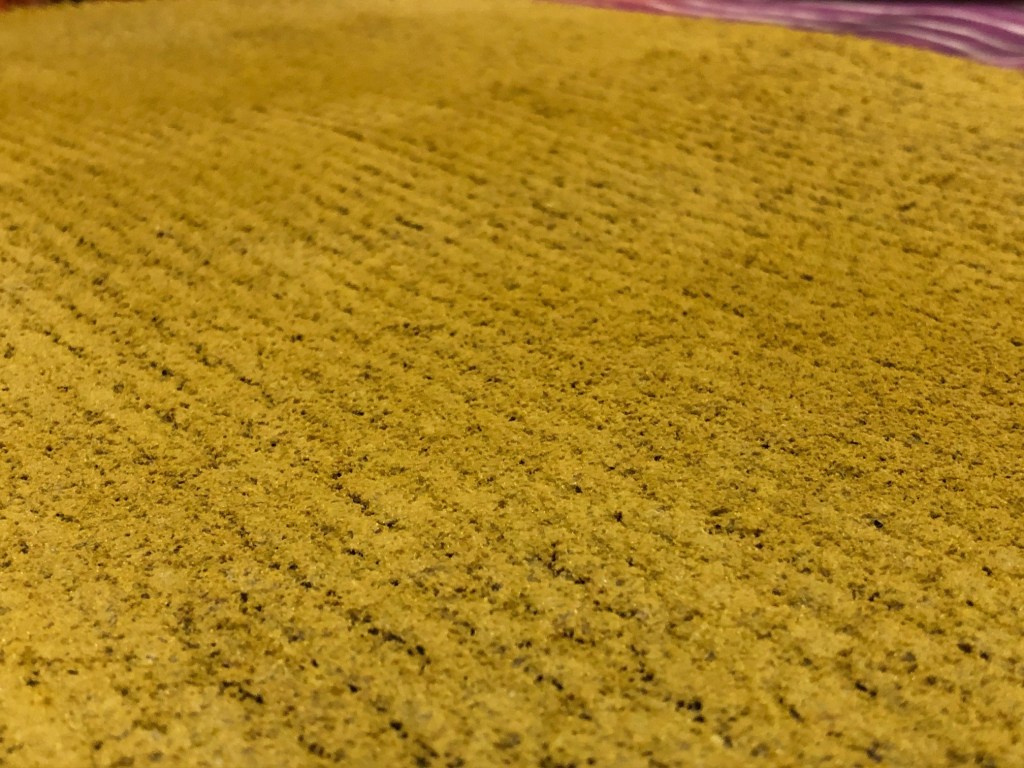
Here is one I did without allow the green paint to dry before I added the PVA and the flock, it created a more Green shinethrough (this is a little bit more experimental and tempramental and I let you explore this yourself, remember you could “repair” this with a yellow spray can if it goes too green).
And one I did using Woodland Scenics Yellow Grass
I hope this one and the last blog (see links above) gives you an idea on what you can do with this kind of mat.
I have done 5 of them so far – it should be enough to cover a normal wargames table and give that illusion of different crops and fields, with the cost of the mat, then paint, pva and scatter say a total cost of £5 per mat. That is a good deal and really not a very difficult project to do. You can then cut them into the sizes you need and perhaps add some further edge detailing etc. I will show in a later blog post how I will use the mats for my table.
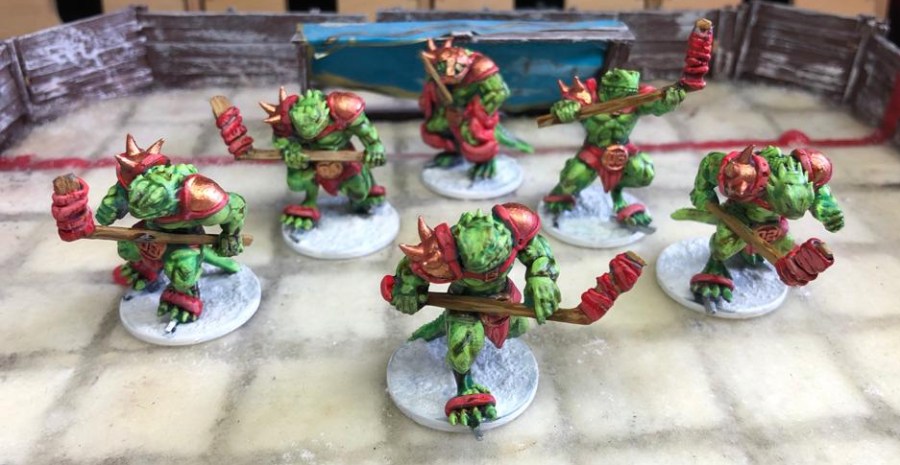
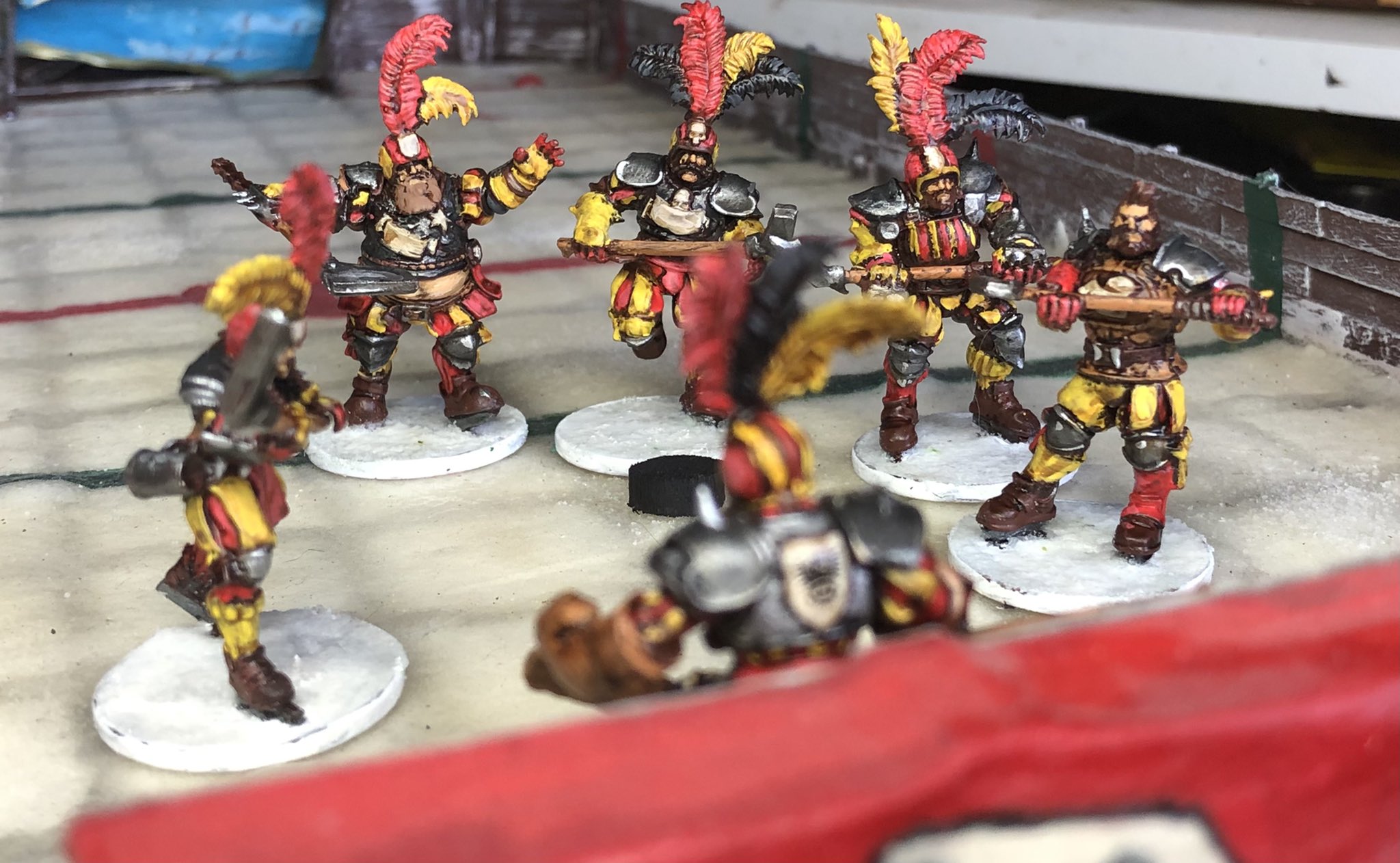
I felt I needed a sixth team for the Fantasy Icehockey project, having so far dwarves, rats, orcs, skeletons and humans. More about this the previous work here.
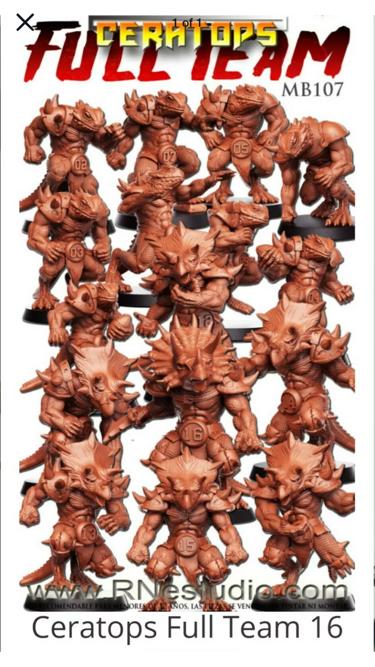
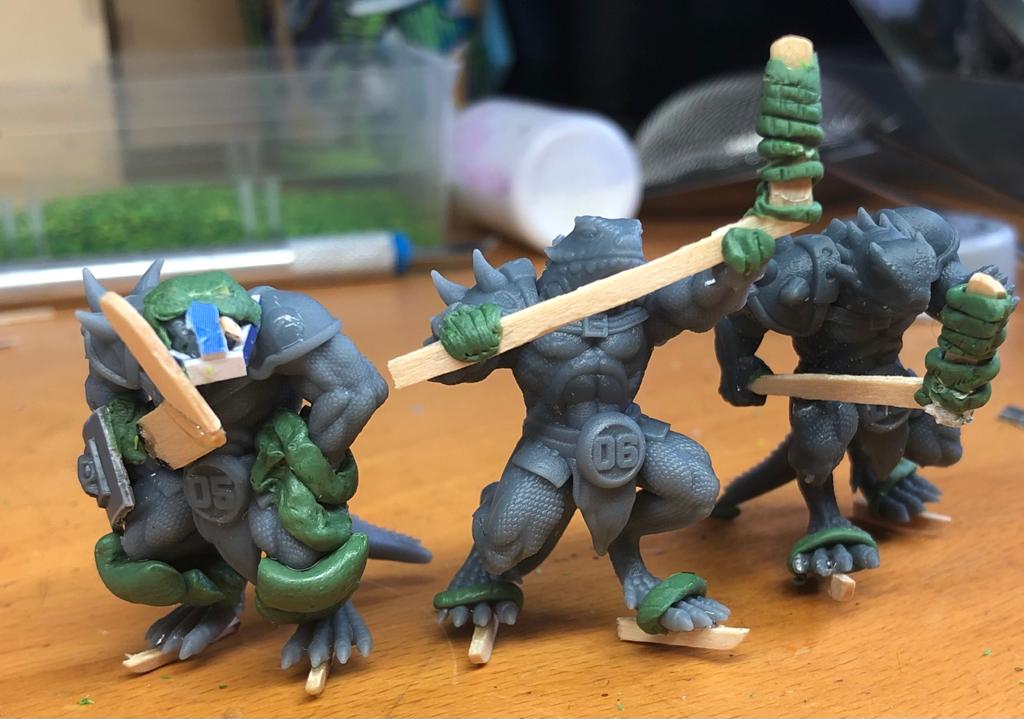
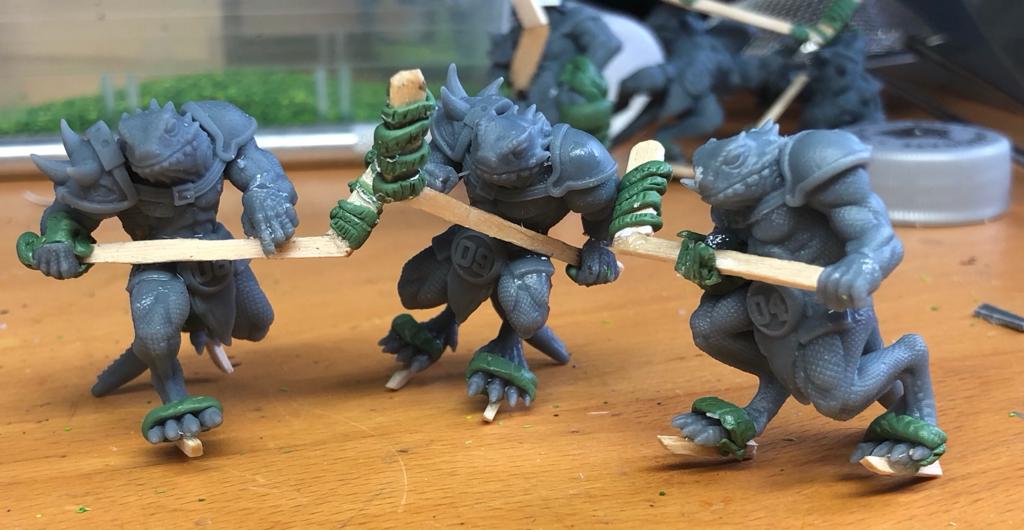
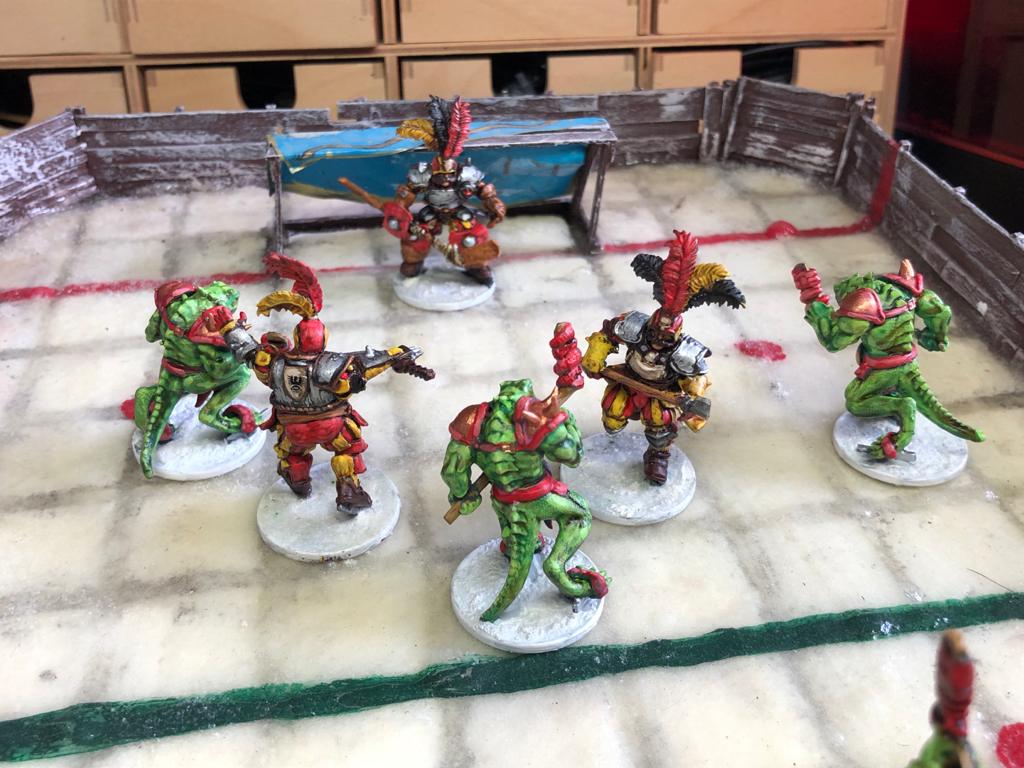
As I have run out of available teams I, just as for the human team, had to find a fantasy football team to convert, adding sticks and skates. I found the team below on ebay – they are printed STL model and come on the typical 3D print resin with a consistency of a Brighton Rock (hard sugar candy) which makes conversions different than say plastic or metal. The team has two types of lizards and I kept the bigger ones on the sides as I might do another team with them later, or do a few star players for this team.
I cut off hands, modified and repostioned added some sticks and skates and filled or added detail with green stuff where needed. As you can see this is pretty brutal and lacks finesse (skill) but works out for getting them done and the idea that they are hockey players on ice and not football players. Not sure how good the Lizard are in a cold environment but I speculate that they have a big fire in their box where they sit and heat up when on the bench or something like that.
The sticks and the skates are made from coffee stirers
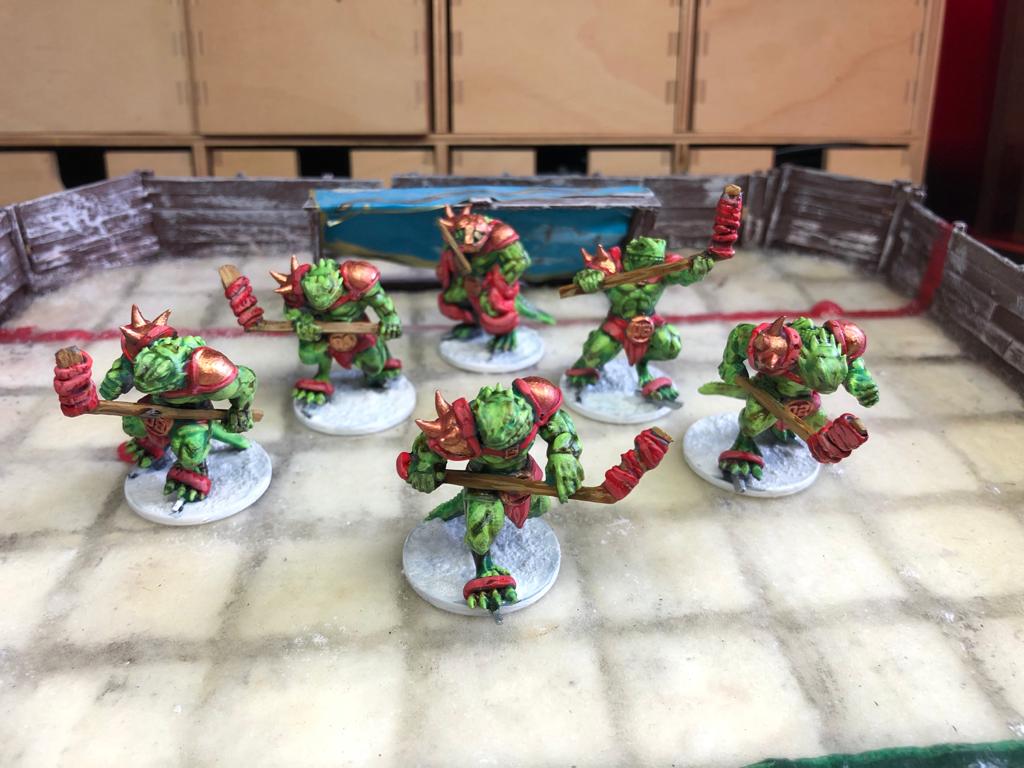
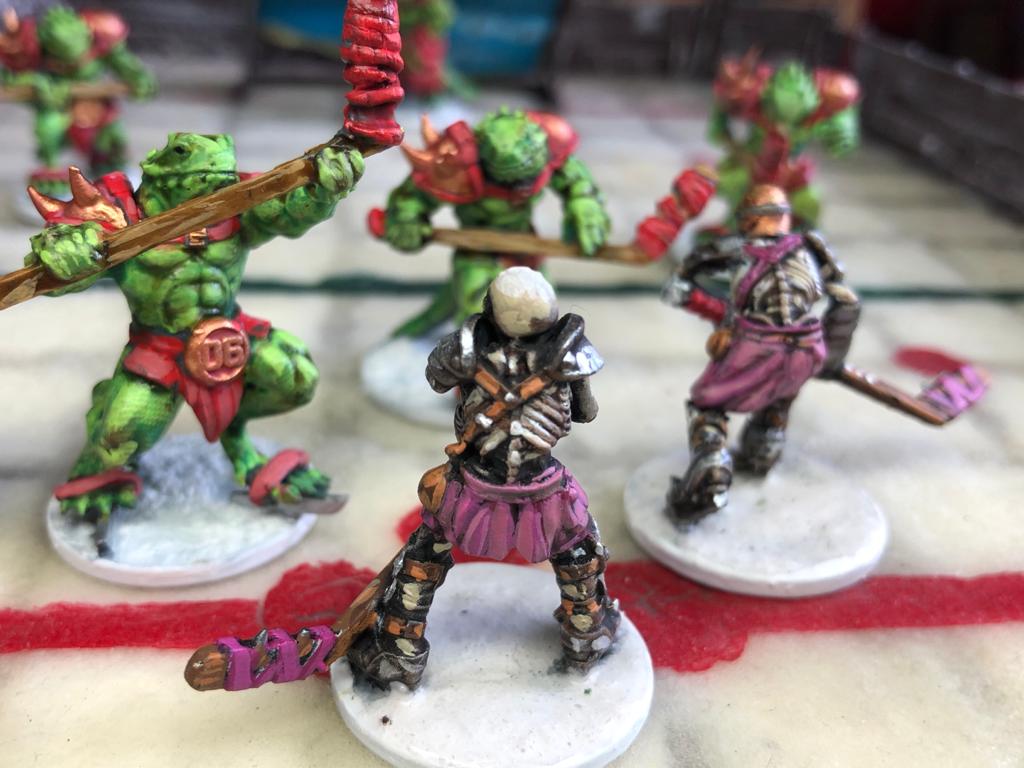
Not sure how comfortable those skates would be but since they do not have shoes I was thinking to add shoes to them but then thought about some kind of beach sandal type of skates – well it is Fantasy so why not. These guys are not very well protected but their game is based on skill and good skating, the tail allows additional tricks to be carried out – a stinging attack whilst still maintaining control of the puck as giving bonus to balance/skating checks. I painted them in a bright green (Vallejo Game Colour – Livery Green 72.033) with a darker green wash, some deep red and bronze. I think it works well overall.They are a fun addition to the overall set – six teams that is enough for a tournament!
/ Hope that was of some interest, have a good week.
This is a write up of my explorations of turning some of the cheap door mats to fields for your wargame. When gaming in ground scales of 1:100, like chain of command, a foot (30 cm) equates to about 30 meter in on the table. So a field measuring say 6 by 6 inches (15cm square), is hardly more than a small garden. I have a number of field tiles that I have used for my 6mm wargaming that kind of works because the grand scales are significantly smaller and a field represents areas with cultivated land as opposed to individual fields, etc.
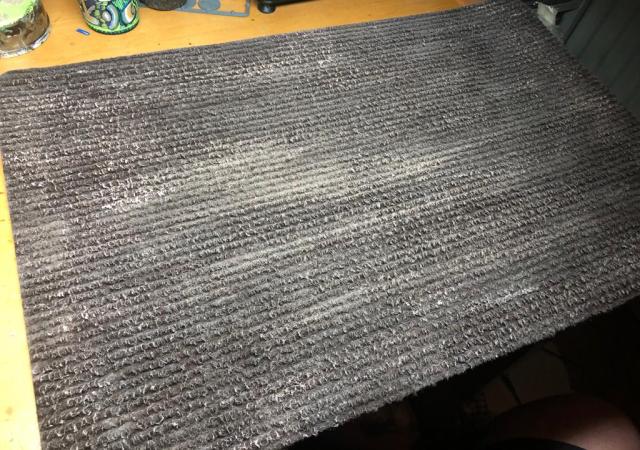
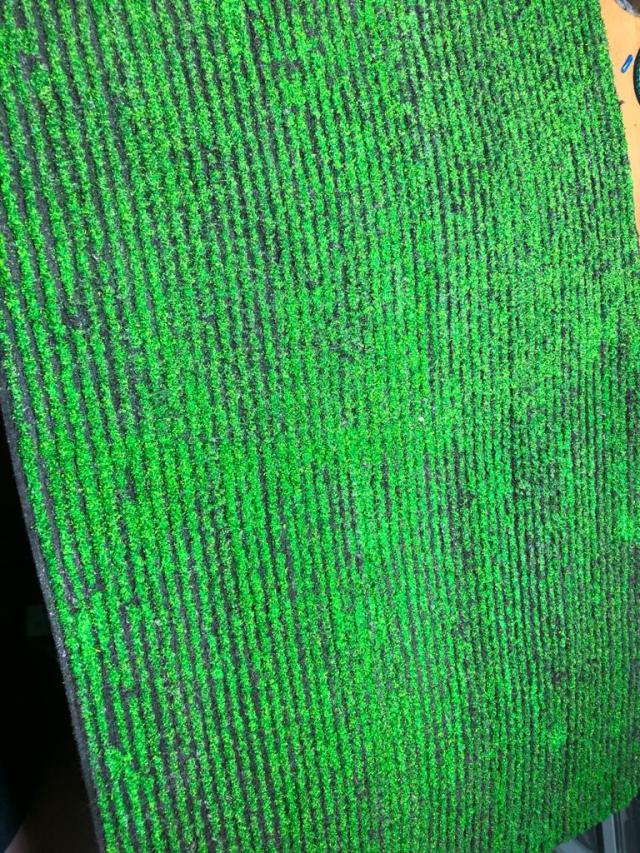
However I found this door mat from B&Q in the UK, they sell at £3 each. They measure 60 by 40 cm (this is about 2 foot by 1 and a quarter foot).
The idea with the mat is the hairy corduroy surface, this forms the basis of the furrows (the elevated aspect) and the base for the scatter (the hairiness). Oh, and a short note. people have used this kind of material before for their wargame fields – this is an attempt to apply a straightforward process with some additional elements to add some depth to the final result rather than claiming originality.
This is a close up of the mat
Anyway lets get started.
Step One – Shitbrown it!
The first thing I want to do it to add some colour to the mat I use a cheap acryloc burnt umber of something like (you could us an emulsion too) that I mix with a generous amount of PVA (this serves to stiffen the surface)
Just work the mess in, you could use a bigger brush than this. Then let it dry before the next step – I would wait about 24 hours.
Step 2 – Highlight it with Bailey’s
For the next step you need a light brown colour similar to the drink Bailey’s in colour. Again this is cheap hobby paint territory, the key is a light brown.
Then just drybrush it over, you do not need to be too careful and remove a lot of excess paint like if you would drybrush say a miniature etc. Do a few strokes on the top (this will be covered anyway) to get rid of excess paint then work it to look something like this, get some of the contrast into the areas between the furrows as this will be mostly visible. The whole idea is to get away from a monotone brownish area. You could leave to dry for a short while but it should not take long to be ready for the next step.
Step 3 – Slap on the PVA
For the next step you need PVA mixed with water at say 50/50 ratio (this is assuming a thick builder type of PVA) if you have more runny PVA then use a little bit less water. Mix it properly. You also need a fine top applicator – this is a typcial 18ml paint pot similar to a vallejo paint bottle. I have a fair few of these and I think I used about 7 or 8 for a mat so if you have a bigger bottle would be more efficient, just make sure you can control the amount that come out carefully.
Apply the glue to the mat on top of the “furrows”, the idea here is that the PVA will capture the scatter we apply for the next stage of the process. DO NOT do the whole mat in a go, I tend to do about a sixth of the mat before I do the next step of applying the scatter. I
Step 4 – Apply some Scatter let dry and Seal with PVA
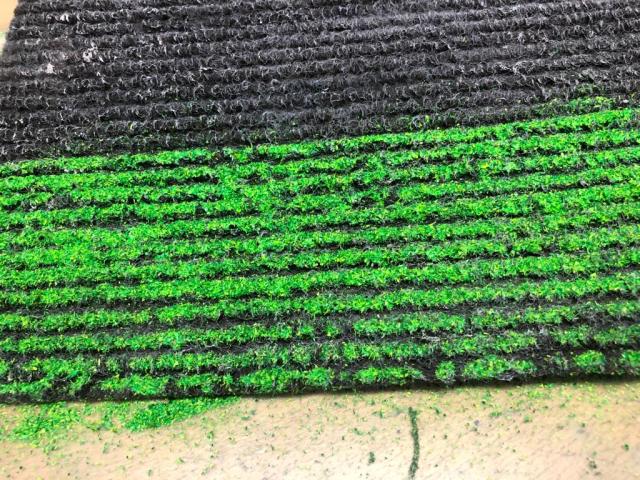
Next we need to apply the scatter, but what do we use?. I have used two products with good success; (i) Woodland Scenics Fine Turf and (ii) Javis Scatter. In this example I have used a mixture of different Javis scatter shades of green. Too clumpy stuff (like the Yellow Coarse Turf from woodland scenics, that would be ideal for creating yellow fields is a little bit too clumpy) is more difficult to work with and I am currently avoiding it. Would be great to find a sawdust type of yellow scatter like the Javis one for making nice yellow fields. If you use a monotone mix perhaps you could add as a final thing before sealing with PVA a drybrush stage of a light colour then the one you used.
Apply the scatter and shake off, a few taps will suffice until you finished the whole mat.
Not the quickest work but the patience pays off. Now wait for it to dry (give it a day) and then give it a proper shake off, then spray some dilluted PVA on top (this is a strongly dilluted milky consistency mix with a little bit of fairly liquid, if you need to know how to do it, try this video https://www.youtube.com/watch?v=qGFmNUTfQr8) and let it dry to ensure that the scatter stays of top.
Effectful and simple to do. Looking pretty decent.
Here is another one that was done with some single colour scatter, then drybrushed with a ligther green as an example. BUT seal it with PVA before you drybrush and do it carefully so you do not loose the scatter. An additonal step. I prefer the first approach as it saves time and gives the contrast/depth in itself.
Single colour scatter with drybrush – works too.
Now of course you cut cut these into the sizes you need and that is what I will do. I intend to use these for 15mm groundscale games, making each filed 60 by 40 meters but also for some smaller scale games.
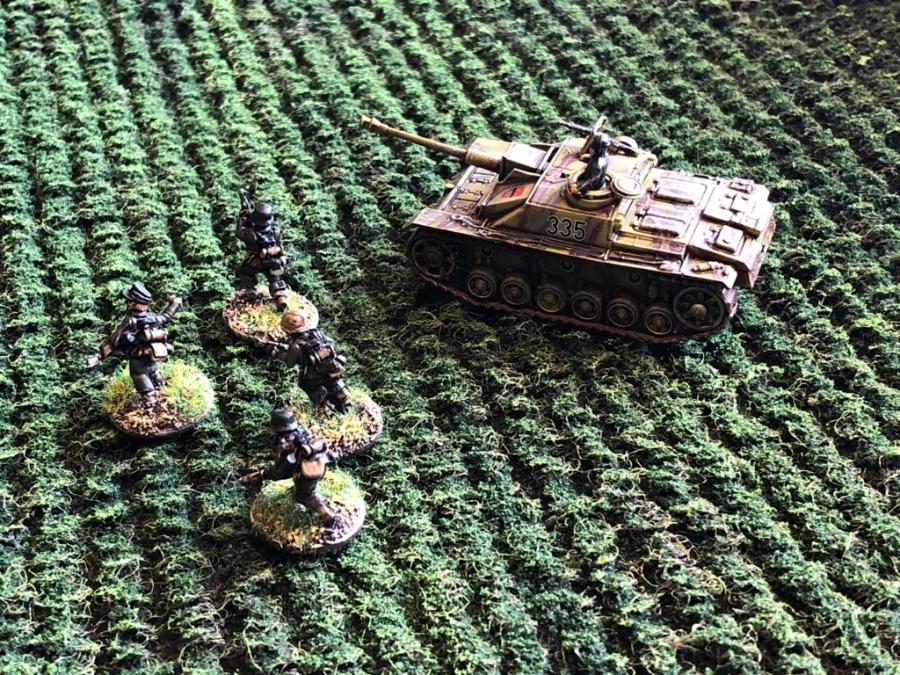
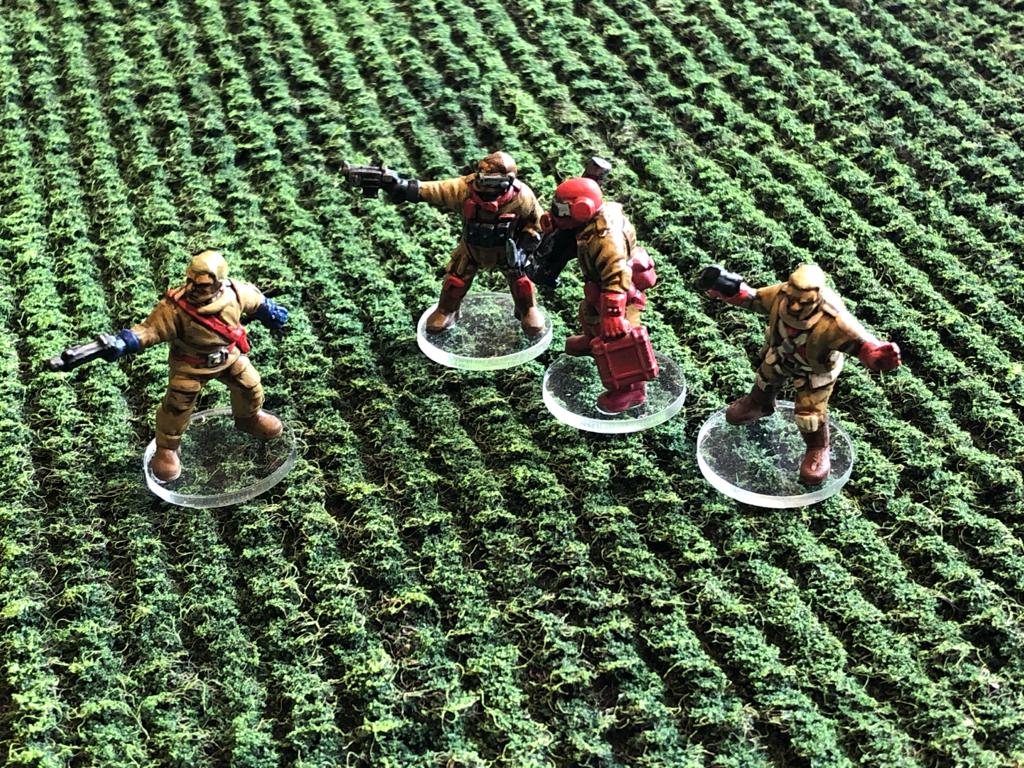
Here is a little bit of how they look versus 6mm, 15mm and 28mm miniatures (not the best light). I think they kind of work with all scales perhaps best with the 15mm.
6mm
15mm
28mm – these being from the Little One’s Crew he has designed for Stargrave and Five Parsecs From Home, but that is for another Podcast.
/ Hope that was of some interest, and if you do come across a sawdusty yellow flock or scatter let me know.
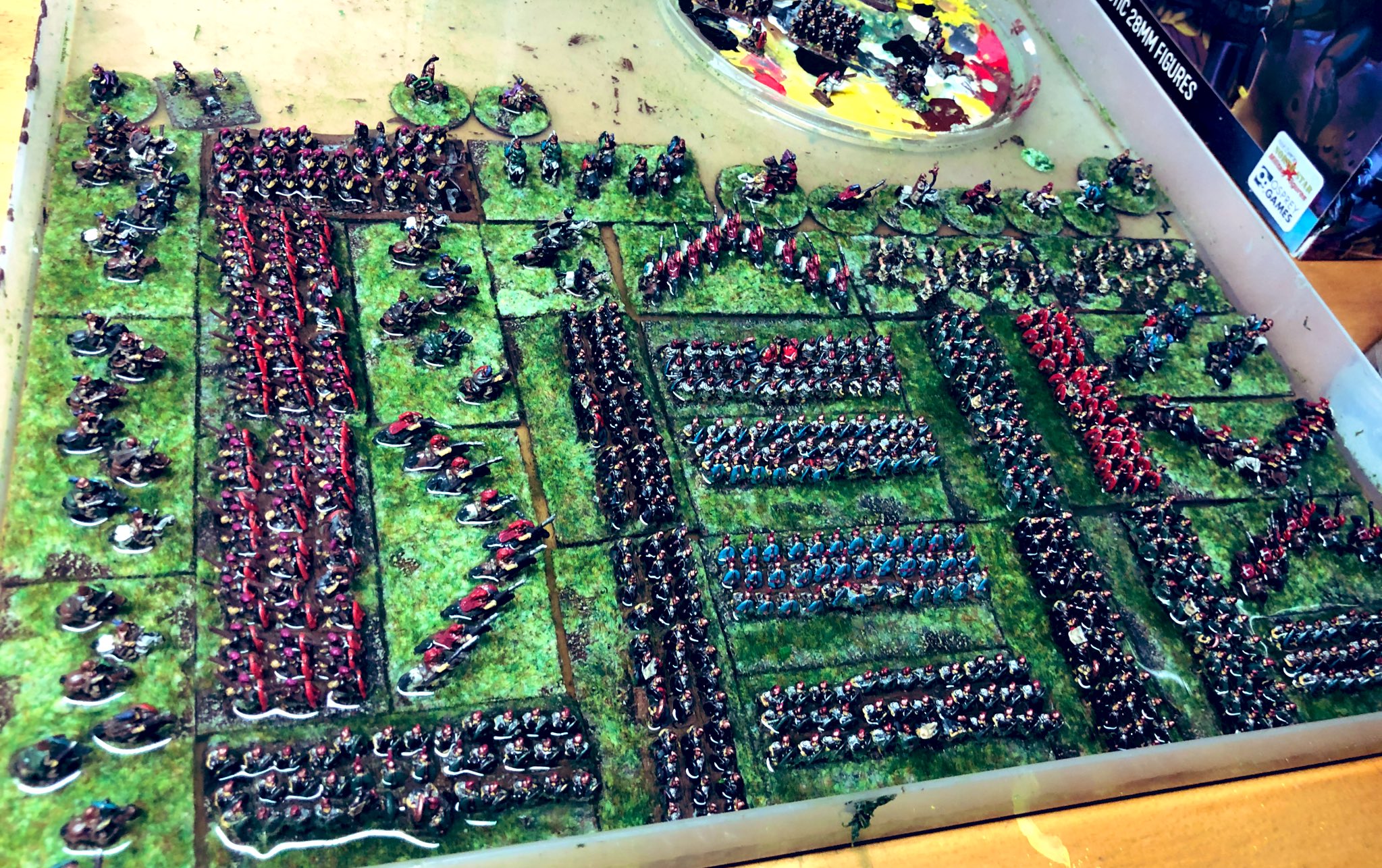
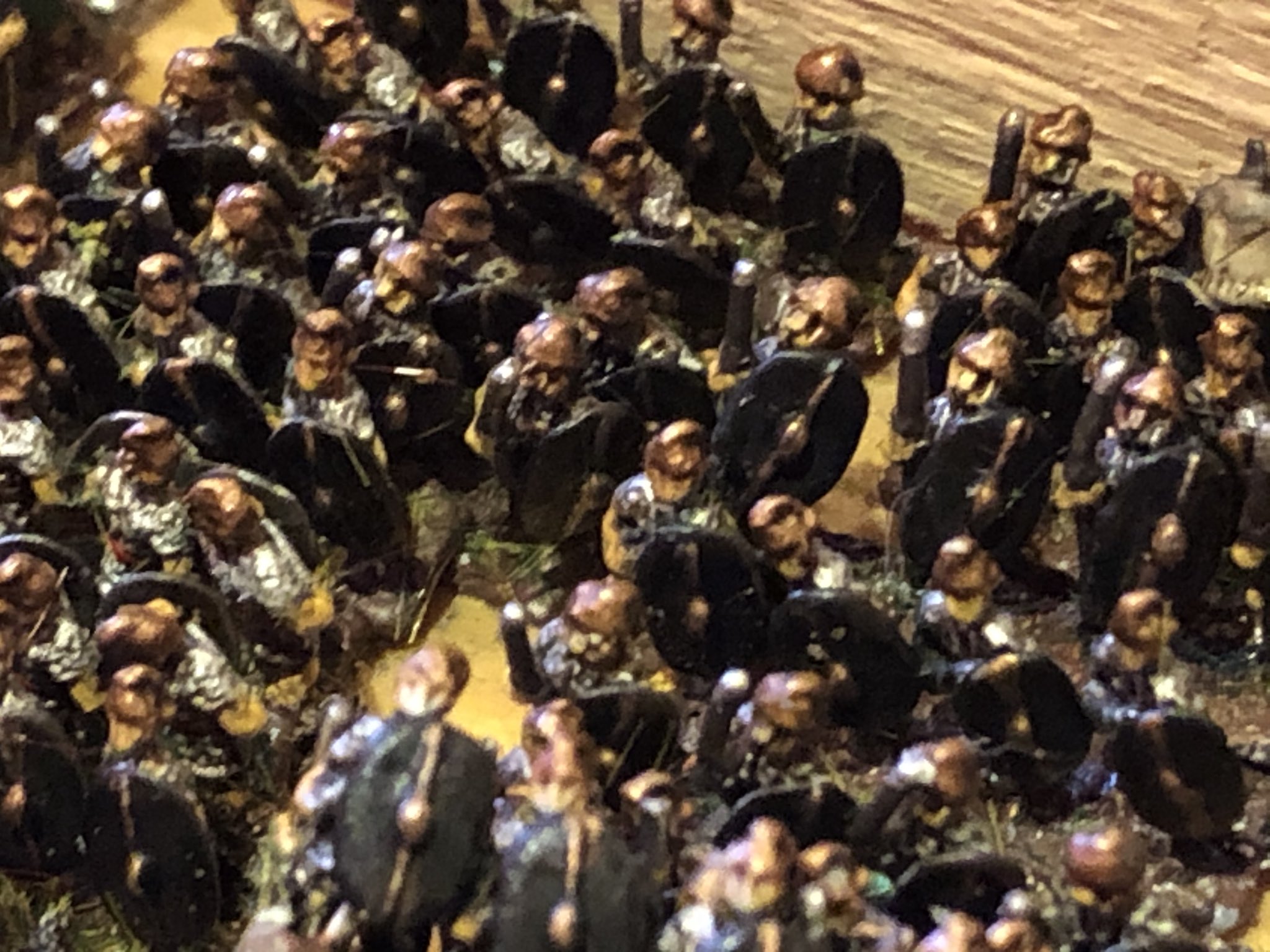
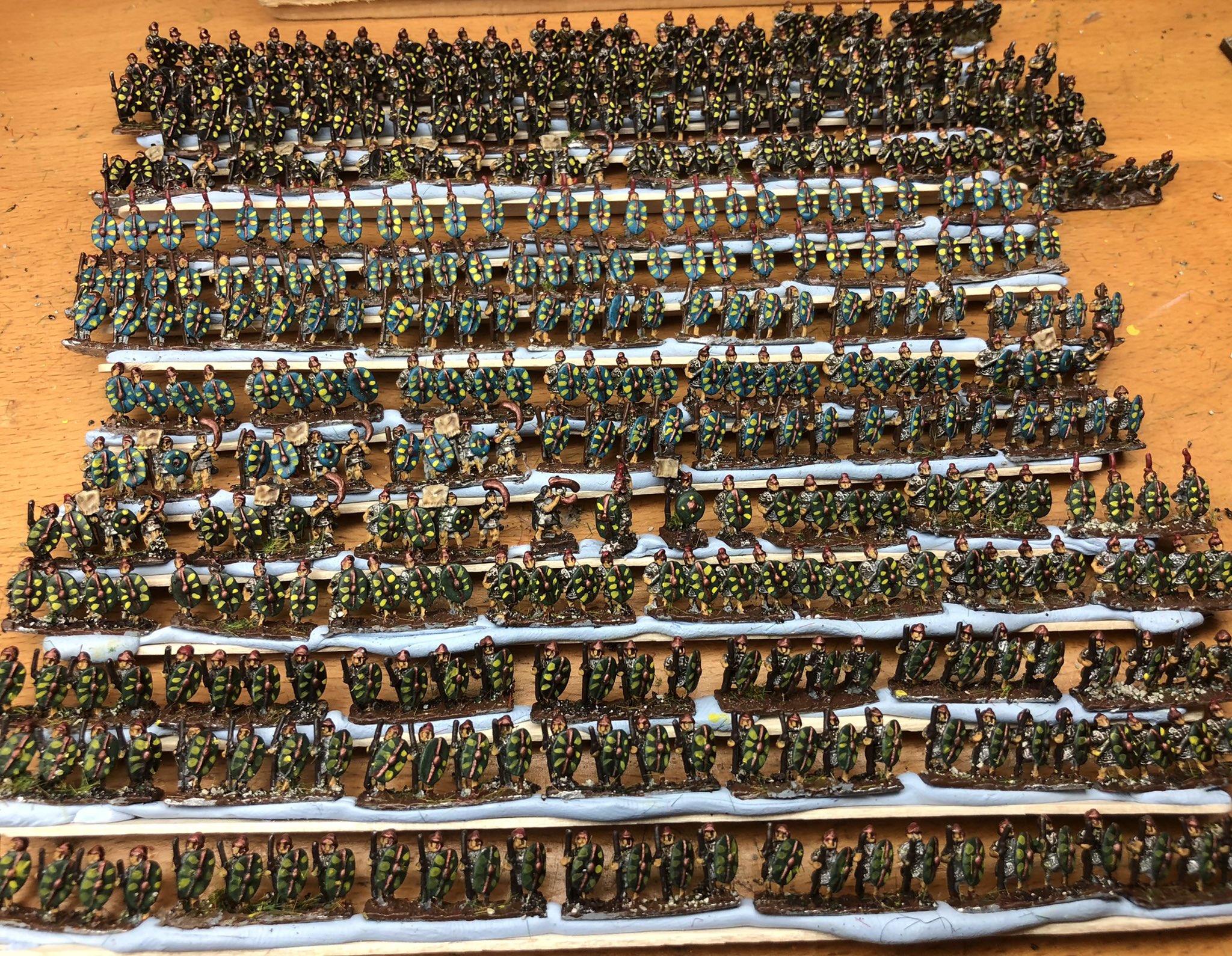
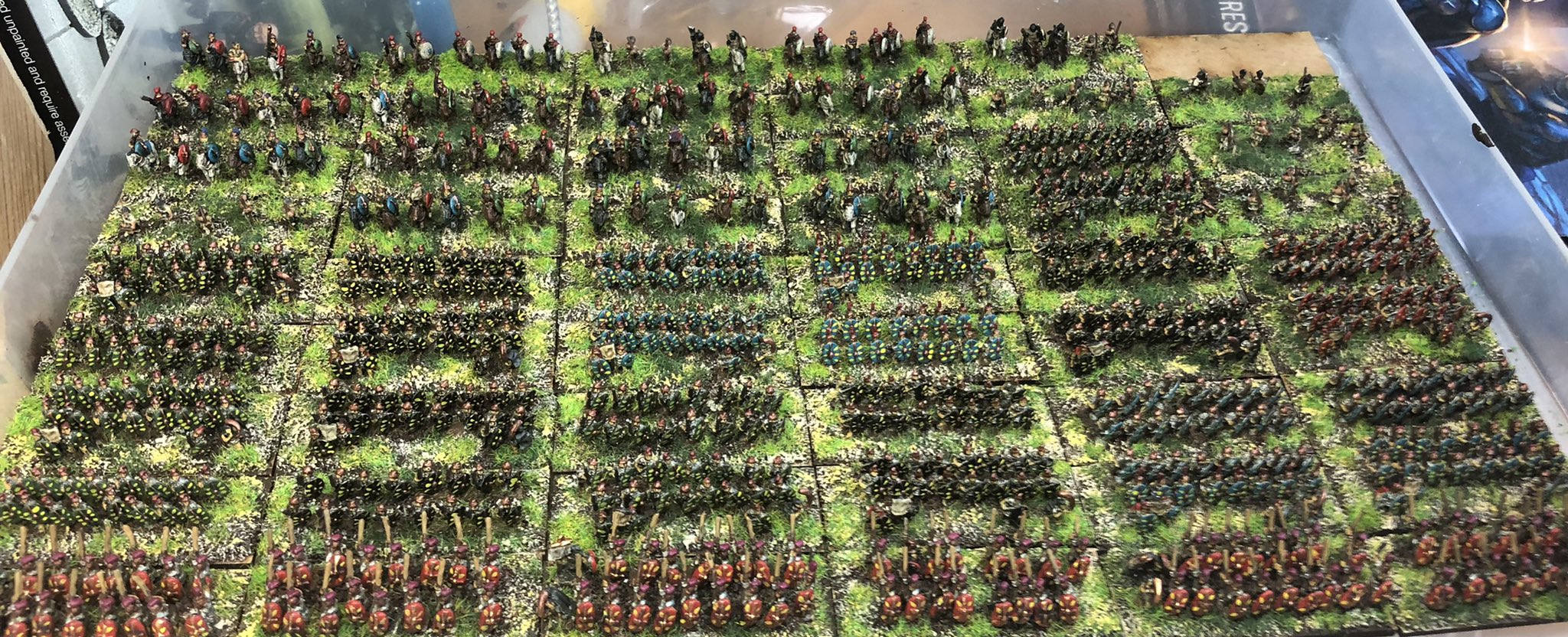
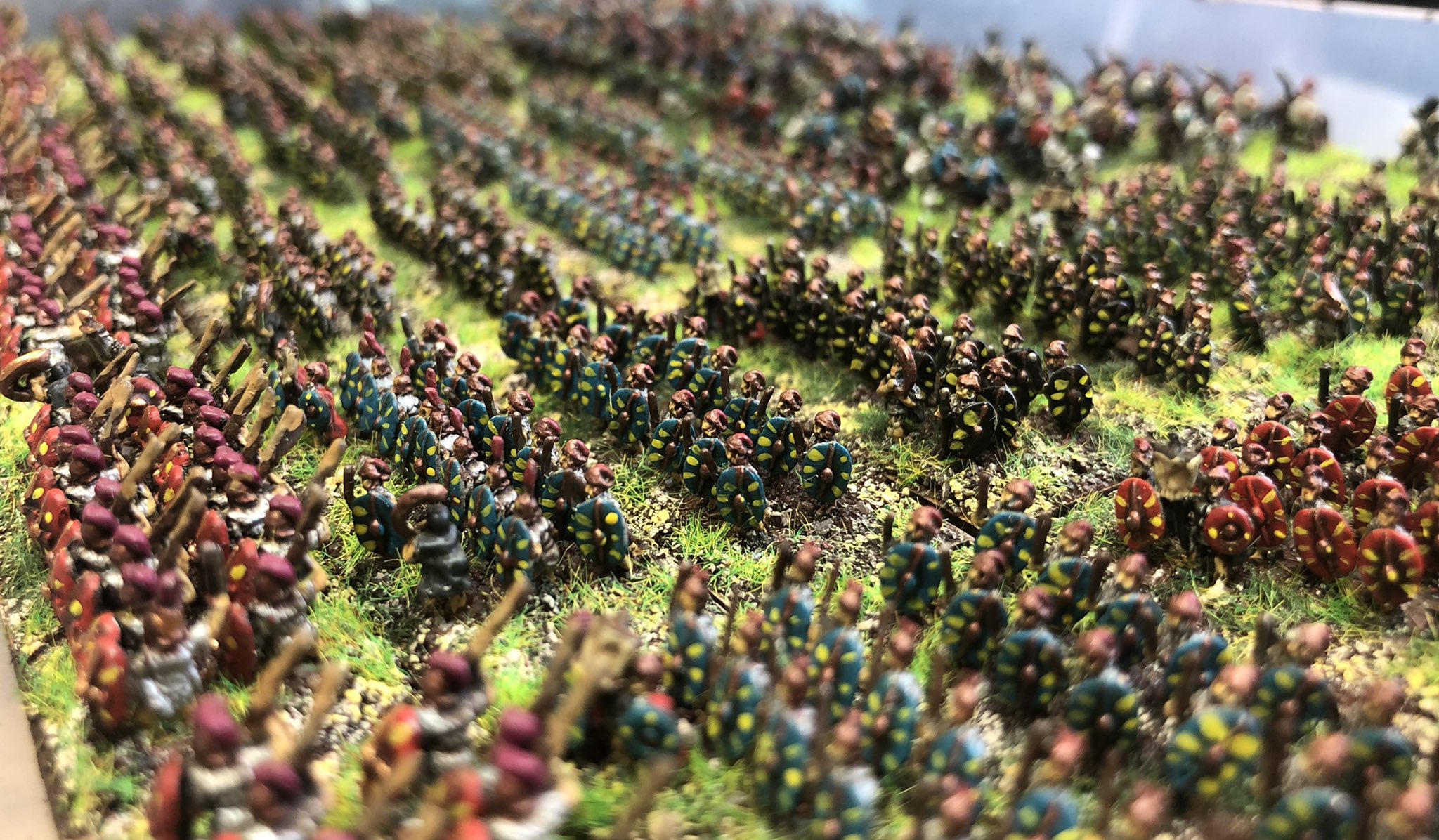
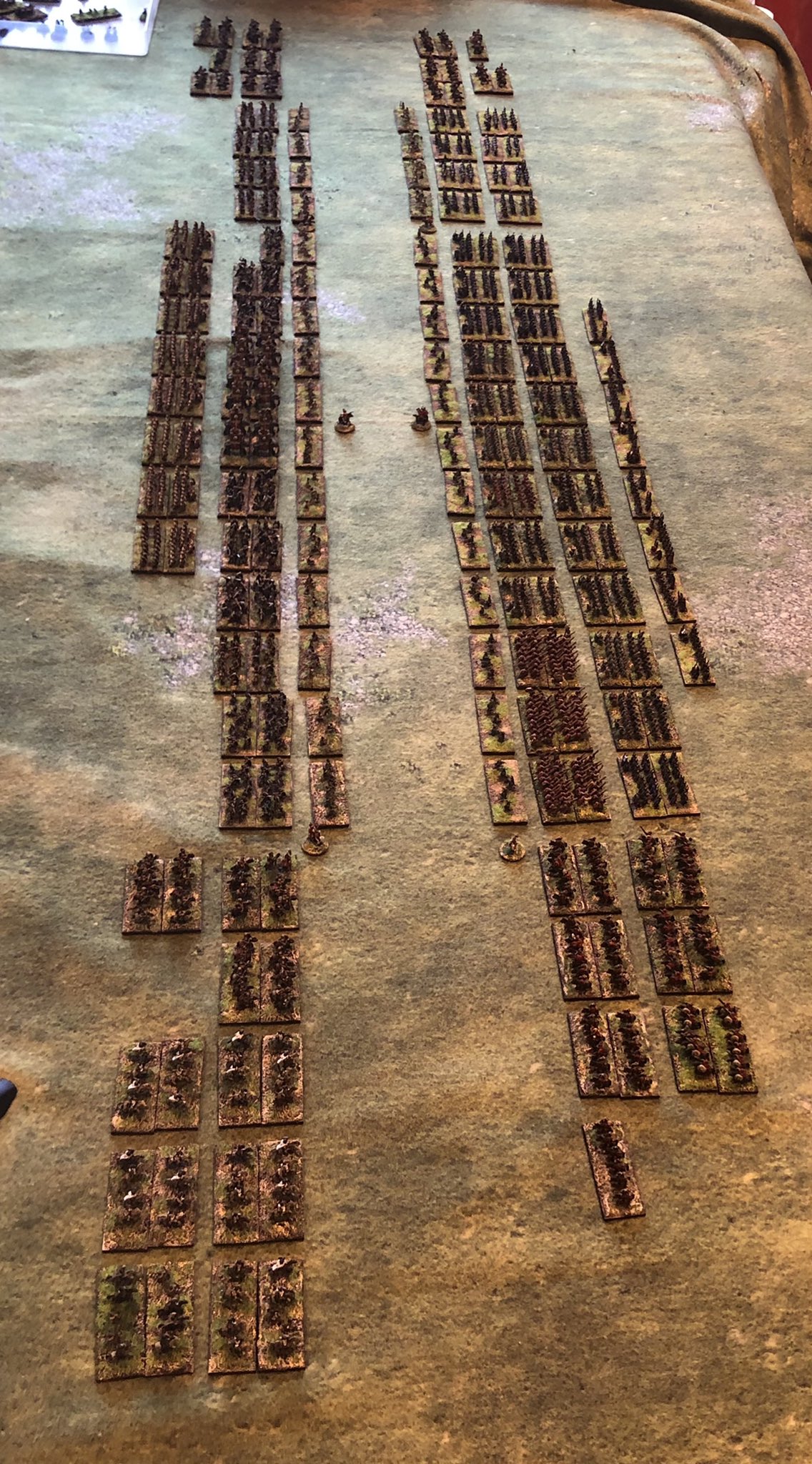
I was flashed a Republican Roman army by Ebay the other day, it looked well painted and there were a lot of miniatures for the £65 asked for including postage, with a mixture of Baccus and Rapier models. Doing a quick calculation I found the metal value was about £62 if the models would have been bought from Baccus and Rapier, the models were really well painted.
Well for the cost of bare metal and the models already base painted I thought it might be quicker to remove the figures from the bases, add some details and rebase them in my own style and base style – I have based all my ancients on 50 by 20mm bases (based on some Command and Colors stuff I have done). Before you do this it could be worth asking the seller how they based the figures – if they based the modes with sand and pva, it is relatively easy to do this (even if they superglued the models first), if a form of filler were used it is still ok but messier and finally if a superglue was used for both attaching the figures and to bind the sand – I would probably give it a pass. These were glued on then based with PVA and Sand – piece of cake.
The Army as delivered, nothing wrong with it!
Here is the steps I took.
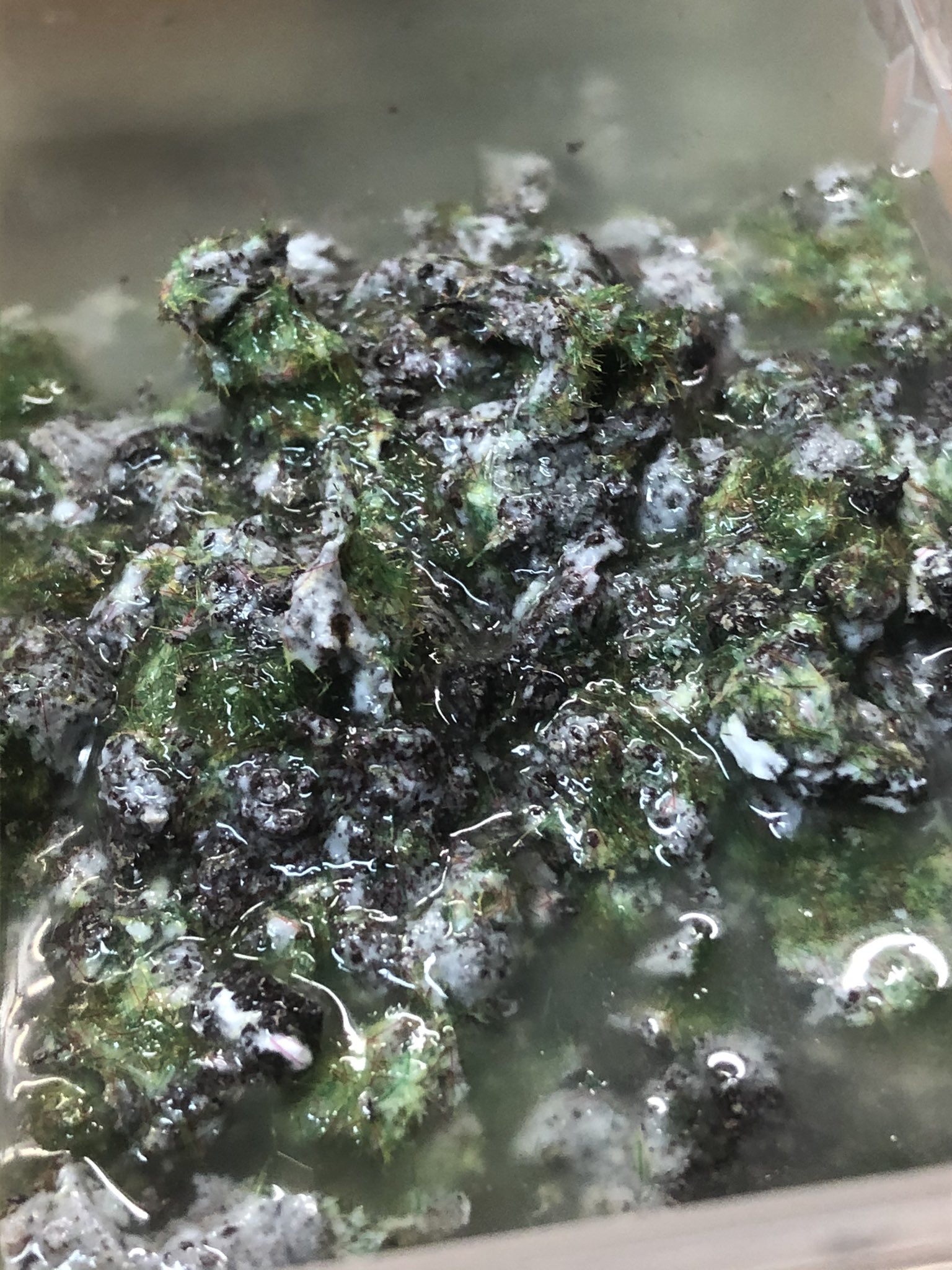
Let it all soak in some water
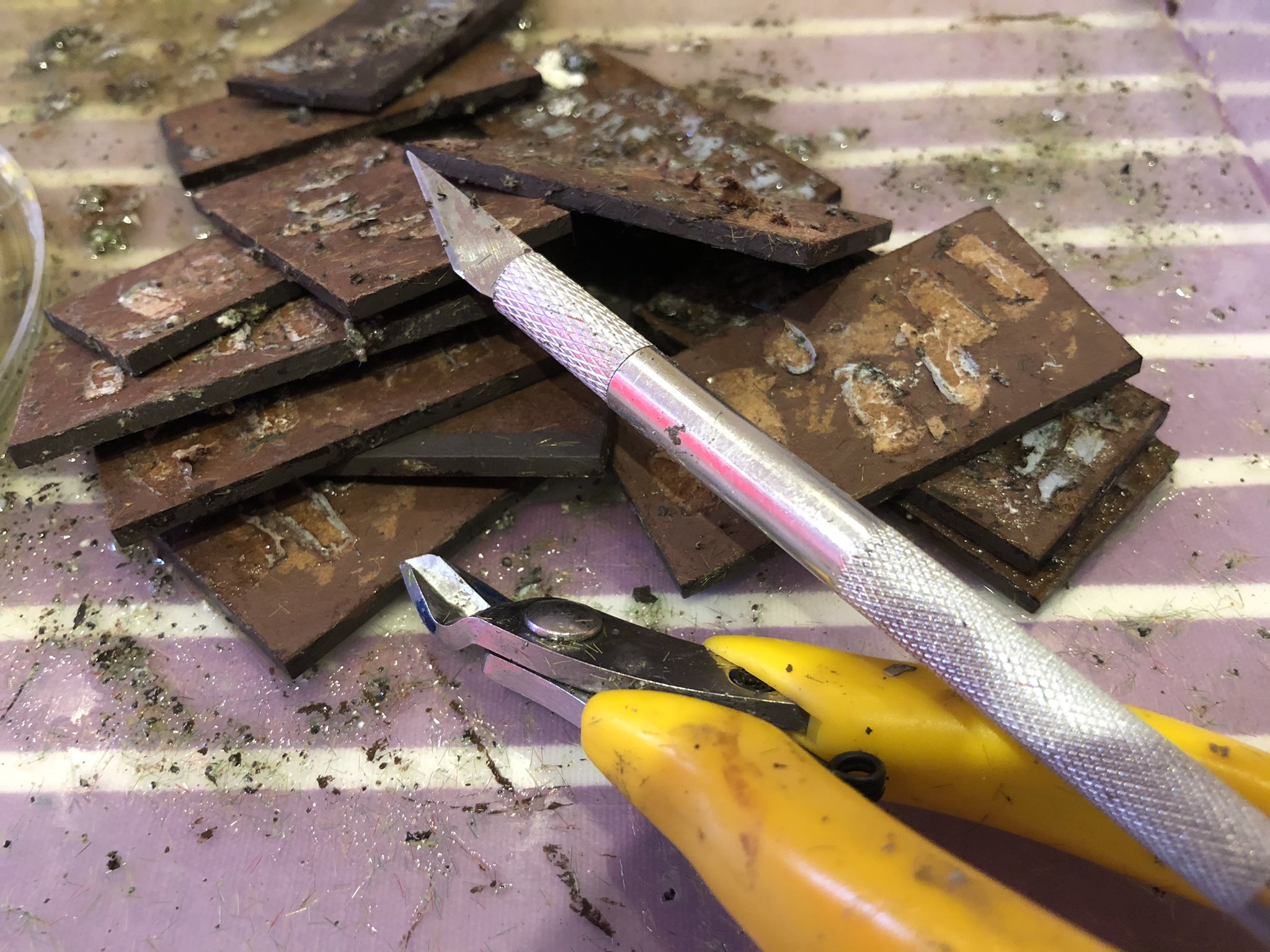
After this I scraped off all the grass, sand and pva (I used a hobby knife, see below).
It creates an interesting mess
Then I removed the miniatures with the following tools
All lining up nicely
Then I added details to the shields, you will spot a few I forgot
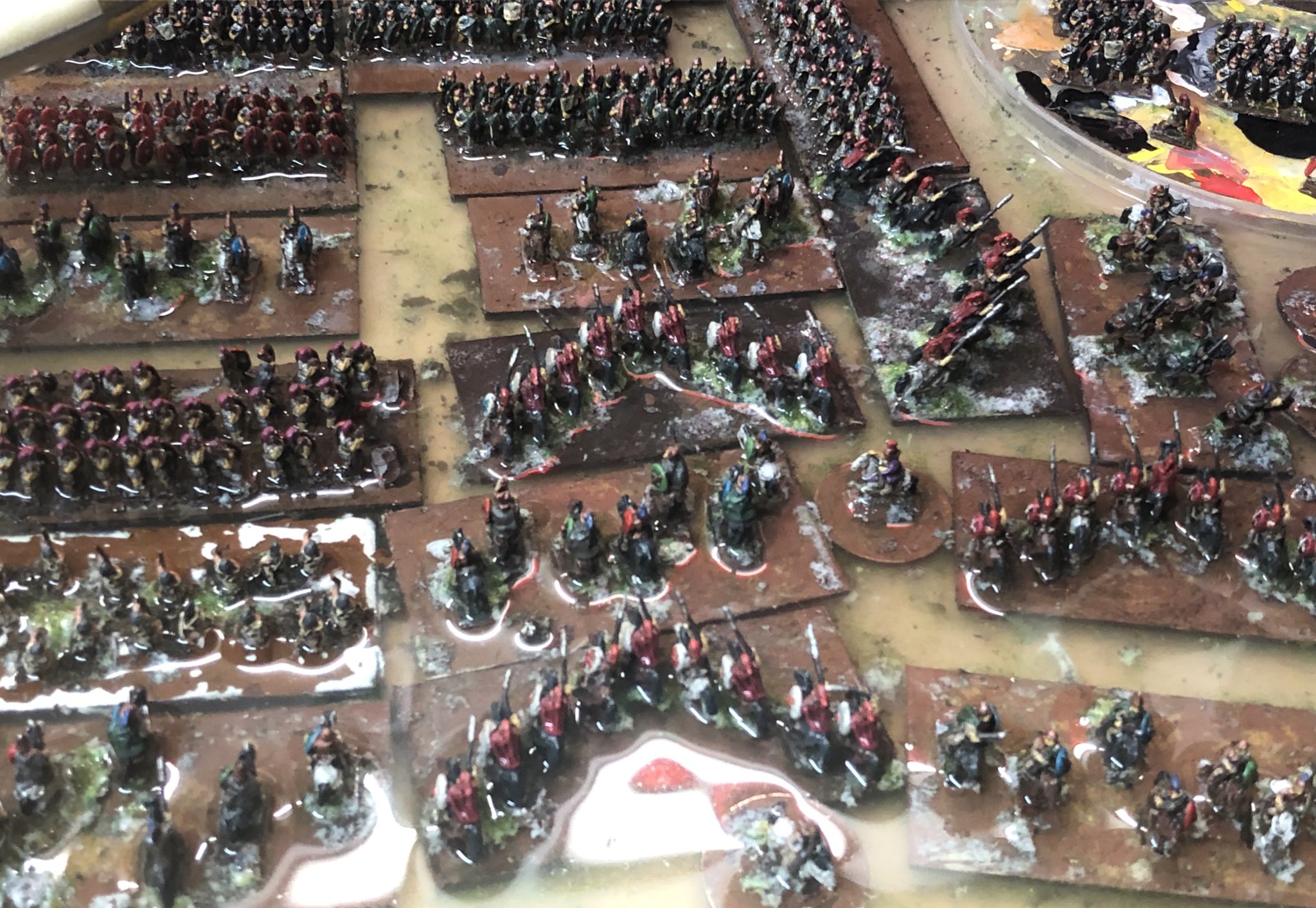
Then I rebased them in my own style.
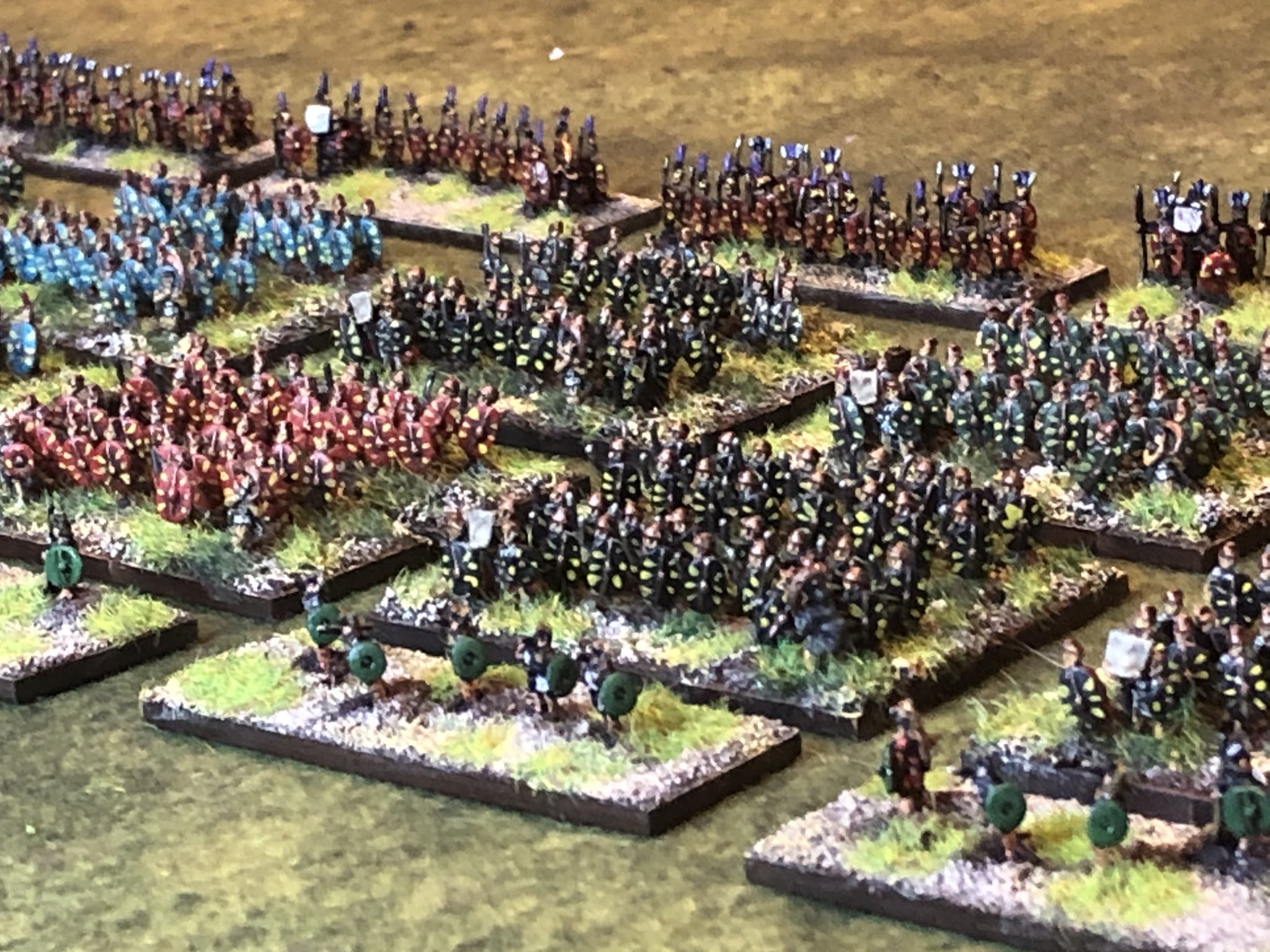
And here mixing them up with the other part of the collection
A mixture of the new and the old,
This is why I do 6mm!
These are old, but who does not like some Elephants?
In total it took me a few sessions, about 9 hours to rebase all the miniatures (including doing the shields and a few more highlights) – I would not have been able to paint the bare lead and base up nowhere near this amount, so it was well worth it and fun. With addition of detail and uniform details it is difficult to see any difference between the models I have painted from scratch and the ones I have rebased.
It is messy and I suppose if the basing has been done with superglue and sand it may be tricky to deal with, but otherwise perfectly ok. I managed to increased the size of my Romans significantly to match my Carthagians very quickly.
In other news…
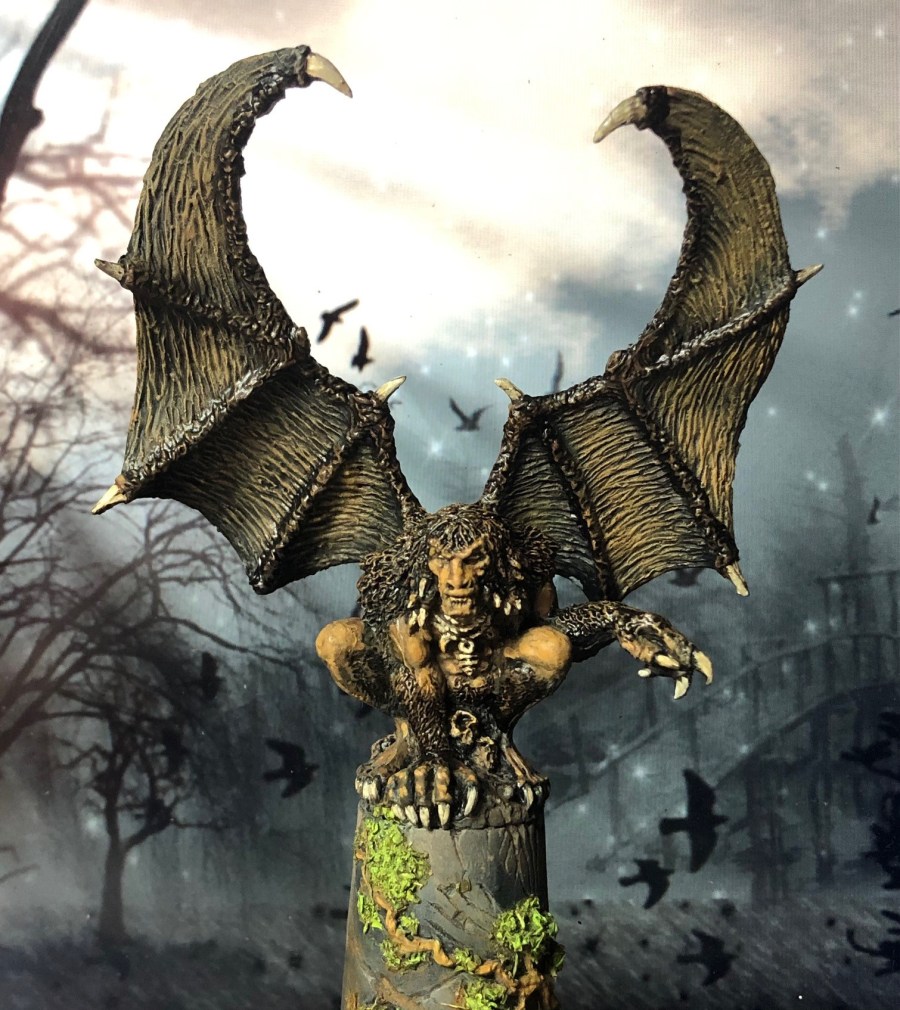
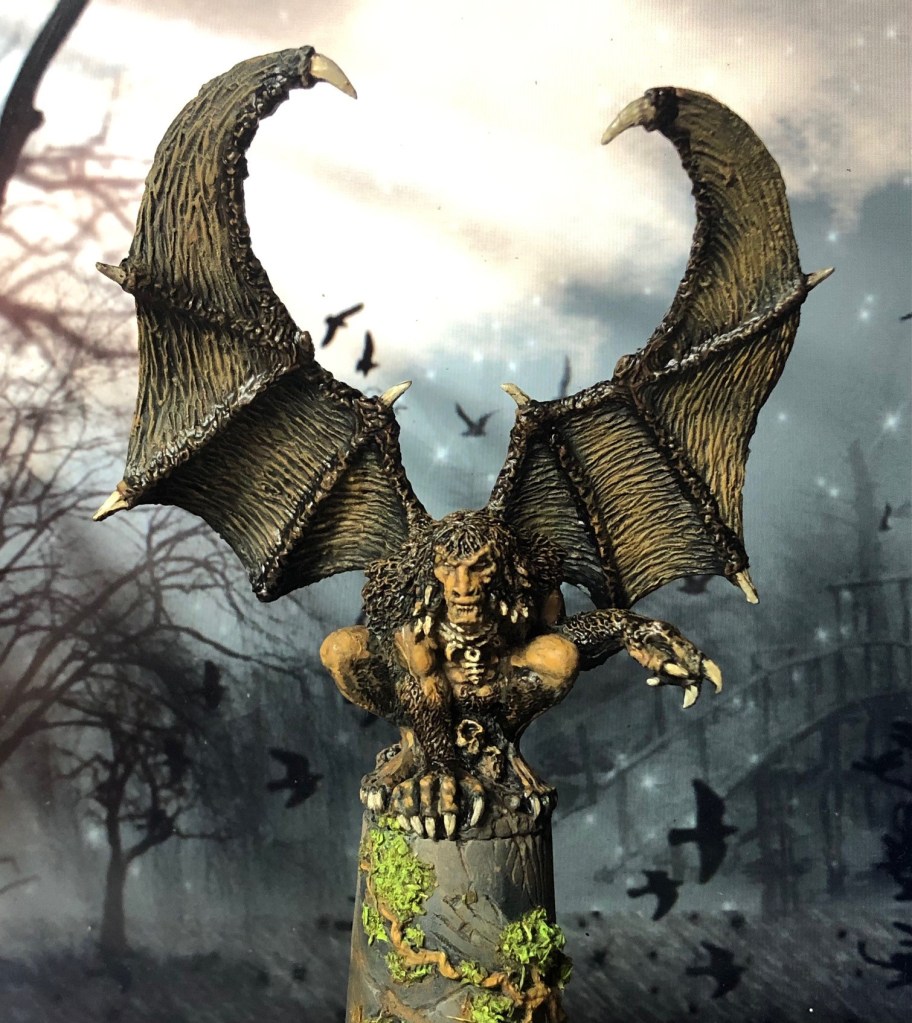
In other news I have enjoyed painting another excellent model I got from Fenris Games – it is called the Dweller in the Ruins and can be bought here in the UK and from Barbaric Splendor, here, in the US. It did not take long and it is an absolute master sculpt – I think a more skilled painter than I could do something really remarkable with the model, but I am more than happy with this result.
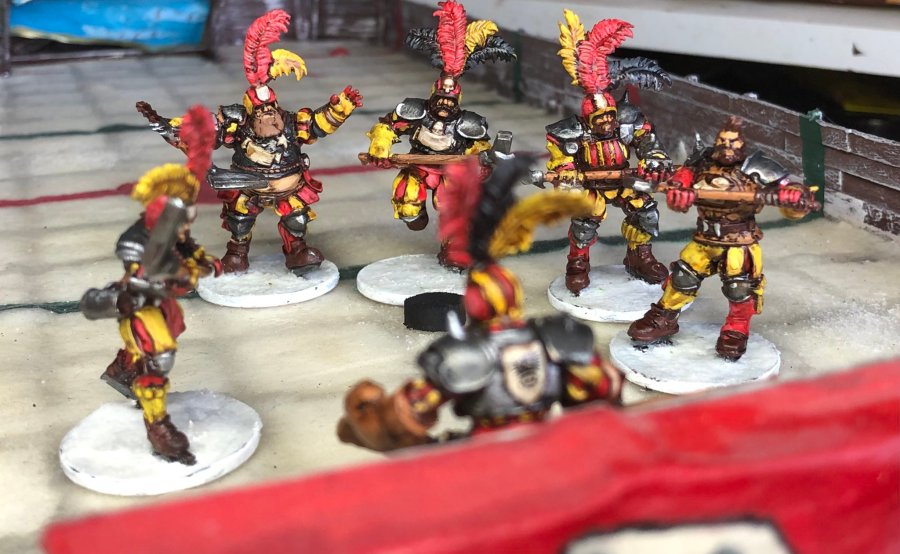
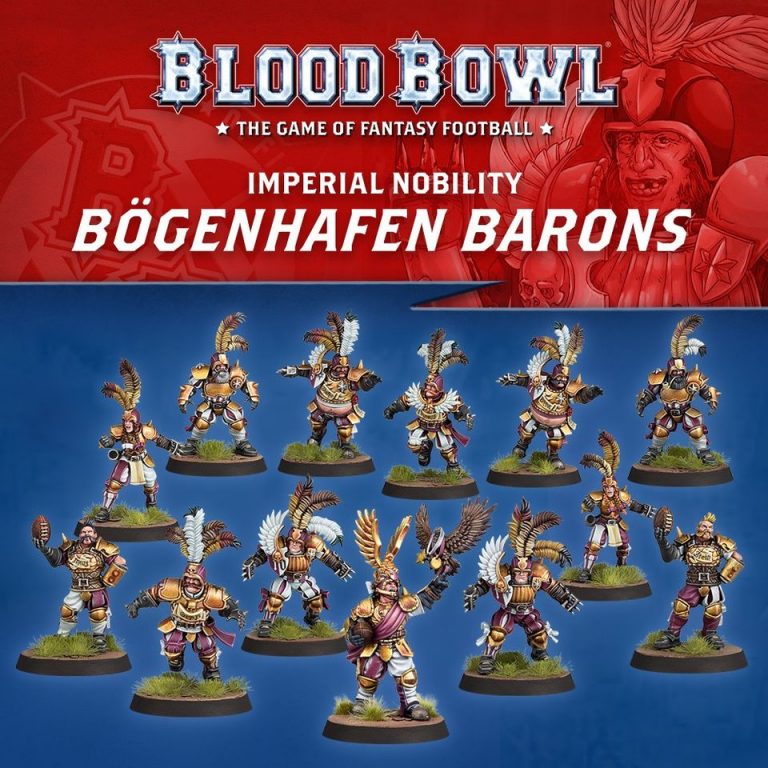
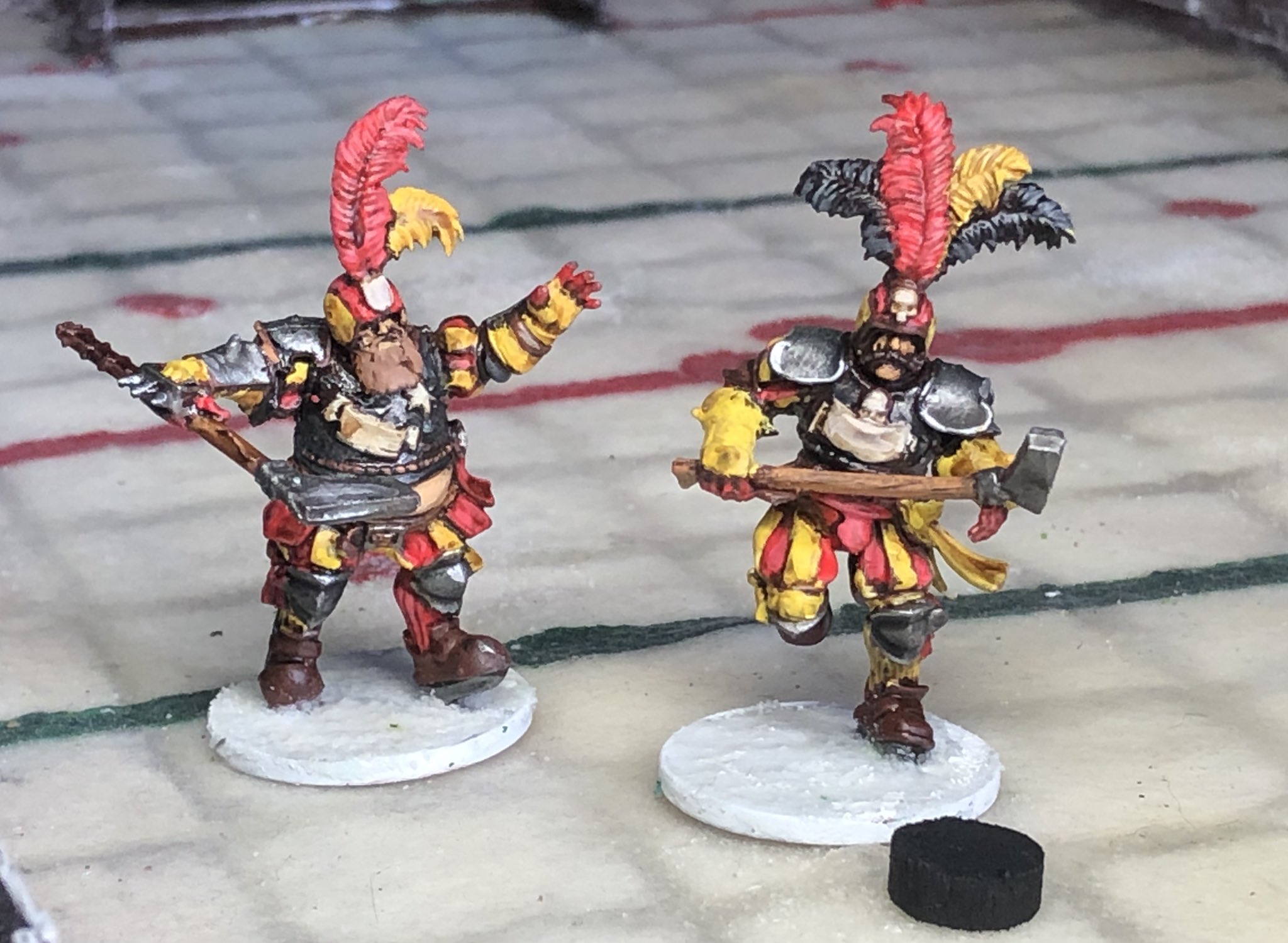
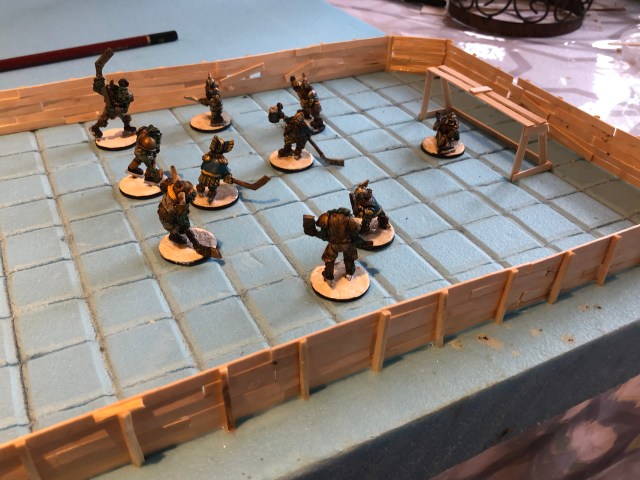
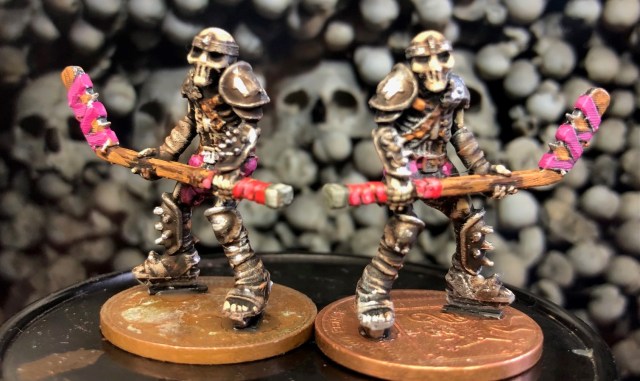
I wanted to add some flavour to my collection of Fantasy Ice Hockey teams, having recently got a Skeleton team I noticed the new Bloodbowl teams and the human team shown below – I thought would be possible to transform them into an ice hockey squad and a goalie.
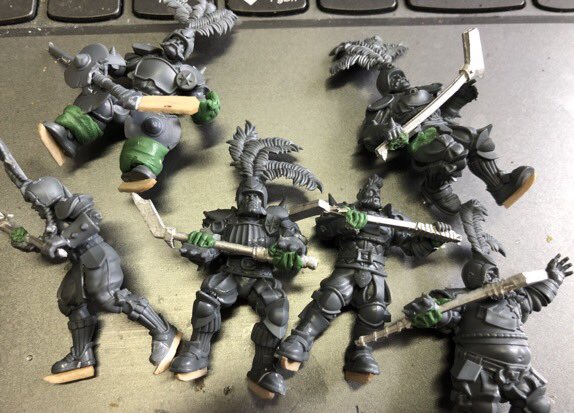
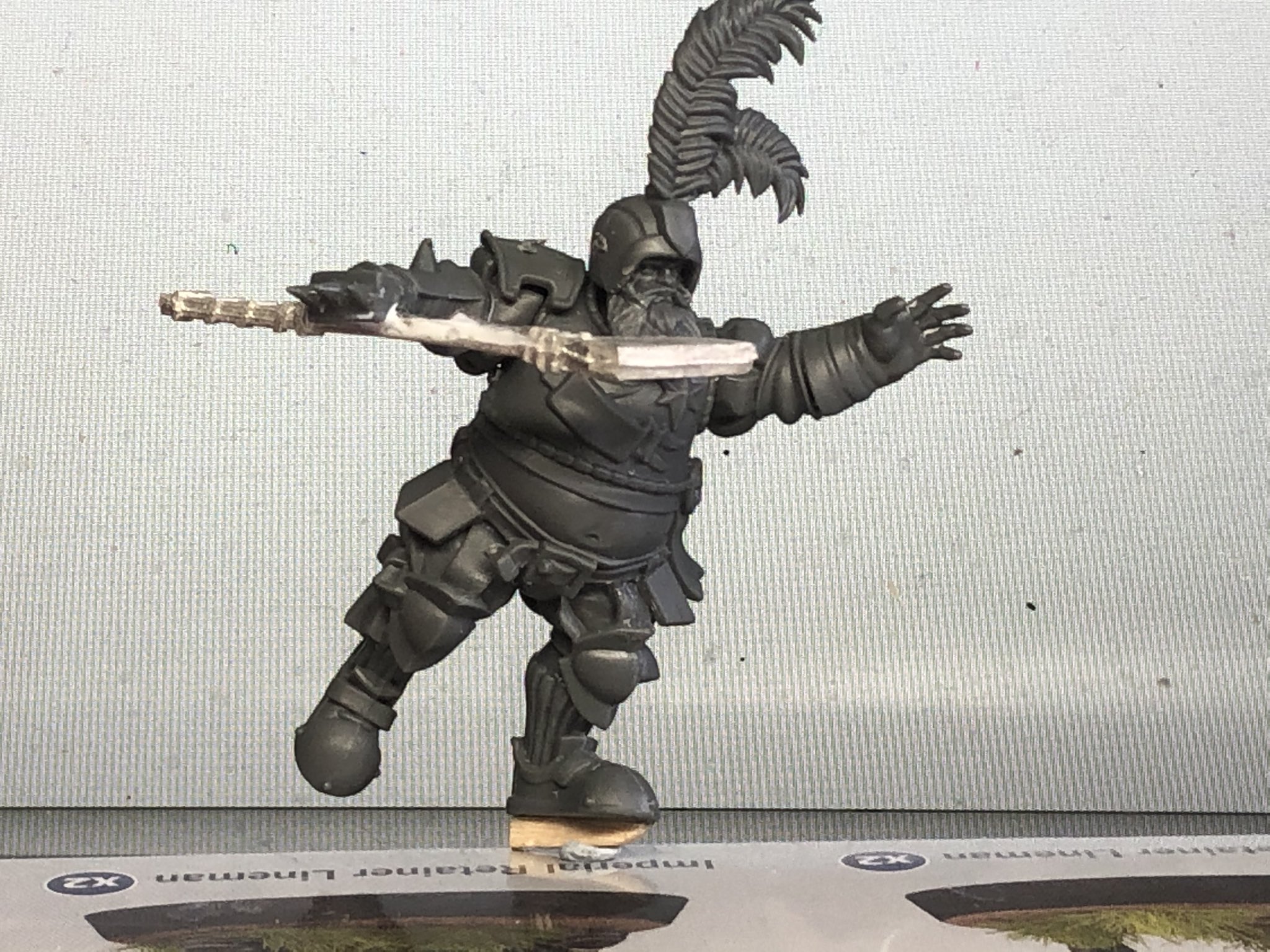
After some adjustments of arms and adding some green stuff and some ice hockey sticks I bought from Impact Miniatures last year, they came out like this.
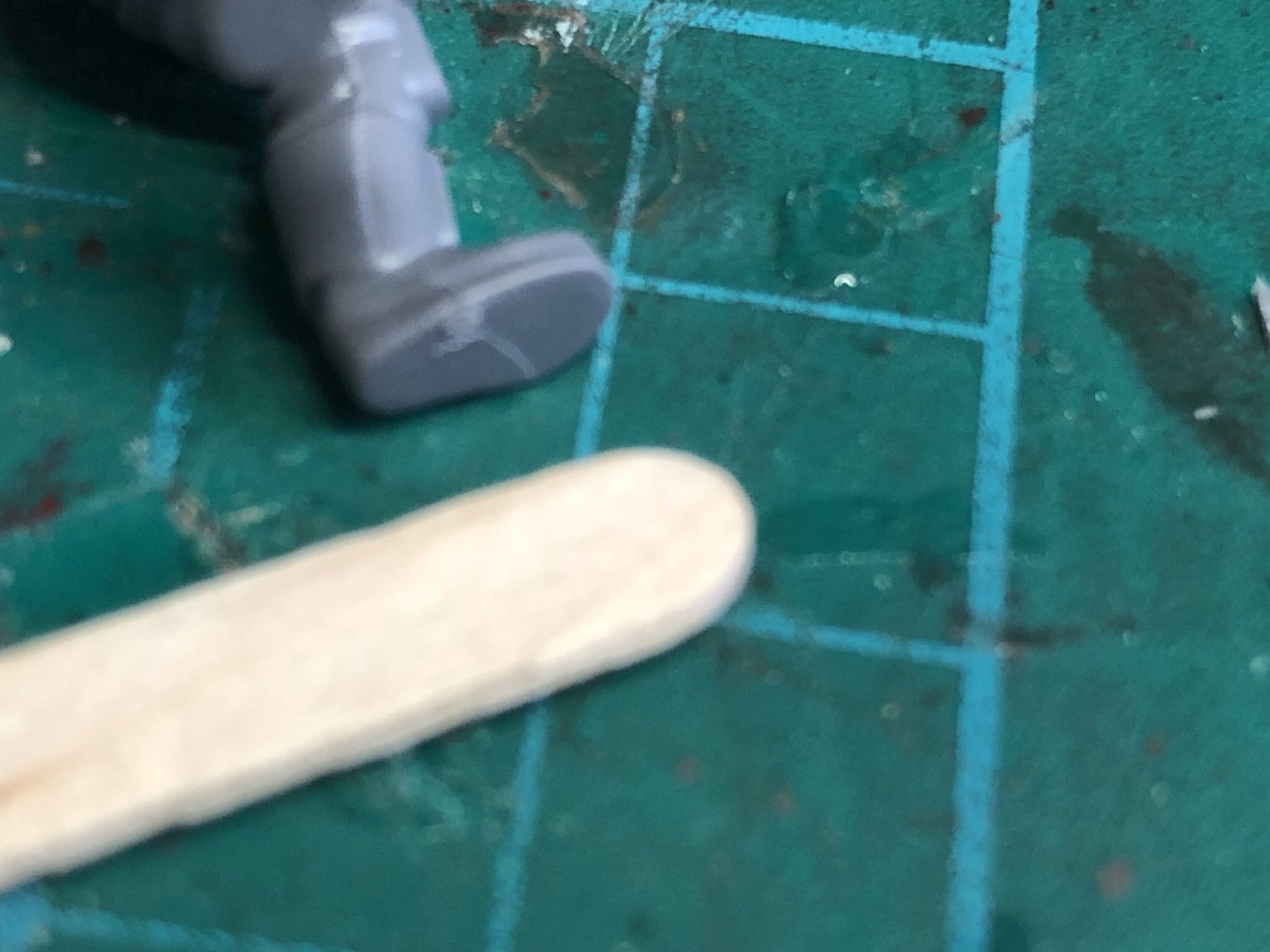
As for the skates I used coffee stirers and some skillful cuts.
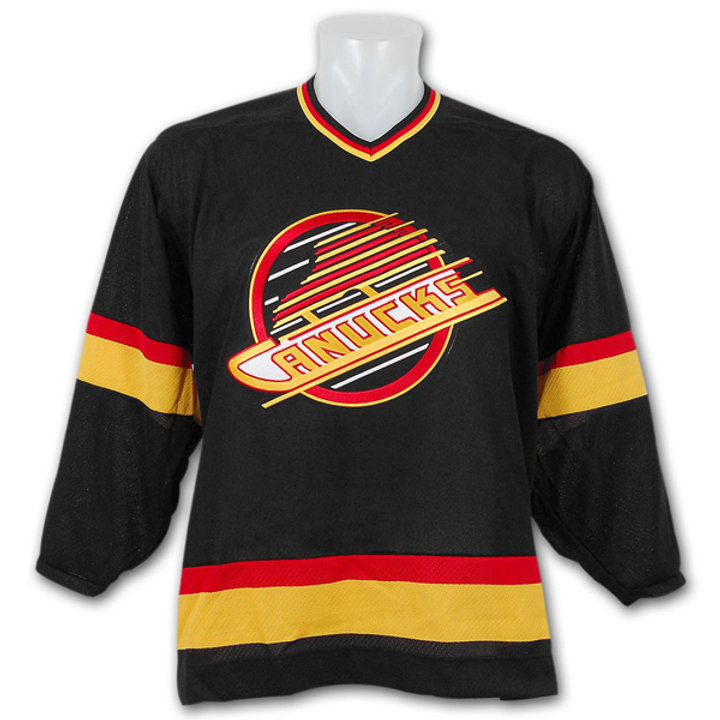
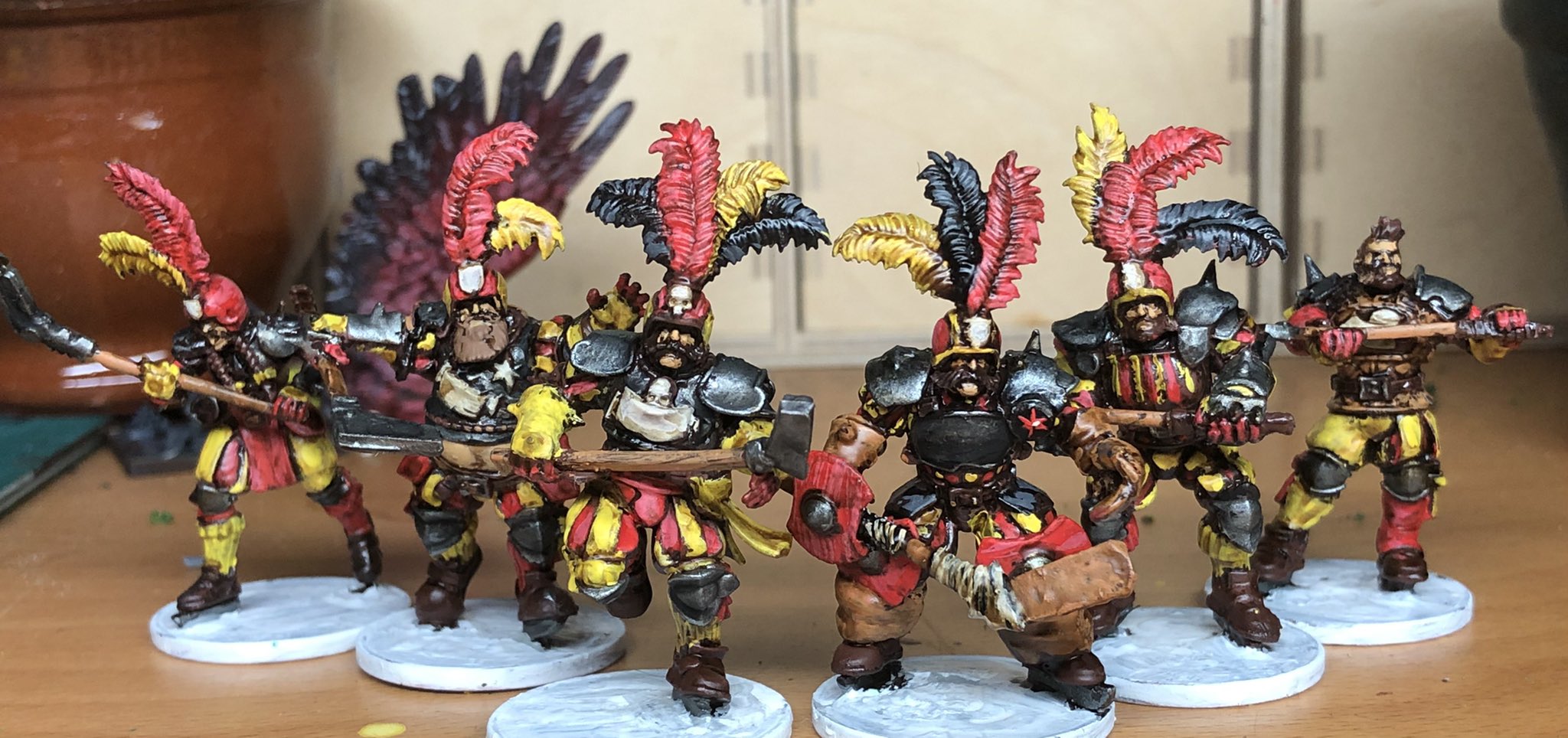
Painting them was based on the old Canucks (Vancouver) Ice Hockey Jerseys.
I am really happy how they came out, hope you like them too.
And of course we had to see if they could skate too.
As I have said before I started Rollaone.com as a thank you for all the contents that is being provided by so many people out there that has helped me over the years in getting inspired, learning techniques, finding out more about various periods and frankly getting a little bit of an escape from it all. I also did it to record the works I was doing for my 6mm in Saga project five years ago.
The first picture appearing on the blog from this blogpost Saga in 6mm – Part 1
I mentioned in a previous blog that the good people at Little Wars TV had nominated this blog for their Caesar Awards 2021 as Wargame Blog of the year (see more details here).
Having spent a long Friday evening (and early Saturday morning) with mates online drinking and remembering the brilliant Mike Hobbs (more here), I was not sure whether I should watch the ceremony or not. However I did fall asleep during the evening and woke up an hour before the start of the award show, being broadcast on Sunday morning at 01.00 due to the time difference between the UK and the States. You can watch the show by using the link below. I really enjoyed the intro and the special song (a proper Broadway number) and of course the show itself. Then the first award given was the blog award and he did say Roll a One, didn’t he?.
Friends of the blog Too Fat Lardies got the award for best Podcast (in hard competition with other friends of the blog Gods own Scale and Battlegames) with their Oddcast, Alex at Storm of Steel Wargaming won the painting video awards and Sonic Sledgehammer Studios for his fantastic how I paint Republican Romans. Well done tot the Lardies, Alex, Sonic and all the other winners.
There was a lots of entries and I was chuffed not pull the shortest straw, or if you wish roll a one, this time.
Thanks to the Judges and the Little Wars TV Patreons!, and to Little Wars for all the good stuff they do for the hobby.
There is a lot of stuff produced for the historical wargaming hobbyist and this kind of acknowledgement is really important and encouraging, I hope not just for myself, but for others to perhaps consider starting a blog, recording a video and sharing it with others, or otherwise getting engaged in creating some content be it serious analytical stuff or light entertainment.
In addition, and whilst I have your attention there is an important thing you can do even if you do not want to produce content yourself, that actually plays in your favour, and that is to let the people who are behind wargaming video channels, blogs, Facebook accounts, etc know that you appreciate what they do – perhaps leave a comment, send them a like, or share the link to others, or follow the blog/channel or whatever it is called.
I have to admit that the small occasional comment from one of the Roll a One regulars or someone just passing by really cheers me up and keeps me and the blog going.
If you do not like what they do and you honestly think that you ought to tell them perhaps you could do it in a nice and constructive way or perhaps move on to something else. I very rarely feel upset having to read a short text or watched a video even if I did not like it, especially if it was free.
The passing of Mike Hobbs last week have really made me appreciate the positivism that someone like Mike spread and how he built bridges between different hobby islands and made it a better place. So whilst we can never be Mike, we can try to be like him – making it more inclusive and fun!
Anyway really humbled by this award, and I am more than sure Mike would have been proud of us too,
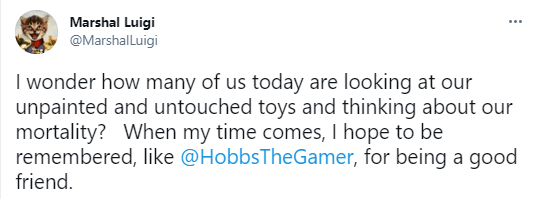
It was with great sadness I received news from Neil Shuck late on the 20th April 2021 that Mike Hobbs, the Welsh Wizard or the Gamer, had suddenly passed. The many beautiful messages on Twitter about Mike and what impact he had on so many aspects of our hobby of gaming, from writing rules, presenting games, talking about games, reviewing games, playing games, painting, etc. Not just wargames but all kind of games – a true table top wizard, be it wargames, board games or roleplaying games. But the best things with Mike was that he was a good mate to me and many others – to me the tweet by Marshal Luigi, kind of summed it up!
Here are just a selection of some of the many impressions Mike made on me and for which I will remember him.
Mike instigated a virtual painting club during lockdown where a bunch of us have been meeting up on a regular basis getting that needed social interaction and escape from it all. It has really been a morale boost during the hard times we all have had during this period. Mike always would lend you an ear not just for the banter but for some harder more serious issues too.
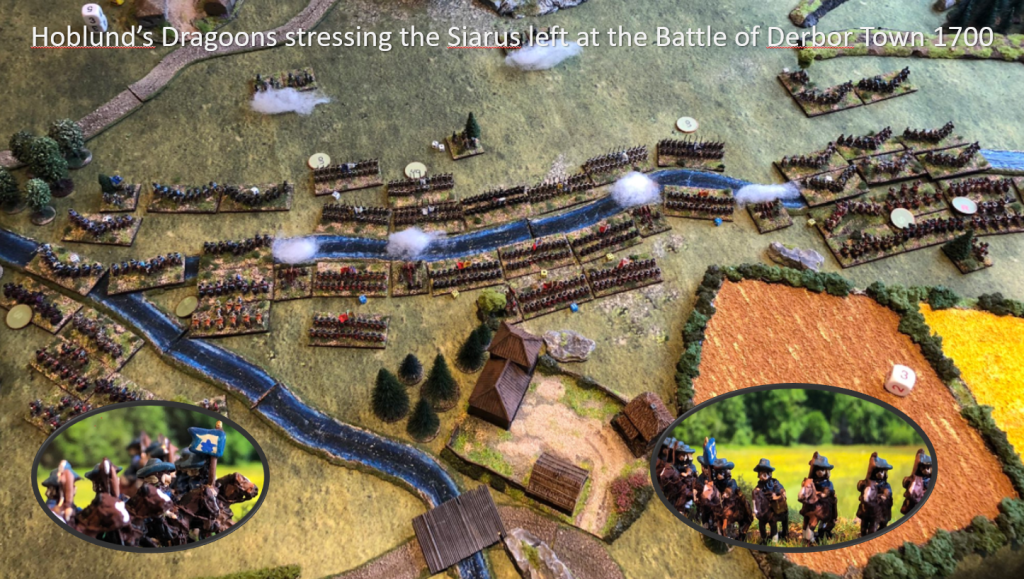
He also did the Hoblund’s Dragoons as part of the 6mm charity project we did last year, that I hope to be able to take somewhere soon. In our first battle his Dragoons played an important role in stressing the Siarus left that eventually led to the overall victory.
When I was planning on doing the Saga in 6mm project a few years ago I had extensive discussions with Mike on how to base the figures and deal with what in essence became a totally different looking and feeling game. He really gave me a lot of time explaining not just the basic rules but how the various battle boards worked, etc.
I also remember that big order we did from Eureka when they came over to Salute to get the full discount – well believe it or not but there was no need to go together to achieve the required amount for the discount when we had finished our shopping carts. Mike ordered Hawkmoon miniatures from their 28mm range – and we recently discussed them and that perhaps he would put some paint on them – I wish I could have seen those.
Hawkmoon from the Eureka Range, not Count “Smartbrass!”
And all those episodes of the Meeples and Miniatures podcast – what a backlog of great listening Mike, Neil and the other hosts built up over the years. It still my favourite podcast – you should check it out.
But finally my favourite memory was when he, Neil and a few others came up to see me at Joy of Six in 2019. Mike gave me the nickname “the Godfather of Six” and he told me I more than deserved it for the Poltava battle – I am really happy you liked it mate and would have liked to share more stuff with you.
When I asked Mike, at Joy of Six, what I else he had been checking out, he said “I just came to support you Per”. That was Mike in a nutshell! He made you feel special and always included.
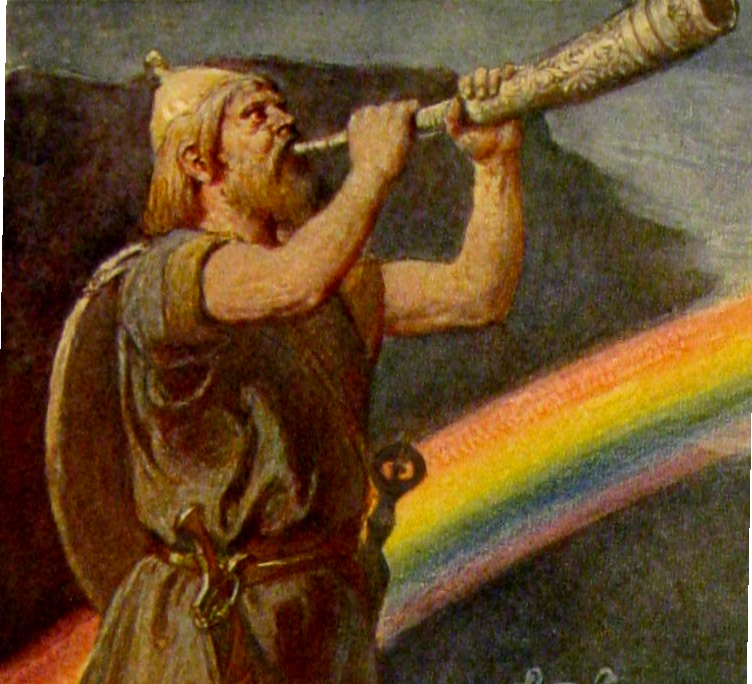
Mike, as you pass over the rainbow bridge to Valhalla (your Glorantha may vary!), I hope you get to see at least a glimpse of all the love that has been pouring out for you over the last 24 hours and I am sure will continue. You did not deserve to go now, but wherever you go you deserve the best.
Hope to see you again one day, I will raise my horn for you! Thanks for all your support to me and the blog over the years! You were brilliant!
Your mate, Per
I extend my most sincere condolences to Mandy, Mike’s family and all his friends, especially to his best mate Neil Shuck (who wrote a really nice blog post about Mike here.).
As you may be aware the Swedish 1984 version of Mutant was my first Roleplaying (Rpg) experience and it was love at first play. I was cajoled into buying it by my cousin who was visiting us when I was 12. We spent about a year with Mutant being the main game we played in our little group, but then moved on and played a wide range of games throughout the teenage years – it was a bloody good time and apart from grinding a bass guitar in a death metal band formed the most important part of my teenage years. I was invited to the Grognard files to give my First, Last and Everything last year where I go into more depth about this, should you be interested (link here). It is with fondness I think back to those times and the adventures our group of friends shared. This post is really about a few reflections and thoughts on me running my first convention scenario for some 28 years.
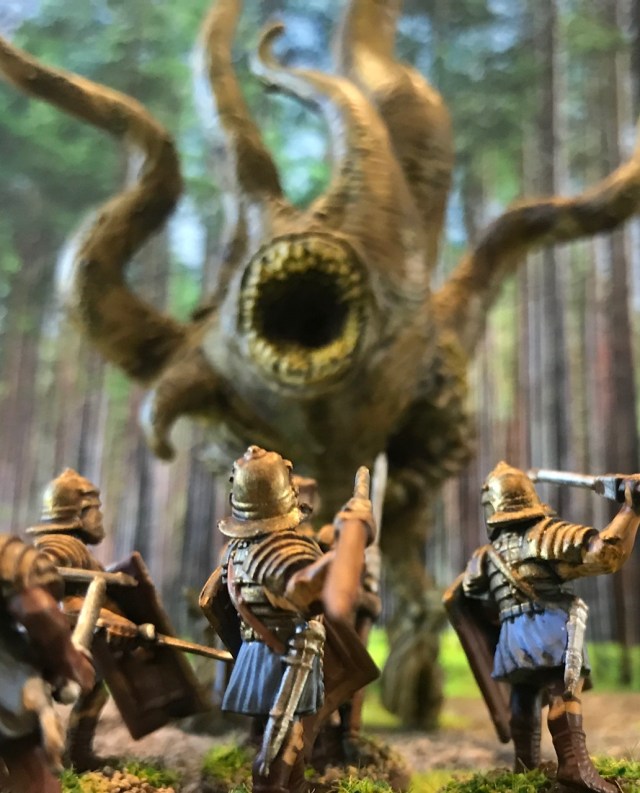
The Blood Eagle – one of the “monsters” in the original Mutant rulebook. This of from the adventures of the nobleman Guss af Edelhus in the forbidden zone in Muskö year 105. Photos of Miniatures from the collection.
Rpgs became something I used to do for a long time and when I started to get back into the wider tabletop gaming hobby I felt more drawn to wargaming – perhaps because it is a more solitary activity in that a lot of progress can be made without having to align your life to someone else’s diary. It is also about the stigma of asking your neighbour at the annual barbeque session whether she or he fancies rolling some dice and fight a bunch of mutated land sharks in Post-apocalyptic Scandinavia.
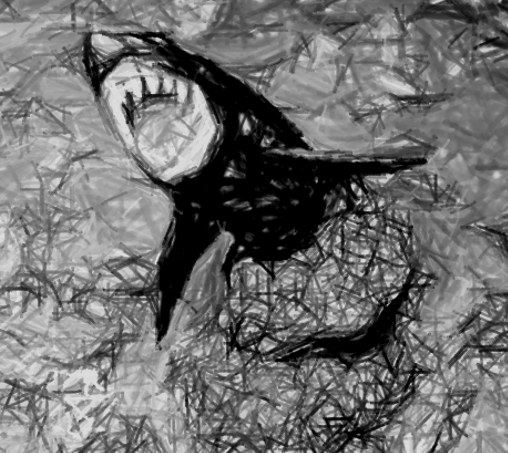
And who will ever forget the Land Shark that almost killed Guss on that foggy day!?
Grognard Files?
I wrote a summary in an earlier blog about the Grognard Files – it is a podcast, that does conventions and other stuff -actually what is really is, is a great community.
“I really enjoy the Grognard files podcast and the throwback to the good old days of 1980s roleplaying. If you have any interest in roleplaying games (rpgs), whether you were around then or not, this is a fantastic show and you should try it out (here is a link to get you started). Being of the somewhat mature nature (not old! – I still bloody play with toy soldiers, so I go for mature or perhaps in need of some maintenance, but never old!) for me this is a proper non-imaginary deja vu experience – I do not just feel like I did it, but I really did this before. I have played many of the games, back in the day, covered so far (often in multiple podcasts, and in addition podcasts have covered rpg magazines and fanzines):
Runequest, Call of Cthulhu, Traveller, Stormbringer, AD&D, Tunnels and Trolls, Top Secret, Mercenaries, Spies and Private Eyes, James Bond Rpg and Judge Dredd
Each game is thoroughly discussed, analyzed and reflected upon. Being a guest on the British Isles since the mid 90ies it is at a level of eccentricity that I recognise well and that is hard to find anywhere else. It is similar to the exploits of those Victorian chaps who invented industrial breakthroughs in their back garden sheds. I absolutely love the concept. Bravo to Dirk, Blythy, Ed and the rest of the crew (not forgetting the eminent Daily Dwarf, link here). I suggest you brew yourself a cup of tea and get a pack of hobnobs and sit down in your favourite chair and listen to the first episode on Runequest. The only thing that may prevent you from having a fantastic time is your ability in making a decent cup of tea!“
The Grognard files have been a nice gateway drug back into the hobby, initially focusing mainly on nostalgic cheap tricks, luring you in with old solid showstoppers like Runequest and Call of Cthulhu, but then expanding to more modern games and concepts, provoking not just the re-purchasing of all the old stuff our parents had slowly binned whilst we were chasing the dream but also buying new and very often shinier things. Almost like a conversion kit really, like my friend’s old Ford Escort from the 80ies that he proudly keeps in pristine condition, not like a museum curator, because there is constantly new gadgets and gizmos being added. “It is still a Ford Escort mate!”, but as he perhaps correctly says, “you do not get it!”. Anyway, enough cars, if I was making a living selling games I would try to find a way to follow in the wake of the Grognard files, like a seagull and take advantage of what it throws up! Well maybe not just games, what about Runequest socks with the Death and Air rune on?.
A Ford Escort, Mark III, but popularly referred to as the 4th Generation, produced between 1986 and 1992. Developed under the codename Erika-86. Well if you get it, you know!.
Sorry think I drifted away again, stay focused …
So in this newfound nostalgia of the old days I got out my old Mutant rulebooks from 1984 (with the Purple Covers) a few years ago and so my wargame/miniatures project #Mutant1984 was born. I have had some great fun with this pressing the world and the miniatures into service to enjoy a wide variety of miniature wargaming rule sets, including Sharp Practice, Infamy, Infamy!, The Men who would be Kings, Mutants and Death Ray Guns, to name a few. Most of the miniatures are conversions from other ranges with headswaps, etc, but there are a fair few things out there that fits in really well with minor modification – well perhaps not anything, but most things, goes in #Mutant1984.
It is a clear contrast to my more “serious” wargaming, where I anal-retentively worry what uniform colour the Queens Life Regiment had in the Summer 1702 following some notes on a large purchase, in the regimental records, of cloth in a different colour than previous uniforms, in early May the same year – did they have time to make new uniforms or not for this particular battle? Joke aside, I am as serious about all my pursuits just in a different way.
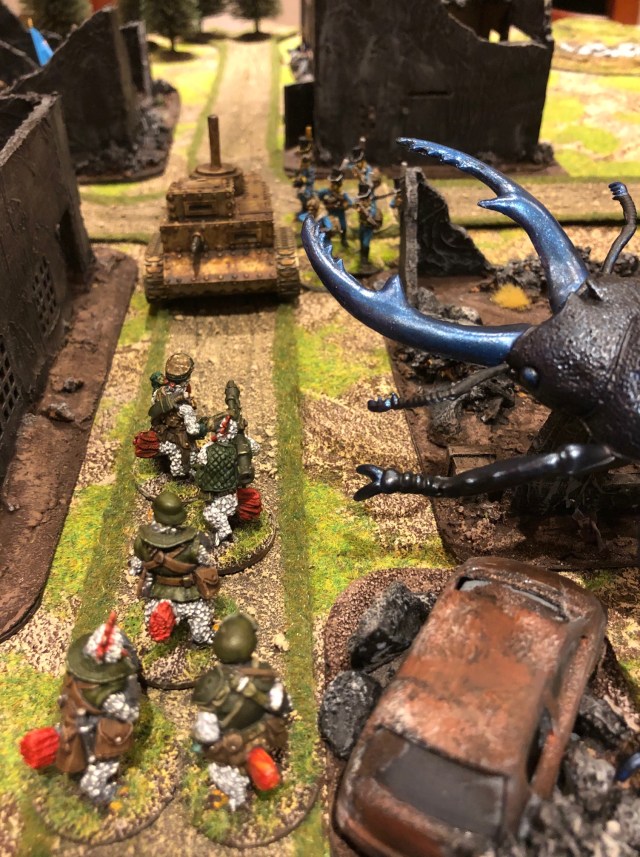
One of the many fun games we had, this time using the Men Who Would be King rules. We had Tanks, Giant Beetles, Some really tough Cocks and a unit of the Pyri-Commonwealths finest marksmen. Some other games below. Check out the Shub-Niggurath from Fenris Games in the last picture or the rare walking Murder Tree in the Mutant World.
As part of Lockdown I have, when possible, attended a Virtual Painting session on Saturdays and as part of that I ended up playing in a Runequest group every 2 weeks herded by Jeremy Short. It has been an absolute blast and we have had some great fun exploring Sartar and getting involved in some excellent adventures. I ran a Call of Cthulhu for this group over Christmas based on a convention Scenario I wrote 30 years ago and really enjoyed GM:ing again.
I attended the 2020 Grogmeet as a player (being virtual due to the pandemic), and had planned to attend in 2019 but some work issues got in the way. Grogmeet is the annual event organised by Dirk and his merry people where people gather to play old and new games. I had an excellent time and played in some amazing games.
I decided to do something for Virtual Grogmeet 2021, that is also an annual event but intentionally virtual. I had to figure out what to run and sat down and reflected for a second on what the whole Grognard thing meant for me. I could have run one of the two Cthulhu scenario that still exist from way back, but thought that there would be a fair share of those offerings. I actually ended up playing James Holloway’s Call of Cthulhu Dark Ages scenario at Virtual Grogmeet this year, this was a fantastic immersion into the Crusader states era with a small scenario but well thought out and presented. This was a story about a delegation arriving from the archbishop looking to buy a relic and with the inhabitants (the players) of a small fief in Crusade-era Lebanon must try to protect the sacred remains without making a powerful enemy.
I was thinking about what I could offer that was a little bit unique and from back in the day, so I flipped through the introductory scenario for the 1984 Mutant book – Uppdrag i Mos Mosel (Mission in Mos Mosel) and realised that it is actually a workable scenario divided into two parts – an initial detective type of situation where the characters are trying to find out what is going on in the village and a second part where they find their way to the lair of the beast – so to speak (that contains it own little quirks with the possibility of forming an unexpected alliance and enough potential radiation damage to allow the characters to survive the scenario but still die after it – life is not fair, not even if you are a hero).
The scenario can perhaps be seen as the love child resulting from the union of Gamma world, D&D and Call of Cthulhu. It offers opportunities for both roleplaying and action (as if they were any different! but I hope you know what I mean). I do not want to go into the detail of the scenario itself as perhaps one day you may find yourself with Nicholas von Rijn in his Palace. The scenario is said to be heavily influenced by the AD&D Adventure Against the Cult of the Reptile God from 1982 (issued two years before Mos Mosel).
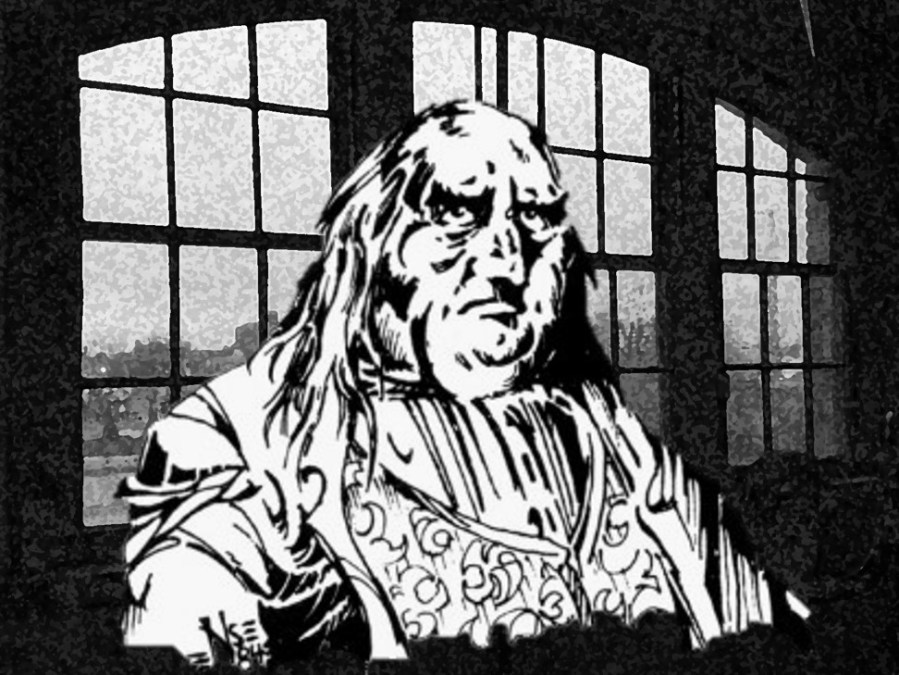
Nicholas fon Rijn puts away the pipe and looks intensively at you, “Well, do you accept the mission?” This was the only illustration in the scenario booklet (by Nils Gulliksson). Fon Rijn Later re-appeared in the epic Original Grey Death two parter and was further detailed in an article in the Gaming Magazine Sinkadus (with irritatingly high characteristics and skill value, but that is another story). The character name was borrowed from a character in Poul Anderson’s Technic History series.
The old Swedish 1984 version of Mutant was based on the Basic Roleplaying System, with the typical stats from 3 to 18 with some exceptions and skills being percentage based. I found our house rules from 1985 or 1986 and included these because it felt right and charming – this was mainly a revision of the set of skills rationalising some skills and including some communication skills (there is a summary of this later on in the handouts presented). The rules are simple and will not get in the way to get started immediately with a group of new players. I feel that too clever rules sometimes fails to shine in one offs, the key is not in how ingenious they are but how easy they are to quickly pick up and use efficiently in a short amount of time.
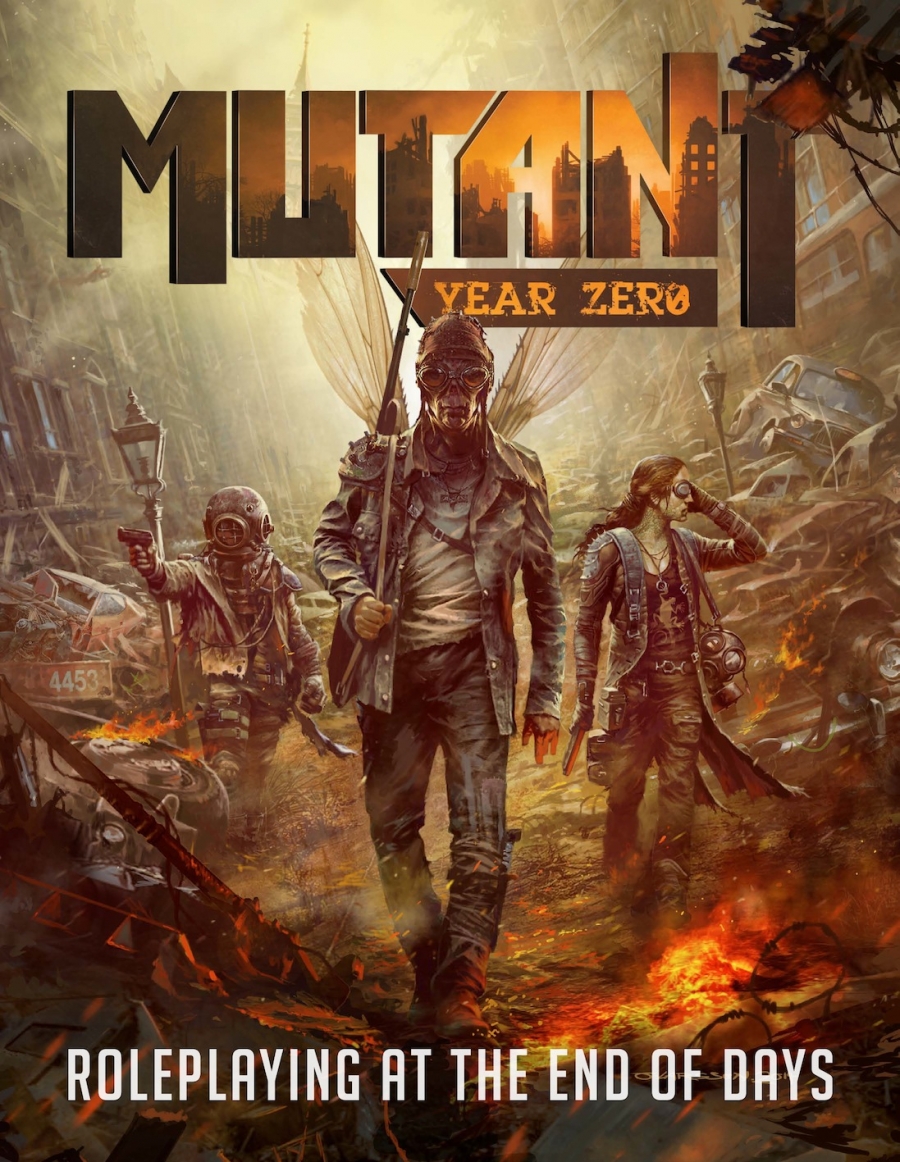
Mutant 1984 is of course the game that started the whole Swedish Post-Apocalyptic RPG era that is still going strong in the excellent Mutant Year 0 game by Free League (more here).
The Free League version is set at an earlier era than the original Mutant and they have recently released Mutant – Hindenburg that is set later than the original Mutant, but so far only in Swedish.
The first thing to decided was how to run it and luckily the group I have been playing in has successfully used Roll20 for the visuals and rolling dice and Google Meet for video and audio. Google Meet is basically a virtual meeting platform that allows you to do an online meeting with multiple individuals and allows sharing voice and video. Roll20 also allows video and audio sharing but is on occasion a little bit wanting (well at least from my experience), but what it does allow though is the ability to manage visuals, as well as combat using maps and tokens for where characters are, and rolling for skills etc in an open way. There is a little bit of a learning curve and I tried but failed to align the character sheet with the ability to press on a skill and roll for it automatically. I run the session rolling in the app and then “manually” checking the character sheet – this works fine.
In addition I fleshed out the scenario a bit by adding some play aids that I have included here (in addition to the few presented in the actual scenario, I have just shown a fragment of one of them here, if you are interested in getting these to run this scenario, let me know).
Part of one the play aids/handouts, the contents of a safe
I also realized that all the main characters were men in the scenario, so I played around with this a little bit. One of the key characters in the Scenario is Wolf, the person that has disappeared, I made him a her called Wolf Babs (I took a picture of the Swedish singer Lill Babs 1960ies single Karl XII and mixed it with a picture of some American Civil war soldiers).
Wolf Babs, Nicholas fon Rijn’s representative in Mos Mosel. Previously a Captain in the Pyri-Commonwealth Army when this picture was taken. Given to the characters at the beginning of the Scenario together with a picture of the Constable Jerry Gaxy who was also missing.
Similar adjustment was done to the actual town of Mos Mosel where I swapped the roles of the Mayoral couple with Mariana being the actual Mayor instead of her husband Gottfred. They were small changes that did not change the overall story but I felt made it more inclusive and modern than the 1984 version. I thank my two girls who has and are showing me that it is not always the big gestures that matter, but also that the small ones does too and as they are easier to achieve and it all adds up, they might be more powerful in the long run.
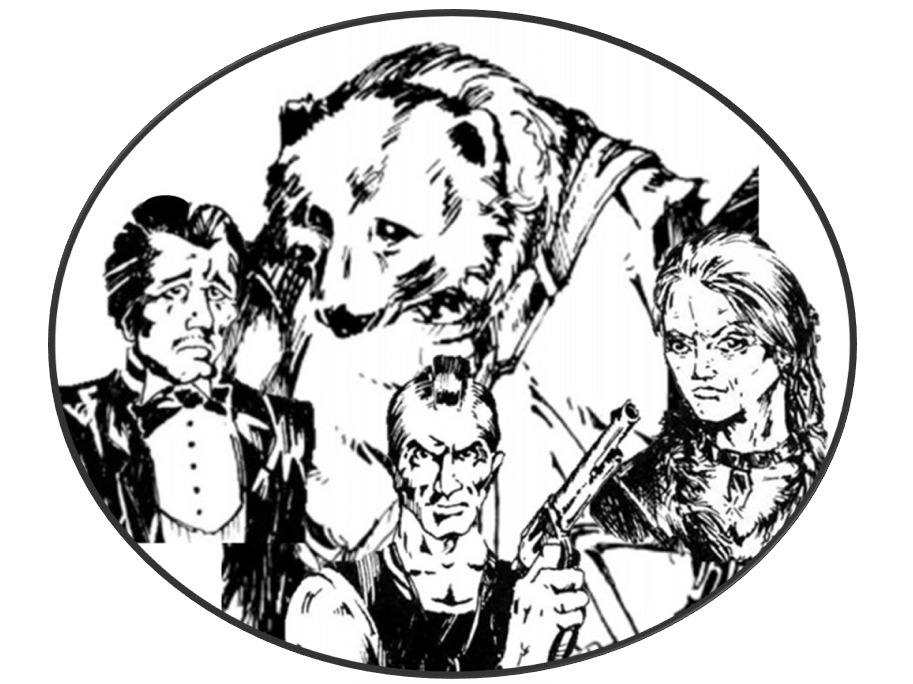
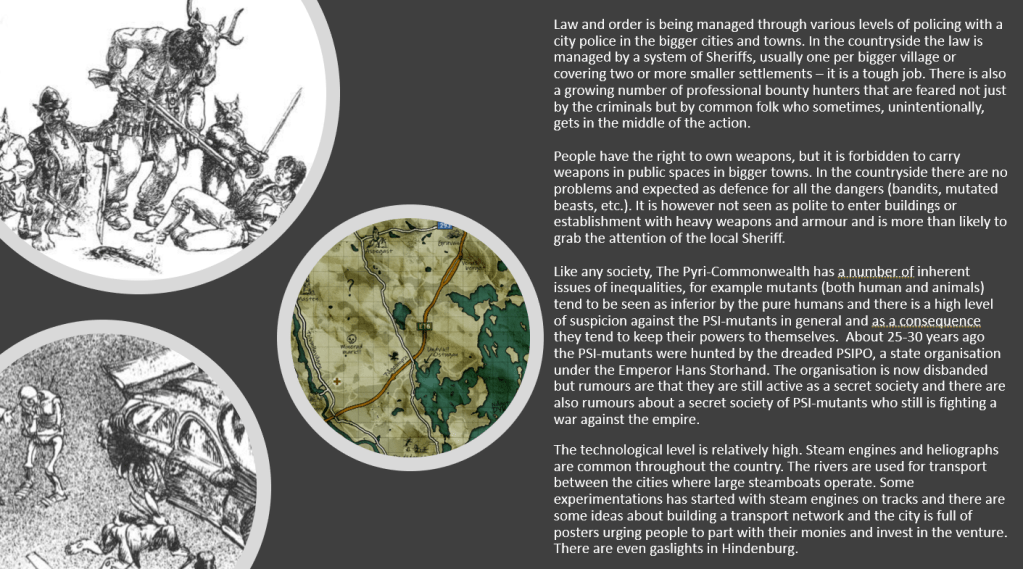
As for the characters I needed to create some kind of balanced group and decided to base the characters on some of the pictures in the original rulebook – now there is one character in the rulebook who we may assume is a woman and that is a picture of a Bear with a pram and some cuddly baby bears, but I could not find a picture of a second female in the basic rule book and had to go to another Swedish RPG supplement of the era (the City Book Kandra for the Drakar och Demoner RPG). The second female character was a PSI mutant and I felt that the power in the drawing was telling the right story and in terms of style aligned to the others (The drawings are all by Nils Gullikson who was a great inspiration with his drawings in the early Swedish RPGs and also in the Swedish RPG magazine Sinkadus).
The adventurers (Drawings by Nils Gulliksson)
I basically designed the Group in a two-role typical fantasy group with a Magician-Thief, the Barbarian-Hunter, Paladin-Bard and Warrior-Rogue. I find this blend works well and gives the characters some room for getting involved when the going gets tough as well as being the lead in some situations – in the rough part of town, in the forest, social interfaces, stealth operations, etc.
I issued each player with a character sheet, with an example below.
…and also a little summary what they know about each other (this to allow some familiarity but not knowing exact details about each other).
I also included a little note on the rules (high level)
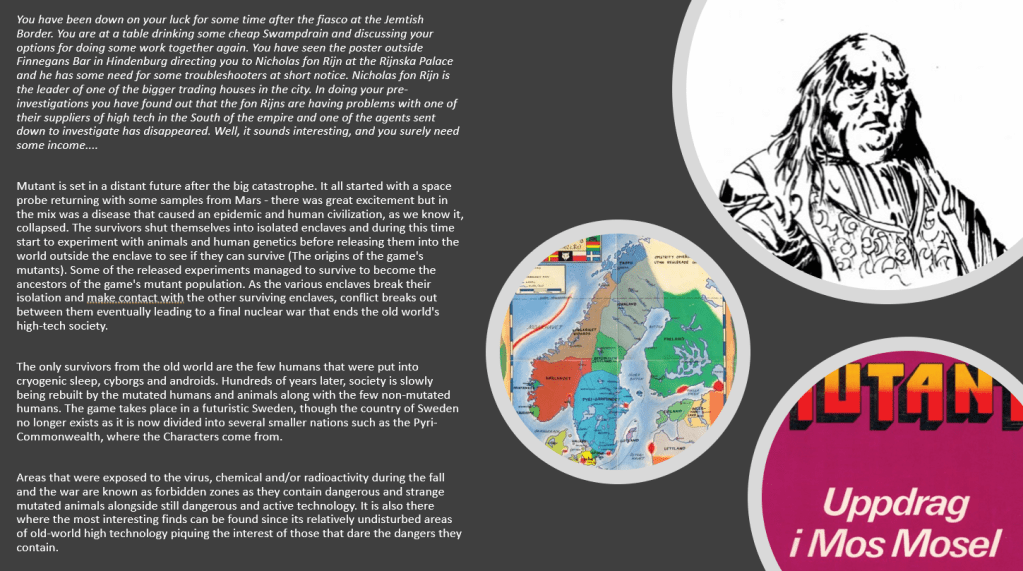
finally I did a few slides about the setting (art from the original rulebook and two of the early scenarios).
In doing the first play test I realised that it would be difficult to play the scenario in the 3 hour session without making it a very stressful and possibly too linear experience. It took the play test group two sessions. So I decided to run the scenario in two sessions – then with what I call a forced fast forward if they characters had not figured out what was going on at the end of the first session, this would allow some start-up and investigation in the first evening and then the final showdown in the second session.
How did it go?
I did a play test of the scenario and the team managed to figure out what was going on indirectly and manage to find their way to the lair of the beast and successfully defeated her (They met with a caterpillar snake who was looking for a mate, the friendliest monster in the rulebook who you do not want to mess with, luckily they did not and carried on their own business).
Thanks to Max, Jeremy, Neil and Simon for helping me out testing the game.
For the team playing it on Grogmeet they also managed to get to the end and remove the problem to fon Rijn’s profits. I felt bad for Tom who tried to communicate in a friendly way in most of the encounters without success but the one time it did matter it solved the problem. Keep optimistic. The team had some unlucky rolls but so did the opposition, they players were relatively less unlucky which is all that matters in the long run.
Thanks Ian, Chris, Tom and Jim for spending two evenings with me!, hope you had a good time, I did.
I may do another scenario using the same characters again, at some future Grogmeet.
As a general comment with regards to the virtual tools available it is really easy to set up and although it is not as a real face to face experience these tools allow you to meet up with mates not just during forces isolation but perhaps also reconnect with that old scattered all over the place gaming group and run some games, both Roll20 and Google Meet are free.
I was a little bit nervous in getting back to running games but with a little bit of help from my friends and perhaps over preparing the scenario I got over it – overall a fantastic experience. All the old confidence is slowly coming back and the realisation is that it is all about trying to have fun and that people that are in this hobby, mostly, is in it for exactly this reason too. Things has not become more cerebral just because the hairline has receded and the waistline has become more generous – things are still ok! So whilst I may not understand the gloriousness of the Ford Escort 4th Generation, I do get this!
I also learned from Neil Benson (https://oldscouserroleplaying.com/), the importance and power of testing tech etc, in advance and also to get things rolling a little bit before, setting up characters, sharing rules information, links, etc. It really makes things easier and on the day and is worth considering if you have time. My best online experience to date was playing a Vikingr scenario with him where we were up and running immediately on the day of the scenario.
…and a Land shark did showed up…
The Land shark (Drawing by Bjornhilda Borg after the encounter)
/ Hope that was of some interest!
NOTE: I also managed to get Grandad into the scenario. He was a funny guy!
Gunnar the Trader
By the way he also appears as a mad scientist in the first installation of the Grey Death Scenario, but that is another story (first on the left, models from Crooked Dice).




























 Roll a One - Wargaming Blog